Neuralink

Search documents
脑机接口燃爆市场!医疗器械指数ETF(159898)含“脑”量24%、盘中获大额净流入
Sou Hu Cai Jing· 2026-01-08 06:36
Core Viewpoint - The brain-computer interface (BCI) sector is experiencing significant growth, driven by technological advancements and increased investment, particularly in the A-share market, with related stocks showing strong performance [1][5]. Group 1: Market Performance - The medical device index ETF (159898) has seen a rise of over 1.94%, with approximately 37 million yuan in net inflow as of the report [1]. - Key stocks in the BCI sector include Kewei Medical, which surged over 19%, and Shuoshi Bio, which increased over 13%, among others [3]. Group 2: Industry Growth - The global BCI market has grown from $1.2 billion in 2019 to nearly $2 billion in 2023, with a compound annual growth rate (CAGR) exceeding 13% [5]. - Projections indicate that the global BCI industry could reach $7.63 billion by 2029, with a CAGR of over 25% from 2024 to 2029 [5]. Group 3: Investment Opportunities - The BCI sector is positioned at a critical juncture with strong policy support, rapid technological iteration, and accelerated commercialization, making it a promising area for investment [8]. - The medical device index ETF (159898) tracks a broad range of medical device sectors, with leading companies like Mindray Medical and United Imaging Healthcare, providing a pure representation of the A-share medical device sector [8][9].



39岁杭州脑科学博士,一把狂揽20个亿
2 1 Shi Ji Jing Ji Bao Dao· 2026-01-08 06:30
Core Insights - Strong Brain Technology, led by Han Bicheng, has secured approximately 2 billion yuan in funding, marking the largest financing in China's brain-computer interface sector [2] - This funding round positions Strong Brain Technology as the second largest globally in the brain-computer interface space, following Neuralink's 650 million USD Series E funding [2] Company Overview - Han Bicheng, the founder of Strong Brain Technology, is a 39-year-old from Mudanjiang, Heilongjiang, with a distinguished academic background, including a bachelor's degree in mechanical engineering from the Korea Advanced Institute of Science and Technology and a PhD from Harvard University [3][4] - The company was established in 2015, and Han chose to return to China to start the business before completing his PhD [5] Technology and Product Development - Strong Brain Technology focuses on non-invasive brain-computer interface technology, which is considered a "non-mainstream" approach compared to the invasive methods predominantly supported by investors [6][8] - The company has developed a "super sensor" capable of detecting neural signals, achieving over 95% accuracy in signal recognition compared to medical-grade EEG devices [8] - Products include smart bionic limbs and brain-computer intelligent sleep devices, with a production milestone of 100,000 high-precision brain-computer interface products reached in 2022 [8] Market Position and Future Goals - The market price for the smart bionic hand is approximately 100,000 yuan, significantly lower than similar foreign products, and allows for immediate use after installation [10] - Strong Brain Technology aims to assist over 6,000 disabled individuals in regaining mobility by 2025, with a long-term vision of helping 1 million individuals with limb disabilities and 10 million patients with Alzheimer's, autism, and insomnia over the next 5 to 10 years [10][12] - The company's valuation reached 9 billion yuan in the 2025 Hurun Global Unicorn List, reflecting its growth and potential in the industry [12]
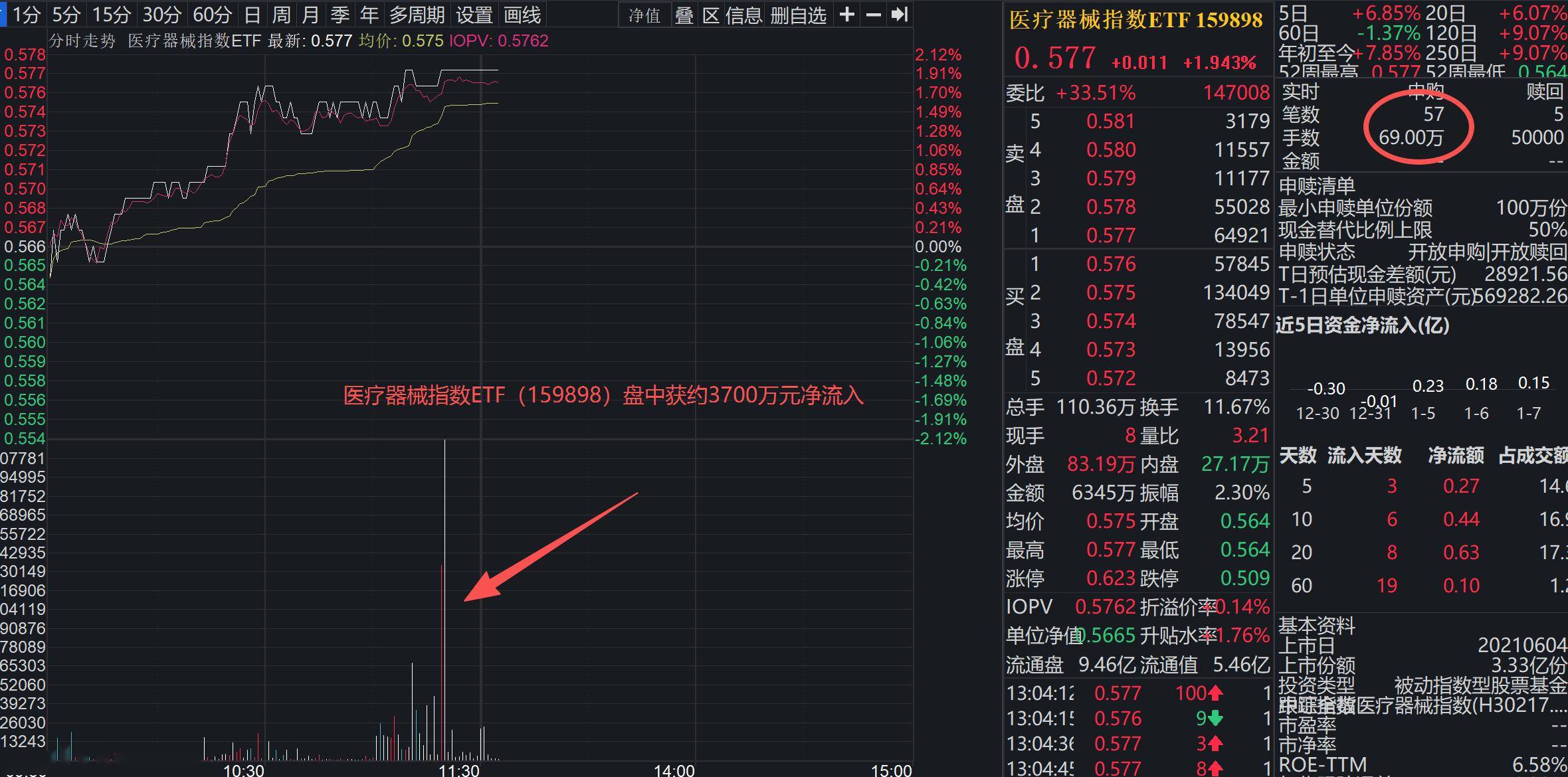
脑机接口概念引爆!资金大举涌入含“脑”量24%的医疗器械指数ETF(159898)
Sou Hu Cai Jing· 2026-01-08 05:49
Core Insights - The brain-computer interface (BCI) concept continues to gain momentum, with related stocks experiencing significant increases, particularly in the medical device sector [1][2]. Group 1: Market Performance - The medical device index ETF (159898) has seen a rise of over 1.94%, with approximately 37 million yuan in net inflow as of the latest report [1]. - Key stocks such as Kewei Medical surged over 19%, while others like Shuoshi Bio and Lepu Medical increased by over 13% and 6% respectively [1]. Group 2: ETF and Index Details - The medical device index ETF (159898) tracks the CSI All Share Medical Device Index, with a BCI concept weight of about 24% [2][3]. - The ETF's latest scale is 536 million yuan, and it has outperformed its peers since 2025 [2]. Group 3: Industry Growth and Projections - The global BCI market size grew from 1.2 billion USD in 2019 to nearly 2 billion USD in 2023, with a compound annual growth rate (CAGR) exceeding 13% [4]. - Projections indicate that the global BCI industry could reach 7.63 billion USD by 2029, with a CAGR of over 25% from 2024 to 2029 [4]. Group 4: Investment Opportunities - The BCI sector is currently experiencing a high-growth phase driven by technological breakthroughs, policy support, and ecosystem collaboration [7]. - The medical field is identified as the most mature and largest segment for BCI commercialization, making it a key area for investment [7].
“马斯克概念”持续发酵!脑机接口、商业航天接连大涨,航天ETF(159267)、港股通生物科技ETF(159102)涨幅居前
Xin Lang Cai Jing· 2026-01-08 05:39
Group 1: Core Insights - A-share major indices showed divergence on January 8, 2026, with the Shanghai Composite Index rebounding, driven by the "Elon Musk concept" and a surge in brain-computer interface and commercial aerospace sectors [1] - The Aerospace ETF (159267) rose by 4.51%, with a trading volume of 1.07 billion yuan, indicating active market participation [1] - The brain-computer interface sector is experiencing significant growth, spurred by Neuralink's announcement of large-scale production of brain-computer interface devices starting in 2026, which lowers application barriers [1] Group 2: Commercial Aerospace Sector - The commercial aerospace sector is gaining strength due to a dual resonance from global and domestic factors, including SpaceX's acceleration in Starship production and the rapid development of satellite internet services [2] - China's "14th Five-Year Plan" supports commercial aerospace development, with major projects like China Star Network and Qianfan Constellation accelerating, leading to a busy launch schedule in 2026 [2] - The Aerospace ETF closely tracks the National Aerospace Industry Index, which consists of high-quality companies in aerospace equipment and military electronics, reflecting the industry's overall performance [2] Group 3: Biotechnology Sector - The Hong Kong Stock Connect Biotechnology ETF (159102) closely follows the Hang Seng Biotechnology Index, focusing on core areas of biotechnology, with a higher concentration of innovative drugs and CXO [3] - The adjusted index aims to more accurately reflect the performance of Hong Kong-listed biotechnology companies, enhancing industry representation [3]
脑机接口概念持续活跃,医疗设备ETF(159873)标的指数急升涨近2%,重磅政策引导推进脑机接口商业化
Xin Lang Cai Jing· 2026-01-08 05:18
Core Insights - The medical device ETF (159873) has seen a significant increase in trading volume and share growth, with a turnover of 4.65% and a transaction value of 5.525 million yuan as of January 8, 2026, reflecting a strong performance in the sector [1] - The underlying index, the CSI All Share Medical Devices and Services Index (H30178), rose by 1.83%, with notable gains from individual stocks such as Kefu Medical (301087) up 19.78%, Shuoshi Biology (688399) up 11.51%, and Lepu Medical (300003) up 7.99% [1] - Over the past two weeks, the medical device ETF has grown by 8.6124 million yuan in scale and 8 million shares in volume, indicating robust investor interest [1] Product Highlights - The medical device ETF (159873) closely tracks the CSI All Share Medical Devices and Services Index, which selects listed companies in the healthcare sector to reflect the overall performance of the theme [1] Hot Events 1. Eight departments, including the Ministry of Industry and Information Technology, have issued an implementation opinion to accelerate the industrialization and commercialization of new terminals such as brain-computer interfaces, aiming for significant advancements in AI technology by 2027 [2] 2. Sichuan Province has set a maximum price of 6,583 yuan per session for brain-computer interface medical services, effective from April 30 this year, as part of a broader integration of 82 neurological service pricing projects [2] Institutional Views - The brain-computer interface industry is entering a phase of accelerated industrialization, supported by a comprehensive policy framework that includes planning, payment, and standards [2] - Zhongyin Securities notes that the National Medical Insurance Administration established independent charging items for invasive and non-invasive brain-computer interfaces in March 2025, with further support from multiple government departments [2] - Global initiatives, such as Neuralink's plans for large-scale production and optimized surgical processes, alongside domestic advancements from companies like Shanghai Ladder Medical and Boruikang, indicate a clearer path for domestic technology development [2]
A股新风口!四个“20CM”涨停!
天天基金网· 2026-01-08 05:18
Core Viewpoint - The article highlights the strong performance of emerging industries such as AI applications, controllable nuclear fusion, brain-computer interfaces, and commercial aerospace, while traditional financial sectors like securities and insurance experienced a downturn [2][10]. AI Applications - AI applications are gaining momentum, particularly in the area of AI for Science, which utilizes AI to accelerate scientific discoveries and optimize research processes [5][6]. - The stock of Zhite New Materials surged by 20% and has increased by 107.33% this year, driven by its development of thin-phase high-temperature insulation and flame-retardant materials using AI [6][8]. - Industry experts believe that AI for Science is the fastest area for commercializing AI applications, addressing key pain points in research-intensive industries [8]. Controllable Nuclear Fusion - The controllable nuclear fusion sector saw significant gains, with stocks like Hahwa Huaton and Hekang New Energy experiencing substantial increases [10][11]. - The sector's performance is bolstered by recent breakthroughs in nuclear fusion research, including the confirmation of the existence of a density-free zone in tokamak experiments [13][16]. Brain-Computer Interfaces - The brain-computer interface sector also showed strong performance, with companies like Aipeng Medical and Kefu Medical seeing notable stock increases [14]. - Recent funding developments, including a 2 billion RMB investment in Strong Brain Technology, highlight the growing interest and potential in this field [17]. Commercial Aerospace - The commercial aerospace sector experienced stock surges, with companies like Shaoyang Hydraulic and Tianrun Technology leading the gains [18][20]. - Analysts predict that emerging industries, including commercial aerospace and brain-computer interfaces, will continue to thrive in 2026, supported by favorable policies and technological advancements [20].

国海证券:Neuralink量产在即 国产脑机链有望充分受益
智通财经网· 2026-01-08 02:53
Core Viewpoint - Neuralink's announcement of mass production in 2026 marks a significant shift from laboratory research to commercial application in the brain-computer interface (BCI) sector, with strong potential benefits for China's BCI industry due to rigid medical demand and supportive policies [1] Group 1: Event Overview - Neuralink, founded by Elon Musk in 2016, plans to start large-scale production of brain-computer interfaces on January 1, 2026, transitioning to a more streamlined and fully automated surgical process [1] - The company has developed three main product lines: Telepathy for motor function disorders, Blindsight for visual reconstruction, and Deep for neurological regulation [2][3] Group 2: Market Potential - The global BCI market is projected to reach approximately $3.19 billion by 2025, with medical applications expected to grow to $40 billion by 2030 and $145 billion by 2040 [4] - In China, the BCI market is anticipated to exceed 3.8 billion yuan by 2025, with a compound annual growth rate of around 20%, reaching 6.14 billion yuan by 2028 [5] Group 3: Policy and Technological Support - China has established a comprehensive support system for the BCI industry, with policies aimed at fostering innovation and establishing a competitive ecosystem by 2030 [6][7] - Significant technological advancements have been made, including successful clinical trials and the development of high-performance BCI systems, indicating a transition from laboratory to large-scale application [7] Group 4: Related Companies - Key companies in the BCI sector include Yanshan Technology, Entropy Technology, Dineike, BGI, Linying Intelligent Manufacturing, Lens Technology, Hanwei Technology, Dongfang Zhongke, Pulite, and Puni Testing [7]

国海证券晨会纪要-20260108
Guohai Securities· 2026-01-08 02:42
Group 1: Lin Qingxuan Company Overview - Lin Qingxuan (2657.HK) is a high-end domestic skincare brand founded in 2003, known for its "oil-based skincare" concept and camellia oil facial essence, focusing on anti-wrinkle and firming skincare products [2][4] - The flagship product, camellia oil essence, has sold over 4.5 million bottles since its launch, accounting for 46% of revenue and 48% of gross profit in the first half of 2025 [2] - The company achieved a revenue of 1.05 billion yuan in the first half of 2025, representing a 98% year-on-year increase, with a net profit margin of 17.3% [2] Group 2: Market Trends and Growth Potential - The "oil-based skincare" market is rapidly growing, with a market size of 5.19 billion yuan in 2023, expected to exceed 11 billion yuan by 2025, driven by consumer awareness and the rise of new domestic brands [3] - The high-end segment of the market is expanding faster than lower price segments, with the market share of products priced above 500 yuan growing significantly [3] - Douyin (TikTok) is a key channel for sales, accounting for 72% of Lin Qingxuan's online sales, with a significant increase in gross merchandise volume (GMV) across various channels [3][4] Group 3: Neuralink and Brain-Computer Interface Industry - Neuralink, founded by Elon Musk, is set to begin large-scale production in 2026, focusing on automated surgical processes for brain-computer interfaces [5][6] - The company has developed three main product lines: Telepathy for motor function disorders, Blindsight for visual reconstruction, and Deep for neurological regulation [6][7] - The brain-computer interface market is projected to reach approximately $3.19 billion by 2025, with significant growth expected in medical applications, consumer electronics, and industrial uses [8][9] Group 4: Policy and Technological Developments - China's government has established a comprehensive support system for the brain-computer interface industry, aiming to create a competitive ecosystem by 2030 [10] - Significant technological advancements have been made, including successful clinical trials and the development of high-throughput wireless systems [11] - The domestic brain-computer interface market is expected to exceed 3.8 billion yuan by 2025, with a projected annual growth rate of around 20% [9]
A股脑机接口股继续强势,南京熊猫、普利特、创新医疗4连板
Ge Long Hui· 2026-01-08 02:41
Group 1 - The core viewpoint of the article highlights a significant surge in A-share market stocks related to brain-computer interface (BCI) technology, driven by recent developments in the sector [1] - Aipeng Medical reached a 20% daily limit increase, while Kefu Medical rose over 15%, indicating strong investor interest in BCI-related companies [1] - Notable stocks such as Nanjing Panda, Pulite, and Innovation Medical achieved a 10% daily limit increase, reflecting a broader trend of positive market sentiment towards BCI stocks [1] Group 2 - The article mentions that on January 6, Strong Brain Technology, a leading company in the BCI field, announced the completion of approximately 2 billion RMB in financing, marking a significant milestone for the industry [1] - This financing round is noted to be the second largest globally in the BCI sector, only behind Neuralink, which is owned by Elon Musk [1] - The financing success of Strong Brain Technology is expected to further stimulate interest and investment in the BCI market, potentially leading to more advancements and innovations in the field [1]



亚辉龙跨界脑机接口遭监管闪电三问 业绩三连降应收账款及存货达11.7亿
Chang Jiang Shang Bao· 2026-01-08 00:01
Core Viewpoint - Company Ayhuilong (688575.SH) is entering the rapidly growing brain-computer interface (BCI) sector through a strategic partnership with Shenzhen Brain Machine Starlink Technology Co., Ltd, which has raised concerns from the stock exchange regarding the feasibility and details of this collaboration [1][2][3] Group 1: Partnership Details - Ayhuilong signed a strategic cooperation framework agreement with Brain Machine Starlink to integrate BCI technology with clinical and market resources for product development and market expansion [1][2] - Brain Machine Starlink, established in September 2025 with a registered capital of 5 million yuan, focuses on comprehensive diagnosis, treatment, and rehabilitation of brain diseases, with several products still in early development stages [3][4] - Ayhuilong holds a 4% indirect stake in Brain Machine Starlink, which is currently developing non-invasive technology products, distinguishing it from Neuralink's invasive approach [4] Group 2: Exchange Inquiries - The Shanghai Stock Exchange issued a rapid inquiry to Ayhuilong, requesting detailed disclosures on the commercial viability of Brain Machine Starlink, the feasibility of collaborative R&D, and the potential for future investments [2][5][6] - The first inquiry focuses on the commercial rationale of Brain Machine Starlink, including its technology routes, product types, and development status, as well as the timeline for future agreements and revenue sharing [4][5] - The second inquiry addresses the feasibility of collaborative R&D, asking for details on ongoing projects, expected investments, and the timeline for signing specific agreements [5][6] - The third inquiry concerns the feasibility of future investments, requesting specifics on potential equity investments or funding support for Brain Machine Starlink [6] Group 3: Financial Performance - Ayhuilong's core business involves the development, production, and sales of in vitro diagnostic instruments and related reagents, with a significant market presence in hospitals [7] - The company experienced a dramatic increase in revenue and net profit in 2022, attributed to sales growth in both non-COVID and COVID-related products, but has since faced a decline in performance [8] - From 2023 to 2025, Ayhuilong's revenue and net profit have shown consecutive declines, with a reported net profit of 60.42 million yuan in the first three quarters of 2025, down 72.36% year-on-year [8][9] - As of September 2025, Ayhuilong's cash flow has significantly decreased, with a net cash flow of 64.99 million yuan, and total receivables and inventory amounting to 1.171 billion yuan [9][10]