Palantir

Search documents
The final stretch setup: Here's what to know
CNBC Television· 2025-11-11 18:19
Market Performance & Outlook - The S&P 500 is up 36% from the April 8th lows and 16% year-to-date [2] - The economy is growing at 4% and productivity growth is running up 3% [2][3] - Earnings are growing 123%, revenues are growing 8%, both exceeding historical averages of 5% [4] - Fourth quarter growth is expected to be 8-12% cumulatively, suggesting a positive outlook [5] - The market has strong tailwinds, including accommodative global central banks and disinflationary trends [6] Technology Sector & AI - Technology is a key driver of the market, but investors are uncertain about the broadening out of the AI trade [8][12] - Mega-cap technology stocks experienced significant market cap fluctuations, adding $618 billion after losing $800 billion the previous week [10] - The market is differentiating between companies with explicable AI capex strategies and those with less clear paybacks [16] Investment Strategies & Considerations - Investors should consider whether they are overweight in technology and assess the potential for technology positions to be a source of liquidity in 2026 [9] - It's important to use stops and ride the best stocks in the market during the year-end meltup period [21] - There are opportunities beyond AI, with various stocks in uptrends and great technical setups, including commodities and energy stocks [19][20]



AI泡沫争议再起!多位顶尖大咖PK 这次有何不同?
2 1 Shi Ji Jing Ji Bao Dao· 2025-11-11 14:43
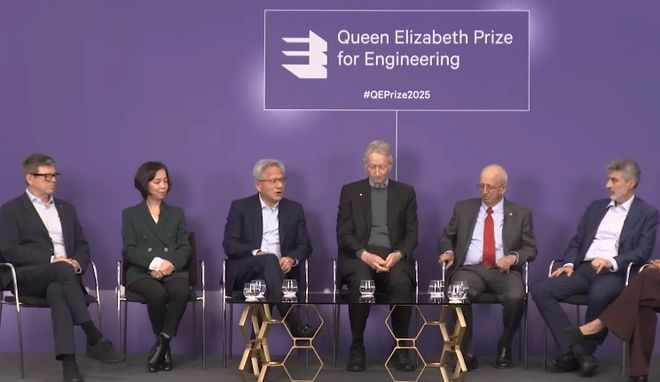
Core Viewpoint - The debate surrounding the "AI bubble" has intensified, with prominent figures in the AI field expressing differing opinions on whether current investments and valuations are sustainable or indicative of a bubble reminiscent of the 2000 internet bubble [1][3][9]. Group 1: AI Industry Perspectives - Jensen Huang argues that unlike the unused "dark fiber" from the early internet era, today's GPUs are fully utilized, suggesting a robust foundation for a new trillion-dollar industry [1]. - Fei-Fei Li emphasizes that AI is still a nascent field with vast potential beyond language processing, indicating significant growth opportunities [1]. - Yann LeCun expresses skepticism about the current paradigm of large language models achieving human-level intelligence, suggesting the need for fundamental breakthroughs [1]. Group 2: Market Reactions - Following Meta's Q3 2025 earnings report, its stock plummeted over 11%, primarily due to investor concerns over its substantial AI capital expenditures [2]. - The stock market's volatility has amplified discussions about the "AI bubble," with comparisons being drawn to the 2000 internet bubble [3]. Group 3: Key Players and Valuations - OpenAI has become a symbol of the current AI frenzy, securing over $1 trillion in infrastructure and chip agreements, yet its estimated valuation of $1 trillion contrasts sharply with its projected annual revenue of $13 billion [4]. - NVIDIA's market capitalization recently surpassed $5 trillion, driven by significant orders for its upcoming chips, showcasing its dominance in the AI sector [5]. - Tesla's ambitious compensation plan for Elon Musk requires the company's market value to reach $8.5 trillion, highlighting the aggressive growth expectations in the AI space [5]. Group 4: Diverging Opinions on AI Investments - There is a stark divide in opinions regarding AI investments, with some experts warning of an impending bubble while others assert that the current AI investment landscape is fundamentally different from the past [9][10]. - David Solomon from Goldman Sachs and Bill Gates have expressed concerns about the sustainability of current AI investments, likening them to the internet bubble [9][10]. - Conversely, proponents argue that the current return on invested capital (ROIC) for AI investments is improving, and NVIDIA's price-to-earnings ratio is lower than during the internet bubble [9]. Group 5: Future of AI and Economic Impact - The Federal Reserve Chairman Jerome Powell stated that the AI boom is not another internet bubble, citing the presence of mature business models and stable profits in AI companies [11]. - Bezos noted that even if an AI bubble bursts, the infrastructure built will remain valuable, akin to essential utilities for future advancements in artificial general intelligence (AGI) [10][12]. - The timeline for achieving AGI remains uncertain, with many companies potentially struggling to survive until that milestone is reached [12][13].
AI泡沫争议再起!多位顶尖大咖PK,这次有何不同?
2 1 Shi Ji Jing Ji Bao Dao· 2025-11-11 14:41
Core Viewpoint - The ongoing debate about the "AI bubble" is intensifying, with prominent figures in the AI field expressing differing opinions on the sustainability and future of AI investments [1][3][8]. Group 1: AI Industry Perspectives - Jensen Huang argues that unlike the internet bubble of the early 2000s, where much infrastructure was unused, today's GPU resources are fully utilized, indicating a robust foundation for a new trillion-dollar industry [1]. - Fei-Fei Li emphasizes that AI is still a nascent field with vast unexplored areas, particularly in "spatial intelligence" beyond language [1]. - Yann LeCun expresses skepticism about the current large language models achieving human-level intelligence, suggesting that fundamental breakthroughs are necessary [1]. Group 2: Market Reactions - Following Meta's Q3 2025 earnings report, its stock plummeted over 11%, primarily due to investor fears regarding its substantial AI capital expenditures [2]. - The stock market's volatility has amplified discussions around the "AI bubble," with comparisons being drawn to the 2000 internet bubble [3]. Group 3: Financial Metrics and Valuations - OpenAI's valuation has reportedly soared to $1 trillion, while its projected annual revenue is only $13 billion, raising concerns about a valuation-revenue imbalance reminiscent of the dot-com era [5]. - NVIDIA's CEO revealed that the company has accumulated $500 billion in orders for its upcoming chips, pushing its market capitalization to over $5 trillion [5]. - Tesla's ambitious compensation plan for Elon Musk requires the company's market value to increase to $8.5 trillion, with a target annual profit of $400 billion, highlighting the aggressive growth expectations in the AI sector [5]. Group 4: Institutional Concerns - Michael Burry has taken significant short positions against NVIDIA and Palantir, reflecting institutional concerns about excessive AI investments [6][7]. - The divergence in opinions about the AI bubble is stark, with some experts warning of an impending collapse while others believe the revolution is just beginning [8]. Group 5: Long-term Viability and Infrastructure - Amazon plans to increase its capital expenditures to approximately $125 billion in 2025 for AI-related infrastructure, despite announcing significant layoffs, indicating a complex relationship between AI investment and workforce management [11]. - Bezos suggests that even if an AI bubble bursts, the infrastructure built will remain valuable for future advancements in artificial general intelligence (AGI) [11]. - The timeline for achieving AGI remains uncertain, posing a challenge for many companies to survive until that potential future [12].
Stocks Rally on Hopes for Shutdown Deal | Closing Bell
Bloomberg Television· 2025-11-10 23:03
Market Performance & Trends - Nasdaq 上涨超过 2%,标普上涨 1.5%,整体市场风险偏好较高 [2] - 半导体板块表现强势,大部分股票上涨 [2] - 黄金上涨约 2.8%,与股市和加密货币市场的风险偏好不一致 [4] - 信息技术板块上涨约 2.7%,领涨各行业板块 [8] - Palantir 股票经历投资者重新评估,此前 Michael Barry 的 Scion Asset Management 披露持有价值约 9.12 亿美元的看跌期权 [9] Company Specific News - Micron Technology 股价上涨约 6.5%,成为标普和纳斯达克 100 指数中的领涨股 [11] - TSMC 的 ADR 上涨约 3%,尽管其增长率降至 18 个月以来的最低水平 [12] - e.l.f Beauty 宣布在墨西哥 Ulta Beauty 正式推出品牌后,股价上涨超过 8% [13] - C3 股价一度上涨 12%,因有消息称该公司正在探索潜在出售或其他选择,最终收盘上涨约 3.6% [13] - Centene 股价下跌 8.8%,原因是立法者即将结束政府停摆,但未能延长《平价医疗法案》 [14] - Oscar Health 股价下跌 17.5% [16] - American Airlines 股价下跌 2.5%,该公司表示周末运营因政府停摆而面临挑战,取消了 1400 架次航班,延误超过 57000 分钟,影响了 25 万名客户 [17][19] - Met Sarah 股价下跌近 15%,此前 Novo Nordisk 拒绝进一步提高对该公司的收购要约 [20] Paramount Skydance - 公司预计总效率将提高 30 亿美元以上 [22] - 计划在 2026 年第一季度初在美国实施价格上涨 [23] - 计划额外裁员 1600 人 [24] - 预计 2026 年收入约为 300 亿美元 [30] The RealReal - 第三季度调整后每股亏损为 0.04 美元,低于预期的 0.056 美元 [24] - 第四季度营收预计为 1.88 亿至 1.91 亿美元,高于预期的 1.795 亿美元 [25]
Investors continue to buy the dip amid market risks, plus Palantir's valuation concerns
Yahoo Finance· 2025-11-10 22:38
Market Sentiment & Trading Behavior - Charles Schwab's STAX index, a behavior-based model analyzing over 40 million accounts, indicates increased bullish sentiment, reaching a seven-month high in October [2] - The STAX indicator has outpaced the S&P 500 for three straight months, marking the first time this bullish trend has been observed since March 2021 [3][4] - Investors are showing a tendency to "buy the dips" in stocks like Nvidia, Meta, and Microsoft, which experienced pullbacks of at least 4-5% in October, with Meta seeing a 15% pullback after earnings [8][9] - Conversely, investors are "selling the rips" in stocks like AMD (up over 50% for the month), Apple (setting an all-time high), and Tesla (bouncing off the bottom), using rallies as opportunities to trim positions [9][10][11] - Clients are starting to allocate a small portion of their portfolios to commodities like gold (27-28% of clients looking to allocate more) and crypto (around 24%), diversifying beyond stocks [13] - There was a shift in October back to the "MAG 7" stocks, indicating a return to familiar and perceived safer investments during market pullbacks [14] Economic Outlook & Investment Strategy - Despite a prolonged government shutdown, the market has largely remained unaffected, with earnings, interest rates, and inflation being the primary market drivers [16][17][18] - Corporate America has demonstrated resilience with four consecutive quarters of double-digit gains and record or near-record profit margins, despite challenges like tariffs [20][21] - The US economy is experiencing 4% GDP growth and creating 50,000 jobs monthly, supported by AI spending (340 billion this year going to 450 billion next year) and 17 trillion in foreign direct investment [21][22][23] - Key risks to the market include a reacceleration of inflation and the Federal Reserve maintaining a restrictive monetary policy [24][26] AI & Tech Valuations - While generally not considering the market to be in an AI bubble, some individual AI stocks are deemed overvalued, with Palantir specifically mentioned as too expensive [28][29] - Palantir is trading at 300 times earnings and 100 times revenues, compared to Nvidia at 32 times earnings, suggesting a significant valuation premium [34]

AI Stock Correction: MSFT, AVGO, IONQ Seen as Stable Tech, Quantum Bets
ZACKS· 2025-11-10 22:11
Market Overview - In early November 2025, U.S. equities, particularly in the technology and AI sectors, faced a significant sell-off, with the Nasdaq Composite experiencing its steepest weekly decline since April, leading to a loss of over $800 billion in market value for AI-focused stocks [1][2][3] AI Sector - The sell-off was characterized as a "sentiment-driven breather," indicating a correction after an overheated AI rally, with concerns about capital intensity due to massive investments required for training frontier models [6][9] - OpenAI's infrastructure commitments reached approximately $1.4 trillion, significantly exceeding its annual revenues of $13 billion, raising questions about the sustainability of AI's capital cycle [2][6] - Investors are advised to focus on AI enablers with proven monetization, such as Microsoft and Adobe, while reducing exposure to unprofitable "story stocks" until they show consistent earnings [7][9] Semiconductor Industry - The semiconductor market demonstrated solid fundamentals, with a reported global market value of $346 billion in the first half of 2025, reflecting an 18.9% year-over-year increase, and an upward revision of the full-year outlook to about $728 billion, indicating a 15.4% growth [8][9] - Despite the positive outlook, the semiconductor space is cyclically sensitive, with potential margin compression due to order normalization and elevated inventories in PCs and smartphones [10] Quantum Computing - Quantum computing remains in an early-stage pre-commercial phase, attracting investor interest but characterized by volatile valuations [11] - Companies like IonQ and D-Wave reported strong revenue growth but still rely heavily on capital markets for funding, indicating ongoing funding needs in the sector [11][12] - Long-term investors are encouraged to treat quantum computing as a speculative allocation, focusing on firms with repeatable commercial traction or partnerships with major cloud providers [12]



12个月涨超1900%,“量子妖股”远超“AI妖股”
美股IPO· 2025-11-10 07:05
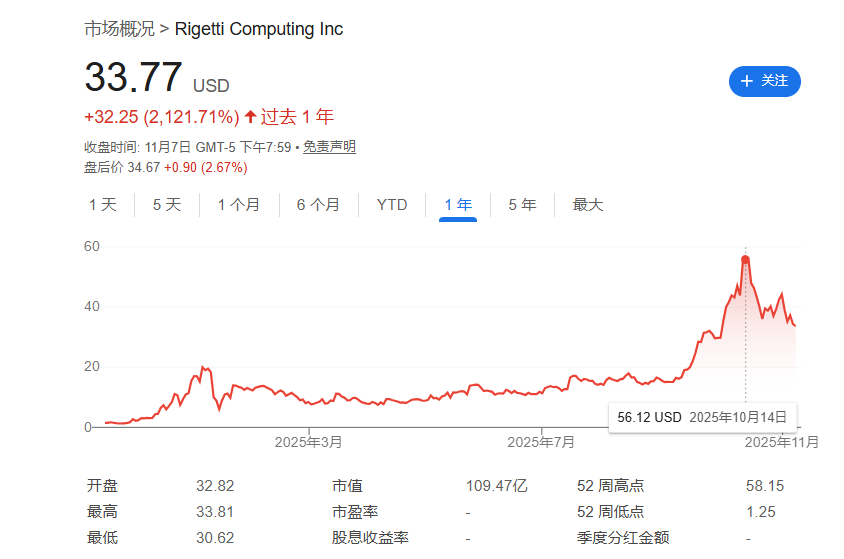
量子计算概念股的市场狂热正在上演。以Rigetti和D-Wave为首的公司,在几乎没有收入和实际应用的情况下,股价于12个月内一度暴涨1900%,市值 突破百亿美元。这一现象引发了市场关于"下一个颠覆性技术"与"投机泡沫"的激烈辩论。 以Rigetti Computing Inc.和D-Wave Quantum Inc.为代表的量子计算公司,在过去12个月里股价一度飙升超过1900%,表现远超许多热门人工智能股 票,成为市场中最具争议的投机热点。 这一惊人涨幅使两家公司的市值双双突破100亿美元,甚至远超AI明星公司Palantir,也超过了金宝汤公司(Campbell's Co.)等老牌企业。然而,它们目 前几乎没有实际应用,且预计未来数年都无法产生可观收入,现金消耗巨大。 市场对此看法两极分化。多头认为,量子计算有望解决从疾病治疗到气候变化等重大问题,是不容错过的下一个颠覆性技术。而空头则警告称,这只是 一个由投机情绪驱动、缺乏基本面支撑的泡沫,注定将会破灭。 在人工智能热潮之后,资本市场正将目光投向量子计算这一更具想象空间的领域。 泡沫担忧并非空穴来风。据彭博汇编数据,Rigetti的估值超过其远期销售 ...

12个月涨超1900%,“量子妖股”远超“AI妖股”
Hua Er Jie Jian Wen· 2025-11-10 02:02
Core Insights - The capital market is shifting its focus from artificial intelligence to quantum computing, which is seen as a field with greater potential for innovation [1] - Quantum computing companies like Rigetti Computing Inc. and D-Wave Quantum Inc. have experienced stock price surges exceeding 1900% over the past year, outperforming many popular AI stocks [1] - Despite their impressive stock performance, these companies currently lack practical applications and are not expected to generate significant revenue in the coming years, leading to high cash burn rates [1] Market Sentiment - There is a polarized view in the market regarding quantum computing; bulls believe it can address major issues like disease treatment and climate change, while bears warn of a speculative bubble lacking fundamental support [1] - Concerns about high valuations are substantiated, with Rigetti's valuation exceeding 500 times its forward sales, compared to 72 times for AI company Palantir and less than 6 times for the Nasdaq 100 index [4] - Despite high valuations, Wall Street analysts remain optimistic, with all ten analysts covering D-Wave recommending a buy, although some analysts face backlash for their bullish outlook on Rigetti [4] Stock Performance - Rigetti's stock has seen a decline of approximately 28% over the past month, while D-Wave's stock has dropped around 16% in the same period [4] - As of November 7, Rigetti's market capitalization stands at $10.947 billion, with a closing price of $33.77, down 28.32% over the past month [5] - D-Wave's market capitalization is approximately $10.09 billion, with a closing price of $29.50, reflecting a decrease of 15.88% over the past month [7]
X @The Economist
The Economist· 2025-11-09 21:00
Despite what Alex Karp, the boss of Palantir, says, investors are hardly “batshit crazy” to bet against his company. But regardless of AI hype, this is a business built to last https://t.co/n1uzHG4pPg ...
12 Deep Value Stocks to Invest In
Insider Monkey· 2025-11-09 15:42
Core Insights - The article discusses the current market concerns regarding high valuations in the tech sector, particularly highlighted by Palantir's nearly 8% drop despite strong earnings, which contributed to a broader market sell-off [2][3] - It emphasizes the potential of deep value stocks as attractive investment opportunities amidst the ongoing AI boom and market volatility [4] Market Overview - Investor discussions are increasingly focused on the high valuations of tech stocks and the potential for a market correction, with Palantir's decline serving as a key example [2] - The S&P 500 fell by 1.17% and the Nasdaq by over 2% following the market reaction to Palantir's performance [2] Expert Opinions - CNBC's Jim Cramer noted that the market's focus on high-growth speculative stocks may lead investors to overlook other opportunities within the S&P 500, where many stocks are trading at reasonable valuations [3] - Cramer views Palantir's decline as a cooling moment for overheated valuations rather than a sign of weakness [3] - Goldman Sachs's David Solomon predicts a potential 10% to 20% drawdown in equity markets within the next 12 to 24 months [4] Investment Strategy - The article suggests that while high-growth tech and AI stocks dominate headlines, there are significant opportunities in deep value stocks, which are characterized by low valuations, steady earnings, and strong fundamentals [4] - The methodology for selecting deep value stocks includes screening U.S.-listed companies with a market capitalization over $2 billion, a forward P/E ratio of 8 or lower, a return on equity of at least 10%, and a dividend yield of at least 1% [7] Deep Value Stocks - The article presents a list of 12 deep value stocks, starting with Bread Financial Holdings, Inc. (NYSE:BFH), which has a forward P/E of 6.54, a return on equity of 14.78%, and a dividend yield of 1.45% [9] - Bread Financial's recent Q3 results exceeded analyst expectations with an EPS of $4.02, supported by a 5% YoY growth in credit sales [11] - Vale S.A. (NYSE:VALE) is highlighted as another deep value stock, with a forward P/E of 6.64, a return on equity of 13.27%, and a dividend yield of 6.6% [13] - Vale's Q3 results showed a 17% YoY EBITDA growth to $4.4 billion, driven by strong iron ore and base metals output [15] - Lincoln National Corporation (NYSE:LNC) is also included, with a forward P/E of 5.23, a return on equity of 23.08%, and a dividend yield of 4.17% [16] - Lincoln reported an EPS of $2.04 for Q3, beating expectations and marking its fifth consecutive quarter of adjusted operating income growth [18]