
华兰疫苗

Search documents
疫苗降到蜜雪冰城价,企业集体亏损
Jing Ji Guan Cha Bao· 2025-09-11 11:34
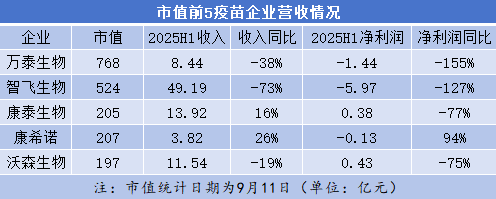
Core Insights - The vaccine industry is experiencing significant challenges, with many companies reporting substantial losses and declining revenues in 2025 [4][20][21] - Price wars and vaccine hesitancy are identified as major factors contributing to the industry's downturn [4][12][14] Financial Performance - In the first half of 2025, major vaccine companies like Zhifei Biological and Wantai Biological reported their first-ever half-year losses, with net profits dropping by 127% and 155% respectively [4][5] - Overall, vaccine revenue for listed companies in China decreased by 60% year-on-year, with net profits down by 113% [4] - Among 17 listed vaccine companies, only 6 reported profits, with the highest profit being 1.22 billion yuan from Chengda Biological [4] Market Dynamics - The top five vaccine companies by market capitalization are Wantai Biological, Zhifei Biological, CanSino, Kangtai Biological, and Watson Biological, with only CanSino showing a profit increase due to its innovative four-valent meningococcal vaccine [4][5] - A significant price drop in flu vaccines has been noted, with prices falling to as low as 5.5 yuan per dose, leading to intense competition [6][7][8] Price Wars - The price of various vaccines, including flu and HPV vaccines, has been driven down due to aggressive competition, with some prices dropping to a fraction of their previous levels [9][10][11] - Wantai Biological's entry into the nine-valent HPV vaccine market has intensified competition, leading to significant price reductions across the sector [9][10] Vaccine Hesitancy - Vaccine hesitancy has become a critical issue, particularly for non-mandatory vaccines, with many individuals expressing doubts about vaccine efficacy [14][15][16] - The overall vaccination rates for flu vaccines remain low in China, with annual rates below 4%, compared to over 50% in developed countries [16] Industry Outlook - The vaccine industry is facing a prolonged period of challenges, with experts predicting that the current downturn may last five to ten years unless significant changes occur in public perception and market dynamics [20][21] - The industry is expected to undergo consolidation, with weaker companies likely to be eliminated as competition intensifies [21]







疫苗降到蜜雪冰城价 企业集体亏损
经济观察报· 2025-09-11 11:16
Core Viewpoint - The vaccine industry is experiencing significant challenges, including price wars, vaccine hesitancy, and intense competition, leading to substantial declines in revenue and profits for major companies [4][10][19]. Group 1: Industry Performance - In the first half of 2025, the overall vaccine revenue for Chinese listed companies decreased by 60% year-on-year, with net profits dropping by 113% [4]. - Major companies like Zhifei Biological and Wantai Biological reported their first half-year losses since going public, with net profits declining by 127% and 155% respectively [4][12]. - Only six out of 17 listed vaccine companies achieved profitability, with the highest profit being 1.22 billion yuan from Chengda Biological [4]. Group 2: Price Wars - The price of flu vaccines has significantly dropped, with some prices reaching as low as 5.5 yuan per dose, marking a new low for public flu vaccine prices [7]. - The price competition has extended beyond flu vaccines to include HPV, shingles, and pneumonia vaccines, with prices for HPV vaccines dropping dramatically [8][9]. - Wantai Biological's revenue fell by 38% to 8.44 billion yuan in the first half of 2025, primarily due to aggressive price competition [9]. Group 3: Vaccine Hesitancy - Vaccine hesitancy has become a significant issue, with many individuals expressing doubts about vaccine efficacy, particularly for non-mandatory vaccines like HPV and flu vaccines [13][15]. - The average flu vaccine coverage in China remains below 4%, significantly lower than in developed countries where it is around 50% [15]. - Factors contributing to vaccine hesitancy include dissatisfaction with COVID-19 vaccine outcomes and the spread of misinformation [15]. Group 4: Market Dynamics - The vaccine market is characterized by increasing competition and product homogeneity, leading to a challenging environment for companies [18][19]. - Experts suggest that the current state of the vaccine industry resembles a "deep winter," with potential for consolidation and elimination of weaker players [19]. - The long-term outlook for the vaccine industry remains uncertain, with expectations of a prolonged period of challenges lasting five to ten years [19].

疫苗降到蜜雪冰城价 企业集体亏损
Jing Ji Guan Cha Wang· 2025-09-11 07:55
Core Viewpoint - The vaccine industry in China is experiencing significant challenges, with many companies reporting substantial losses and a decline in revenue due to price wars, vaccine hesitancy, and intense competition [1][4][15]. Group 1: Financial Performance of Vaccine Companies - In the first half of 2025, major vaccine companies like Zhifei Biological and Wantai Biological reported their first-ever half-year losses, with net profits dropping by 127% and 155% respectively [1][3]. - Overall, the revenue of Chinese vaccine listed companies decreased by 60% year-on-year, and net profits fell by 113% in the first half of 2025 [1]. - Among the top five vaccine companies by market capitalization, only CanSino reported a year-on-year net profit increase, attributed to its innovative four-valent meningococcal vaccine [2][3]. Group 2: Price Wars and Market Dynamics - The price of flu vaccines has significantly dropped, with some prices reaching as low as 5.5 yuan per dose, leading to a price war that has affected various vaccine types including HPV and pneumonia vaccines [4][5]. - Wantai Biological's revenue from its main product, the bivalent HPV vaccine, fell by 38% to 8.44 billion yuan, marking its first loss since going public [5][8]. - The industry is facing a normalization of price competition, with companies engaging in various promotional strategies to capture market share, further compressing product pricing [8][15]. Group 3: Vaccine Hesitancy - Vaccine hesitancy has become a significant issue, with many individuals expressing doubts about vaccine efficacy, particularly for non-mandatory vaccines like HPV and flu vaccines [10][12]. - The average flu vaccine coverage in China remains below 4%, significantly lower than in developed countries where it can reach 50% [12]. - Factors contributing to vaccine hesitancy include dissatisfaction with COVID-19 vaccine outcomes, misinformation, and a lack of awareness regarding the importance of adult vaccinations [12][13]. Group 4: Future Outlook and Industry Challenges - The vaccine industry is expected to face prolonged challenges, with experts predicting that the current competitive landscape will lead to consolidation and potential elimination of weaker players [15][16]. - The market for adult vaccines is particularly underdeveloped, and significant efforts are needed to improve public awareness and acceptance [12][16]. - The industry consensus suggests that without substantial changes in public perception and a more robust adult vaccination framework, the market will continue to struggle [16].
国产疫苗再突破
Xiangcai Securities· 2025-09-07 10:21
Investment Rating - The industry rating is maintained at "Overweight" [4] Core Insights - The vaccine industry is experiencing pressure on performance, with Q2 2025 results still in a downward trend due to high competition and supply-demand imbalances. Companies are focusing on innovative vaccines and pipeline adjustments to navigate the current market challenges [10][28] - Recent breakthroughs include the approval of the first recombinant shingles vaccine for clinical trials and the acceptance of a clinical application for a domestic pentavalent vaccine, indicating progress in breaking the import monopoly [5][10] Market Performance - The vaccine sector saw a decline of 2.08% last week, with a cumulative increase of 1.37% in 2025. The overall pharmaceutical sector reported a 1.4% increase [6][13] - The relative performance of the vaccine sector compared to the CSI 300 index shows a decline of 8% over the past month and 20% over the past year [5] Company Performance - Leading companies in the vaccine sector include Hualan Biological Engineering, Kangtai Biological Products, and CanSino Biologics, while underperformers include Olin Biological, Liaoning Chengda, and Zhifei Biological [7] Valuation Metrics - The vaccine sector's price-to-earnings (PE) ratio is 107.62X, reflecting a significant increase of 24.74X, while the price-to-book (PB) ratio stands at 1.98X, showing a slight decrease [8][9] Investment Recommendations - The report emphasizes the importance of innovation and international expansion for long-term growth in the vaccine industry. Companies with strong research and development capabilities and differentiated products are recommended for investment, specifically highlighting CanSino and Kanghua Biological [10][30]
流感疫苗出现5.5元“冰点价”,今年以来价格多次探底
Di Yi Cai Jing· 2025-09-04 03:00
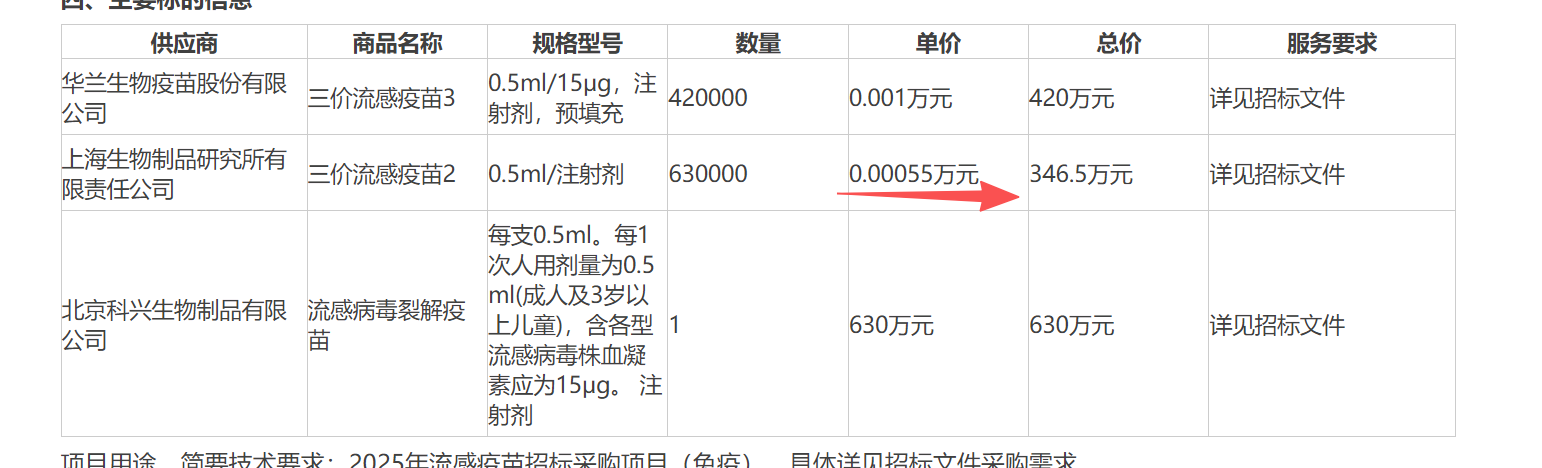
Core Insights - The price of domestic trivalent influenza vaccines in the public market has significantly decreased, with recent bids showing prices as low as 5.5 yuan per dose, marking a new low in the public vaccine market [1][3][4] Pricing Trends - The price of trivalent influenza vaccines has dropped below 10 yuan per dose since last year, with multiple instances of price reductions in 2023 [1][3] - In September, the Beijing public resource trading platform announced that the Shanghai Biological Products Research Institute won a bid for trivalent influenza vaccines at 5.5 yuan per dose, while Hualan Biological's bid was 10 yuan per dose [1][4] - The price of vaccines in the public market may not cover production costs, leading to a price war among manufacturers aiming to maintain market share [4][5] Market Dynamics - The public health budget for influenza vaccinations has increased, prompting manufacturers to focus more on the public market amid competition from quadrivalent vaccines [4][5] - The production of influenza vaccines is time-sensitive, as they must be produced based on the WHO's annual strain recommendations, leading to potential waste if bids are unsuccessful [5] Vaccine Types and Innovations - The market includes various types of influenza vaccines, with the most common being split virus vaccines, while innovative products like quadrivalent subunit vaccines are less affected by price competition [8] - The first quadrivalent subunit influenza vaccine, Hui Er Kang Xin, has been listed in the national insurance directory with a price range of 326.5 to 359 yuan per dose [8] Vaccination Rates - The average vaccination rate for influenza vaccines in China has remained below 4% from 2020 to 2023, with higher rates among children (12%) and lower rates among the elderly (below 5%) [10]
单针319元,中慧生物IPO复盘:2000亿疯狂抢筹,4000倍超额认购,靠一款疫苗撬动200亿市值
市值风云· 2025-09-01 10:09
Core Viewpoint - The article highlights the significant market interest and potential of Zhonghui Biotech, particularly its innovative vaccine products, amidst a competitive landscape in the biotech industry [3][5]. Group 1: Company Overview - Zhonghui Biotech-B (02627.HK) debuted on the Hong Kong stock market on August 11, 2025, with a first-day stock price surge of 158%, and by August 25, its cumulative stock price increase reached 307.8%, with a market capitalization exceeding HKD 20 billion [3]. - The company experienced overwhelming investor interest during its IPO, achieving over 4,000 times subscription and raising more than HKD 200 billion, making it the "super subscription king" in the Hong Kong biotech sector for the year [3][5]. - Founded in 2015 by An Youcai, Zhonghui Biotech focuses on innovative vaccine development, with its core products being a quadrivalent influenza virus subunit vaccine and an in-development lyophilized rabies vaccine [6][9]. Group 2: Product Details - The quadrivalent influenza virus subunit vaccine, named "Hui Er Kang Xin," received approval from the National Medical Products Administration (NMPA) in May 2023 and began commercialization in the third quarter of the same year [7][9]. - "Hui Er Kang Xin" is the only approved quadrivalent influenza virus subunit vaccine in China, targeting two types of influenza A viruses (H1N1 and H3N2) and two types of influenza B viruses [8][9]. - The vaccine is priced at RMB 319 per dose, significantly higher than many competing products priced under RMB 100, which poses a challenge for market penetration [17][21]. Group 3: Financial Performance - Zhonghui Biotech's sales revenue is projected to increase from RMB 52.2 million in 2023 to RMB 260 million in 2024, representing a nearly 400% growth [9][11]. - Despite the revenue growth, the company reported a net loss of RMB 4.25 billion in 2023, which is expected to narrow to RMB 2.59 billion in 2024 [9][11]. - The company has invested RMB 5.36 billion in R&D from 2023 to the first quarter of 2025, which is 1.7 times its total revenue during the same period [24][25]. Group 4: Market Challenges - The company faces intense competition, with other firms reducing their influenza vaccine prices, which could impact the market share of "Hui Er Kang Xin" [21][22]. - The World Health Organization (WHO) suggests that trivalent influenza vaccines may suffice for current vaccination needs, potentially threatening the market for quadrivalent vaccines [23]. - Zhonghui Biotech's pricing strategy may face further pressure as more quadrivalent vaccines enter the market, with 19 additional influenza vaccines currently in clinical development [22][29]. Group 5: Future Prospects - Zhonghui Biotech is expanding its product pipeline, with 11 vaccines in development, including mRNA vaccines and recombinant vaccines targeting various diseases [27][29]. - The company is also pursuing international market opportunities, having registered its products in Macau and initiated registration in the Philippines, with plans for further expansion into multiple countries [33][34]. - The overall human vaccine market in China is projected to grow from RMB 53.5 billion in 2019 to RMB 96.1 billion in 2024, with a compound annual growth rate of 12.4% [29][30].

A股中期分红创新高,高股息股受关注
Huan Qiu Wang· 2025-08-31 01:51
Group 1 - A-share companies have announced over 800 mid-term cash dividend plans, setting a historical record, with total cash dividends exceeding 639 billion yuan and a cash dividend ratio of 21.36% of total net profits [1] - The banking sector leads in dividend scale, with an expected mid-term cash dividend of 237.54 billion yuan in 2025, followed by industries such as oil and petrochemicals, telecommunications, non-bank financials, coal, and transportation [1] Group 2 - Major companies like China Mobile and Industrial and Commercial Bank of China have cash dividends exceeding 50 billion yuan, while over 20 companies, including Chang'an Automobile and Hengli Petrochemical, are initiating mid-term dividends for the first time [3] - In terms of cash dividend ratios, companies like Shuoshi Biology and Yisheng Shares have exceptionally high ratios, with Shuoshi Biology proposing a cash dividend of 34 yuan per 10 shares, resulting in a cash dividend ratio of 7142.28% [3] - Institutional investors show a clear preference for high dividend yields, with Dongfang Yuhong leading at a yield of 7.87%, and several other companies also exceeding 5% [3][4] Group 3 - Among stocks with dividend yields over 2%, six companies, including Bingchuan Network and Jinneng Technology, reported net profit growth exceeding 50% in the first half of the year [4] - Bingchuan Network achieved a net profit of 336 million yuan, marking a turnaround, with a mid-term dividend yield of 2.3% [4]






7142.28%,现金分红比例最高是它! 稀缺,高股息+高增长股出炉(附名单)
Zheng Quan Shi Bao· 2025-08-30 12:11
Group 1 - The trend of interim dividends is becoming a new norm in the A-share market, shifting from an optional choice to a mandatory response for companies to reward investors [1][2] - A total of 809 listed companies have announced interim cash dividend plans, representing 14.91% of all A-share companies, both figures are historical highs [2] - The total amount of interim cash dividends reached 639.13 billion yuan, accounting for 21.36% of the total net profit of A-share companies in the first half of the year, marking the highest levels ever [2] Group 2 - The banking sector is the most generous in terms of cash dividends, with an expected payout of 237.54 billion yuan for the mid-2025 period [3] - Notable companies such as China Mobile, Industrial and Commercial Bank of China, and China Petroleum are leading the dividend distribution, with China Mobile alone distributing 54.09 billion yuan [3] - Over 240 companies are set to distribute more than half of their profits as dividends, with the highest cash dividend ratios seen in companies like Shuoshi Biology and Yisheng Shares, despite their low net profits [4] Group 3 - A total of 72 stocks have a dividend yield of over 2%, with Dongfang Yuhong leading at 7.87% [5] - Companies with a dividend yield exceeding 5% include Siwei Liekong and Shuoshi Biology, indicating strong cash flow and profitability [5] - The highest proportion of holdings by social security funds is in Huawang Technology, which is a leading company in the domestic decorative paper industry [6] Group 4 - Six stocks with a dividend yield above 2% have seen net profit growth exceeding 50%, indicating strong performance and recovery [6] - Ice Glacier Network, for example, reported a net profit of 336 million yuan, marking a turnaround from losses in the previous year [6]



华兰疫苗2025年上半年增收不增利 流感疫苗贡献超40%收入
Mei Ri Jing Ji Xin Wen· 2025-08-28 13:40
Core Viewpoint - Hualan Biological's revenue increased by 68.77% in the first half of 2025, despite a challenging environment for the vaccine industry, primarily driven by significant sales of rabies vaccines and a doubling of flu vaccine revenue [1][2][3]. Revenue Performance - Hualan Biological achieved a revenue of 59.96 million yuan in the first half of 2025, marking a year-on-year growth of 68.77% [1]. - The company's net profit attributable to shareholders was 20.80 million yuan, a decrease of 17.71% compared to the previous year [1]. - The flu vaccine revenue grew by 132.94%, contributing approximately 40% to the total revenue [2][3]. Market Dynamics - The domestic vaccine industry is undergoing a deep adjustment period due to price wars, particularly in the HPV vaccine segment, which has led to significant revenue declines for several companies [2]. - Hualan Biological's proactive sales efforts and increased market promotion have resulted in a notable rise in sales, especially for rabies vaccines [1][3]. Sales and Marketing Strategy - Sales expenses increased by 30.78% to 28.99 million yuan, reflecting the company's efforts to enhance market penetration and awareness [4]. - Hualan Biological's sales network covers over 30 provincial regions and more than 2,500 disease control centers, achieving a coverage rate of over 70% [4]. Future Growth Prospects - The company is focusing on expanding its product pipeline, with ongoing clinical trials for new vaccines, including a freeze-dried Hib vaccine and mRNA vaccines for flu and RSV [5]. - Hualan Biological aims to increase the sales revenue and market share of its rabies vaccine while enhancing public awareness of flu vaccination [5].
机构风向标 | 华兰疫苗(301207)2025年二季度已披露前十大机构累计持仓占比86.46%
Xin Lang Cai Jing· 2025-08-28 10:33
Group 1 - Hualan Vaccine (301207.SZ) reported its semi-annual results for 2025, revealing that as of August 27, 2025, 13 institutional investors held a total of 520 million shares, accounting for 86.46% of the total share capital [1] - The top ten institutional investors include Hualan Biological Engineering Co., Ltd., CYBER CREATOR LIMITED, and several others, with their combined holding ratio increasing by 0.11 percentage points compared to the previous quarter [1] Group 2 - In the public fund sector, one fund, Southern CSI 1000 ETF, increased its holdings, while two funds, including China Merchants National Biomedicine Index A and Tianhong National Biomedicine ETF, reduced their holdings slightly [2] - Four new public funds were disclosed compared to the previous quarter, including Huaxia CSI 1000 ETF and several others [2] - On the foreign investment side, Hong Kong Central Clearing Limited was the only foreign fund to increase its holdings slightly [2]