
新石器

Search documents
可风雨无阻“即时送达”,今年深圳无人车将突破千台
Nan Fang Du Shi Bao· 2025-06-18 05:52
Core Insights - Shenzhen is leading the development of the automated delivery industry, with a significant increase in the number of functional autonomous vehicles and delivery volumes, aiming to set a national benchmark [6][11] - A large-scale "automated delivery drill" was conducted, showcasing the capabilities of various autonomous delivery vehicles under complex conditions, which is crucial for the logistics efficiency during the 618 shopping festival [1][5] Group 1: Industry Development - The automated delivery sector in Shenzhen is characterized by a rich demand for various scenarios and a complete industrial ecosystem, with over 300 operational autonomous vehicles currently on the road [3][5] - By the end of 2025, the number of functional autonomous vehicles in Shenzhen is expected to exceed 1,000, reflecting rapid growth in the automated delivery industry [6][11] Group 2: Technological Advancements - The automated delivery vehicles have successfully completed over 5 million deliveries in outdoor scenarios, demonstrating their efficiency in meeting instant delivery demands [3] - The integration of a new logistics network model combining buses, subways, autonomous vehicles, and drones is being developed to enhance the automated delivery system [6][11] Group 3: Safety and Regulation - Shenzhen has established the first industry self-regulation agreement to ensure the safe development of the automated delivery sector, covering key aspects such as vehicle approval, road access, and data integration [8] - A management and scheduling platform for functional autonomous vehicles has been developed to support unified regulatory access and road assessment capabilities [8] Group 4: Talent Development - The city is attracting top talent from leading companies in the industry, with initiatives in place to cultivate a skilled workforce for the automated delivery sector [11] - Collaboration between public transport entities and educational institutions aims to create a talent pipeline that supports the industry's growth [11]


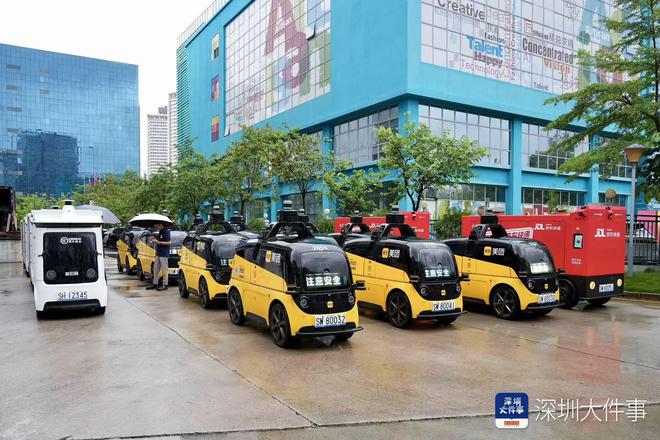
深圳自动配送车集结备战618 年底无人车运营规模将破1000台
Zheng Quan Shi Bao Wang· 2025-06-18 03:59
Core Viewpoint - The article highlights the rapid development of the automated delivery industry in Shenzhen, emphasizing the city's efforts to establish itself as a national benchmark for automated logistics solutions, particularly in preparation for the upcoming 618 shopping festival [1][2]. Group 1: Automated Delivery Operations - A large-scale "automated delivery drill" took place in Shenzhen, featuring over 40 automated delivery vehicles from major companies like Meituan and SF Express, aimed at ensuring efficient logistics during the shopping festival [1][2]. - The automated delivery vehicles have completed over 5 million outdoor deliveries in Shenzhen, showcasing their operational capabilities and collaboration with human couriers for instant delivery services [2][3]. Group 2: Industry Development and Standards - Shenzhen's automated delivery industry is projected to exceed 1,000 operational vehicles by the end of 2025, positioning the city as a leader in the sector [3][4]. - The city has established a comprehensive logistics network integrating buses, subways, unmanned vehicles, and drones, while traditional transport companies are also adapting to the automated delivery model [4][5]. - Strict management protocols have been implemented, including unified vehicle identification, regulatory compliance, and a centralized operational platform to ensure safety and efficiency [4][5]. Group 3: Talent and Infrastructure - Shenzhen has attracted top talent from leading companies in the automated delivery sector, and partnerships with educational institutions are fostering a skilled workforce for the industry [4]. - Over 300 kilometers of roads have been opened for automated delivery, with a rapid response mechanism in place to accommodate business needs [5].
重卡行业无人驾驶应用现状及趋势展望
2025-06-15 16:03
Summary of Key Points from the Conference Call Industry Overview - The conference call discusses the current status and future trends of the **autonomous driving technology** in the **heavy truck industry**, particularly focusing on its applications in various sectors such as mining, logistics, and sanitation [1][2]. Core Insights and Arguments Autonomous Driving in Mining - Autonomous driving technology has transitioned from small-scale pilot projects before 2022 to large-scale implementation in mining operations, with approximately **3,000 autonomous mining trucks** currently in the domestic market, of which over **2,400** are in operation, resulting in a penetration rate of about **7%** [2][10]. - The market is expected to reach a **10% penetration rate** within the next three years, primarily in large open-pit mines, while other types of mines face challenges due to high transformation costs and limited effectiveness [11]. - Over **90%** of new mining trucks sold are electric, with preferences varying by region; hybrid models are favored in harsh environments, while pure electric models are preferred in milder southern regions [14]. Autonomous Driving in Ports - Port applications utilize traditional technologies like **AGV** and **PVR**, enhancing logistics efficiency and reducing labor costs. Key players include **Feiyu Technology** and **Huawei**, with the market experiencing continuous growth [4]. Autonomous Driving in Logistics - The trunk logistics sector has not yet achieved large-scale commercial operation, although the technology is ready. Companies like **Hidi** are exploring convoy operation modes to reduce costs and improve efficiency [5][18]. - The delivery sector has reached **L4** level automation, primarily in end-delivery scenarios, with companies like **New Stoneware** and **White Rhino** nearing this level of automation [6]. Sanitation Industry Applications - In the sanitation sector, autonomous vehicles operate on fixed routes for short-distance cleaning tasks, with a focus on project contracting for comprehensive service delivery. Notable companies include **Kuwah Technology** and **Wenyan Zhixing** [7]. Additional Important Insights - The **market share** of leading companies in the autonomous heavy truck sector shows **Yikong Zhijia** holding approximately **50%** of the market, while **CD Zhijia** and **Tage Zhijia** follow with significantly lower shares due to recent safety incidents [26]. - The **engineering operation model** is viewed as a more favorable business model for rapid market penetration and long-term customer relationships, as it alleviates the financial burden on clients [20][22]. - The **integration of autonomous driving kits** with existing vehicle models requires customized development to ensure optimal performance, highlighting the importance of collaboration between technology providers and manufacturers [23][24]. Future Outlook - The key factor for the growth of the autonomous heavy truck market in the next **3-5 years** is expected to be **policy changes** rather than technological limitations. Current regulations are stringent due to past safety incidents, but as policies evolve, the market could see significant expansion [27].
5连板后急速暴跌,Robovan这么快熄火?
格隆汇APP· 2025-06-14 08:38
Core Viewpoint - The topic of "unmanned delivery" is gaining significant attention, with various developments indicating a potential turning point for the large-scale implementation of unmanned delivery systems in logistics [1][6]. Group 1: Market Dynamics - SF Express's unmanned vehicles are starting to scale up, and several autonomous driving companies focused on logistics have successfully secured funding [2]. - The secondary market's perception of the commercial prospects for unmanned delivery is improving, leading to a rapid increase in related concept stocks [2]. - Notable companies like Yunnei Power, Tongda Electric, and Xingwang Yuda have shown active performance in the market [3]. Group 2: Cost Reduction and Efficiency - The emergence of "affordable" unmanned delivery vehicles is expected to significantly reduce logistics costs [8]. - Last-mile delivery costs account for 60% of the total logistics costs, highlighting the need for automation due to labor shortages and high expenses [11]. - Utilizing unmanned vehicles for last-mile delivery can optimize costs by 0.1-0.2 yuan per order compared to traditional fuel vehicles [13]. - The introduction of unmanned delivery vehicles can reduce costs by over 60% for new energy logistics vehicles due to savings on driver expenses [14]. Group 3: Industry Growth and Projections - By 2024, the scale of unmanned delivery vehicles is expected to exceed 6,000 units, with daily delivery volumes significantly increasing [15]. - The unmanned delivery vehicle market is projected to reach a scale of 100,000 units by 2026 [16]. - Major express companies are ramping up their plans for unmanned vehicles, with projections for significant increases in the number of unmanned delivery vehicles by 2025 [20]. Group 4: Technological Advancements - The cost of unmanned delivery vehicles is rapidly decreasing, with hardware costs dropping significantly [22]. - New models, such as the E6 unmanned delivery vehicle priced at 19,800 yuan, are making L4-level unmanned delivery vehicles more accessible [23][24]. - Advances in technology, including automated driving algorithms and sensor integration, are contributing to the declining costs of unmanned delivery vehicles [27]. Group 5: Future Applications and Market Potential - Unmanned delivery vehicles are expected to expand beyond last-mile delivery to include applications in e-commerce warehousing, industrial parks, and smart city logistics [40]. - The overall market value of the unmanned logistics vehicle industry in China is projected to reach 594.8 billion yuan by 2030 [40]. - The demand for unmanned vehicles is increasing, with more companies entering the market and enhancing the professionalism of related products and services [43].


5连板后急速暴跌,Robovan这么快熄火?
格隆汇APP· 2025-06-14 08:37
顺丰同城无人车开始起量,多家专注于物流场景的自动驾驶企业也纷纷传出融资成功的消息。 在政策松绑、资本与技术的双重驱动下,末端配送与干线货运的无人化变革正在加速推进,二级市场对于无人配送的商业前景认知也在提升, 推动相关概念股的迅速上涨。 如云内动力、通达电气、星网宇达等在相关时间节点均表现活跃。 尤其是德邦股份,5月26日-6月3日期间累计涨幅达72.16%,换手率高达24.27%。 但股价在公告澄清尚未部署无人物流车后,随之下跌超20%。 无人配送规模化落地的拐点,是否真的到来了? 作者 | 弗雷迪 数据支持 | 勾股大数 据(www.gogudata.com) 近期,关于"无人配送"的话题热度持续攀升,一系列消息让这一领域备受关注。 01 "白菜价"设备问世,加速压降物流成本 种种迹象显示, 无人配送规模化落地的拐点逐渐迫近。 无人配送是指通过无人驾驶技术和智能物流系统实现的物流运输与配送服务,自动驾驶等级要达到L4层级,需要AI、传感器融合、车路协同等 技术的融合。 配送行业转向自动化解决方案, 最主要的动力来自庞大的物流配送需求,和传统物流末端人力短缺以及高昂成本之间的矛盾。 去年,中国快递业务量突破 ...

无人车行业深度:物流无人车浪潮起,产业变革新机遇
Hua Yuan Zheng Quan· 2025-06-13 08:21
Investment Rating - The report maintains a "Positive" investment rating for the logistics unmanned vehicle industry [5] Core Insights - The logistics unmanned vehicle industry is entering a phase of large-scale commercialization driven by product price reductions, open road rights, and diverse application scenarios [5] - The main application scenario for logistics unmanned vehicles is last-mile delivery, which can significantly reduce costs and improve efficiency for express delivery companies [5][6] - The potential market size for logistics unmanned vehicles is estimated to reach 207.1 billion yuan, with the ability to replace up to 4.44 million traditional commercial vehicles annually [52] Summary by Sections 1. Logistics Unmanned Vehicles: Commercialization Milestone - Logistics unmanned vehicles are defined as autonomous cargo transport tools primarily used in express delivery and other logistics scenarios [10] - The current largest application scenario is the delivery from express service points to community stations, which can replace traditional delivery vehicles and reduce labor costs [25] 2. Manufacturing Segment: Clear Industry Trends and Growing Orders - The market for logistics unmanned vehicles is expected to exceed 100 billion yuan, with significant replacement potential for traditional vehicles [52] - Leading companies like New Stone and Nine Knowledge have reported rapid growth in orders, indicating strong demand in the market [53] 3. Application Segment: Last-Mile Delivery and Cost Reduction - Express delivery companies are increasingly adopting unmanned vehicles for last-mile delivery, which can enhance profitability for franchisees [6] - Companies like SF Express and Debon are actively integrating unmanned vehicles into their operations, leading to cost savings and operational efficiency [5][6] 4. Investment Analysis - The report suggests focusing on companies such as SF Holdings, SF Same City, and Debon, which are well-positioned to benefit from the adoption of unmanned vehicles [5][6]


九识无人车事故频发背后:核心创始团队扎堆从京东物流离职
Nan Fang Du Shi Bao· 2025-06-12 10:29
Core Viewpoint - The rapid deployment of autonomous delivery vehicles, particularly by Jiushi Intelligent, has been marred by a series of traffic accidents, raising concerns about safety and the pace of technological advancement in the industry [1][2][3]. Group 1: Company Overview - Jiushi Intelligent, established in August 2021, claims to have developed L4-level autonomous driving technology suitable for commercial applications [1][6]. - The company has quickly iterated five models of smart urban delivery vehicles within two years, setting a record for the speed of commercialization in the industry [2][14]. - The founding team of Jiushi Intelligent includes former key members from JD Logistics, indicating a strong background in autonomous vehicle technology [6][8]. Group 2: Recent Incidents - A series of accidents involving Jiushi Intelligent's delivery vehicles have occurred, including a rear-end collision and an incident where a vehicle dragged an electric bike [3][4]. - The company has attributed these incidents to operational errors during remote control and challenges in recognizing deformed obstacles [3][4]. - Despite no injuries reported, these events have sparked significant safety concerns regarding the deployment of autonomous delivery vehicles [1][3]. Group 3: Industry Context - The logistics sector's "last mile" delivery is considered the most costly, making it a prime target for autonomous vehicle applications [4]. - As of 2024, over 6,000 autonomous delivery vehicles have been deployed across various scenarios, significantly increasing daily delivery volumes [4][12]. - The industry is witnessing a trend of shortened development cycles for autonomous delivery vehicles, with many companies achieving commercialization within a year [12][14]. Group 4: Challenges and Considerations - Experts highlight that the large-scale rollout of autonomous delivery vehicles faces challenges such as market entry, cost, safety, and collaboration with logistics companies [5]. - Legal experts emphasize the complexity of assigning liability in traffic accidents involving autonomous vehicles, considering factors like technology performance and operational management [5][16]. - The rapid development and deployment of Jiushi Intelligent's vehicles have raised questions about intellectual property rights and potential infringement issues due to the backgrounds of its founding team [15][18].
无人物流车商业化进程及展望
2025-06-11 15:49
Summary of Key Points from the Conference Call Industry Overview - The conference call discusses the development and commercialization of unmanned logistics vehicles, driven by advancements in communication technology, model computing power, and energy revolution, which enhance delivery efficiency and service quality in the express delivery and takeaway sectors [1][2][3]. Core Insights and Arguments - Approximately 100 cities in China have issued licenses for unmanned vehicles, with expectations that by 2027, most suitable cities will have completed the licensing process [2]. - Unmanned logistics vehicles are primarily utilized in four scenarios: transportation (50-200 km), transshipment (10-50 km), short-haul (1-10 km), and last-mile delivery (less than 1 km) [1][5]. - The express delivery industry anticipates a business volume of 206 billion packages by 2025, with potential for 10 billion packages to incorporate sensors, leading to a fully unmanned logistics chain [8]. - The cost of leasing unmanned vehicles is approximately 40,000 yuan annually, while purchasing costs around 26,000 yuan, with a focus on reducing costs (15%-50%) and improving efficiency (1.5%-2.5%) [3][10][11]. Important but Overlooked Content - The logistics industry is seeing a significant increase in the use of reusable packaging with built-in sensors, costing around 2-3 yuan each, which can enhance safety and tracking [7]. - The battery issue remains a critical challenge, with solutions including rapid battery swapping (adding 8,000 yuan in costs) and fast charging (adding 3,000 yuan) [9]. - The operational efficiency of unmanned vehicles can improve marginal benefits at secondary distribution points by 15%-35%, depending on the specific circumstances [13]. - Major logistics companies are planning to purchase between 3,000 to 6,000 unmanned vehicles in 2025, with significant regional variations in deployment [15]. - The future of unmanned logistics vehicles is promising, particularly in smart warehousing and overseas markets, with companies actively exploring these opportunities [18][19]. Conclusion - The unmanned logistics vehicle sector is poised for growth, driven by technological advancements and increasing demand for efficiency in logistics operations. The focus on battery technology and the development of vehicles suitable for various scenarios will be crucial for future success in this industry [19][20].
计算机行业研究:激光雷达系列深度之五:AEBS新规催化标配预期,割草机+无人城配快速放量
SINOLINK SECURITIES· 2025-06-11 11:37
Investment Rating - The report recommends key global lidar leaders such as SUTENG and Hesai in the context of the accelerating release of non-automotive lidar applications [4] Core Viewpoints - The report emphasizes that lidar is not only the "eye of intelligent driving" but also a "next-generation universal sensor" that is expected to cover all broad robotic scenarios in the future [5] - The intelligent lawn mower market is witnessing significant orders, and the robovan market is rapidly scaling from 1 to 10, validating the report's logic [5] - The report highlights that the automotive lidar market is accelerating upward due to cost reduction and policy catalysis, with L3/L4 advanced intelligent driving expected to create a "value inflation engine" for vehicles [5] Summary by Sections Automotive Market - The new AEBS regulations are expected to promote the standardization of lidar in vehicles, leading to both down-market and high-end growth [7] - For L2 and below models, the AEBS regulations may push for lidar to become standard in M1 and N1 vehicle types [11] - For L3 models, high-performance lidar and multi-lidar setups are becoming essential for domestic L3 vehicles [5][24] - The L4 market is seeing significant breakthroughs with major manufacturers deploying 7-10 lidar units in their fleets [5][31] Lawn Mower Market - The trend towards 3D perception is clear, with lidar becoming a necessary sensing solution for smart lawn mowers [5] - The report estimates that the total addressable market (TAM) for lawn mower lidar could reach 6.4 billion yuan [5] - Leading lidar manufacturers are signing contracts with smart lawn mower clients, with order volumes exceeding one million units [5][7] Robovan Market - The report identifies robovans as a new market for ADAS lidar, with significant cost reductions in logistics [5] - The TAM for robovan lidar is projected to reach 40 billion yuan, indicating a substantial market opportunity [5] - Major lidar manufacturers are forming partnerships with leading robovan manufacturers, focusing on cost control and compliance with automotive-grade standards [5][31]

无人物流深度
2025-06-10 15:26
Summary of the Autonomous Logistics Vehicle Industry Conference Call Industry Overview - The autonomous logistics vehicle industry is experiencing explosive growth, with an expected scale of 30,000 units by 2025, increasing to 100,000 units by 2026, and potentially reaching 600,000 units by 2030. The penetration rate could reach 30% in the short term, corresponding to a market space of approximately 600,000 vehicles, with long-term potential exceeding 1 million vehicles [2][4][19]. Key Insights and Arguments - **Profitability Model**: Companies primarily profit through hardware sales and Full Self-Driving (FSD) services. Initial hardware sales may incur losses, but the software service model is profitable. A breakeven point is reached at 5,000 units sold, with a profit of 40,000 to 50,000 yuan per vehicle at 50,000 units sold, resulting in a net profit margin close to 50% [2][5][22]. - **Cost Reduction**: The cost of logistics has significantly decreased, with the cost per delivery dropping to 0.08 yuan, a 60% reduction compared to traditional methods. The hardware cost gap with traditional logistics vehicles has narrowed to about 20,000 to 30,000 yuan, enhancing economic viability [2][17]. - **Technological Development**: The industry is moving towards lightweight mapping and even no-mapping solutions, which lower costs and deployment times but require higher data collection and algorithm demands. The deployment time for lightweight mapping is significantly shorter, taking only one to two days compared to two weeks to a month for high-definition mapping [2][6][16]. - **Policy Support**: There is increasing policy support, with over 200 cities in China accelerating the issuance of road usage permits, simplifying processes for industry development [2][13][14]. Competitive Landscape - **Barriers to Entry**: The competitive barriers in the autonomous logistics vehicle sector include access rights, differences in autonomous driving technology, and innovation in business models. Efficiently mobilizing resources to meet diverse demands is crucial [3][21]. - **Market Leaders**: Key players include the publicly listed company WeRide, Jinlong Automobile, and Zhongyou Technology. Other notable companies include intelligent hardware manufacturers and electric vehicle-related firms [8][23][24]. Market Demand and Growth Expectations - **Order Growth**: Major manufacturers are seeing significant increases in orders, with companies like 90 and New Stone achieving substantial sales targets. The market demand is strong and continues to grow [18][19]. - **Future Projections**: The industry is expected to grow significantly in the coming years, with projections of 30,000 units in 2025, 100,000 units in 2026, and 600,000 units by 2030. Chinese companies are growing rapidly, while overseas markets are expanding at a slower pace [19][20]. Application Scenarios - **Ideal Use Cases**: Short-distance transportation scenarios, such as urban cross-district or rural-urban routes, are more suitable for autonomous logistics development due to their standardization potential. The e-commerce and express delivery sectors are the most mature and automated, making them the first to adopt autonomous logistics solutions [11][12]. Conclusion - The autonomous logistics vehicle industry is at a pivotal moment, driven by technological advancements, significant cost reductions, and strong policy support. The competitive landscape is evolving, with established players and new entrants vying for market share. The future looks promising, with substantial growth expected in both domestic and international markets.