
华夏航空

Search documents
400余家上市公司齐聚!关于海南封关、制造强国、“十五五”资本市场、AI等领域投资机会,答案都有了
Mei Ri Jing Ji Xin Wen· 2025-12-12 10:29
Group 1: Conference Overview - The "2025 14th Annual Conference on the Development of Listed Companies and the Exchange of Opportunities in Hainan Free Trade Port" was held in Haikou from December 11 to 13, with over 400 listed companies and 20 institutions participating [1] - The conference coincided with the countdown to the full closure of Hainan Free Trade Port, emphasizing Hainan's role as a new experimental field for reform and opening up [1] Group 2: Institutional Opening in Hainan - Hu Xiaolan emphasized that the future focus for Hainan is to advance post-border institutional opening, aligning domestic systems with international high-standard economic and trade rules [3][4] - The core of high-level opening is not just about tariff reductions and market access but also about improving domestic regulations and standards to match international practices [4] Group 3: Market Competition and Fairness - Hu Xiaolan highlighted the importance of ensuring fair competition among market participants, addressing both anti-monopoly and anti-unfair competition measures [6] - The need for equal treatment of state-owned, private, and foreign-invested enterprises in market access and subsidies was stressed to prevent market distortion [6] Group 4: Manufacturing Industry Insights - Su Bo discussed the achievements of China's manufacturing sector, noting that its share of global manufacturing value added increased from 19.8% in 2010 to 31.1% in 2023 [7] - He identified the need for breakthroughs in key technologies such as high-end chips and industrial software to close the gap with leading manufacturing countries [7] Group 5: Capital Market Trends - Lian Ping indicated that equity assets have become the preferred choice for capital allocation as funds shift from the real estate market to other sectors [10][11] - The A-share market is seeing a rise in technology content, with the electronic sector surpassing the banking sector in market capitalization [10] Group 6: Emerging Industry Opportunities - Various industry leaders discussed opportunities in AI, digital economy, and health-conscious consumer trends, indicating a shift towards personalized and experience-driven consumption [12][14] - The importance of data governance in AI applications was highlighted, emphasizing the need for deep understanding and precise management of industry data [12] Group 7: Robotics and AI Development - Nanshan Aluminum's chairman mentioned that the robotics sector is seen as a new growth area, with expectations for the market size to reach trillions [18] - The integration of AI in traditional industries poses challenges, particularly in maintaining production while implementing new technologies [19]


华夏航空CEO吴龙江:探索用AI组合“吃住行游购娱”等要素,满足高品质旅行需求
Mei Ri Jing Ji Xin Wen· 2025-12-12 06:28
每经讯 12月11日至13日,由每日经济新闻与海南国际经济发展局联合主办的2025第十四届上市公司发 展年会暨海南自贸港开放机遇交流大会系列活动在海口举行。12月12日,华夏航空CEO(首席执行官) 吴龙江在主会场圆桌讨论环节表示,民航企业有三个特点,分别是已完成数字化的巨量数据、要求精准 运转的系统以及大量资金的快速流转,这三个特性为AI(人工智能)赋能创造了一种可能,那便是在 人、飞机、机场、航路、天气等持续动态的运转过程中,寻找安全可靠的解决方案,这也是华夏航空一 直在探索的内容。 "旅行的本质要素是吃、住、行、游、购、娱,如何对这些要素进行组合,是我们在探索的事情。现在 的'自由行',容易'有了自由没了品质',所以如何把这些要素进行有效组合,满足消费者高品质体验的 需求,这是我们所看到的价值锚点,我们正在努力。"吴龙江说道。 封面图片来源:每经原创 据吴龙江介绍,华夏航空后续将探索的AI赋能方向包括增效、增收等。对于增收部分,吴龙江称将探 索与产业链上下游的联动。 ...

华夏航空CEO吴龙江:不会烧钱做AI,希望能“以AI养AI”
Mei Ri Jing Ji Xin Wen· 2025-12-12 05:41
此外,吴龙江还表示,目前的AI"语文好、数学不好"。"逻辑思维能力是它的优势,但处理大量图表、 数据是它的弱项,需要等待这些能力的改善和提升,期待未来大模型的进步。" 在资源的投入上,吴龙江提出,公司希望是以AI来养AI。"我们不会去烧钱,希望是伴随着AI应用产生 的效益,成为下一步投入的资本,用这样的方式解决AI持续快速迭代问题。" 每经记者:吴泽鹏每经编辑:张益铭 每经讯 12月11日至13日,由每日经济新闻与海南国际经济发展局联合主办的2025第十四届上市公司发 展年会暨海南自贸港开放机遇交流大会系列活动在海口举行。12月12日,华夏航空CEO(首席执行官) 吴龙江在主会场圆桌讨论环节表示,过去一年,公司对AI(人工智能)的认识经历了从"狂热"到"冷 静"的过程。 "我们发现AI还没那么智能,它的理解力和运算力没有那么强。例如,人在作出判断时可以参照经验进 行快速决策,但AI往往容易'忘事儿',很难每次都结合全量数据进行思考,在行业应用当中,这是需要 继续摸索的。" 每日经济新闻 ...
华夏航空CEO吴龙江:不会烧钱做AI 希望能“以AI养AI”
Mei Ri Jing Ji Xin Wen· 2025-12-12 05:33
在资源的投入上,吴龙江提出,公司希望是以AI来养AI。"我们不会去烧钱,希望是伴随着AI应用产生 的效益,成为下一步投入的资本,用这样的方式解决AI持续快速迭代问题。" (文章来源:每日经济新闻) "我们发现AI还没那么智能,它的理解力和运算力没有那么强。例如,人在作出判断时可以参照经验进 行快速决策,但AI往往容易'忘事儿',很难每次都结合全量数据进行思考,在行业应用当中,这是需要 继续摸索的。" 此外,吴龙江还表示,目前的AI"语文好、数学不好"。"逻辑思维能力是它的优势,但处理大量图表、 数据是它的弱项,需要等待这些能力的改善和提升,期待未来大模型的进步。" 12月11日至13日,由每日经济新闻与海南国际经济发展局联合主办的2025第十四届上市公司发展年会暨 海南自贸港开放机遇交流大会系列活动在海口举行。12月12日,华夏航空CEO(首席执行官)吴龙江在 主会场圆桌讨论环节表示,过去一年,公司对AI(人工智能)的认识经历了从"狂热"到"冷静"的过程。 ...
四中全会精神在基层丨“支支串飞”航线激活西部丝路游
Bei Jing Ri Bao Ke Hu Duan· 2025-12-12 04:33
Core Insights - Gansu Province is enhancing its tourism experience by introducing a new "branch flight" model, which allows tourists to travel between multiple destinations efficiently, addressing the long-standing issue of "long travel, short stay" in the region [1][3][4] Group 1: Innovations in Air Travel - Gansu Provincial Airport Group has launched the "branch flight" model, enabling connections between cities like Lanzhou, Qingyang, and Dunhuang, thus improving tourist access to cultural sites [4][6] - The new flight routes include Lanzhou to Jinchang to Jiayuguan and Lanzhou to Zhangye to Dunhuang, developed in collaboration with various airlines [4][6] Group 2: Product Development and Market Expansion - The airport group has created six core products to stimulate tourism, including discounted "flight + hotel" packages and educational travel activities tailored to different age groups [4][6] - Educational programs have been designed around the new flight routes, offering activities such as traditional Chinese medicine camps and space science camps [4][6] Group 3: Performance Metrics - The average passenger load factor for the new branch flight routes has increased from 60% to over 75% since their launch [6] - By early December, over 260,000 passengers had been transported via the new routes, with Dunhuang and Jiayuguan airports achieving record passenger throughput of over 1.3 million and 1.2 million, respectively [6][7] Group 4: Future Plans - The airport group aims to further enhance its flight network, creating a 1 to 2-hour air travel radius centered around Lanzhou, with plans to extend services to regions like Xinjiang and Qinghai [7]

浙江舟山:“海岛快巴”实现“干支通,全网联”
Zhong Guo Min Hang Wang· 2025-12-12 02:33
Core Insights - The "Island Express" project launched by Zhoushan Putuo Mountain International Airport in 2020 has successfully operated over 1,100 helicopter flights, serving more than 15,000 passengers in five years, contributing positively to the establishment of a one-hour air traffic circle in Zhejiang [1][2]. Group 1: Project Overview - Zhoushan is China's first major port city established on an archipelago, known for its rich tourism resources and diverse islands, including the famous 5A-rated Putuo Mountain scenic area [2]. - The "Island Express" service connects Zhoushan Airport to several islands, including Dongji Island, Shengsi Island, Gouqi Island, and Qushan Island, addressing transportation limitations posed by geographical constraints [2][4]. Group 2: Operational Model - The airport has implemented a "trunk and branch connection, full network integration" model, allowing seamless travel with a single ticket purchase for both commercial flights and helicopter services [4][6]. - Key operational strategies include bundling trunk flights with helicopter segments, establishing dedicated transfer counters for luggage handling, and promoting sales through official airline platforms to enhance customer experience [6][8]. Group 3: Additional Services - In addition to the "Island Express," Zhoushan Airport has also opened three domestic routes to Wenzhou, Lishui, and Quzhou, further supporting the one-hour air travel demand within Zhejiang [8].

交通运输行业2026年投资策略:时来天地皆同力
GF SECURITIES· 2025-12-11 05:08
Core Insights - The report emphasizes that domestic demand is recovering ahead of external demand, with a focus on low base effects in 2026, making bottomed-out sectors worth attention [3] - It highlights that upstream sectors are recovering before downstream sectors, with significant demand elasticity expected in early 2026, particularly in bulk supply chains and dry bulk shipping [3] - The report notes that price increases are anticipated before volume growth, with a focus on dry bulk shipping, e-commerce logistics, and airlines benefiting from supply constraints and favorable oil exchange rates [3] Industry Overview - The transportation sector ranked 29th in the market as of December 10, 2025, reflecting significant pressure on fundamentals, with a -1% performance in the Shenwan primary transportation index [18][19] - The report identifies structural opportunities in logistics and shipping, despite the overall economic cycle affecting the sector [20] - It indicates that the transportation sector's performance is closely tied to economic fundamentals, with a notable correlation between ROE and economic cycles [23] Sub-industry Analysis - In logistics, domestic demand is stabilizing while external trade remains robust, with expectations of price increases due to anti-involution policies [11][20] - The airline sector is experiencing improvements in supply and demand, with a focus on capturing opportunities in private airlines and airport duty-free consumption recovery [11][20] - The shipping sector, particularly dry bulk shipping, is highlighted as a cost-effective opportunity for 2026, driven by supply and demand dynamics [11][20] Investment Strategy - The report suggests a strategy of seeking alpha within beta, focusing on sectors with low beta characteristics that are expected to turn around in 2026 [11][20] - It emphasizes the importance of identifying individual stocks within the transportation sector that can outperform the broader market, given the anticipated recovery in demand [11][20] - The report outlines a cautious but optimistic outlook for 2026, with a focus on sectors that have shown resilience and potential for recovery [11][20]


航空2026年投资策略:映日荷花别样红
ZHONGTAI SECURITIES· 2025-12-10 15:39
Investment Highlights - The report emphasizes a positive outlook for the aviation industry in 2026, driven by a gradual recovery in demand and an expected increase in ticket prices, with domestic market capacity growth remaining slow [6][9] - The investment strategy suggests focusing on major airlines with significant fleet sizes and strong cyclical attributes, such as China Southern Airlines, China Eastern Airlines, and Hainan Airlines, as well as smaller regional airlines like Huaxia Airlines and low-cost carriers like Spring Airlines [6][9] 2025 Aviation Review - Global aviation growth is projected to slow down, with IATA forecasting a 5.8% increase in RPK (Revenue Passenger Kilometers) for 2025, while the Asia-Pacific region is expected to lead with a 9% growth [7][21] - China's aviation industry showed profitability in the first three quarters of 2025, with major airlines like Air China, China Eastern, and China Southern expected to achieve full-year profitability [7][19] - The average passenger load factor in China reached 85.12%, an increase of 1.7 percentage points year-on-year, indicating strong demand recovery [7][39] 2026 Aviation Outlook - The supply-demand balance is expected to improve, with international travel demand benefiting from visa-free policies and corporate expansion abroad, leading to optimistic growth forecasts [6][9] - The report anticipates that 2026 will be a year where the positive cycle of volume and price in the aviation market becomes widely recognized, with a shift in growth engines from domestic to international markets [6][9] - The report highlights that the average ticket prices are expected to rise due to reduced competition and high load factors, with the industry moving away from aggressive price wars [7][49] Supply Side Analysis - The global backlog of aircraft orders has reached a record high of 17,000 units, but delivery rates have not returned to pre-pandemic levels, leading to a supply gap [7][55] - Major aircraft manufacturers like Boeing and Airbus are struggling to meet delivery targets, which may continue to constrain capacity growth in the coming years [7][55] - The report notes that the utilization rates of existing aircraft have reached peak levels, limiting the potential for further supply increases [7][49] Demand Side Analysis - The report indicates that international travel demand is expected to remain strong, particularly due to favorable visa policies and a growing preference for short-haul destinations among Chinese travelers [7][91] - Domestic business travel is projected to recover gradually, while leisure travel demand remains robust, with a notable increase in the number of young and elderly travelers [7][86] - The report highlights that the recovery in inbound tourism is also expected to continue, supported by visa-free entry policies for foreign visitors [7][100]
航空机场板块12月10日涨1.14%,海航控股领涨,主力资金净流出369.65万元
Zheng Xing Xing Ye Ri Bao· 2025-12-10 09:09
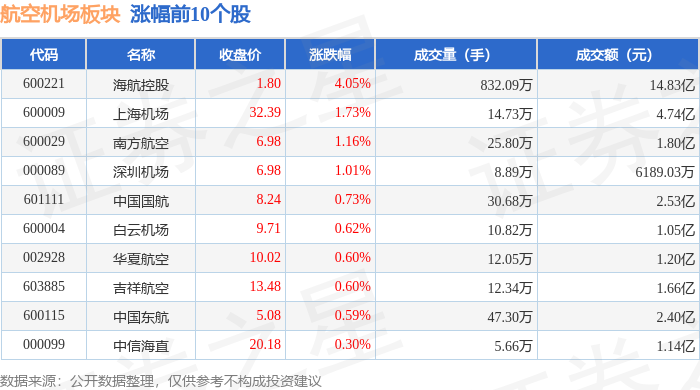
Core Insights - The aviation and airport sector saw a rise of 1.14% on December 10, with HNA Holding leading the gains [1] - The Shanghai Composite Index closed at 3900.5, down 0.23%, while the Shenzhen Component Index closed at 13316.42, up 0.29% [1] Stock Performance - HNA Holding (600221) closed at 1.80, up 4.05% with a trading volume of 8.32 million shares [1] - Shanghai Airport (600009) closed at 32.39, up 1.73% with a trading volume of 147,300 shares [1] - Southern Airlines (600029) closed at 6.98, up 1.16% with a trading volume of 258,000 shares [1] - Shenzhen Airport (000089) closed at 6.98, up 1.01% with a trading volume of 88,900 shares [1] - China National Aviation (601111) closed at 8.24, up 0.73% with a trading volume of 306,800 shares [1] - Baiyun Airport (600004) closed at 9.71, up 0.62% with a trading volume of 108,200 shares [1] - Huaxia Airlines (002928) closed at 10.02, up 0.60% with a trading volume of 120,500 shares [1] - Juneyao Airlines (603885) closed at 13.48, up 0.60% with a trading volume of 123,400 shares [1] - China Eastern Airlines (600115) closed at 5.08, up 0.59% with a trading volume of 473,000 shares [1] - CITIC Offshore Helicopter (000099) closed at 20.18, up 0.30% with a trading volume of 56,600 shares [1] Capital Flow - The aviation and airport sector experienced a net outflow of 3.6965 million yuan from institutional investors, while retail investors saw a net inflow of 8.92532 million yuan [2] - The overall capital flow indicates a mixed sentiment among different investor types within the sector [2] Individual Stock Capital Flow - HNA Holding saw a net inflow of 14.2 million yuan from institutional investors, but a significant outflow of 85.3144 million yuan from retail investors [3] - China Eastern Airlines had a net inflow of 23.1458 million yuan from institutional investors, with retail investors also experiencing a net outflow [3] - China National Aviation had a net inflow of 9.8210 million yuan from institutional investors, while retail investors had a net inflow of 660.88 million yuan [3] - Baiyun Airport had a net inflow of 3.9543 million yuan from institutional investors, but retail investors faced a net outflow [3] - Huaxia Airlines had a net inflow of 3.0489 million yuan from institutional investors, with retail investors showing a slight net inflow [3]





华夏航空20251209
2025-12-10 01:57
Summary of Huaxia Airlines Conference Call Company Overview - **Company**: Huaxia Airlines - **Date**: December 9, 2025 Key Points Industry and Market Performance - Huaxia Airlines' stock price increased by 30% from January to November 2025, leading among listed airlines [2] - Civil aviation branch subsidies reached approximately CNY 3,100 per hour in the first 11 months, a year-on-year increase of over 10%, and more than double compared to pre-pandemic levels [2][3] - The airline's aircraft utilization rate is expected to be 8.1 hours for the year, with a potential increase to 8.5 hours by 2026, indicating operational efficiency improvement [2][3] Operational Challenges - The company faces a shortage of captains, with a 20% gap for the C909 model, requiring 70 but currently having only 53 [4][11] - Maintenance issues with Pratt & Whitney engines affect operational efficiency, with 22 engines impacted; 15 are expected to be resolved by the end of next year [4][5][10] - Fuel price sensitivity remains unchanged; a CNY 1,000 increase per ton affects profits by CNY 450 million [4][26] Financial Performance - For the first three quarters of 2025, Huaxia Airlines reported a net profit of CNY 620 million, benefiting from capacity recovery and revised branch aviation subsidy management [3] - Average quarterly subsidies for the first three quarters were CNY 160 million, showing a year-on-year increase of over 25% [6][22] - The company’s asset-liability ratio is approximately 83.16%, with plans to reduce it to below 75% [24][25] Fleet and Capacity Management - The fleet size reached 78 aircraft, expected to grow to 80 by year-end, including 31 A320s, 33 CRJ900s, and 16 C909s [2][7] - Plans to dispose of CRJ900s while introducing 3 A320s and 6 C909s, potentially increasing total fleet size by 1-2 aircraft [7] Pricing and Revenue Trends - Ticket prices turned positive year-on-year starting in September, with an increase of 3-4% [4][6] - November's passenger load factor reached 82%, a record high, with an expected annual load factor exceeding 82% [6][29] - The company anticipates ticket prices to stabilize in 2026, maintaining a cautious outlook [4][18] Strategic Developments - Post-scheduling adjustments resulted in a 4.5% increase in flight slots, with significant growth in the Northwest (82%) and East China (nearly 40%) regions [8] - The company is exploring new markets in East and Central China, such as Quzhou and Wuhu, with potential for future operations [16] Competitive Landscape - Huaxia Airlines differentiates itself from competitors like Chengdu Airlines by focusing on branch aviation, with a lower proportion of trunk routes [12] - Despite competition in the Xinjiang market, the company maintains a stable operational network and government support [11][13] Future Outlook - The company aims to enhance aircraft utilization to nearly 9 hours by the end of 2026, with a projected capacity growth of around 10% [28] - The anticipated operational strategy includes dual aircraft operation with A320 and C909 models to reduce costs and improve efficiency [28] - The overall industry is expected to see continued improvement in passenger load factors, although Huaxia Airlines remains cautious about future growth [29]