
荣耀

Search documents
Omdia:苹果手机2025年出货超2.4亿部创新高,vivo首次跻身全球第四
Feng Huang Wang· 2026-01-30 03:15
Group 1 - Apple achieved a record annual shipment of 240.6 million iPhones in 2025, marking a 7% year-on-year increase and maintaining its position as the global leader for the third consecutive year [5] - In Q4, Apple set a new quarterly shipment record, with a 26% year-on-year growth in the Chinese mainland market, driven primarily by demand for the iPhone 17 series [5] Group 2 - Xiaomi shipped 165.4 million units in 2025, retaining its position as the third-largest global smartphone manufacturer, although its Q4 shipments declined by 2% [6] - Vivo entered the global top four for the first time with shipments of 105.3 million units, reflecting a 4% year-on-year growth [6] - OPPO shipped 100.7 million units, experiencing a 3% year-on-year decline, but returned to growth in Q4 due to new product launches [6] Group 3 - The report indicates that rising costs of key components and memory chips at the end of the year have begun to suppress shipment expectations for 2026 [6] Group 4 - In 2025, the market share of the top ten global smartphone manufacturers was as follows: Apple 19%, Samsung 19%, Xiaomi 13%, Vivo 8%, OPPO 8%, Transsion 8%, Honor 6%, Lenovo 5%, Huawei 4%, and Realme 3% [7]


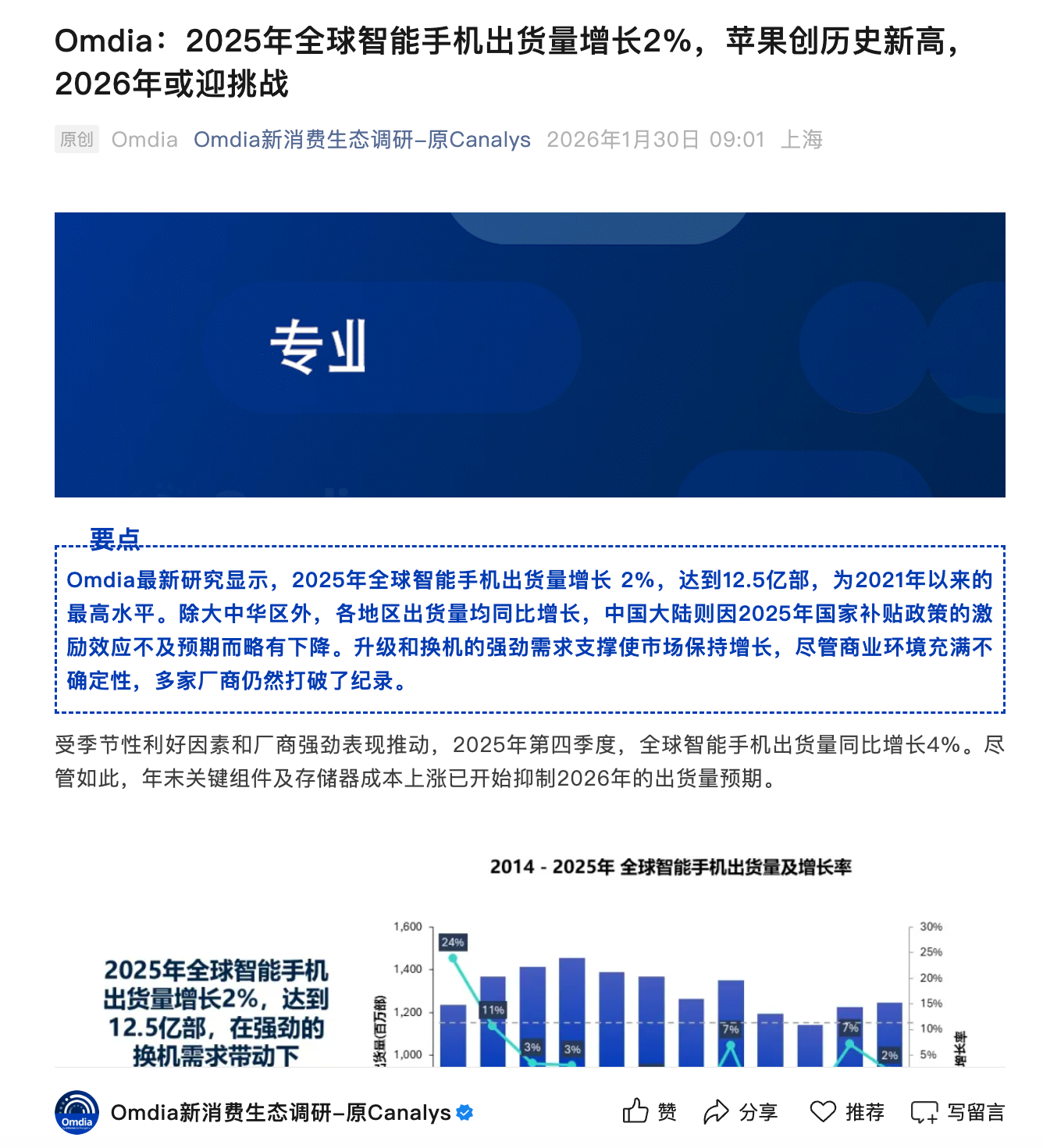
Omdia:2025年全球智能手机出货量增长2% 达到12.5亿部
Zhi Tong Cai Jing· 2026-01-30 01:41
Core Insights - Global smartphone shipments are projected to grow by 2% in 2025, reaching 1.25 billion units, marking the highest level since 2021, with all regions except Greater China experiencing year-on-year growth [1] - The fourth quarter of 2025 saw a 4% year-on-year increase in global smartphone shipments, driven by seasonal factors and strong vendor performance, although rising costs of key components began to suppress expectations for 2026 [1] Group 1: Company Performance - Apple achieved a record annual shipment of 240.6 million iPhones in 2025, a 7% increase year-on-year, maintaining its position as the largest smartphone manufacturer for the third consecutive year [4] - Samsung rebounded in 2025 with a 7% year-on-year increase in shipments, closing the year with a strong fourth quarter, driven by resilient demand for flagship models and a recovery in the entry-level market [4] - Xiaomi defended its top three position despite a 2% decline in fourth-quarter shipments, impacted by weak entry-level demand and significant market contraction [5] Group 2: Market Dynamics - Vivo entered the fourth position for the first time, with a 4% year-on-year increase in shipments to 10.53 million units, supported by success in the Indian market and stable domestic performance [5] - OPPO ranked fifth, with annual shipments of 10.07 million units, experiencing a 3% year-on-year decline, but returning to growth in the fourth quarter with the launch of new models [5] - Despite challenges, several manufacturers outside the top five maintained positive growth, with Honor and Lenovo achieving year-on-year increases of 11% and 6%, respectively [5] Group 3: Future Outlook - Concerns for 2026 are emerging due to escalating supply-side pressures on DRAM, NAND, and other semiconductors, which may compress profit margins and force price adjustments [8] - Companies must effectively manage supply chain pressures and strengthen long-term partnerships to mitigate the impact of rising costs on consumer demand [8] - The focus for manufacturers will shift towards profitability and exploring alternative revenue sources, with a strategic opportunity to capture upgrade demand and ensure market share sustainability [11]

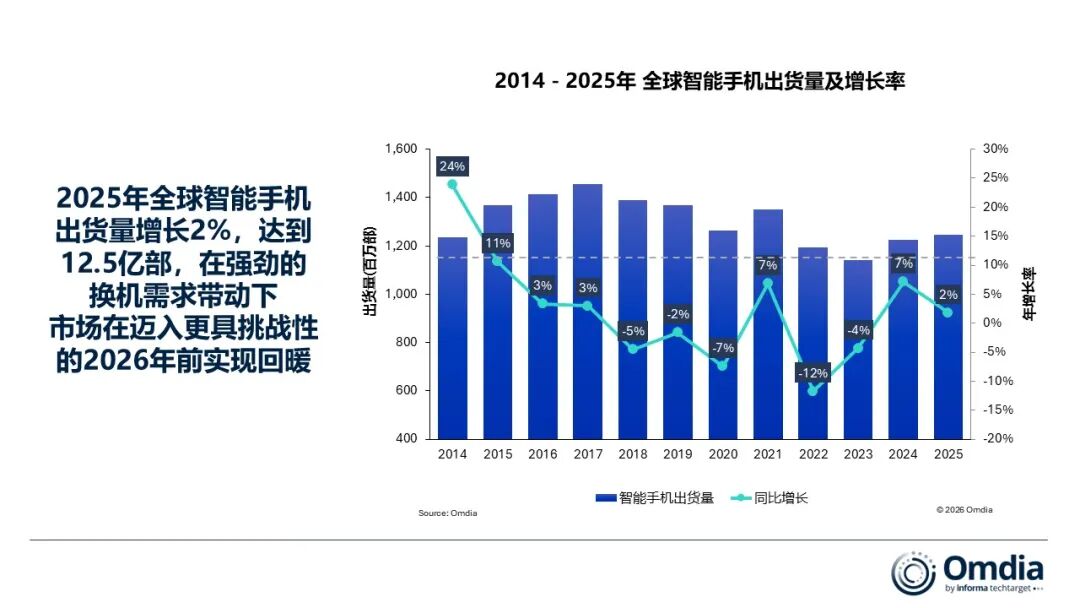
Omdia:2025年全球智能手机出货量增长2%,苹果创历史新高,2026年或迎挑战
Canalys· 2026-01-30 01:03
Core Insights - Omdia's latest research indicates that global smartphone shipments are expected to grow by 2% in 2025, reaching 1.25 billion units, marking the highest level since 2021. All regions except Greater China are projected to see year-on-year growth, while mainland China is expected to experience a slight decline due to underwhelming effects of national subsidy policies in 2025 [1][9] Group 1: Market Performance - In Q4 2025, global smartphone shipments increased by 4% year-on-year, driven by seasonal factors and strong performance from manufacturers. However, rising costs of key components and memory are beginning to suppress shipment forecasts for 2026 [2] - Apple achieved a record annual shipment high in 2025, with iPhone shipments growing by 7% to 240.6 million units, maintaining its position as the largest smartphone manufacturer globally for the third consecutive year. The fourth quarter saw the highest single-quarter iPhone shipments, with mainland China market growth of 26% driven by strong demand for the iPhone 17 series [5] - Samsung rebounded significantly in 2025 after three consecutive years of decline, with a 7% year-on-year increase in shipments, slightly below Apple's figures. The company ended the year strongly with a 16% increase in Q4 shipments, supported by resilient demand for flagship models and a recovery in the mass market [5] - Xiaomi maintained its top three position in 2025 despite facing challenges at year-end, with a 2% decline in Q4 shipments. The company's strategy of expanding its product range from entry-level to high-end models, along with AIoT products, is central to its value growth [6] - Vivo entered the fourth position for the first time, with a 4% year-on-year increase in shipments to 10.53 million units, benefiting from continued success in the Indian market and stable performance in the domestic market. OPPO ranked fifth, with annual shipments of 10.07 million units, down 3% year-on-year [6] Group 2: Emerging Trends and Challenges - Outside the top five, several manufacturers continued to show positive growth despite a challenging market environment. Honor and Lenovo grew by 11% and 6% respectively, achieving historical highs. Huawei regained the top position in mainland China for the first time in five years, while Nothing became the fastest-growing manufacturer in 2025, with shipments surging by 86% to over 3 million units [7] - Omdia's senior analyst highlighted that while 2025 was positive for most manufacturers, concerns about the outlook for 2026 have emerged. Supply-side pressures on DRAM, NAND, and other semiconductors are causing significant worry among manufacturers, potentially compressing profit margins and forcing price adjustments, which could ultimately suppress consumer demand [9][11] - As market contraction becomes increasingly inevitable in 2026, manufacturers will focus on profitability and explore alternative revenue sources. The current market volatility presents a competitive window for manufacturers, suppliers, and partners to quickly respond to challenges and capture opportunities among upgrade and replacement users [11][12]

折叠屏在东北变“碎碎冰”
第一财经· 2026-01-29 15:49
Core Viewpoint - The article discusses the challenges and growth prospects of the foldable smartphone market, particularly focusing on durability issues in low temperatures and the expected increase in shipments due to Apple's entry into the market in 2026 [3][13]. Durability Issues in Low Temperatures - Foldable smartphones face durability problems in extremely low temperatures, as highlighted by a viral incident where a user's device was damaged in Harbin due to temperature fluctuations [5][11]. - The core reason for screen breakage in cold weather is attributed to the material properties of flexible OLED screens, which become brittle at low temperatures, leading to issues like delamination and liquid leakage [12]. - Recommendations for using foldable phones in cold environments include minimizing opening and closing the device outdoors and allowing it to warm up before use [12] [13]. Market Growth Predictions - Despite durability concerns, the global shipment of foldable smartphones is expected to reach 24 to 25 million units in 2026, a growth of approximately 41% to 47% from 17 million units in 2025 [14]. - The Chinese market is projected to see shipments of 12 to 13 million units in 2026, reflecting a growth of 20% to 30% from 10 million units in 2025 [14]. - The foldable smartphone market is anticipated to remain small, accounting for about 2% of the total global smartphone sales of approximately 1.15 billion units in 2026 [15]. Market Dynamics and Competitive Landscape - China has become the largest market for foldable smartphones, with local manufacturers focusing on innovation in hinge design, screen technology, and overall device performance [17]. - Major brands like Huawei, Apple, and Samsung are expected to dominate the market, with Huawei holding a significant share of around 50% in China [18]. - The competitive landscape is characterized by a clear division among leading brands, with Huawei showing a 14% increase in sales, while other brands like Honor and Vivo are facing challenges [18]. Future Observations - The introduction of Apple's foldable smartphone is anticipated to significantly influence market dynamics, with expectations for innovations in hardware and software that could enhance user experience [20]. - The ongoing "trade-in" subsidy policy in China may provide additional support for the foldable smartphone market, although rising costs present challenges for manufacturers [20].

速卖通拿下增速前10,被海外机构评为“美国大赢家”
Guan Cha Zhe Wang· 2026-01-29 13:49
Core Insights - The report by Similarweb highlights AliExpress as one of the fastest-growing e-commerce platforms in developed markets, including the US, UK, Germany, and Australia, for the year 2025 [1][4]. Group 1: Performance Metrics - In the US, AliExpress experienced a website traffic increase of 18.7% year-on-year, making it one of the top ten fastest-growing platforms and earning the title of "2025 US Big Winner" [1][4]. - In Australia, AliExpress saw a remarkable growth of 45.5% in website visits, ranking as the fastest-growing e-commerce platform and second overall in the comprehensive ranking, just behind chatGPT [4]. - In the UK, the app downloads for AliExpress increased by 38.5%, placing it third in the comprehensive app ranking [4]. - In Germany, website traffic for AliExpress grew by 34.5%, securing the fifth position in the overall ranking, surpassing Temu [4]. Group 2: Strategic Initiatives - The user growth of AliExpress is attributed to its shift towards a "branding + localization" strategy starting in 2024, moving away from a reliance on price competition [4]. - The company launched the "Super Brand Going Global Plan" in 2025, aimed at helping brands achieve higher sales at half the cost of Amazon, attracting several leading brands such as Xiaomi, Honor, Baseus, and Nubia [4]. - In 2026, AliExpress plans to introduce a combination of "overseas hosting + brand going global," focusing on core cross-border industrial belts in Zhejiang, Guangdong, and Henan, while continuing to recruit Chinese brand merchants [5]. Group 3: Market Positioning - The report indicates that platforms providing stable logistics, clear after-sales rules, and strong brand power are more likely to gain long-term consumer loyalty, contrasting with the previous low-price competition model [4]. - On Black Friday 2025, AliExpress's download numbers in Europe surpassed those of Amazon, marking a significant entry into Amazon's core market [4]. - A survey by AMZ123 revealed that 87% of Amazon sellers plan to use AliExpress as a secondary growth channel for brand expansion [4].


折叠屏变“碎碎冰”难题待解,苹果“折叠大法”引领今年风向
Di Yi Cai Jing· 2026-01-29 13:46
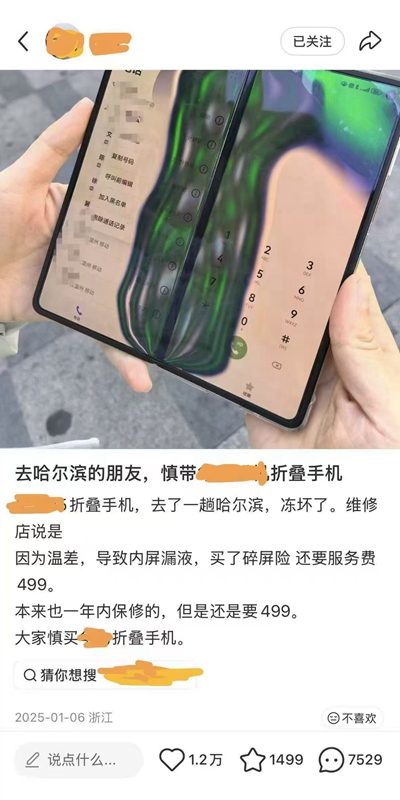
极低温下的耐用问题待解 2025年1月6日,上述博主在小红书上配图提醒说,去哈尔滨的朋友慎带折叠屏手机。她透露,其折叠屏 手机冻坏了;维修店说是因为温差,导致内屏漏液,买了碎屏险,还要服务费499元。当时这条内容分 享引发了上万网友关注、7000多条评论。 折叠屏手机的全球出货量今年预计将达到2500万部左右。 近日,折叠屏在东北变成"碎碎冰"的话题登上热搜榜。第一财经记者发现,其中一张热图是来自一位小 红书博主一年前的分享。 尽管折叠屏不抗冻的话题隔了一年"又火了",调研机构预测,受苹果将入市等因素影响,折叠屏手机今 年出货量仍将增长,全球、中国出货量有望分别达2500万部和1300万部左右。而折叠屏手机在极低温下 的耐久问题仍有待超薄玻璃等材料的进步。 "(这个话题)又火了",这位博主在1月28日告诉第一财经记者,她的折叠屏手机已修好,正常用没问 题。她是浙江人,去年到东北是参加别人的婚礼。她建议,折叠屏手机不要在那么低温的环境下拿出 来,回屋以后,暖和一下,再"掰开"用。 至于多少摄氏度以下不能用,这位博主说,其实也有概率问题。她后来在评论区看到,说明书上是有写 的。对于说明书是否有写0摄氏度或者多少摄 ...
马化腾不看好的「豆包手机」,杀出「围剿」丨36氪独家
36氪· 2026-01-29 13:31
1月26日,在腾讯公司年会上,马化腾罕见评价了豆包手机—— 他直言腾讯反对将用户的手机屏幕传到云端,因为这"极其不安 全、不负责任"。 以下文章来源于智能涌现 ,作者邱晓芬 智能涌现 . 直击AI新时代下涌现的产业革命。36氪旗下账号。 文 | 邱晓芬 编辑 | 苏建勋 来源| 智能涌现(ID:AIEmergence) 封面来源 | IC photo 对此评价,豆包手机方面快速做出回应,称将严格遵守用户授权,云端处理遵循"不存储、不训练原则"。 马化腾的评价,也揭开了豆包手机此前的隐痛。2025年12月,字节旗下豆包手机在发布仅一天后,便经历了一场严重"围 剿"——其AI Agent由于触及了各大超级APP的流量和核心数据,引发了美团、微信、阿里系在内互联网厂商的联合封锁,AI功 能几近瘫痪。 尽管如此,豆包手机的故事尚未落幕。 据"智能涌现"独家获悉,字节已于去2025年底开启豆包手机助手正式版项目, 新机预计将于2026年Q2中晚期发布。 有供应链人士称,字节对新机的预期不低,比第一代的测试版大大提升。在模式方面,豆包二代手机依旧合作中兴努比亚,由 中兴负责硬件,豆包负责AI。 对此,字节方面暂无回复。 ...

2025年全球畅销TOP10手机出炉 | OPPO小平板曝光 还有台超大屏?
Xin Lang Cai Jing· 2026-01-29 12:13
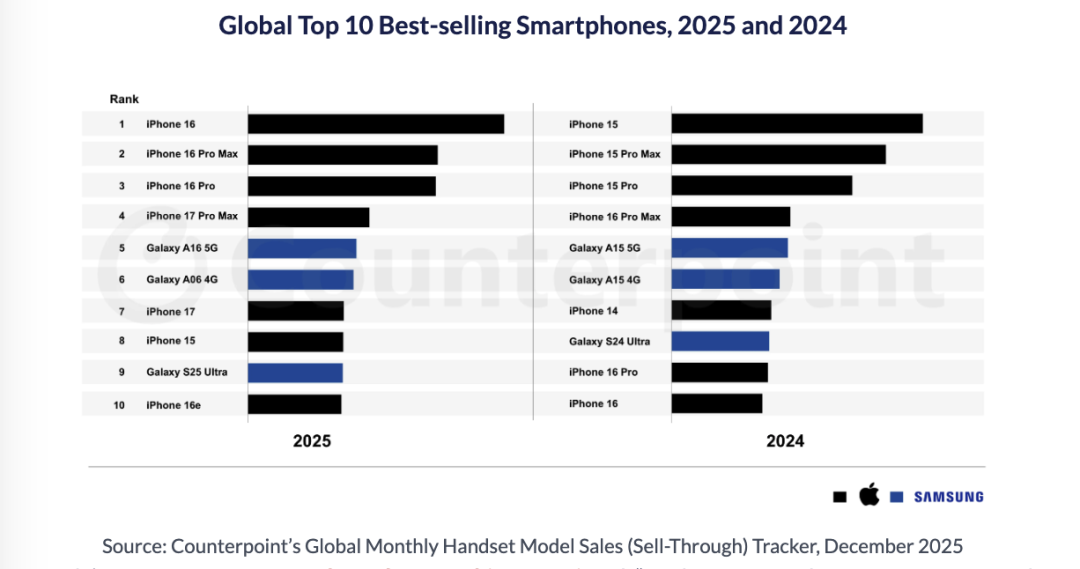
Group 1 - The core point of the article highlights the top-selling smartphones globally in 2025, with Apple dominating the list with seven models and Samsung with three [3][16][22] - The top ten best-selling smartphones for 2025 include iPhone 16, iPhone 16 Pro Max, iPhone 16 Pro, iPhone 17 Pro Max, Samsung Galaxy A16 5G, Samsung Galaxy A06 4G, iPhone 17, iPhone 15, Samsung Galaxy S25 Ultra, and iPhone 16e [3][16][22] - Notably, the iPhone 17 series was released in September 2025 and achieved significant sales within a short period, indicating strong market performance [18][22] Group 2 - The sales data from 2024 and 2023 shows that the best-selling models were iPhone 15 and iPhone 14, with iPhone 16 projected to be the top seller in 2025 [22] - There are speculations about the sales leader for 2026, as the iPhone 17 standard version is currently underperforming compared to the 17 Pro Max [22] - Additionally, there are reports of new tablet developments from OPPO, including an 8.8-inch OLED tablet and a larger tablet with a battery capacity of approximately 13,000mAh [22][24]
iPhone Air爆改eSIM卡槽?业内称很难,极致轻薄其实很小众?
Shen Zhen Shang Bao· 2026-01-29 10:41
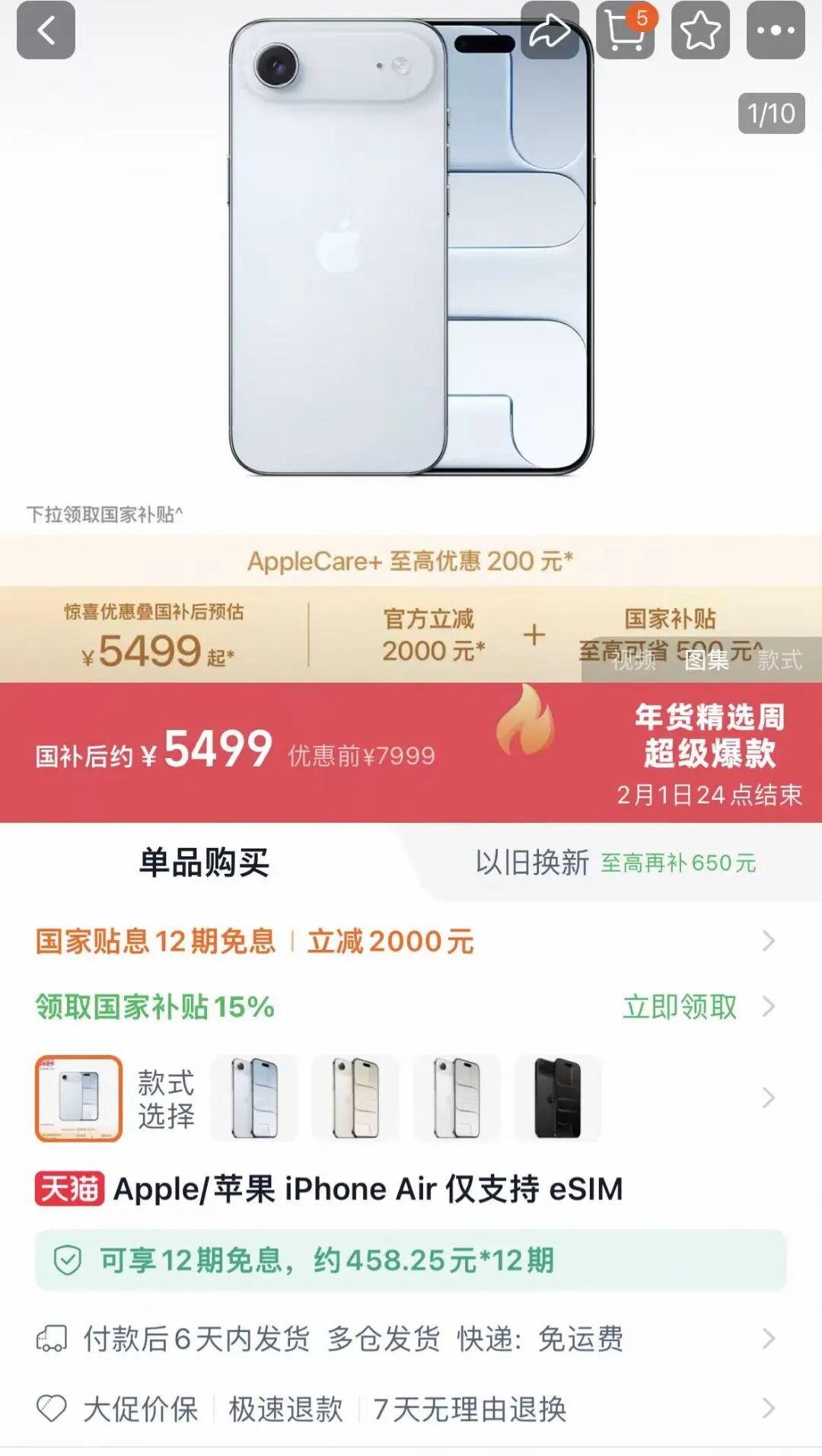
Core Viewpoint - The recent significant price drop of the Apple iPhone Air, originally priced at 7999 yuan, now starting at 5499 yuan after a reduction of 2000 yuan, highlights the product's poor sales performance since its launch just over three months ago [1][10]. Group 1: Sales Performance - The iPhone Air has seen disappointing sales, with cumulative activation numbers below 200,000 units as of January 24, 2026, which is significantly below expectations [4][10]. - Following the price cut, there are reports of stock shortages for certain models at authorized Apple stores, indicating a potential short-term increase in demand [10]. Group 2: eSIM Technology Challenges - The adoption of eSIM technology in the iPhone Air has been a major hurdle, as many users find the activation process cumbersome compared to traditional SIM cards [4][5]. - Users must visit physical stores with identification to activate eSIM services, which has led to frustration and a lack of understanding of the new technology [6][8]. - The complexity of eSIM management, especially for users accustomed to physical SIM cards, poses a significant barrier to widespread adoption [8][11]. Group 3: Market Strategy and Consumer Preferences - Analysts suggest that the iPhone Air's design and features have not sufficiently impressed consumers, making it difficult to stand out in a competitive market [10][11]. - The initial high pricing has limited market acceptance, and while the price reduction may attract some buyers, it risks damaging the brand's image and consumer confidence [10]. - The trend towards ultra-thin devices may not align with consumer preferences for battery life and usability, indicating a potential shift in Apple's future product strategy towards larger foldable screens and AI hardware [11].
预计Q2中晚期发布!豆包手机卷土重来:从“被围剿”,到“反围剿”
3 6 Ke· 2026-01-29 06:55
尽管如此,豆包手机的故事尚未落幕。 据《智能涌现》独家获悉,字节已于去2025年底开启豆包手机助手正式版项目,新机预计将于2026年 Q2中晚期发布。 1月26日,在腾讯公司年会上,马化腾罕见评价了豆包手机——他直言腾讯反对将用户的手机屏幕传到 云端,因为这"极其不安全、不负责任"。 对此评价,豆包手机方面快速做出回应,称将严格遵守用户授权,云端处理遵循"不存储、不训练原 则"。 马化腾的评价,也揭开了豆包手机此前的隐痛。2025年12月,字节旗下豆包手机在发布仅一天后,便经 历了一场严重"围剿"——其AI Agent由于触及了各大超级APP的流量和核心数据,引发了美团、微信、 阿里系在内互联网厂商的联合封锁,AI功能几近瘫痪。 有供应链人士称,字节对新机的预期不低,比第一代的测试版大大提升。在模式方面,豆包 二代手机 依旧合作中兴努比亚,由中兴负责硬件,豆包负责AI。 对此,字节方面暂无回复。 除了攻坚自己的硬件之外,豆包手机还在尝试两条腿走路——和一众手机厂商接洽不同形式的合作。 《智能涌现》获悉,豆包手机与手机厂商谈判的合作模式,主要分为两类: 对于自研生态完善(模型、算力、入口、OS)的手机大厂,比如 ...