华安基金

Search documents
两市ETF两融余额减少8.12亿元丨ETF融资融券日报
2 1 Shi Ji Jing Ji Bao Dao· 2026-01-21 03:23
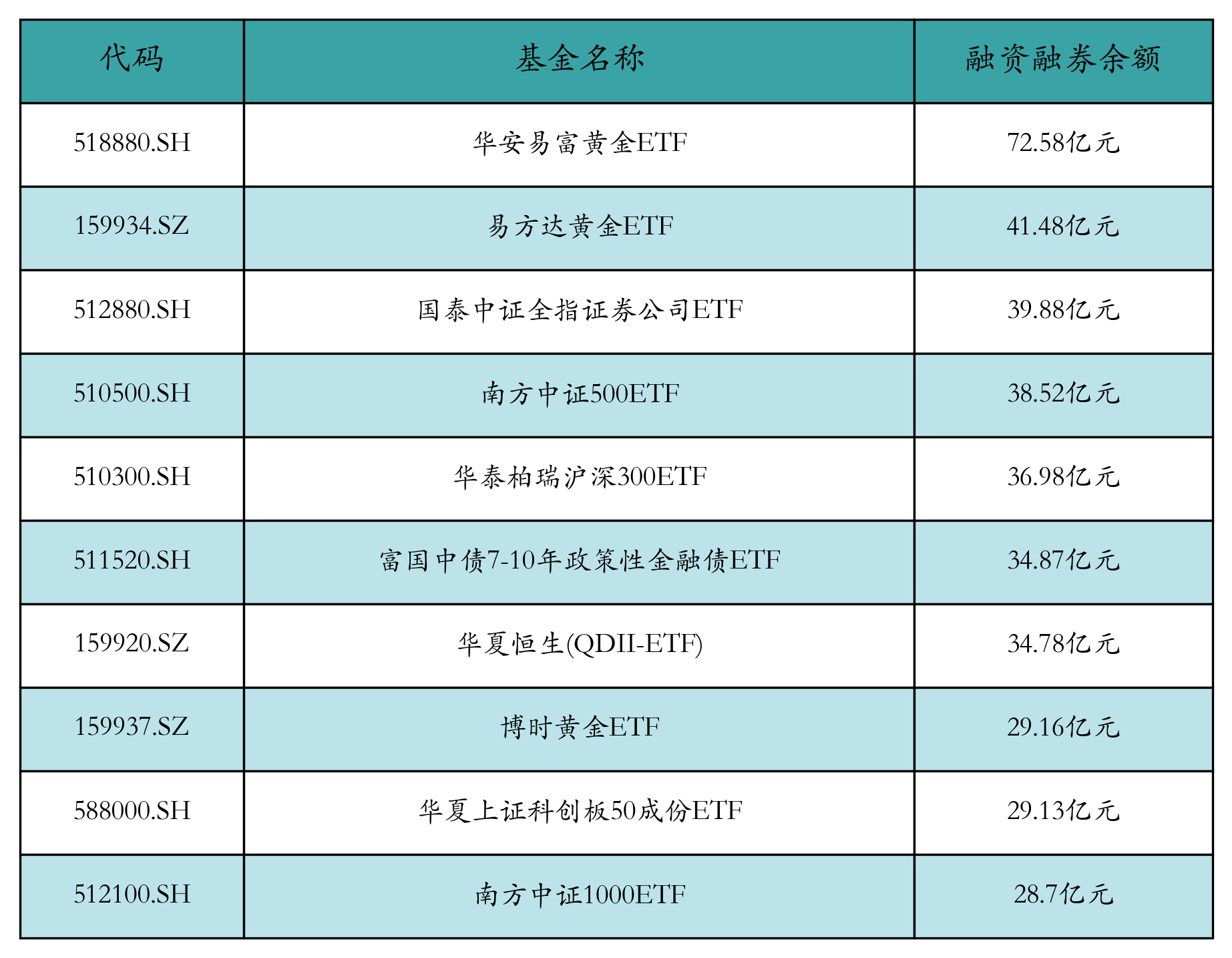
Market Overview - As of January 20, the total ETF margin balance in the two markets is 122.93 billion yuan, a decrease of 0.81 billion yuan from the previous trading day [1] - The financing balance is 115.22 billion yuan, down by 0.998 billion yuan, while the securities lending balance is 7.71 billion yuan, an increase of 0.186 billion yuan [1] - In the Shanghai market, the ETF margin balance is 86.28 billion yuan, a decrease of 0.61 billion yuan, with a financing balance of 79.51 billion yuan, down by 0.808 billion yuan [1] - In the Shenzhen market, the ETF margin balance is 36.65 billion yuan, a decrease of 0.202 billion yuan, with a financing balance of 35.71 billion yuan, down by 0.19 billion yuan [1] Top ETF Margin Balances - The top three ETFs by margin balance on January 20 are: - Huaan Yifu Gold ETF (7.258 billion yuan) - E Fund Gold ETF (4.148 billion yuan) - Guotai CSI All-Share Securities Company ETF (3.988 billion yuan) [2] Top ETF Financing Amounts - The top three ETFs by financing amount on January 20 are: - Hai Futong CSI Short Bond ETF (5.135 billion yuan) - Huatai-PB Southern Dongying Hang Seng Technology Index (QDII-ETF) (1.078 billion yuan) - Huaxia Hang Seng Technology (QDII-ETF) (1.005 billion yuan) [4] Top ETF Net Financing Amounts - The top three ETFs by net financing amount on January 20 are: - GF CSI Hong Kong Innovative Medicine (QDII-ETF) (88.0038 million yuan) - Bosera 30-Year Treasury Bond ETF (62.1176 million yuan) - Huabao CSI Medical ETF (50.7989 million yuan) [5] Top ETF Securities Lending Amounts - The top three ETFs by securities lending amount on January 20 are: - Southern CSI 1000 ETF (1.52 billion yuan) - Southern CSI 500 ETF (1.18 billion yuan) - GF CSI 1000 ETF (293.241 million yuan) [6]

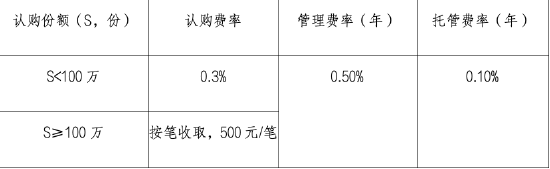
聚焦有矿资产 华安中证有色金属矿业主题ETF1月26日发行
Xin Lang Cai Jing· 2026-01-21 01:25
有色领域再添配置新工具,华安中证有色金属矿业主题ETF(认购代码:512943;基金二级市场交易代 码:512940)将于1月26日发行。据了解,该产品紧密跟踪中证有色金属矿业主题指数,聚焦有矿企 业,均衡囊括各细分品种龙头。 有色金属是指除铁、铬、锰及其合金以外的所有金属的统称。它们是现代工业、高新技术和国防建设不 可或缺的基础材料和关键战略资源。中证有色金属矿业主题指数从有色金属行业中选取40只拥有有色金 属矿产资源储量的上市公司证券作为指数样本,反映有色金属矿业主题上市公司证券的整体表现。 据悉,中证有色金属矿业主题指数核心成分股均为国内有色金属龙头企业,覆盖铜、锂、稀土、铝、黄 金等核心资源品。和其他有色类指数相比,中证有色金属矿业主题指数仅选取拥有有色金属矿产资源储 量的企业,更聚焦上游采矿环节,剔除了仅从事冶炼与加工等环节的公司。同时行业配置较为均衡,确 保各细分领域市值前三的头部公司均能入选,并且成分股数量较少,权重更集中于龙头公司,弹性或更 强。 从有色金属产业链看,矿山企业的收入直接挂钩于铜、锂、锌等金属的现货价格,而其成本(采矿、选 矿)相对固定。当金属价格上涨时,绝大部分增量收入将直接转 ...
金价持续刷新历史纪录,是入场还是“等待”?
Sou Hu Cai Jing· 2026-01-20 17:10
Core Viewpoint - The gold prices have surged significantly, reaching new highs, driven by various market dynamics including increased investment demand and macroeconomic factors [1][5]. Group 1: Gold Price Trends - As of January 19, the spot gold price exceeded $4690 per ounce, while silver reached $94.12 per ounce, both hitting record highs [1]. - Since 2026, the spot gold price has increased by over 7%, with 2025 witnessing more than 50 historical highs and an annual increase of over 70%, marking the highest annual growth in 46 years [1]. Group 2: Consumer Behavior and Sales Impact - Despite rising gold prices, consumer demand has cooled, with a reported 7.95% decline in gold consumption in China for the first three quarters of 2025, and a 32.50% drop in gold jewelry consumption [2]. - Retailers are facing challenges as consumers prefer to buy during price increases, leading to a decrease in sales for non-essential purchases [2]. Group 3: Market Adaptations - Jewelry brands are adapting by offering lightweight, high-value products and implementing trade-in policies, which have increased trade-in business by 20% [4]. - The focus on enhancing the gross profit contribution per gram of gold jewelry is seen as crucial for retailers to navigate the current market conditions [4]. Group 4: Investment Demand - Investment demand for gold has outpaced consumption for the first time in 30 years, with gold bars and coins sales increasing by 24.55% year-on-year [5]. - The global ETF inflow for gold reached $89 billion in 2025, indicating strong international interest in gold as an investment [5]. Group 5: Factors Driving Gold Prices - The ongoing global monetary easing policies and concerns over currency devaluation are primary drivers of rising gold prices, as investors seek gold as a hedge against inflation [6]. - Geopolitical uncertainties and increased central bank purchases of gold further support the demand and price stability for gold [6].
华安基金“双十”老将蒋璆“清仓式”卸任!下一站或奔私
2 1 Shi Ji Jing Ji Bao Dao· 2026-01-20 13:15
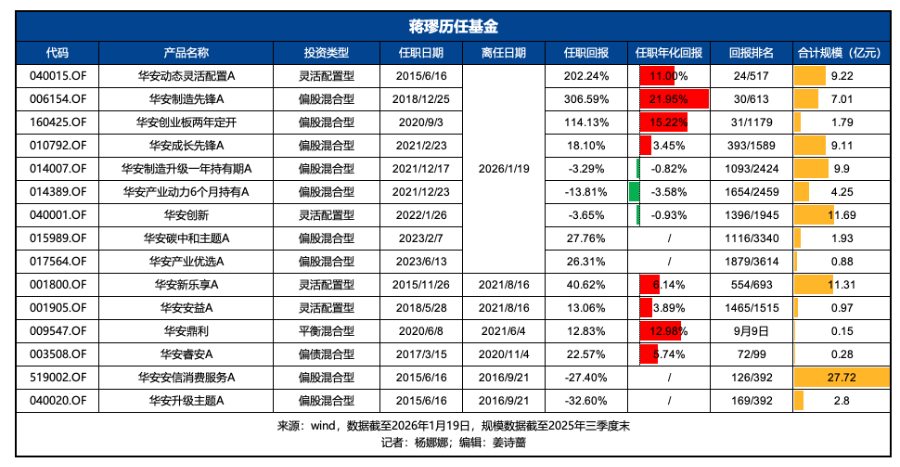
Core Viewpoint - The resignation of Jiang Qiu, a senior fund manager at Huashan Fund, after over 14 years, is attributed to "personal reasons," and he has completely exited from managing all nine funds under his supervision, with speculation that he may transition to private equity [1][4][19]. Fund Performance Summary - Jiang Qiu managed nine funds, with notable performances including: - Huashan Dynamic Flexible Allocation A, which achieved a return of 202.24% since its inception, with an annualized return of 11.00%, ranking 24th out of 517 in its category [5]. - Huashan Manufacturing Pioneer A, with a return of 306.59% and an annualized return of 21.95%, ranking 30th out of 613 [5][6]. - Huashan Growth Pioneer A, which had a return of 18.10% and ranked 393rd out of 1589 [5]. - Conversely, some funds under Jiang's management performed poorly, such as: - Huashan Manufacturing Upgrade One-Year Holding A, which recorded a loss of 3.29% since inception [7]. - Huashan Industry Power Six-Month Holding A, with a loss of 13.81% [7]. Market Context and Fund Management Challenges - Jiang Qiu's management coincided with market highs, leading to significant inflows into his funds, but subsequent market corrections resulted in substantial losses for investors who entered at peak times [10]. - The performance of Jiang's funds reflects a broader issue in the industry where fund managers may experience strong long-term returns, but individual investor experiences can vary significantly due to market timing and fund inflows [10][12]. Transition and Future Implications - Jiang Qiu's departure may impact Huashan Fund's investment team and the performance continuity of the funds he managed, raising concerns among investors about the ability of new managers to maintain performance [19]. - The trend of fund managers transitioning to private equity or other platforms reflects ongoing changes in the industry, driven by competitive pressures and personal career aspirations [23].
6只黄金主题基金近一年涨幅翻倍
2 1 Shi Ji Jing Ji Bao Dao· 2026-01-20 11:58
Group 1 - The global gold market reached a milestone on January 20, with London spot gold prices breaking the $4,700 per ounce mark, peaking at $4,737.35 per ounce, while COMEX gold futures rose above $4,742.9 per ounce, both recording daily gains of over 1% and setting new historical highs [1] - The World Gold Council reported that in 2025, global gold prices set historical records 53 times, leading to a surge in gold-related fund products, particularly gold-themed ETFs, which have shown strong capital attraction [1] - Currently, there are 20 gold-themed ETF products in the market, including 14 gold ETFs and 6 gold stock ETFs, indicating a growing and diversified product system [1] Group 2 - The top-performing gold stock ETF managed by Huaxia Fund (159562.SZ) achieved a remarkable 107.94% increase, followed closely by Yongying Fund's gold stock ETF (517520.SH) with a 107.60% rise, while the lowest-performing physical gold ETF still recorded a 62.76% increase [2] - In the past year, these 20 gold-themed ETFs attracted over 130 billion yuan in net inflows, with Huaxia Fund's gold ETF (518880.SH) leading with over 45 billion yuan, pushing its total scale above 100 billion yuan [2] - As of the end of the third quarter of 2025, global gold ETF inflows surged to $89 billion, with total assets under management (AUM) reaching $559 billion, both marking historical highs [2] Group 3 - The strong performance of the gold market is driven by multiple macroeconomic factors, including sustained gold purchases by global central banks, which provide long-term structural support for gold prices [3] - As of December 2025, China's gold reserves stood at 74.15 million ounces, with an increase of 30,000 ounces that month, marking the 14th consecutive month of gold accumulation by the central bank, instilling long-term confidence in the market [3] - Inflation persistence and monetary policy expectations are also contributing to the upward potential of gold prices, with analysts predicting that the Federal Reserve may need to implement more aggressive rate cuts than currently anticipated due to a deteriorating job market and rising unemployment [3]
创业板50指数ETF今日合计成交额28.56亿元,环比增加42.44%
Zheng Quan Shi Bao Wang· 2026-01-20 08:54
Core Viewpoint - The trading volume of the ChiNext 50 Index ETF reached 2.856 billion yuan today, marking an increase of 851 million yuan from the previous trading day, with a growth rate of 42.44% [1] Trading Volume Summary - The Huazhang ChiNext 50 ETF (159949) had a trading volume of 2.223 billion yuan today, an increase of 661 million yuan from the previous day, with a growth rate of 42.28% [1] - The Chuang 50 ETF (159681) recorded a trading volume of 247 million yuan, up by 149 million yuan from the previous day, with a significant growth rate of 151.94% [1] - The Invesco Great Wall ChiNext 50 ETF (159682) had a trading volume of 293 million yuan, increasing by 31.1 million yuan from the previous day, with a growth rate of 11.86% [1] Market Performance Summary - As of market close, the ChiNext 50 Index (399673) fell by 2.00%, while the average decline of related ETFs tracking the ChiNext 50 Index was 1.97% [1] - The ETFs with the largest declines today included the Huatai-PB ChiNext 50 ETF (159383) and the Wanji ChiNext 50 ETF (159372), which fell by 2.09% and 2.07% respectively [1] Detailed Trading Data - The trading data for various ChiNext 50 ETFs shows significant increases in trading volume for several funds, with the Chuang 50 ETF (159681) and the Chuang 50 ETF ICBC (159370) leading with increases of 151.94% and 145.14% respectively [1]

债券ETF资金持续流出 | 债券ETF跟踪
Xin Lang Cai Jing· 2026-01-20 06:39
Fund Flow - As of January 16, 2026, bond ETFs experienced a net outflow of 16.512 billion yuan over the past week, with interest rate, credit, and convertible bond ETFs seeing net outflows of 5.307 billion yuan, 14.018 billion yuan, and a net inflow of 2.814 billion yuan respectively [21][24] - Since 2025, cumulative net inflows for interest rate, credit, and convertible bond ETFs have reached 60.615 billion yuan, 487.023 billion yuan, and 25.964 billion yuan respectively, totaling 573.603 billion yuan [21][24] Index Performance - The China Bond New Comprehensive Index rose by 0.18% over the past week, while short-term pure bond and medium-to-long-term pure bond funds increased by 0.02% and 0.05% respectively [19][24] - The CSI AAA Sci-Tech Bond Index and the Shanghai Benchmark Market Company Bond Index both increased by 0.11% [19][24] Net Value Performance - Various types of bond ETFs generally saw an increase in net value, with the 30-year government bond ETF from Bosera rising by 0.37%, and the government bond ETF from Huaxia increasing by 0.31% [23][24] - Convertible bond ETFs and the Shanghai Convertible Bond ETF rose by 1.05% and 0.68% respectively [23][24] Credit Bond ETF and Sci-Tech Bond ETF Performance - As of January 16, 2026, the median unit net value for credit bond ETFs and sci-tech bond ETFs was 1.0128 and 1.0010, with increases of 0.09% and 0.07% respectively [25][32] - The Dachen credit bond ETF performed relatively well, increasing by 0.10% [25][32] Duration Tracking of Credit Bond ETFs - As of January 16, 2026, the holding durations for short-term bond ETFs, corporate bond ETFs, and urban investment bond ETFs were 0.34 years, 1.56 years, and 2.13 years respectively [32][34] - For market-making credit bond ETFs, the median holding durations for products tracking the Shanghai and Shenzhen market-making corporate bonds were 3.58 years and 2.80 years respectively [32][34]

净流出,超400亿元
Zhong Guo Ji Jin Bao· 2026-01-20 06:37
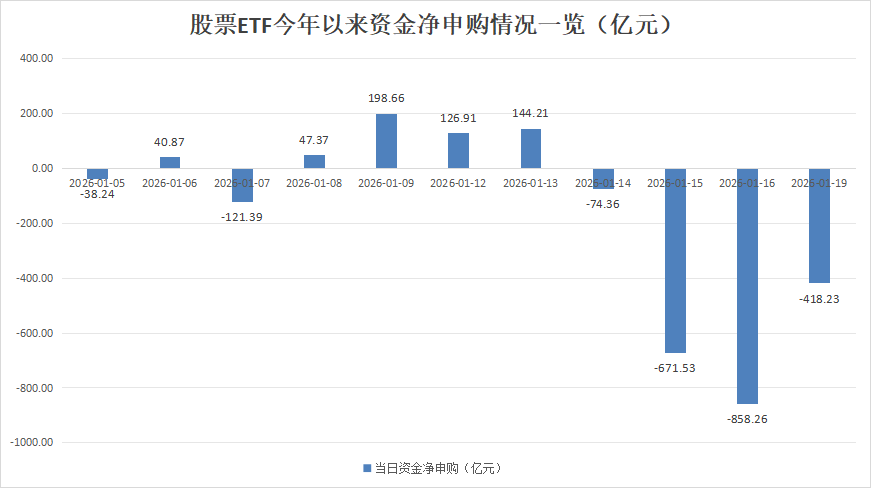
Core Viewpoint - The stock ETF market continues to show a trend of significant capital outflow, indicating a cooling effect on the A-share market amidst recent volatility [1][2][10]. Group 1: Market Overview - On January 19, the A-share market experienced a net outflow of over 400 billion yuan from stock ETFs, marking the third consecutive day of significant outflows [1][2]. - The total scale of all stock ETFs reached 4.61 trillion yuan, with a net outflow of 418.23 billion yuan on the same day [2][4]. - The overall trading volume in the two markets decreased to 2.73 trillion yuan, with a relatively weak performance from large-cap stocks [2]. Group 2: ETF Performance - Industry and commodity ETFs saw net inflows of 155.04 billion yuan and 22.44 billion yuan, respectively, while broad-based ETFs experienced a net outflow of 586.07 billion yuan [4]. - The largest outflows were observed in the four major Hu-Shen 300 ETFs, which collectively saw over 300 billion yuan in net outflows [5][8]. - Specific ETFs such as the Huaxia Electric Grid Equipment ETF led the inflows with over 25 billion yuan, while the Hu-Shen 300 ETFs faced significant outflows, with individual ETFs seeing net outflows exceeding 50 billion yuan [6][8]. Group 3: Fund Management Insights - Major fund companies like E Fund and Huaxia Fund reported continued inflows in certain ETFs, with E Fund's Robot ETF reaching a historical high of 174 billion yuan [4][6]. - The market is characterized by a resilient overall performance, with active trading and significant inflows into industry-themed ETFs supported by strong fundamentals [10].
净流出,超400亿元!
Zhong Guo Ji Jin Bao· 2026-01-20 06:22
Core Viewpoint - The stock ETF market experienced significant net outflows, exceeding 400 billion yuan on January 19, marking the third consecutive day of substantial outflows, totaling over 1.9 trillion yuan in the past three trading days [1][2]. Group 1: Market Performance - The A-share market continued its volatile trend, with the Shanghai Composite Index rising by 0.29% to 4114.00 points, while the CSI 300 Index increased by 0.05% [2]. - Trading volume in the Shanghai and Shenzhen markets decreased to 2.73 trillion yuan, with weaker performance from large-cap stocks and stronger performance from growth-style sectors [2]. Group 2: ETF Fund Flows - The total scale of all stock ETFs (including cross-border ETFs) reached 4.61 trillion yuan, with a net outflow of 418.23 billion yuan on January 19 [2]. - Industry and commodity ETFs saw net inflows of 155.04 billion yuan and 22.44 billion yuan, respectively, while broad-based ETFs experienced net outflows of 586.07 billion yuan, leading to a decrease in their scale by 694.95 billion yuan [4]. Group 3: Specific ETF Performance - The top net inflows were observed in industry ETFs, with the Huaxia Electric Grid Equipment ETF leading at over 25 billion yuan, followed by the Penghua Chemical ETF with over 11 billion yuan [6]. - Four major CSI 300 ETFs collectively saw net outflows exceeding 300 billion yuan, with the Southern CSI 1000 ETF experiencing over 50 billion yuan in outflows [5][6]. Group 4: Market Sentiment and Outlook - Analysts noted that the recent net outflows from broad-based ETFs have contributed to a cooling effect on the previously hot market, aiding in the stable operation of the A-share market [7]. - The market is expected to maintain a volatile pattern in the short term, with potential support from funds adjusting their positions, while long-term sentiment remains optimistic [7].
净流出,超400亿元!
中国基金报· 2026-01-20 06:19
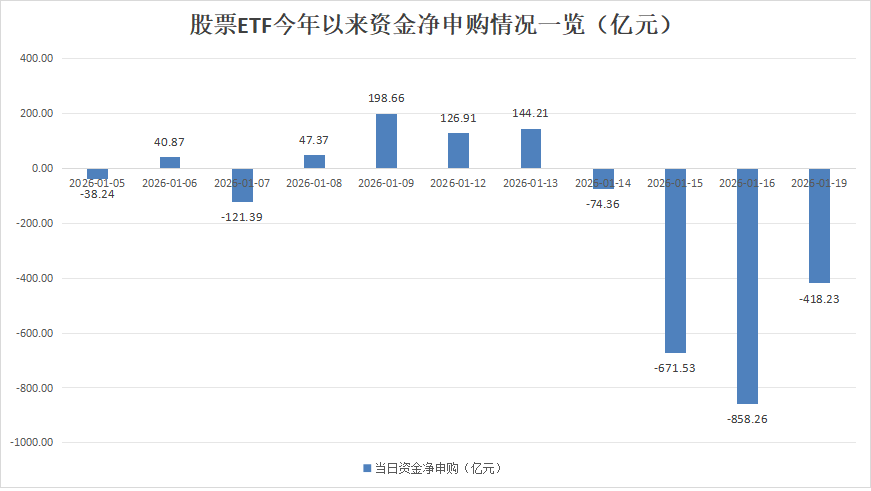
Core Viewpoint - The stock ETF market in China has experienced significant net outflows, with over 400 billion yuan withdrawn on January 19, marking the third consecutive day of substantial outflows, totaling over 1.9 trillion yuan in the past three trading days [2][5]. Group 1: Market Overview - On January 19, the A-share market continued its volatile trend, with the Shanghai Composite Index rising by 0.29% to 4114.00 points, while the CSI 300 Index increased by 0.05%. However, trading volume decreased to 2.73 trillion yuan, indicating weaker performance among large-cap stocks [5]. - The total scale of all stock ETFs (including cross-border ETFs) reached 4.61 trillion yuan as of January 19, with a net outflow of 418.23 billion yuan on that day [5]. Group 2: ETF Performance - Industry and commodity ETFs saw net inflows, with industry theme ETFs and commodity ETFs attracting 155.04 billion yuan and 22.44 billion yuan, respectively. In contrast, broad-based ETFs experienced net outflows totaling 586.07 billion yuan, with a decrease in scale of 694.95 billion yuan [7]. - Specific ETFs tracking the electric grid equipment index saw the highest net inflow of 25.83 billion yuan, while those tracking the CSI 300 index faced the largest net outflow of 306.94 billion yuan [7]. Group 3: Fund Company Insights - Major fund companies like E Fund and Huaxia Fund reported continued net inflows in certain ETFs. For instance, E Fund's robotics ETF saw a net inflow of 4.2 billion yuan, reaching a record high of 174 billion yuan [8]. - Huaxia Fund's electric grid equipment ETF and non-ferrous metals ETF also led in net inflows, with 25.83 billion yuan and 6.01 billion yuan, respectively [8]. Group 4: Outflow Analysis - The top ten ETFs with the largest net outflows were all broad-based ETFs, with four major CSI 300 ETFs collectively experiencing over 300 billion yuan in outflows. Other broad-based ETFs like the CSI 1000 ETF and the SSE 50 ETF also reported significant outflows [12]. - The net outflow from the top ten ETFs included notable amounts such as 55.64 billion yuan from the CSI 300 ETF managed by E Fund and 89.82 billion yuan from another CSI 300 ETF managed by Huatai-PB [13]. Group 5: Market Sentiment and Future Outlook - Industry experts suggest that the recent outflows from broad-based ETFs have contributed to cooling the initially heated market, which may help stabilize the A-share market. The overall market remains resilient, with active trading and continued inflows into industry theme ETFs supported by strong fundamentals [14]. - The market is expected to maintain a volatile pattern in the short term, with potential support from funds adjusting their positions, while the long-term outlook remains optimistic [14].