华硕

Search documents
Windows10停服,全球PC市场出货骤增7%
Guan Cha Zhe Wang· 2025-10-21 10:08
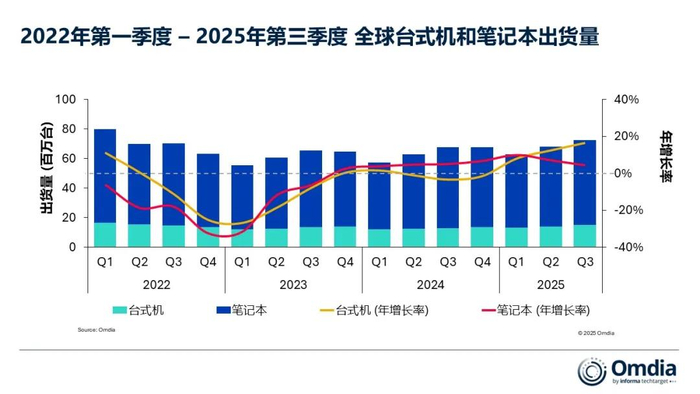
Core Insights - Omdia's latest research indicates a 6.8% year-on-year growth in total shipments of desktops, laptops, and workstations, reaching 72 million units by Q3 2025, driven primarily by device upgrade demands as Windows 10 service termination approaches [1][4] Shipment Data - In Q3 2025, laptop shipments (including mobile workstations) are expected to grow by 4% to 57.2 million units, while desktop shipments (including desktop workstations) are projected to increase by 17% to 15.2 million units [1][4] - Lenovo leads the global PC market with a shipment of 19.4 million units, a 17% increase year-on-year, followed by HP with 15 million units (11% growth), Dell with 10.1 million units (3% growth), Apple with over 6 million units, and Asus with 5.8 million units (7% growth) [5][6] Upgrade Demand - The demand for PC upgrades remains strong among enterprises and consumers, particularly as the deadline for Windows 10 service termination approaches [4][6] - A survey indicated that only 39% of respondents believe their clients have completed PC upgrades, while 18% plan to continue using Windows 10 post-support termination, indicating a significant need for ongoing support and guidance from Microsoft and its partners [4] Future Outlook - Major industry players are expected to unveil new product roadmaps to stimulate PC purchasing demand, with upcoming releases of advanced PC chipsets from Qualcomm and Intel [6] - The 2026 International Consumer Electronics Show (CES) is anticipated to showcase new and attractive PC products, with a focus on "edge AI" technology [6]


机构:受Windows 10停服影响,三季度全球PC市场出货骤增7%
Guan Cha Zhe Wang· 2025-10-21 09:51
Core Insights - Omdia's latest research indicates that the total shipment of desktops, laptops, and workstations is expected to grow by 6.8% year-on-year, reaching 72 million units by Q3 2025, driven by strong device upgrade demand as Windows 10 support ends [1][4] Shipment Growth - Laptop shipments, including mobile workstations, are projected to increase by 4% to 57.2 million units, while desktop shipments, including desktop workstations, are expected to rise by 17% to 15.2 million units [1][4] Market Dynamics - The end of Windows 10 support has led to heightened demand for PC upgrades among both enterprises and consumers, with a significant portion of users still on Windows 10 or using PCs older than five years [4] - A survey indicated that only 39% of enterprise customers have completed their PC upgrades, while 18% plan to continue using Windows 10 post-support, suggesting ongoing opportunities for Microsoft and its partners to promote transitions [4] Vendor Performance - Lenovo leads the global PC market with a shipment of 19.4 million units, a 17% increase year-on-year, followed by HP with 15 million units (11% growth), and Dell with 10.1 million units (3% growth) [5][6] - Apple and Asus follow with shipments of 6.6 million and 5.8 million units, respectively, with Apple maintaining over 6 million units for five consecutive quarters [6] Future Outlook - Major industry players are expected to unveil new product roadmaps to stimulate PC demand, with Qualcomm and Intel launching upgraded chipsets [6] - The upcoming CES 2026 is anticipated to showcase new and attractive PC products, with a focus on "edge AI" technology [6]




报告:受Windows 10停服影响 全球PC市场出货量大涨
Zhong Guo Xin Wen Wang· 2025-10-21 07:41
Group 1 - The core viewpoint of the articles indicates a positive growth trend in the global PC market, with total shipments expected to reach 72 million units in Q3 2025, reflecting a year-on-year increase of 6.8% [1][2] - The demand for PC upgrades is driven by the termination of Windows 10 services on October 14, leading to a strong need for device updates among enterprises and consumers [1] - Omdia's report highlights that a significant portion of Windows users are still on Windows 10 or using PCs older than five years, indicating a potential market for upgrades [1] Group 2 - From a vendor perspective, Lenovo is projected to perform strongly with a 17% year-on-year increase in shipments, reaching 19.4 million units in Q3 2025 [2] - HP ranks second with shipments of 15 million units, reflecting an 11% year-on-year growth [2] - Dell ranks third with a modest growth rate of 3%, while Apple continues to show resilience with over 6 million units shipped for the fifth consecutive quarter [2]
Omdia:2025年第三季度全球PC市场同比增长6.8% 联想继续蝉联榜首
Zhi Tong Cai Jing· 2025-10-21 05:49
Core Insights - Omdia's latest research indicates that total shipments of desktops, laptops, and workstations are expected to grow by 6.8% year-on-year in Q3 2025, reaching 72 million units, driven by strong device upgrade demand as Windows 10 service termination approaches [1][4] Industry Overview - The demand for PC upgrades remains robust as the deadline for Windows 10 service termination is imminent, with a significant portion of users still on Windows 10 or using PCs older than five years [4][6] - A recent survey revealed that only 39% of B2B clients have completed their PC upgrades to Windows 11, indicating a substantial need for ongoing support and guidance from Microsoft and its partners [6] Company Performance - Lenovo reported a strong performance in Q3 2025, with shipments increasing by 17% year-on-year to 19.4 million units, solidifying its leading position in the global PC market [1][7] - HP ranked second with shipments of 15 million units, reflecting an 11% year-on-year growth, while Dell ranked third with a 3% increase in shipments [7][8] - Apple maintained its position in fourth place, with shipments exceeding 6 million units for the fifth consecutive quarter, and Asus rounded out the top five with a 7% year-on-year growth [7][8] Market Share Data - In Q3 2025, Lenovo held a market share of 26.7%, followed by HP at 20.7%, Dell at 14.0%, Apple at 9.0%, and Asus at 8.0% [8]
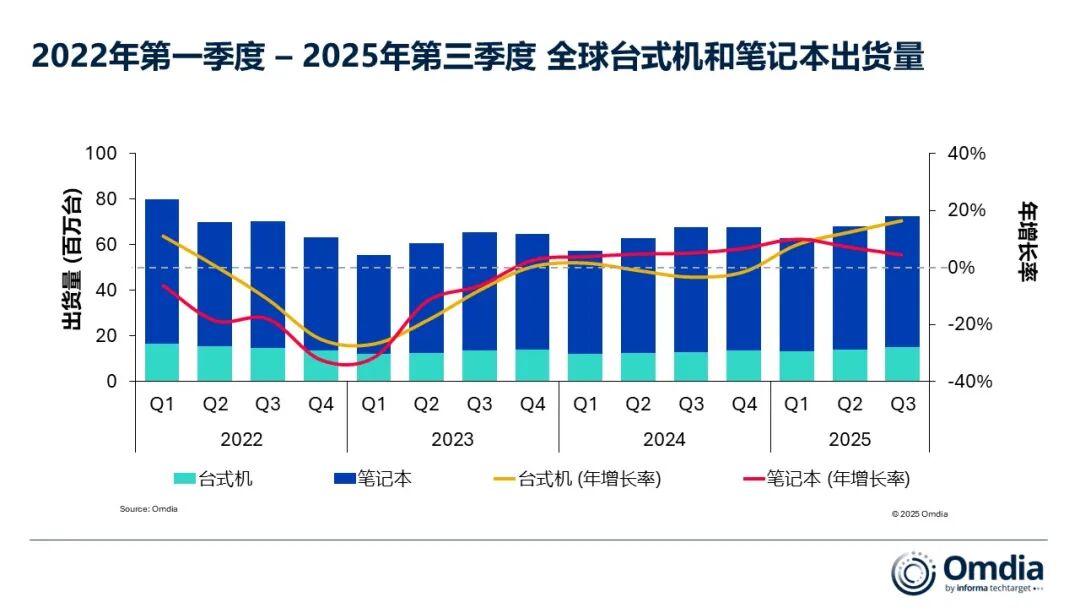
Omdia:2025年第三季度全球PC市场同比增长6.8% 联想(00992)继续蝉联榜首
智通财经网· 2025-10-21 05:48
Core Insights - The total shipment volume of desktops, laptops, and workstations is projected to grow by 6.8% year-on-year in Q3 2025, reaching 72 million units, driven by the demand for device upgrades as Windows 10 service termination approaches [1][3] - Lenovo has shown strong performance in Q3 2025, with a shipment increase of 17% year-on-year, solidifying its leading position in the global PC market [1][6] Industry Overview - The demand for PC upgrades remains high as the deadline for Windows 10 service termination approaches, with many users still on Windows 10 or using PCs older than five years [3][5] - A survey indicates that only 39% of B2B clients have completed their PC upgrades to Windows 11, suggesting significant work remains for Microsoft and its partners [5] Company Performance - Lenovo's Q3 2025 shipments reached 19.4 million units, capturing a market share of 26.7% [7] - HP ranked second with shipments of 15 million units, reflecting an 11% year-on-year growth, while Dell ranked third with a 3% growth [6][7] - Apple maintained its position with over 6 million units shipped for the fifth consecutive quarter, and Asus shipped 5.8 million units, marking a 7% increase [6][7] Future Outlook - Major industry players are expected to unveil new product roadmaps to stimulate PC purchasing demand, with Qualcomm and Intel announcing upgrades to their high-end PC chipsets [5][6] - The 2026 CES is anticipated to showcase new and attractive PC products, with a focus on "device-side AI" [6]
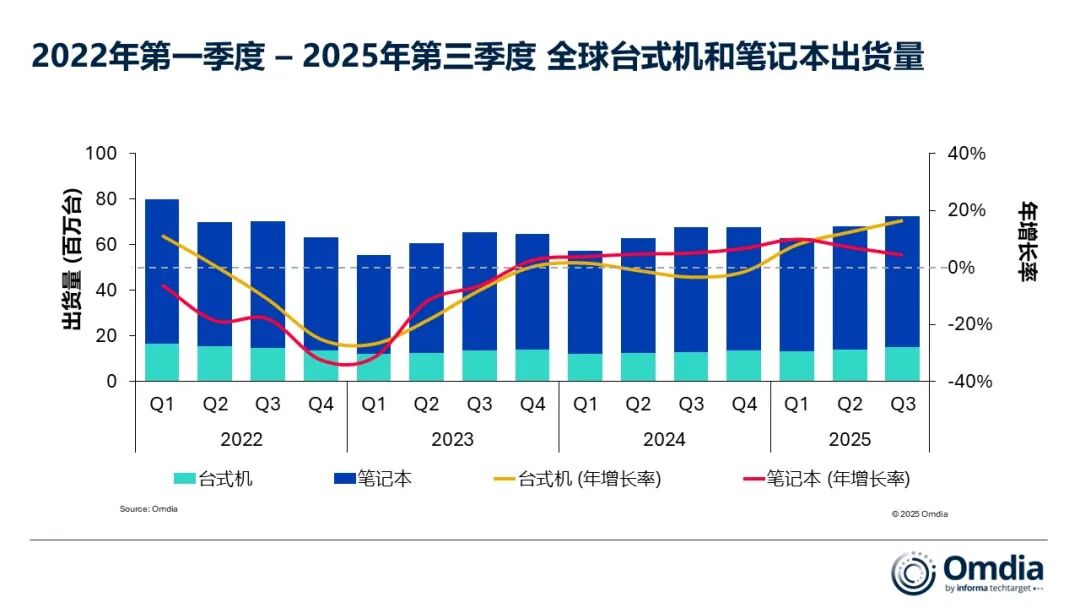
Omdia:随着Windows 10停止服务,2025年第三季度全球PC市场增长7%,联想继续蝉联榜首
Canalys· 2025-10-21 04:02
Core Insights - The total shipment volume of desktops, laptops, and workstations is expected to grow by 6.8% year-on-year in Q3 2025, reaching 72 million units, driven by device upgrade demands as Windows 10 service termination approaches [2][5] Group 1: Market Trends - The demand for PC upgrades remains strong among enterprises and consumers, particularly as the deadline for Windows 10 service termination approaches on October 14 [5] - A significant portion of Windows users are still on Windows 10 or using PCs older than five years, indicating a need for continued promotional efforts from Microsoft and its partners [5][8] Group 2: B2B Transition Challenges - A recent survey indicates that only 39% of B2B clients have completed their transition to Windows 11, with 18% planning to continue using Windows 10 post-support termination [8] - This presents an ongoing opportunity for Microsoft and its OEM partners to provide transition support and guidance [8] Group 3: Product Innovations - Major industry players are unveiling new product roadmaps to stimulate PC purchasing demand, with Qualcomm and Intel launching upgraded chipsets [8] - The 2026 CES is anticipated to showcase new and attractive PC products, with a focus on "device-side AI" [8] Group 4: Company Performance - Lenovo showed strong performance with a 17% year-on-year increase in shipments, reaching 19.4 million units, solidifying its market leadership [8] - HP ranked second with 15 million units shipped, an 11% increase, while Dell ranked third with a 3% growth [8] - Apple and Asus also performed well, with Apple maintaining over 6 million units shipped for five consecutive quarters and Asus achieving a 7% year-on-year growth [8]

基础化工:新材料周报:PEEK小巨人再战IPO,深圳新增一高端电子化学品产业园-20251019
Huafu Securities· 2025-10-19 09:22
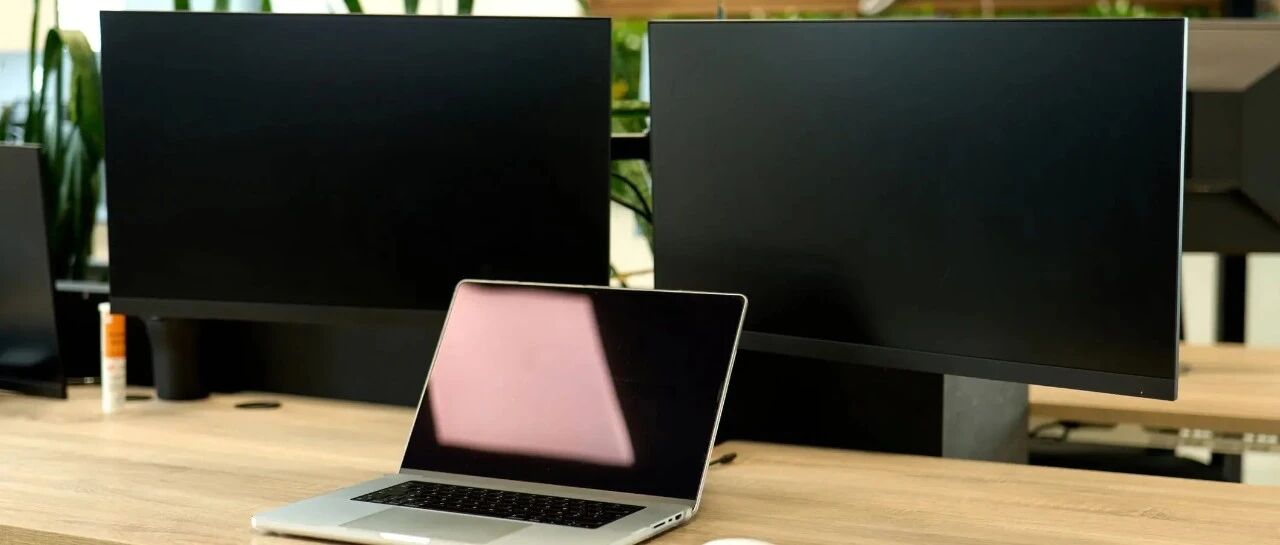
Investment Rating - The industry investment rating is "Outperform the Market" [6] Core Insights - The Wind New Materials Index closed at 4848.42 points, down 5.2% week-on-week. Among six sub-industries, the semiconductor materials index fell 6.79%, while the display device materials index decreased by 4.64% [3][12] - Zhejiang Pengfulong Technology Co., Ltd. has restarted its IPO process, aiming to raise approximately 723 million yuan for various projects, including a future factory for high polymer materials [4][31] - Shenzhen has approved the overall planning of a high-end electronic chemical industry park, focusing on a "5+3+X" industrial system to enhance competitiveness and promote industrial clustering [4][34] Summary by Sections Overall Market Review - The Wind New Materials Index decreased by 5.2% this week, with notable declines in semiconductor materials and other related indices [3][12] - The top gainers included Xiangyuan New Materials (up 8.03%) and Changhong High-Tech (up 5.06%), while the largest losers were Lianrui New Materials (down 15.52%) and Jiuri New Materials (down 15.2%) [26][27] Recent Industry Hotspots - BASF and Xiaomi are expanding their collaboration to develop 100 new automotive paint colors over the next three years [30] - The semiconductor materials sector is experiencing rapid domestic production acceleration, with significant growth in downstream wafer fabrication plants [4][30] - The global PC shipment is projected to grow by 9.4% year-on-year in Q3 2025, reaching 75.8 million units, driven by Windows 11 upgrades and device replacements [34][35] - TSMC's market share in the pure wafer foundry market has surpassed 70%, reflecting strong demand driven by AI expansion [36][39] Key Companies to Watch - Focus on Tongcheng New Materials for its progress in import substitution in the photoresist sector [4] - Attention on Huate Gas for its integrated industrial chain in electronic specialty gases [4] - National Ceramic Materials is expected to maintain high growth across its three main business segments [4]
赋予“灵魂”的教育机器人,AI数字伙伴如何破解个性化学习难题?
机器人大讲堂· 2025-10-19 04:03
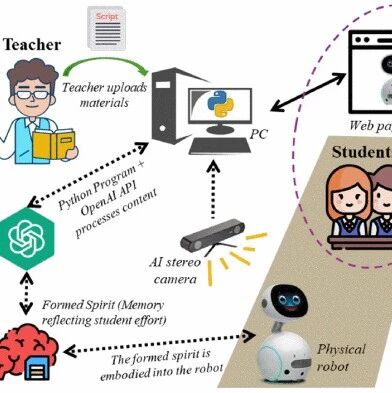
Core Insights - The article discusses the challenges faced by educational robots, including limited availability, restricted interaction time, and lack of personalization, which leads to a significant decline in student interest within 1-2 months [1]. Group 1: Challenges in Educational Robotics - Educational robots enhance classroom engagement but are often expensive and limited in number, leading to students sharing them [1]. - The interaction with these robots is confined to classroom hours, resulting in a lack of continuous learning opportunities [1]. - A study indicates that approximately 60% of students lose interest in educational robots after 1-2 months, highlighting the issue of short-term interest decay [1]. Group 2: Proposed Solutions - A research team from Taiwan has introduced an "AI Personalized Robot Framework" that pairs each robot with an AI digital partner to enhance student learning outcomes and engagement [2]. - The framework is based on digital twin technology and large language models (LLMs) to ensure continuous connection and dynamic responses [3]. Group 3: Framework Architecture - The framework consists of three layers: - Infrastructure layer with modular design connecting physical robots to cloud LLM services for scalability [4]. - Data interaction layer that records and analyzes student learning behaviors and preferences to create personalized digital profiles [4]. - Application performance layer allowing students to interact with digital partners via mobile devices, with physical robots serving as their tangible representation [4]. Group 4: Implementation of Personalized Learning Mechanism - The learning model includes two interconnected phases: - An extracurricular preparation phase where students interact with digital partners, earning virtual currency to customize their partners [5]. - A classroom presentation phase where the digital partner's "soul" is transferred to a shared physical robot, enhancing the learning experience [8]. Group 5: Empirical Research and Results - A quasi-experimental study was conducted with 90 students divided into three groups to evaluate the effectiveness of the AI personalized robot system [9]. - After ten weeks, results showed that the experimental group using the AI personalized robot system had significantly better post-test scores, with an effect size of 0.21, indicating substantial educational value [11]. - The experimental group also demonstrated higher levels of ownership and engagement, with increased participation in extracurricular activities compared to the other groups [12][14]. Group 6: Practical Implications - The research provides a feasible path for the large-scale application of educational robots, allowing schools to implement personalized education within limited budgets [14]. - The modular design of the framework allows for adaptability across various subjects, making it applicable in language learning, STEM education, and vocational training [14].
网传大批英伟达5090显卡现身大陆,微星急撇清
Guan Cha Zhe Wang· 2025-10-17 00:57
Core Viewpoint - A photo circulating on social media shows a large number of MSI GeForce RTX 5090 graphics cards, raising questions about their authenticity and availability in China, especially given the U.S. government's export controls on NVIDIA products [1][5][10]. Group 1: Product Details - The RTX 5090 series is NVIDIA's flagship product, which has been subject to U.S. export controls, leading to the introduction of a China-specific version, the RTX 5090D, with a 29% reduction in AI computing power and a starting price of 16,499 yuan [5][10]. - The RTX 5090D v2 was launched in August to replace the banned RTX 5090D, featuring a further 25% reduction in memory and bandwidth while maintaining the same price [5][11]. - The AI computing power of the RTX 5090D was reduced from 3352 TOPS to 2375 TOPS, a decrease of approximately 29.15% [5][11]. Group 2: Market Dynamics - The RTX 5090 graphics cards are in high demand, with new units selling for over 22,000 yuan and used units priced between 20,000 and 21,000 yuan, significantly higher than the 16,499 yuan price of the RTX 5090D v2 [10][11]. - The scarcity of the RTX 5090 has led to speculation about potential lifting of restrictions in China, as well as increased prices due to its perceived value among consumers [10][11]. Group 3: Company Response - MSI has publicly distanced itself from the RTX 5090 graphics cards found in the viral photo, stating that they have never officially sold or distributed these products in mainland China [10][11]. - The company emphasized that any RTX 5090 products in China are not from authorized channels and do not come with MSI's quality control or warranty services [11]. - MSI's response is seen as a way to comply with NVIDIA's sales policies and mitigate potential risks associated with unauthorized sales [11]. Group 4: Financial Performance - MSI reported a revenue of 18.834 billion New Taiwan Dollars (approximately 4.375 billion yuan) in August 2025, a year-on-year increase of 14.68% but a quarter-on-quarter decrease of 2.65% [14]. - For the first eight months of the year, MSI's cumulative revenue reached 153.037 billion New Taiwan Dollars (approximately 35.55 billion yuan), reflecting a year-on-year growth of 20.91% [14]. - Compared to competitors like ASUS and Gigabyte, MSI's growth remains lower, with ASUS achieving a revenue of 62.815 billion New Taiwan Dollars (approximately 14.611 billion yuan) in August, a year-on-year increase of 9.93% [14].

黄仁勋:家用 240W,这才是交给马斯克的“第一台 AI”
3 6 Ke· 2025-10-17 00:24
Core Insights - The delivery of the DGX Spark device by NVIDIA's CEO Jensen Huang to Elon Musk symbolizes a significant shift in AI technology, making powerful AI capabilities accessible to individuals rather than being confined to large data centers [3][10][45] - The collaboration between BlackRock, Microsoft, and NVIDIA to acquire Aligned for $40 billion highlights the growing investment in AI infrastructure and the importance of computational power as a core resource in the industry [3][4] Group 1: DGX Spark Device - The DGX Spark is a compact supercomputer weighing 1.2 kg and consuming only 240 watts, capable of running large AI models locally without needing cloud connectivity [11][24] - This device allows users to train, fine-tune, and deploy AI applications directly from their desktops, marking a shift from centralized cloud-based AI to personal, localized AI capabilities [6][12][33] - The integration of NVIDIA's latest technology into the DGX Spark makes it a comprehensive AI toolbox, enabling various complex tasks such as image generation and voice recognition [13][14] Group 2: AI Accessibility and Empowerment - Huang emphasizes that AI should not be a privilege of a few companies but should be as accessible as personal devices like smartphones and laptops [12][33] - The DGX Spark represents a democratization of AI, allowing individuals and smaller companies to harness AI capabilities without relying on external services [38][41] - The shift from being mere users of AI to becoming "igniters" of AI capabilities is a transformative change in how individuals interact with technology [21][22] Group 3: Cost and Efficiency - The transition from large data centers requiring up to 1 gigawatt of power to a 240-watt desktop device significantly reduces the cost and complexity of deploying AI [24][25] - Key factors contributing to this efficiency include the integration of all necessary components into one device, high operational efficiency, and the accessibility of the technology for a broader audience [26][28][30] - The reduction in AI deployment costs from millions to thousands of dollars makes it feasible for individuals and small businesses to utilize AI technology [40][41] Group 4: AI Sovereignty - Huang argues that both companies and individuals need to maintain control over their AI capabilities and data, rather than relying solely on external services [37][39] - The DGX Spark enables users to train and deploy their own AI models, ensuring that proprietary data remains secure and under their control [38][41] - This shift in AI sovereignty empowers individuals to create personalized AI solutions tailored to their specific needs [41][42] Group 5: Ecosystem Transformation - The introduction of the DGX Spark is expected to reshape the AI application ecosystem, moving from cloud-based services to localized, user-controlled applications [42][44] - Users can now customize and modify AI applications without needing to connect to remote servers, fundamentally changing the user experience [43][44] - The competition in the AI space will increasingly focus on who can provide the best local experience rather than just the most powerful models [44]