华东医药

Search documents
未知机构:国泰海通医药春节期间创新药领域重点新闻梳理上市公司恒瑞医药-20260224
未知机构· 2026-02-24 02:50
【国泰海通医药】春节期间创新药领域重点新闻梳理-上市公司 恒瑞医药: 1)2/12 CDE官网显示公司递交了ANGPTL3单抗SHR-1918针对HOFH的上市申请。 目前公司暂未披露1918的III期临床结果; 1)2/20 公司公告阿美替尼已获欧洲药品管理局EMA批准在欧盟上市,用于EGFR19del或L858RNSCLC一线治疗, 以及T790MNSCLC治疗; 石药集团: 1)2/16 公司公告旗下受体偏向性GLP1/GIP激动剂月制剂SYH2082在美国获批临床; 信立泰: 翰森制药: 1)2/20 公司公告阿美替尼已获欧洲药品管理局EMA批准在欧盟上市,用于EGFR19del或L858RNSCLC一线治疗, 以及T790MNSCLC治 【国泰海通医药】春节期间创新药领域重点新闻梳理-上市公司 恒瑞医药: 1)2/12 CDE官网显示公司递交了ANGPTL3单抗SHR-1918针对HOFH的上市申请。 目前公司暂未披露1918的III期临床结果; 翰森制药: 1)2/20 公司在《欧洲呼吸杂志子刊-开放研究》ERJ OPEN RESEARCH上披露了IL17RB单抗SM17针对CRSWNP和 IPF ...

手术机器人板块迎来密集催化,医疗创新ETF(516820)多空胶着
Sou Hu Cai Jing· 2026-02-24 02:41
Core Viewpoint - The medical device sector is experiencing a turning point, driven by performance recovery and innovation in overseas markets, with a focus on surgical robots, brain-computer interfaces, AI medical technology, and high-potential innovative devices like PFA, RDN, and TAVR [1] Group 1: Market Performance - As of February 24, 2026, the CSI Medical and Medical Device Innovation Index (931484) rose by 0.25%, with notable increases in component stocks such as Aier Eye Hospital (up 2.23%), Yingke Medical (up 1.96%), and Xingqi Eye Medicine (up 1.45%) [1] - The Medical Innovation ETF (516820) is currently in a state of market tension, with the latest quote at 0.36 yuan [1] Group 2: Industry Developments - Recent developments in the surgical robot sector, including successful bids from MicroPort Robotics and Aikang Medical, have significantly raised market expectations for the commercialization of related equipment [1] - Continued funding interest in cutting-edge areas such as AI medical technology and brain-computer interfaces is noted, alongside a U.S. court ruling that deemed tariff policies illegal, further strengthening the logic for medical device exports [1] Group 3: Index Composition - As of January 30, 2026, the top ten weighted stocks in the CSI Medical and Medical Device Innovation Index include WuXi AppTec, Mindray Medical, and Hengrui Medicine, collectively accounting for 63.9% of the index [2]

减肥药市场持续火热:两大巨头口服大战在即
Feng Huang Wang· 2026-02-17 00:51
Core Insights - The global weight loss drug market has undergone significant changes in the past five years, with Novo Nordisk's semaglutide gaining approval for weight loss in the U.S. in 2021, marking the entry of GLP-1 weight loss drugs into the pharmaceutical industry [1] - By 2025, Eli Lilly's tirzepatide is projected to achieve $36.5 billion in sales, highlighting the commercial potential of the weight loss sector [1] - The competition has shifted from injectable forms to oral formulations, with Novo Nordisk's oral semaglutide receiving approval in December 2025, becoming the first oral GLP-1 obesity treatment [1][2] Group 1: Market Dynamics - The approval of oral medications signifies a breakthrough beyond the physical limitations of injection pens, enhancing Novo Nordisk's product line defensively [2] - A surge in prescription volume for oral semaglutide has been observed, with approximately 50,000 prescriptions per week by January 23, 2026 [1] - Eli Lilly is also advancing in the oral GLP-1 space with its orforglipron, which has shown positive results in clinical trials and is expected to launch in mid-2026 [2] Group 2: Competitive Landscape - Novo Nordisk's oral semaglutide is a peptide drug, while Eli Lilly's tirzepatide is a small molecule oral drug, showcasing differentiation in their approaches [3] - Small molecule products are expected to have simpler development processes and better cost control, potentially impacting market competition if safety and efficacy are validated [3] - Other pharmaceutical giants, including AstraZeneca and various domestic companies, are also developing oral GLP-1 drugs, indicating a broadening competitive landscape [3][4] Group 3: Clinical Developments - AstraZeneca's oral GLP-1 receptor agonist, elecoglipron, has achieved positive results in key Phase 2 trials and is moving towards Phase 3 development [3] - Domestic companies like HengRui Medicine and others are advancing their oral GLP-1 drug pipelines, with promising clinical trial results [4] - The oral weight loss drug market is expected to grow, but injectable forms will still play a role in the short term, with rising expectations for their effectiveness and safety [4][5] Group 4: Future Outlook - The core patent for semaglutide will expire in 2026 in several markets, paving the way for a wave of generic versions, which may lead to more affordable options for consumers [5] - The penetration of GLP-1 weight loss drugs is anticipated to expand beyond first-tier cities, reaching broader markets [5]


2025年医美平台消费榜单解码:玻尿酸守擂,超声炮“失速”
Mei Ri Jing Ji Xin Wen· 2026-02-14 12:49
Core Insights - The Chinese medical beauty market is experiencing a significant shift in 2025, marked by a 93.40% growth in the regenerative filling materials sector, but with notable disparities among brands [1][2] - The "Matthew Effect" is becoming evident, where leading brands are gaining market share at the expense of smaller competitors, particularly in the context of regulatory barriers and technological advancements [1][10] Regenerative Filling Materials - Regenerative filling materials have emerged as the "MVP" of the year, with a 93.40% increase in sales in 2025, continuing a trend of rapid growth over the past three years [2] - The brand "Zhenai Su Fei" under Aimeike leads with a remarkable 463% growth, while "Yiyan Shi" from Huadong Pharmaceutical, once a market leader, has seen a 56% decline [2][3] - Despite the growth of "Zhenai Su Fei," its contribution to Aimeike's overall performance remains uncertain, as the company reported over a 20% decline in revenue and net profit in the first three quarters of 2025 [2] Market Dynamics - The decline of "Yiyan Shi" is attributed to its earlier market entry leading to reduced novelty among consumers, and some users seeking alternative products after initial experiences [3] - The market for ultrasonic devices, once a star in anti-aging treatments, has seen a 55.2% drop in sales, indicating a shift in consumer preferences and budget constraints [4][8] - In contrast, the "Meila Meisheng" ultrasonic knife has gained popularity, with a 147.22% increase in sales, appealing to users aged 35 and above [4][5] Competitive Landscape - The competitive landscape is tightening, with head brands further squeezing the market space for smaller brands, as consumers tend to prefer established, reliable products [4] - The decline in ultrasonic device sales is not solely due to the emergence of new technologies but also reflects market misuse and consumer fatigue [7][10] Hyaluronic Acid Market - Hyaluronic acid remains a top-selling product, with a 19.70% increase in sales in 2025, despite facing challenges such as oversupply and intense price competition [8][9] - The product's versatility and ability to cater to a wide range of consumer needs contribute to its sustained popularity, positioning it as a mainstay in the anti-aging market [9] Future Growth Areas - The market is transitioning towards specialized segments, with a focus on individual needs and the emergence of new growth areas such as recombinant collagen products, hair loss treatments, and weight management [10][11] - The recombinant collagen market is projected to grow at a compound annual growth rate of 41.4% from 2023 to 2027, indicating strong potential for expansion [10]

免费领取!《2025中国合成生物制造产业发展白皮书》
synbio新材料· 2026-02-13 23:01
Core Viewpoint - The article emphasizes the rising importance of biomanufacturing as a strategic and innovative field that disrupts traditional production methods, presenting it as a new growth point for optimizing industrial structure and transforming economic models [1]. Group 1: Current Status and Trends - The "2025 China Synthetic Biomanufacturing Industry Development White Paper" was officially released on August 1, highlighting the current state and trends of biomanufacturing [1]. - The report analyzes the global biomanufacturing industry, including key platform facilities and a comparative study of the US and China in this sector [7]. Group 2: Policy Landscape - The white paper outlines major domestic and international policies affecting biomanufacturing from 2024 to 2025, providing insights into regulatory frameworks [7]. Group 3: Industry Map and Applications - It presents a comprehensive map of the Chinese biomanufacturing industry and identifies key application areas, including pharmaceuticals, food, personal care, agriculture, chemicals, materials, and energy [7]. Group 4: Key Enterprises - The report selects ten leading enterprises in the Chinese biomanufacturing sector and details the strategic directions of 15 listed companies in synthetic biology [7][8]. Group 5: Investment and Challenges - The document discusses the investment landscape in synthetic biology from 2024 to mid-2025 and addresses the challenges faced by the biomanufacturing industry in China, along with proposed countermeasures [7].





脑机接口迎来新突破,医疗创新ETF(516820)交投活跃
Xin Lang Cai Jing· 2026-02-13 05:40
Group 1 - The core viewpoint of the news highlights the mixed performance of the constituents of the CSI Pharmaceutical and Medical Device Innovation Index, with Pizhou Pharmaceutical leading the gains at 1.08% and Xinhengcheng leading the losses [1] - The Medical Innovation ETF (516820) is currently priced at 0.36 yuan, with a turnover rate of 0.63% and a transaction volume of 11.7 million yuan during the trading session [1] - Over the past month, the average daily transaction volume of the Medical Innovation ETF reached 62.8 million yuan [1] Group 2 - Brain Tiger Technology has successfully implanted a fully wireless brain-computer interface in its first clinical patient, who can now perform daily activities such as shopping and sending red envelopes through thought control [1] - According to Jiao Yin International Securities, the pharmaceutical industry is expected to continue shifting towards innovative drugs and high clinical value products due to ongoing medical insurance cost control and centralized procurement [1] - The market sentiment has improved, and significant business development transactions are driving strong performance in the pharmaceutical sector, with a stable outlook expected to continue into 2026 despite potential short-term volatility [1] Group 3 - The CSI Pharmaceutical and Medical Device Innovation Index consists of 30 publicly listed companies with good profitability, growth potential, and research innovation capabilities, reflecting the overall performance of profitable and growth-oriented pharmaceutical and medical device companies [2] - As of January 30, 2026, the top ten weighted stocks in the index include WuXi AppTec, Mindray Medical, and Hengrui Medicine, accounting for a total of 63.9% of the index [2]
礼来新药在华获批,医疗创新ETF(516820)备受关注
Xin Lang Cai Jing· 2026-02-13 02:33
Group 1 - The core viewpoint of the news highlights the performance of the China Securities Pharmaceutical and Medical Device Innovation Index, with Zhejiang Medicine leading the gains at 1.43% and Xinhecheng experiencing the largest decline [1] - The Medical Innovation ETF (516820) has a latest price of 0.36 yuan, with a turnover rate of 0.28% and a transaction volume of 5.138 million yuan during the trading session [1] - Over the past month, the average daily transaction volume of the Medical Innovation ETF reached 62.8359 million yuan, indicating strong market interest [1] Group 2 - Recently, Eli Lilly's drug, Migalastat, received approval from the National Medical Products Administration of China for two formulations to treat moderate to severe active Crohn's disease and ulcerative colitis, marking a significant advancement in targeted therapies for autoimmune diseases in the digestive system [1] - According to CMB International, the pharmaceutical industry is experiencing structural differentiation due to medical insurance cost control and normalized centralized procurement, with resources increasingly concentrating on innovative pharmaceutical and medical device companies with technological barriers [1] - Since Q4 2025, both domestic and foreign institutions have been increasing their positions in the innovative pharmaceutical and medical device supply chain, reflecting a clearer market logic for allocating innovative assets with clinical value and overseas potential [1] Group 3 - The China Securities Pharmaceutical and Medical Device Innovation Index (931484) selects 30 publicly listed companies with good profitability, growth potential, and research innovation capabilities to reflect the overall performance of the pharmaceutical and medical device sector [2] - As of January 30, 2026, the top ten weighted stocks in the index include WuXi AppTec, Mindray Medical, Heng Rui Medicine, Aier Eye Hospital, and others, accounting for a total of 63.9% of the index [2]
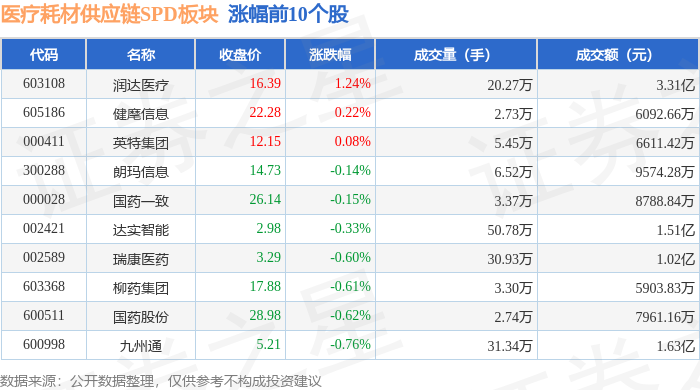
医疗耗材供应链SPD板块2月12日跌0.7%,浙江震元领跌,主力资金净流出8556.57万元
Sou Hu Cai Jing· 2026-02-12 09:28
Core Insights - The medical consumables supply chain SPD sector experienced a decline of 0.7% compared to the previous trading day, with Zhejiang Zhenyuan leading the drop [1] - The Shanghai Composite Index closed at 4134.02, up 0.05%, while the Shenzhen Component Index closed at 14283.0, up 0.86% [1] Sector Performance - The following companies in the medical consumables supply chain SPD sector showed varied performance: - RunDa Medical (603108) closed at 16.39, up 1.24% with a trading volume of 202,700 shares and a transaction value of 331 million yuan - JianMo Information (605186) closed at 22.28, up 0.22% with a trading volume of 27,300 shares and a transaction value of 60.93 million yuan - YingTe Group (000411) closed at 12.15, up 0.08% with a trading volume of 54,500 shares and a transaction value of 66.11 million yuan - Other companies like Langma Information (300288) and Guoyao Yizhi (000028) saw slight declines of 0.14% and 0.15% respectively [1] Capital Flow - On the same day, the medical consumables supply chain SPD sector saw a net outflow of 85.57 million yuan from institutional investors, while retail investors contributed a net inflow of 79.17 million yuan [2] - The capital flow for specific companies included: - RunDa Medical had a net inflow of 35.06 million yuan from institutional investors, while retail investors had a net outflow of 27.57 million yuan [3] - Zhejiang Zhenyuan experienced a net outflow of 0.82 million yuan from institutional investors, but a net inflow of 4.14 million yuan from retail investors [3]


国联民生证券:小核酸重构减肥逻辑 INHBE与ALK7靶点初步验证
智通财经网· 2026-02-12 06:43
Core Viewpoint - The report from Guolian Minsheng Securities highlights the synergistic effects of small nucleic acid drugs and GLP-1 class drugs in the weight loss sector, suggesting they could become a "golden duo" for weight management [1][4]. Group 1: Drug Efficacy and Development - Arrowhead has reported promising initial weight loss results from two small nucleic acid drugs targeting INHBE and ALK7, with ARO-INHBE showing an average fat reduction of 9.9% and liver fat reduction of up to 38.6%, alongside a 3.6% increase in lean tissue [1]. - ARO-ALK7 demonstrated a dose-dependent average reduction of ALK7 mRNA by 88%, confirming the TRiM platform's ability to inhibit fat cell gene expression [1]. - Wave Life's WVE-007 targeting liver INHBE showed a 9.4% reduction in visceral fat and a 4.5% overall fat reduction after three months, with a 3.2% increase in lean body mass [3]. Group 2: Market Trends and Collaborations - Major pharmaceutical companies are increasingly investing in small nucleic acid drugs, with Eli Lilly committing $1.2 billion in collaboration with Saint Inbiotech for RNAi candidate drug development for metabolic diseases [3]. - Eli Lilly also invested $1 billion in HAYA's lncRNA platform for obesity and related metabolic disease treatments, while Novo Nordisk partnered with Replicate Bioscience for a $550 million project targeting obesity and type 2 diabetes [3]. - The speed of Chinese pharmaceutical companies in developing small nucleic acid drugs for weight loss is nearly on par with international counterparts, with several companies like Hengrui Medicine and Innovent Biologics actively pursuing this area [5]. Group 3: Investment Recommendations - The report suggests focusing on companies involved in small nucleic acid weight loss targets, including Hengrui Medicine, Chengdu Xian Dao, China National Pharmaceutical Group, East China Pharmaceutical, and others [6].



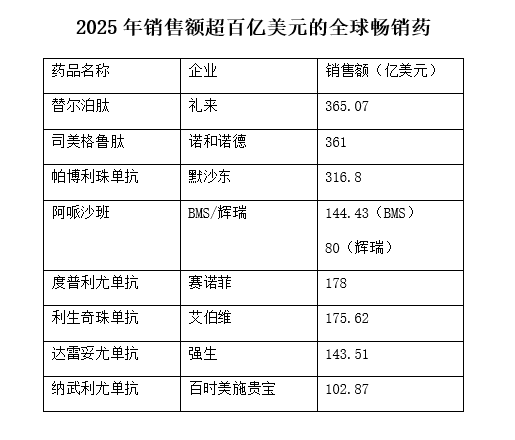
“药王”更迭 替尔泊肽年销售额超365亿美元登顶
Xin Jing Bao· 2026-02-12 04:54
Core Insights - The global pharmaceutical industry is witnessing a significant shift in the rankings of best-selling drugs, with several products surpassing $10 billion in sales for 2025 [1][2]. Group 1: Sales Performance - Novo Nordisk's semaglutide briefly topped the sales chart in Q1 2025 but was ultimately surpassed by Eli Lilly's tirzepatide, with both drugs exceeding $30 billion in sales [1][3]. - Tirzepatide achieved a remarkable year-on-year sales growth of 121%, while semaglutide's growth was only 13% [3]. - The sales figures for semaglutide in the first half of 2025 reached $16.683 billion, maintaining its position as a top-selling drug [3]. Group 2: Competitive Landscape - The GLP-1 drug class is experiencing intense competition, with both tirzepatide and semaglutide being key players [4][5]. - The market is dominated by Novo Nordisk and Eli Lilly, but Chinese pharmaceutical companies are also making significant strides in this area [5][6]. - New GLP-1 drugs are under development, including Novo Nordisk's CagriSema and Eli Lilly's retatrutide, which shows potential for greater weight loss than tirzepatide [5]. Group 3: Oncology and Autoimmune Drugs - The PD-1 inhibitor pembrolizumab (Keytruda) remains a top seller in oncology, with sales reaching $31.68 billion in 2025, despite falling to third place [7]. - Nivolumab (Opdivo) also crossed the $10 billion mark, achieving sales of $10.29 billion [8]. - In the autoimmune disease sector, drugs like dupilumab and risankizumab achieved sales of $17.8 billion and $17.562 billion, respectively [8]. Group 4: Anticoagulants - The anticoagulant apixaban continues to show strong sales growth, with BMS reporting $14.443 billion in sales, a year-on-year increase of 8% [9]. - Pfizer's reported revenue from apixaban reached $8 billion, making it their second-largest selling product [9].