
Commonwealth Fusion Systems

Search documents
Inside the race for fusion energy: Commonwealth Fusion CEO on powering the future of AI
CNBC Television· 2025-10-01 22:23
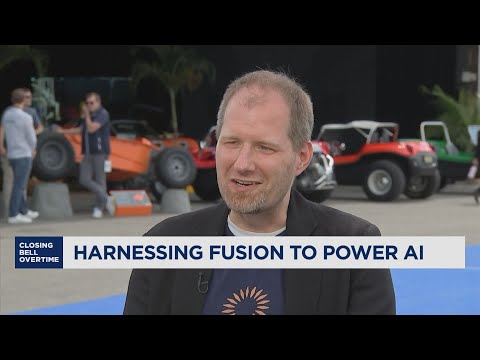
Fusion Energy Overview - Fusion energy is the power source of the stars and could power next-generation technologies [2][3] - The industry has seen significant investment, with over $10 billion of private capital invested in over 50 fusion companies [6] - Prototype plants are being built, including Commonwealth Fusion Systems' (CFS) plant in Massachusetts [6] Commonwealth Fusion Systems (CFS) - CFS is one of the largest and most capitalized fusion organizations globally, second only to the Chinese government program [7] - CFS is building a prototype plant with "steel in the ground" and has plans for a commercial plant [7] - CFS announced plans in December to build the first commercial fusion power plant in Virginia [9] Virginia Power Plant - The Virginia power plant will be 400 megawatts, the size of a large coal or natural gas plant [10] - The power from the Virginia plant has already been bought by Google to power data centers [10] - The Virginia plant is expected to be online in the early 2030s [12] Technology and Safety - A scientific breakthrough four years ago allowed for a significant reduction in the size of fusion power plants, approximately 50 times smaller [16][17] - Fusion power plants are designed to automatically shut off if there is any problem, ensuring safety [24] - Fusion power plants do not produce long-lived nuclear waste and are decoupled from traditional nuclear power concerns [25] Commercialization - CFS is moving from deep science into commercialization, with the Virginia plant shaping up [27] - The company is starting to see what the first commercial product will look like and how it will be delivered [27] - CFS's prototype plant in Massachusetts is about 70% complete and is expected to be turned on in 2026, with power generation starting in 2027 [18][19]

X @Bloomberg
Bloomberg· 2025-09-03 08:07
Company Strategy - Commonwealth Fusion Systems 计划在 2030 年代末或 2040 年代初在日本部署一个反应堆 [1] Leadership - CEO Bob Mumgaard 在一次采访中透露了该计划 [1]
X @TechCrunch
TechCrunch· 2025-08-28 20:31
Commonwealth Fusion Systems has raised nearly $3 billion to commercialize its fusion power plant. It hopes to send electricity to the grid in the early 2030s. https://t.co/q55xovYdKE ...
Commonwealth Fusion Systems Raises $863 Million Series B2 Round to Accelerate the Commercialization of Fusion Energy
Prnewswire· 2025-08-28 10:00
Core Insights - Commonwealth Fusion Systems (CFS) has raised $863 million in a Series B2 fundraising round, moving closer to commercializing fusion power [1][2] - This fundraising round is the largest among deep tech and energy companies since CFS' $1.8 billion Series B round in 2021, bringing total capital raised by CFS to nearly $3 billion, which is about one-third of the total capital invested in private fusion companies globally [2][8] - CFS aims to complete its fusion demonstration machine, SPARC, and advance the development of its first ARC power plant in Virginia with the new funds [2][8] Investment and Investor Landscape - The oversubscribed funding round attracted a diverse range of international investors, including venture capitalists, private equity firms, sovereign wealth funds, and industrial companies [3][8] - New investors include notable names such as Brevan Howard Macro Venture Fund, Counterpoint Global (Morgan Stanley), and NVIDIA's venture capital arm, NVentures [4][6] - A consortium of 12 Japanese companies, led by Mitsui & Co. and Mitsubishi Corporation, also participated in the funding round [5] Strategic Partnerships and Future Plans - CFS is advancing plans to build the world's first grid-scale fusion power plant, ARC, in Chesterfield County, Virginia, with the goal of putting power on the grid in the early 2030s [7][8] - The company has established strategic partnerships with Dominion Energy and Google, which has agreed to purchase half the power produced at the plant [9] Industry Impact and Vision - CFS is positioned as a leader in the fusion industry, with its advancements in high-temperature superconducting magnets and rapid execution in constructing SPARC [7][8] - The company is seen as offering a clear path to commercial fusion, which could provide a reliable source of clean energy and improve global energy access [7][10] - Investors express confidence in CFS's potential to reshape the global energy landscape and contribute to energy independence and security [10][11]
比尔盖茨、马云等超级富豪,原来他们都在投资核聚变商业化公司
Sou Hu Cai Jing· 2025-08-01 04:56
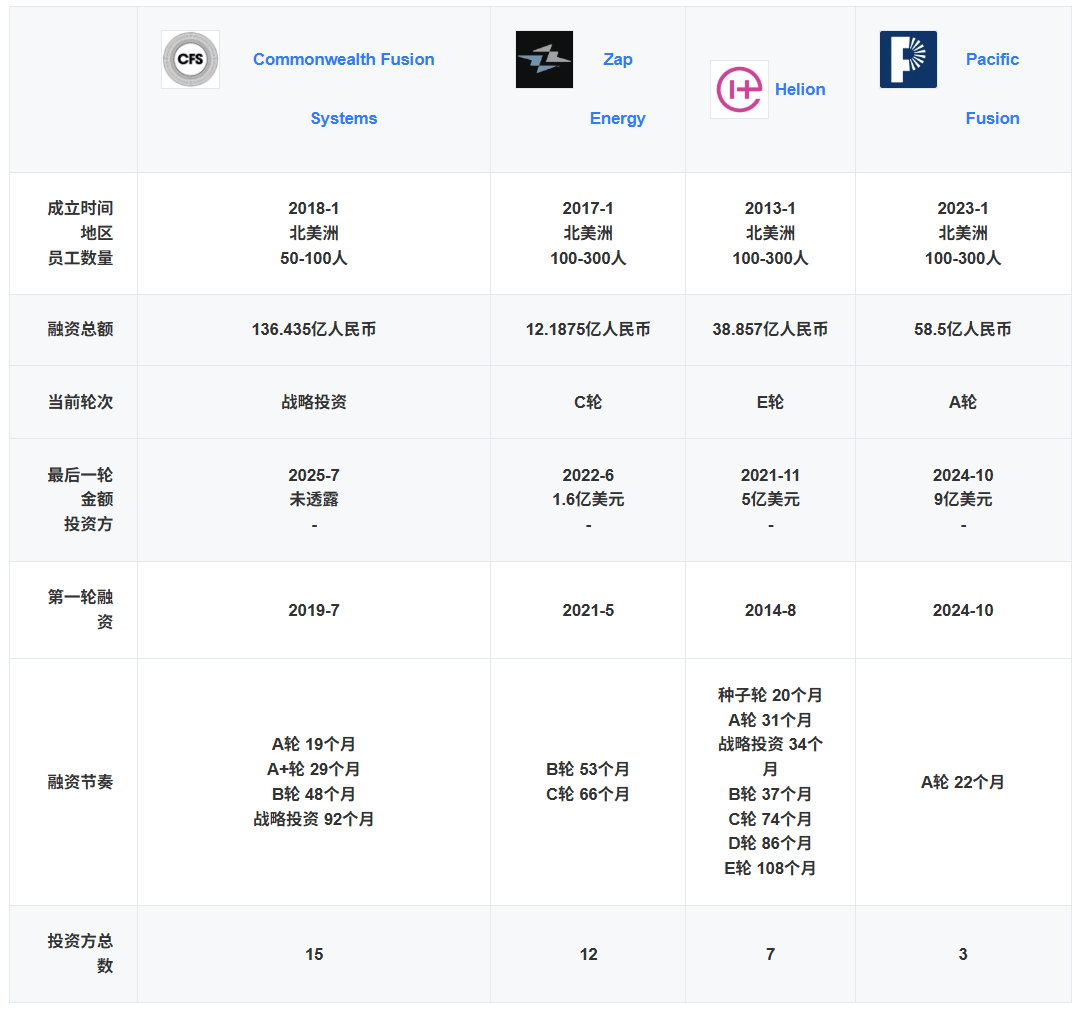
Core Insights - The article highlights the growing investment in nuclear fusion companies in China and the United States, with a total of over 100 billion RMB in funding for 12 domestic companies and approximately 26.9 billion RMB for 9 U.S. companies [1][2]. Domestic Investment Landscape - In China, nuclear fusion commercialization is in its early stages, with significant investments from state-owned enterprises, national funds, and local government capital [1]. - The total funding for domestic nuclear fusion companies has surpassed 100 billion RMB, indicating strong governmental and institutional support [1]. U.S. Nuclear Fusion Companies - The U.S. nuclear fusion sector is marked by 23 publicly disclosed investment events, with a total estimated funding of 26.9 billion RMB [1]. - Key players in the U.S. include Commonwealth Fusion Systems, Pacific Fusion, Helion, and Zap Energy, each securing over 1 billion RMB in funding [1][2]. Commonwealth Fusion Systems (CFS) - CFS, founded in 2018, focuses on commercializing nuclear fusion by leveraging decades of research from MIT [4]. - The company has raised over 2 billion USD, making it the most funded startup in the nuclear fusion sector, with notable investors including Tiger Global, Bill Gates, and Google [6]. Pacific Fusion - Established in 2023, Pacific Fusion has quickly attracted attention, securing 900 million USD in funding led by General Catalyst [9]. - The company focuses on pulse magnetic-driven inertial confinement fusion, utilizing advanced techniques to achieve fusion conditions [8]. Helion - Founded in 2013, Helion has raised approximately 570 million USD, with significant milestones including achieving plasma heating to 100 million degrees Celsius [10][11]. - The company is working on the Polaris project, which aims to demonstrate net electricity production from fusion [11]. Zap Energy - Zap Energy, established in 2017, has made significant progress in funding, completing a 160 million USD Series C round in 2022 [13]. - The company collaborates with Lawrence Livermore National Laboratory to advance its fusion technology [12]. Investment Trends - The article identifies active investors in the nuclear fusion space, including Lowercarbon Capital and Breakthrough Energy Ventures, both focused on climate change solutions [17][18]. - Lowercarbon Capital has made five investments in nuclear fusion companies, while Breakthrough Energy Ventures, founded by Bill Gates, has invested in multiple U.S. firms [17][18]. Global Investment Landscape - Other notable investors include Khosla Ventures, Starlight Ventures, Capricorn Investment Group, and Mithril Capital Management, all of which have shown interest in the nuclear fusion sector [19][21][22]. - Tencent has also participated in funding a European fusion technology company, First Light Fusion, indicating a broader interest in fusion technology beyond domestic investments [22].
东大要刺刀见红了!短短20天,中美相继押上国运对拼
Xin Lang Cai Jing· 2025-07-30 14:25
Core Viewpoint - The establishment of China Fusion Energy Company in Shanghai marks a significant step towards the commercialization of nuclear fusion technology in China, which is expected to have profound implications for future energy needs and human civilization [1][2]. Group 1: Company Establishment and Implications - China Fusion Energy Company has officially been established, indicating that China's nuclear fusion project has reached a commercial phase [1]. - The formation of this company suggests that the Chinese government has conducted thorough strategic assessments and believes the technology is ready for market implementation [2]. - The establishment of this company is seen as a platform for commercial operations in the nuclear fusion sector, which is expected to drive significant advancements in energy production [2]. Group 2: Energy Landscape and Challenges - Current energy sources, including fossil fuels and nuclear fission, are limited and pose environmental challenges, with fossil fuels expected to last only about 200 years at current consumption rates [4]. - Nuclear fission relies on uranium, which is scarce in China, leading to a heavy dependence on imports for 80% of its uranium needs [4]. - The limitations of existing energy sources hinder technological advancements and space exploration due to low energy density and high costs associated with traditional fuels [5]. Group 3: Advantages of Nuclear Fusion - Nuclear fusion primarily uses deuterium, which is abundant in seawater, making it a virtually limitless energy source [6]. - The energy output from nuclear fusion is significantly higher than that of nuclear fission, with one gram of nuclear fuel releasing up to 90 million kilowatt-hours of energy, compared to 2 million kilowatt-hours from fission [6]. - Fusion does not produce greenhouse gases or long-lived radioactive waste, making it a cleaner and safer energy option [6]. Group 4: Strategic Competition - The establishment of China Fusion Energy Company comes amid intense competition with the United States, which is also making strides in nuclear fusion technology [8][14]. - Recent agreements, such as the one between Commonwealth Fusion Systems and Google for a significant power supply from a commercial fusion plant, highlight the urgency and stakes involved in this technological race [8][14]. - Both China and the U.S. are racing against time to achieve commercial fusion energy by 2030, which could redefine energy production and human civilization [14].

点汞成金,一年5吨!聚变公司称破解千年炼金谜题
Jin Shi Shu Ju· 2025-07-23 06:59
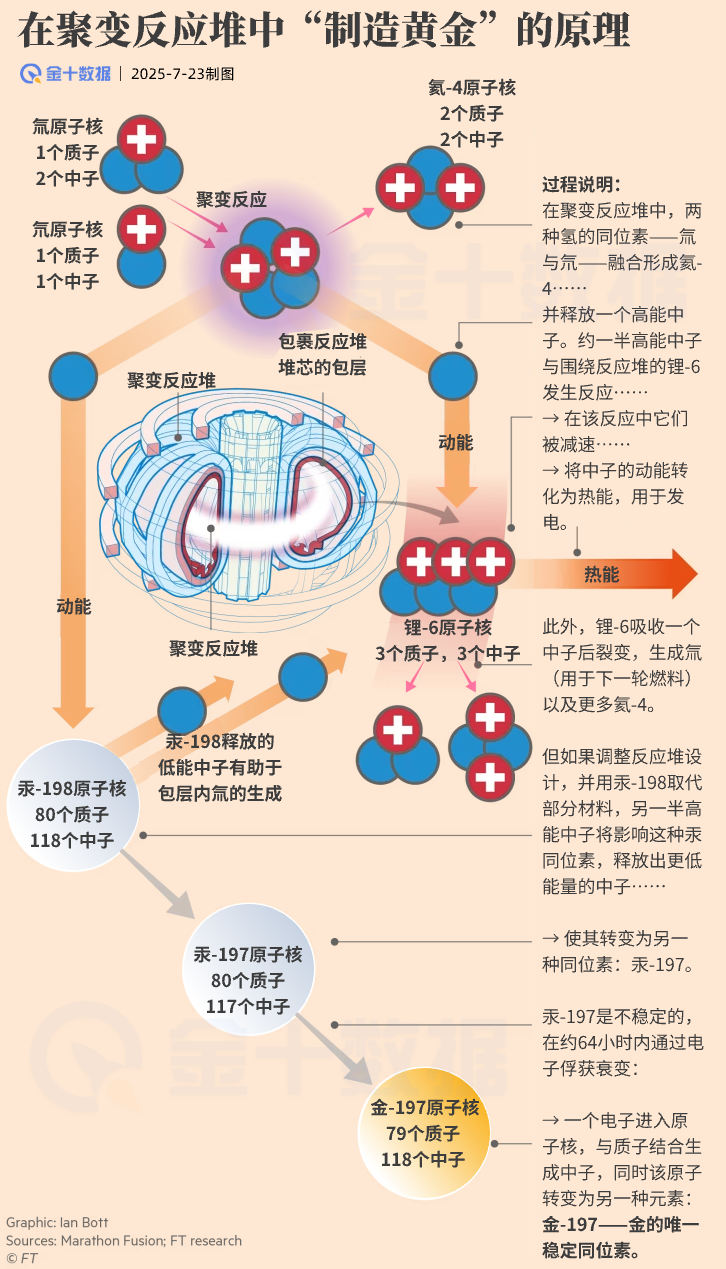
Core Viewpoint - Marathon Fusion, a San Francisco-based fusion energy startup, claims to have developed a method to transmute mercury into gold through nuclear transmutation, potentially solving the age-old alchemical quest of turning base metals into gold [2][3]. Company Overview - Founded in 2023 by Kyle Schiller and Adam Rutkowski, Marathon Fusion aims to tackle key technological challenges in fusion power plant construction [2][3]. - The company currently employs 12 full-time staff and has secured $5.9 million in private investment along with approximately $4 million in government grants [3]. Technological Innovation - The proposed fusion process utilizes neutrons released during fusion reactions to facilitate the transmutation of mercury into gold, with an estimated annual production of about 5,000 kilograms of gold per gigawatt of power generated [2][3]. - The process involves introducing mercury-198 into the breeding blanket of a fusion reactor, where it can be converted into mercury-197, which then decays into stable gold-197 [3][4]. Market Potential - The global annual gold production is approximately 3,500 tons, and the company believes that the gold market is large enough to absorb additional supply without significantly disrupting prices [5]. - The potential revenue from gold production could double the overall revenue of fusion power plants, as the estimated market value of the gold produced would be comparable to the electricity generated [2][5]. Industry Context - The fusion industry has seen a surge in private investment, with $2.6 billion raised in the past year, bringing the total funding to $9.8 billion across 53 companies [5]. - Despite the theoretical feasibility of fusion energy, achieving net energy output remains a significant challenge, with some experts suggesting that commercial fusion power may still be decades away [5][6].
钱多项目少,投资人在投什么?2025年Q2风投市场全解析 | Jinqiu Select
锦秋集· 2025-07-15 09:31
Core Insights - The global venture capital market reached $94.6 billion in Q2 2025, marking the second-highest level in recent years, despite a significant drop in the number of deals to an eight-year low [2][9][14] - The current investment landscape is characterized by a "winner-takes-all" mentality, with funds increasingly concentrated on top-tier projects, making it crucial for entrepreneurs to understand the new rules of the game [4][3] Investment Trends - AI continues to dominate, attracting half of the total investment funds, with AI-tagged companies enjoying a median financing amount of $4.6 million, significantly higher than the market average [5][7][24] - Hard technology is on the rise, with six out of the top ten financing cases in Q2 2025 directed towards this sector, driven by factors such as the resurgence of U.S. manufacturing and advancements in clean energy [16][21] - Corporate venture capital (CVC) investments have decreased to a seven-year low, but the average deal size has reached its highest level since 2021, indicating a shift towards fewer, larger investments [39][42] Sector-Specific Insights - Defense technology is becoming a hotbed for investment, with a median revenue multiple of 17.4, slightly higher than AI companies, reflecting strong investor confidence [20] - The quantum computing sector saw $2.2 billion in investments in the first half of 2025, a 69% increase from the previous year, as major tech companies make significant breakthroughs [57][61] - The nuclear energy sector is experiencing a revival, with projected investments reaching $5 billion in 2025, driven by the energy demands of the AI industry [63][71] Future Investment Opportunities - The stablecoin market is expected to see explosive growth, with projected funding reaching $10.2 billion in 2025, fueled by improved regulatory conditions [46][49] - The defense technology sector is anticipated to attract more investors, with the number of participating institutions expected to grow by 34% from 2024 to 2025 [54] - The nuclear energy sector is positioned to become a critical infrastructure component in the AI era, as companies seek reliable energy sources to support their operations [71]

Google's data center energy use doubled in four years
TechCrunch· 2025-07-01 19:52
Core Insights - Google's data centers have seen a dramatic increase in electricity consumption, more than doubling from 14.4 million megawatt-hours in 2020 to 30.8 million megawatt-hours in 2024, indicating a growth of over 113% in just four years [1][2][5] - Data centers are responsible for 95.8% of Google's total electricity usage, highlighting the significant impact of this segment on the company's overall energy consumption [2] - The company's power usage effectiveness (PUE) has improved only marginally over the past decade, reaching 1.09 in 2024, suggesting that further efficiency gains may be challenging to achieve [6] Energy Strategy - Google is committed to using only carbon-free electricity sources, which has led to substantial investments in various energy technologies, including geothermal, nuclear fission, and fusion [7][10][15] - The company has made significant renewable energy purchases, including 600 megawatts of solar capacity in South Carolina and 700 megawatts in Oklahoma, as part of a broader $20 billion investment in carbon-free power plants [11][12] - Currently, about 66% of Google's data center electricity consumption is matched to the hour with carbon-free sources, but there are regional disparities, with Latin America achieving 92% while the Middle East and Africa only reach 5% [14]


苹果或放弃自研AI模型;扎克伯格宣布重组Meta人工智能团队丨全球科技早参
Mei Ri Jing Ji Xin Wen· 2025-07-01 00:05
Group 1 - Apple is considering abandoning its self-developed AI models and may use AI technologies from Anthropic or OpenAI for the new version of Siri, indicating that its internal progress in AI may not meet expectations [2][3] Group 2 - Moderna announced that its experimental mRNA-based flu vaccine produced a stronger immune response than existing vaccines in a Phase 3 trial, paving the way for the approval of its COVID-19/flu combination vaccine [4][5] Group 3 - Google is increasing its investment in the nuclear fusion startup Commonwealth Fusion Systems (CFS) and has signed a power purchase agreement with the company, aiming to develop and expand clean and safe fusion energy [5][6] Group 4 - A research team from the National University of Singapore has developed a new type of perovskite organic tandem solar cell, achieving a world record light-to-electricity conversion efficiency of 26.4% over an effective area of 1 square centimeter, with potential applications in drones and wearable devices [6][7] Group 5 - Meta's CEO Mark Zuckerberg announced a major restructuring of the company's AI team, creating a "Superintelligence Lab" (MSL) that will encompass various teams focused on developing open-source Llama software and foundational AI research projects [7][8]


