
Kimi

Search documents
Kimi海外收入已超国内,推进“Anthropic + Manus”战略
Xin Lang Cai Jing· 2026-02-02 00:29
格隆汇2月2日|据36氪,Kimi公司近日宣布,其海外收入已超过国内市场,并计划进一步推 进"Anthropic + Manus"战略。该战略旨在整合前沿技术,提升产品研发能力和市场竞争力。公司希望通 过这一举措,在国际市场上占据更大份额,并巩固其在人工智能领域的领先地位。 ...
Kimi海外收入已超国内,要做“Anthropic + Manus”|智能涌现独家
3 6 Ke· 2026-02-02 00:06
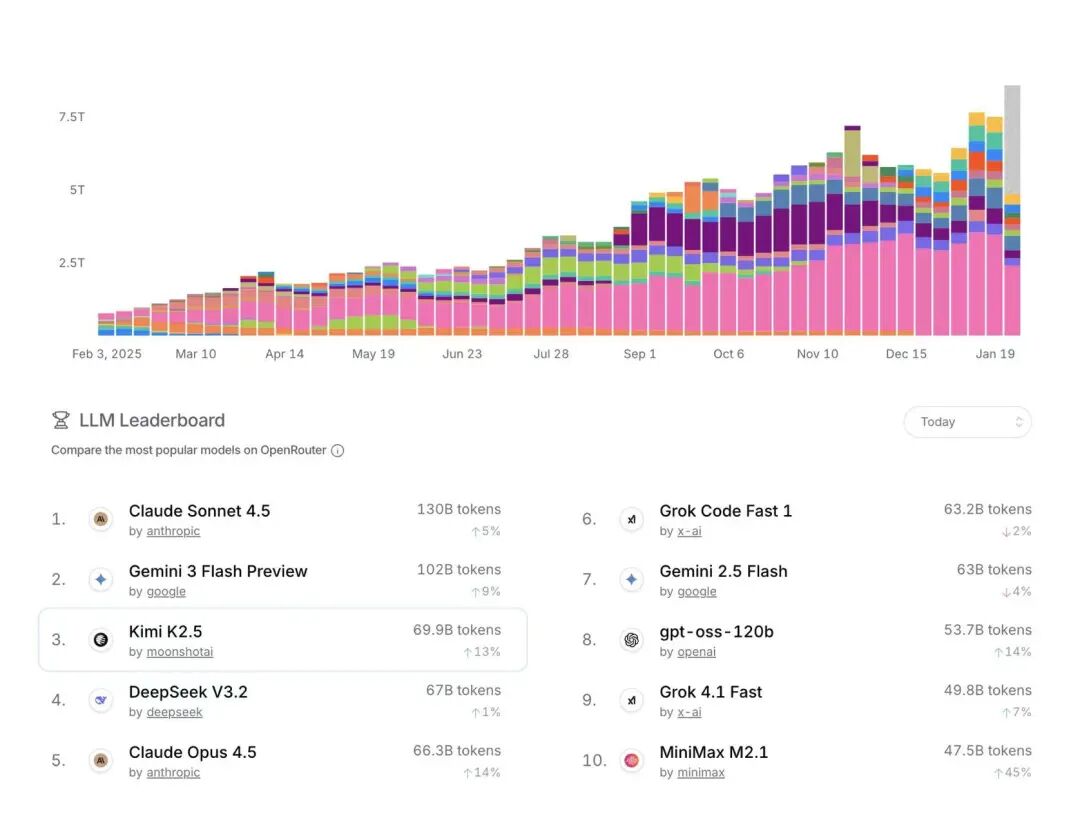
Core Insights - Kimi has recently announced that its overseas revenue has surpassed domestic revenue, with a fourfold increase in global paid users following the release of the new model K2.5 [2][7] - The K2.5 model has quickly gained popularity, ranking third on Openrouter, just behind Claude Sonnet 4.5 and Gemini 3 Flash [4][6] - Kimi's approach focuses on enhancing AI capabilities through a multi-agent system, allowing for parallel task execution and significantly improving efficiency in various applications [9][10] Revenue and User Growth - Kimi's overseas API revenue has increased fourfold since November 2025, with monthly growth rates for both overseas and domestic paid users exceeding 170% [7] - The global paid user base has seen a fourfold increase shortly after the K2.5 model release [2] Model Development and Features - The K2.5 model is Kimi's most advanced to date, featuring a native multimodal architecture that covers visual understanding, code generation, and agent clusters [7] - K2.5 has achieved state-of-the-art results in benchmark tests, surpassing some closed-source models like GPT-5.2 and Claude Opus 4.5 [7] Technological Innovations - Kimi's development strategy emphasizes algorithmic and efficiency innovations, focusing on critical explorations due to limited resources [11] - The company has successfully implemented unique optimizations in large-scale LLM training, such as the Muon optimizer and a self-developed linear attention mechanism [11] Product Strategy - Kimi aims to position itself as a productivity tool for end-users while also attracting developers through its API platform [12] - The company has rebranded its C-end product to Kimi Agent, indicating a focus on creating more refined and thematic products [12][14] Competitive Positioning - Kimi's strategy aligns with that of Anthropic, focusing on foundational model intelligence and open-sourcing its technology to build influence [10] - The company is concentrating on high-demand scenarios like coding and office automation, which are expected to have clear commercialization prospects [14][15]

深度|从 OpenClaw 们自掏腰包补贴,看中国模型又一个全球时刻
Z Potentials· 2026-02-01 13:38
Core Insights - The article discusses the strategic move by OpenClaw to subsidize the use of the Kimi K2.5 model, marking a significant moment in the AI landscape where cost-sensitive agents are concerned [1][3] - The Kimi K2.5 model has gained substantial attention in the global tech community, with experts suggesting that the market has yet to fully recognize its value and disruptive potential [7][22] Group 1: Subsidy Strategy - OpenClaw's decision to subsidize Kimi K2.5 is its first self-funded initiative since its rise, indicating a bold public bet in a highly competitive environment [3][4] - Other companies, including Open Code and Kilo Code, have also announced similar subsidies to attract users to Kimi K2.5, highlighting a trend among key players in the industry [5][4] Group 2: Market Response and Performance - The Kimi K2.5 model has quickly risen to the top ranks in global API usage, achieving third place in the OpenRouter model call rankings shortly after its launch [15][20] - Kimi K2.5 has been recognized as the top open-source model in code capabilities and ranks sixth overall, demonstrating its competitive edge against closed-source models [19][20] Group 3: Structural Changes in AI - The release of Kimi K2.5 is seen as a pivotal moment for open-source AI, challenging the dominance of closed-source models from companies like OpenAI and Google [22][23] - Investors and industry experts are beginning to view the open-source model as a viable alternative, with the potential to significantly reduce AI costs and reshape the competitive landscape [25][26] Group 4: Shifts in Perception of Chinese Models - Kimi's overseas revenue has surpassed domestic income, indicating a structural shift towards a global developer and enterprise customer base [27] - The perception of Chinese AI models is changing, with Kimi K2.5 being recognized as a strong contender rather than a mere alternative, as it gains traction in developer communities [28][29]

安踏斥资123亿成为彪马最大股东;TikTok Shop东南亚跨境电商推出春节专项激励政策|36氪出海·要闻回顾
36氪· 2026-02-01 13:35
Group 1 - Anta Sports has invested €1.506 billion (approximately RMB 12.3 billion) to acquire a 29.06% stake in PUMA SE, becoming its largest shareholder, which will accelerate its globalization efforts [5] - The partnership aims to leverage PUMA's strong brand presence in football, motorsport, and fashion to fill Anta's gaps in professional sports and fashion crossover [5] - PUMA's established channels in Europe, North America, the Middle East, and Latin America will provide a platform for Anta's brands to enter international markets more efficiently [5] Group 2 - Kimi's overseas revenue has surpassed domestic revenue, with a fourfold increase in global paid users following the launch of its new model K2.5 [6] - Kimi's K2.5 model has gained significant traction, ranking third on Openrouter, indicating strong market demand [6] - TikTok Shop in Southeast Asia has launched a "Spring Festival Incentive Program" to encourage merchants to prepare inventory and marketing materials ahead of the holiday season [5][6] Group 3 - Xiaomi's Redmi Note 15 series was launched in Qatar, with prices starting at 759 Qatari Riyals, reinforcing its strategic retail partnership with Intertec Group [7] - NineSight's RoboVan has commenced regular operations in the UAE, marking a significant step in its logistics automation efforts [7] - The Chinese beverage company Dongpeng has attracted $150 million in cornerstone investment from Qatar Investment Authority for its Hong Kong IPO, marking a significant milestone for Chinese consumer brands [10] Group 4 - The trend of Chinese companies establishing battery storage factories overseas is resurging, with Kemet and Chuangneng New Energy planning a $200 million factory in Egypt [9] - Longi Green Energy and NeoVolta are collaborating to build a battery storage system production base in Georgia, USA, indicating a growing interest in international battery manufacturing [9] Group 5 - The Chinese Ministry of Commerce plans to launch a national-level overseas comprehensive service platform to support companies in their international expansion efforts [13] - The platform will provide resources across various sectors, including legal, financial, and logistics, to facilitate smoother overseas operations for businesses [13]


国产大模型密集上新工程化闯关还有三道坎
Mei Ri Jing Ji Xin Wen· 2026-02-01 13:08
Core Insights - Recent updates from multiple domestic large model manufacturers indicate a shift from merely competing on parameters and dialogue performance to a deeper focus on engineering and system-level capabilities [1] - The transition aims to enable large models to evolve from "research achievements" to "industrial products," allowing non-AI professional teams to utilize these models in a stable, secure, and cost-effective manner [1] Group 1: Challenges in Engineering Large Models - The first challenge is balancing cost and efficiency, as high-parameter models incur significant training and inference costs, creating financial pressure for most enterprises [2] - The second challenge involves meeting industrial-grade requirements for stability and interpretability, as current models still exhibit issues like "hallucinations" and output variability, which can pose risks in critical applications [2] - The third challenge is integrating large models with existing systems, which requires complex API integration, data format conversion, and workflow restructuring [2] Group 2: Solutions and Strategic Directions - Breakthroughs in these challenges are difficult, necessitating a shift from pursuing extreme parameters to optimizing computational efficiency, making models more accessible and usable for enterprises [3] - Companies should focus on providing comprehensive services and solutions rather than just models, enhancing reliability and interpretability through techniques like prompt engineering and retrieval-augmented generation [3] - Successfully navigating these engineering challenges will allow domestic large models to transition from frequent updates to deeper, more sustainable usage, ultimately creating significant industrial value and market returns [3]
每经热评丨国产大模型密集上新工程化闯关还有三道坎
Xin Lang Cai Jing· 2026-02-01 13:07
Core Insights - Recent updates from multiple domestic large model manufacturers indicate a shift from merely competing on parameters and dialogue performance to a deeper focus on engineering and system-level capabilities [1] - The transition aims to enable large models to evolve from "research achievements" to "industrial products," allowing non-AI professional teams to utilize these models in a stable, secure, and cost-effective manner [1] Group 1: Challenges in Engineering Large Models - The first challenge is balancing cost and efficiency, as high-parameter models incur significant training and inference costs, creating financial pressure for most enterprises [2] - The second challenge involves meeting industrial-grade requirements for stability and interpretability, as current models still exhibit issues like "hallucinations" and output variability, which can pose risks in critical applications [2] - The third challenge is integrating large models with existing systems, which requires complex API integration, data format conversion, and workflow restructuring [2] Group 2: Pathways to Overcoming Challenges - Breakthroughs in these challenges are technically demanding, necessitating a shift from "pursuing extreme parameters" to "optimizing unit computational efficiency" to make models more accessible and usable for enterprises [3] - Clients are not purchasing technical parameters but rather the stable capabilities to solve problems, indicating a need to transition from merely providing models to offering comprehensive services and solutions [3] - Implementing techniques like prompt engineering and retrieval-augmented generation can help build safeguards for key application scenarios, enhancing reliability and interpretability of results [3]
热评丨国产大模型密集上新工程化闯关还有三道坎
Mei Ri Jing Ji Xin Wen· 2026-02-01 13:06
Core Insights - Domestic large model manufacturers are advancing their models, moving beyond mere parameter competition to focus on engineering and system-level capabilities [1] - The recent launch of various models, such as Qwen3-Max-Thinking by Alibaba and Music2.5 by MiniMax, has sparked significant interest in the AI sector, with MiniMax's stock rising over 20% [1] - The transition from "research achievements" to "industrial products" is crucial, enabling non-AI professional teams to utilize large models effectively and affordably [1] Group 1: Challenges in Engineering Large Models - The first challenge is balancing cost and efficiency, as high-parameter models incur significant training and inference costs, making it financially burdensome for most companies [2] - The second challenge involves meeting industrial-grade requirements for stability and interpretability, as current models may produce unreliable outputs in critical applications like finance and healthcare [2] - The third challenge is integrating large models with existing systems, which requires complex API integration and data format conversion, yet many models remain at a demonstration level without deep integration capabilities [2] Group 2: Path to Overcoming Challenges - Breakthroughs in these challenges are difficult, necessitating a shift from pursuing extreme parameters to optimizing computational efficiency, making models more accessible for enterprises [3] - Companies are increasingly seeking stable solutions rather than just technical specifications, prompting a shift from merely providing models to offering comprehensive services and solutions [3] - Implementing techniques like prompt engineering and retrieval-augmented generation can help mitigate issues like "hallucinations," enhancing reliability and interpretability of results [3]
Kimi海外收入已超国内;唐宁街10号官宣:泡泡玛特欧洲总部将设在伦敦丨Going Global
创业邦· 2026-02-01 10:09
Key Insights - TikTok Shop in Southeast Asia has launched a "Spring Festival Uninterrupted" incentive plan to encourage merchants to prepare inventory and marketing materials ahead of the holiday season [5][6] - AliExpress is projected to be one of the fastest-growing platforms in the U.S. by 2025, with a website traffic increase of 18.7% year-on-year [6] - Pop Mart has announced London as its European headquarters, planning to open seven new stores in the UK and create over 150 jobs [9] - The total shipment of Pingtouge's "Zhenwu" PPU chips has reached several hundred thousand units, with performance comparable to NVIDIA's H20 [10] - Anta Sports is set to acquire a 29.06% stake in Puma, becoming its largest shareholder, which is expected to enhance its global market position [12] - Kimi's overseas revenue has surpassed domestic revenue, with a fourfold increase in global paid users following the release of its new model K2.5 [13] - BYD is collaborating with Vietnamese automaker Thaco to establish a $130 million electric vehicle battery factory in Vietnam [17] - SpaceX has applied to deploy up to 1 million satellites to create a data center network in orbit, significantly expanding its existing Starlink constellation [23] - Samsung Electronics has raised NAND flash prices by over 100% in Q1 2024 due to increased demand driven by AI applications [24][25]

十亿红包拉开春节大战
投中网· 2026-02-01 06:41
Core Viewpoint - The article discusses the competitive landscape of AI applications during the Chinese New Year, highlighting major companies' strategies to attract users through cash giveaways and promotional activities, reminiscent of past successful marketing tactics in the mobile payment and short video sectors [6][7][12]. Group 1: AI Application Strategies - Major companies like Tencent, ByteDance, and Baidu are launching cash giveaway campaigns during the Spring Festival, with Tencent planning to distribute 1 billion yuan in red envelopes, aiming to replicate the success of WeChat's past marketing strategies [6][7]. - The competition is not merely a marketing tactic but a strategic positioning based on historical experiences, as the Spring Festival has proven to be a critical period for user acquisition in the Chinese internet landscape [7][10]. - The article notes that the past successes of WeChat and Alipay during the Spring Festival have set a precedent for how companies can leverage this period to achieve exponential user growth [10][12]. Group 2: User Growth and Market Dynamics - The article emphasizes that user growth for AI applications is not just about numbers but is crucial for model evolution and future ecosystem positioning, with major players facing pressure to expand their user bases [13][14]. - Data from QuestMobile indicates that by September 2025, monthly active users for major AI applications like ByteDance's Doubao and Tencent's Yuanbao are projected to be 172 million and 33 million, respectively, suggesting significant room for growth in the AI user market [13]. - The need for user growth is tied to the acquisition of training data, which is essential for improving AI models, creating a positive feedback loop that enhances content accuracy and attracts more users [14]. Group 3: Commercialization Paths for AI - The article outlines three main commercialization paths for AI models: selling APIs, subscription services, and advertising monetization, with current subscription rates for AI tools being relatively low [16]. - The challenge for AI companies is to increase user bases and improve service quality to enhance conversion rates for paid services, with the Spring Festival presenting a prime opportunity for user acquisition [16]. - Advertising is highlighted as a potential revenue stream, but companies must first engage users effectively to increase their daily usage time, which currently averages only 10 minutes [16]. Group 4: Competitive Landscape and Small Firms - Smaller AI firms face challenges in competing with larger companies' aggressive marketing strategies during the Spring Festival, leading them to focus on enhancing their models and finding niche applications [21][22]. - The article suggests that while large firms dominate the cash giveaway landscape, the influx of new users attracted by these promotions could benefit the entire AI industry by fostering user habits and expanding the market [22][23]. - The potential for smaller firms to innovate and carve out specific niches is emphasized, as they may not compete directly with larger firms but can develop unique applications that meet specific user needs [21][22].




2026年2月海外金股推荐:优选地产、大宗和科技
GOLDEN SUN SECURITIES· 2026-02-01 06:40
Recent Key Events - Tencent and Baidu announced their Spring Festival red envelope distribution plans, with Tencent distributing 1 billion RMB and Baidu offering 500 million RMB in red envelopes [1][8] - Alibaba launched the Qwen3-Max-Thinking model, which has over 1 trillion parameters and 36 trillion tokens of pre-training data, marking it as their largest and most capable model to date [2][9] - The U.S. and China are actively promoting the development of the autonomous driving industry, with significant policy initiatives and pilot programs being launched [3][10] Market Situation - The Hang Seng Index rose from 25,631 points at the end of December 2025 to 27,827 points by January 28, 2026, reflecting an increase of 8.6% [11] - The Hang Seng Technology Index increased by 7.0% during the same period, with significant gains in sectors such as durable consumer goods and semiconductors [15][11] Current Investment Recommendations - Focus on growth-oriented real estate and energy companies such as Beike, China Qinfa, and Power Development [21] - Pay attention to resource-rich and cost-advantaged non-ferrous metal companies like China Aluminum [21] - Consider internet companies benefiting from AI model iterations and ecosystem improvements, including Alibaba, Tencent, and Kuaishou [21] - Look for undervalued consumer electronics component firms with strong growth potential, such as Q Technology and AAC Technologies [21] - Monitor Robotaxi operators like WeRide and Pony.ai, which are expected to benefit from the high demand for autonomous driving [21] Company-Specific Insights - Beike (2423.HK) is positioned as a restructuring force in the brokerage service industry, with significant growth in both new and second-hand housing transactions expected [22] - China Qinfa (0866.HK) is set to benefit from improved coal quality and rising coal prices, with a focus on expanding its operations in Indonesia [24][27] - Power Development (1277.HK) is expanding its overseas operations and has secured a partnership for a heavy mineral project, which is expected to significantly boost its profitability [30][31] - China Aluminum (2600.HK) maintains a strong position in the electrolytic aluminum market, with a comprehensive industry chain and improved profitability due to rising aluminum prices [34][36] - Alibaba (9988.HK) is enhancing its AI capabilities with the Qwen model and is seeing growth in its cloud services and e-commerce segments [38][39] - Tencent (0700.HK) is launching new AI-driven social features and has reported strong revenue growth, particularly in gaming and advertising [43][44]