上海银行

Search documents
携程涉嫌垄断被立案调查,其金融版图都有哪些?
Sou Hu Cai Jing· 2026-01-16 04:50
Core Viewpoint - Ctrip is under investigation by the State Administration for Market Regulation for suspected monopolistic behavior, which may lead to significant fines and increased regulatory scrutiny on its comprehensive financial ecosystem [2] Group 1: Investigation and Financial Impact - The investigation is based on the Anti-Monopoly Law of the People's Republic of China, with potential fines estimated at 4% of Ctrip's domestic sales revenue for 2024, amounting to approximately 1.5 billion RMB, which could reduce its net profit margin by 2 percentage points in fiscal year 2026 [2] - Ctrip has stated it will cooperate with regulatory authorities and aims to foster a sustainable market environment [2] Group 2: Financial Ecosystem Overview - Ctrip has developed a comprehensive financial ecosystem that includes consumer finance, insurance agency, payment services, and micro-lending, leveraging its vast user base to monetize traffic and enhance its core business competitiveness [3] - In 2024, the financial segment generated revenue of 4.6 billion RMB, accounting for 8.61% of total revenue, with a year-on-year growth of 31.43% [3] Group 3: Key Financial Licenses and Operations - Ctrip has acquired multiple financial licenses through direct investments and full ownership, including a third-party payment license obtained through the acquisition of Shanghai Dongfang Huirong Information Technology Service Co., Ltd. [4] - The core entity, Chongqing Ctrip Micro Loan Co., Ltd., has a registered capital of 5 billion RMB and offers consumer finance products, contributing significantly to Ctrip's financial operations [4] Group 4: Compliance Risks and Regulatory Challenges - Ctrip's financial operations include commercial factoring, financing guarantees, insurance agency, and fund sales, with a leading position in license coverage among OTA peers [5] - Despite strong growth in Chongqing Ctrip Micro Loan's revenue and profit, compliance risks are emerging, particularly regarding the ownership structure of Shanghai Shangcheng Consumer Finance Co., Ltd., which does not fully comply with new regulatory requirements [6][7] - Ctrip's fund sales division faces challenges due to the lack of a public fund sales license, limiting its business expansion in this area [8]



姚振华及宝能集团等被恢复执行13.4亿,被执行总金额超494亿
Xin Lang Cai Jing· 2026-01-16 04:05
Core Viewpoint - The news highlights the financial difficulties faced by Baoneng Group and its chairman, Yao Zhenhua, including significant legal and debt issues, as well as a recent controversy regarding the undervaluation of assets in a court auction [1][3][6]. Group 1: Financial and Legal Issues - On January 15, Baoneng Group and Yao Zhenhua were reported to have two new enforcement cases totaling over 1.34 billion yuan, with one case amounting to approximately 1.1 billion yuan and the other about 246 million yuan [1][5]. - Baoneng Group currently has 48 enforcement cases with a total amount exceeding 49.4 billion yuan, and 48 records of being untrustworthy debtors involving over 3.87 billion yuan [6]. - The company has 347 concluded cases with a total enforcement amount of about 33.5 billion yuan, and an unpaid total of 28.48 billion yuan [6]. Group 2: Business Operations and Investments - Baoneng Group, founded in March 2000, has a registered capital of approximately 300 million yuan and is involved in various sectors including investment in real estate and financial services [1][5]. - The group has invested in 68 companies, with 11 of them already deregistered, and has indirect investments in over 14,900 companies [2][6]. - Yao Zhenhua has stated that Baoneng Group has invested approximately 26 billion yuan in Qoros Auto from 2018 to 2025 [8]. Group 3: Recent Controversies - Yao Zhenhua recently released a video alleging illegal actions in the auction process of Qoros Auto's assets, claiming that the core assets were undervalued at 1.535 billion yuan, while a third-party evaluation suggested a value of 8 billion yuan [3][7]. - The second auction of the Qoros Auto factory in Changshu failed to attract bidders, with a starting price of 859.6 million yuan, which was 20% lower than the first auction [7].
公司刚退市,董事长千万豪宅被拍卖
3 6 Ke· 2026-01-16 03:11
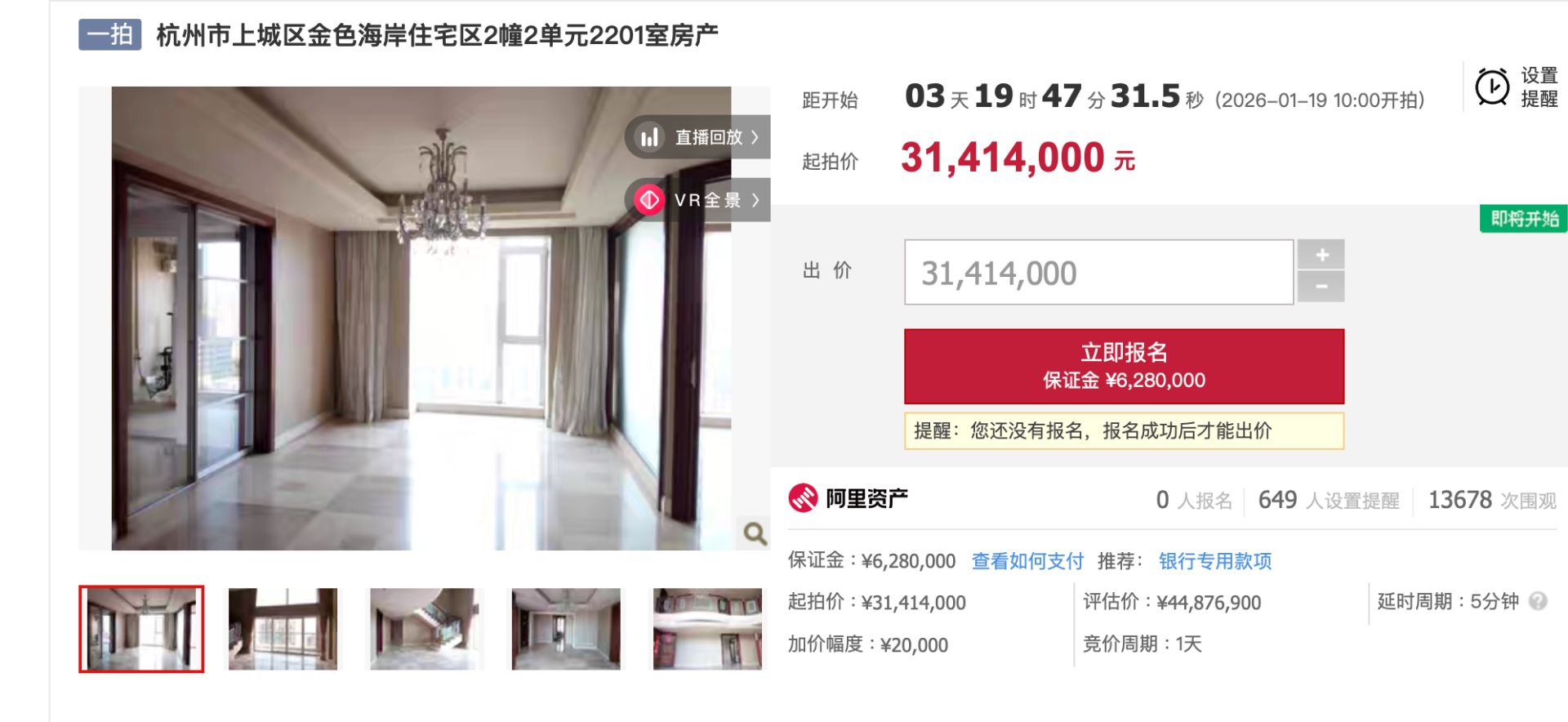
浙系房企德信集团因债务问题不久前摘牌退市,董事长胡一平名下一套江景豪宅将在1月19日法拍。 据《杭州市不动产登记信息查询记录》记载,该房源曾经法院多次查封,并带有一笔4500万元债权,2022年4月以最高额抵押的方式抵押给了上海银行杭州 分行,债务履行期限至2025年4月18日。 金色海岸2幢2单元总高30层,建成于2007年,2201室是小区少有的大户型跃层,建筑面积376.8㎡,带有三个阳台,保姆间还包含一个卫生间。 现场图片显示,整套房产装有入户防盗门,大门上还贴着红色春联,内部物品已搬空。沿着客厅的旋转楼梯可以走到23层,部分窗户可以看见江景。房屋整 体外观维护保养情况一般,室内局部墙面有受潮痕迹,部分墙纸已有脱胶情况。 杭州华正房地产估价咨询有限公司出具的一份涉执房地产处置司法评估报告显示,这套房产登记于2010年9月,为胡一平、魏佩芬二人共同共有。 公开资料显示,除德信集团董事长外,胡一平还担任浙江省房地产业协会会长、杭州市湖州商会会长等社会职务。1月10日,在杭州市湖州商会三届四次会 员大会暨2026新春年会上,他作为会长上台致辞。这是德信集团旗下地产平台德信中国退市之后,胡一平首次出现在公开场 ...
银行“十万亿俱乐部”成员达10家
21世纪经济报道· 2026-01-16 03:03
记者丨叶麦穗 编辑丨方海平 银行业绩快报捷足先登,截至1月15日,已经有浦发银行、中信银行2家银行先后发布了2025 年的"成绩单",双双实现归母净利润正增长,不过从业绩快报来看,两家银行去年的发展路 径,有一定的区别,其中中信银行"稳扎稳打",浦发银行则是"高举高打",值得一提的是, 两大股份行还联袂迈入"10万亿俱乐部",至此该俱乐部的成员达到10家 。 规模指标上,报告期末,浦发银行集团口径下资产总额达100817.46亿元,较上年末增加 6198.66 亿 元 , 增 长 6.55%; 负 债 总 额 92573.16 亿 元 , 较 上 年 末 增 加 5402.17 亿 元 , 增 长 6.20%。 资产质量方面,两家银行则全部得以改善。中信银行不良率1.15%,略降0.01个百分点;拨备 覆盖率203.61%,同比下降5.82个百分点。整体来看算是"稳扎稳打"。 浦发银行则明显更加"进攻"。不良率1.26%,同比下降0.10个百分点;拨备覆盖率200.72%, 同比上升13.76个百分点显示出要将"蛋糕做大"的想法。 浙商证券银行业分析师邱冠华的观点认为,2025年浦发银行规模增长方面,总资产同 ...


上海银行股份有限公司关于“上银转债”2026年付息公告
Shang Hai Zheng Quan Bao· 2026-01-15 19:28
Core Viewpoint - Shanghai Bank will begin paying interest on its convertible bonds, "Shangyin Convertible Bonds," starting January 26, 2026, for the period from January 25, 2025, to January 24, 2026 [2][11]. Group 1: Convertible Bond Overview - The company issued 20 billion RMB worth of convertible bonds on January 25, 2021, with a total of 20 million bonds issued at a face value of 100 RMB each [5]. - The bonds have a maturity period of six years, from January 25, 2021, to January 24, 2027 [5]. - The bonds are convertible into the company's A-shares [2]. Group 2: Interest Payment Details - The interest rates for the bonds are structured as follows: 0.30% for the first year, 0.80% for the second year, 1.50% for the third year, 2.80% for the fourth year, 3.50% for the fifth year, and 4.00% for the sixth year [3]. - The interest for the current period is set at 3.50% (including tax), amounting to 3.50 RMB per bond [11]. - The interest payment record date is January 23, 2026, with the interest payment date and ex-dividend date both on January 26, 2026 [4][12]. Group 3: Tax Implications - Individual investors are subject to a 20% tax on interest income, resulting in a net payment of 2.80 RMB per bond after tax [14]. - For corporate investors, the interest income is subject to self-payment of taxes, with the gross amount remaining at 3.50 RMB per bond [14]. - Foreign institutional investors are temporarily exempt from corporate income tax and value-added tax until December 31, 2025 [15]. Group 4: Contact Information - The issuer is Shanghai Bank, located at 688 Zhongshan South Road, Huangpu District, Shanghai [15]. - The underwriter and trustee for the convertible bonds is Guotai Junan Securities Co., Ltd. [15].

多家银行开年推出资产提升活动
Zheng Quan Ri Bao Zhi Sheng· 2026-01-15 16:41
除国有大行外,上海银行、南京银行、祁县农商银行、安庆农商银行等中小银行也纷纷跟进。 本报记者 彭妍 开年以来,多家银行推出资产提升活动,以丰厚权益吸引客户参与。与以往侧重吸纳存款不同,此次银 行将重心转向资产管理规模(AUM)增长,加速布局财富管理业务,引导客户开展多元化财富配置。 苏商银行特约研究员薛洪言对《证券日报》记者表示,在净息差持续收窄的背景下,银行稳定负债端、 扩大零售客户资产规模的需求迫切。在开年的重要节点,推出资产提升活动可快速沉淀资金、缓解负债 压力,还能挖掘客户财富管理需求、提升客户黏性。当前银行业务模式正发生根本性转变,零售AUM 已成衡量零售业务竞争力与盈利潜力的关键指标。 1月12日,中国农业银行广东省分行通过微信公众号发布"资产提升有礼"活动,根据客户月日均金融资 产提升档位发放奖励。活动覆盖存款、理财、基金、保险、国债等多类金融资产,最低提升门槛10万 元,达标可获52000小豆;提升600万元以上最高可领240万小豆。小豆可兑换生活电器、家居百货等实 物,或打车券、购物卡等权益。 1月5日,工商银行推出"升金有礼"活动,同步上线资产提升奖励与资产达标礼双档福利。用户可依据资 产 ...


银行财富管理架构变阵 抢滩300万亿居民资产
2 1 Shi Ji Jing Ji Bao Dao· 2026-01-15 15:07
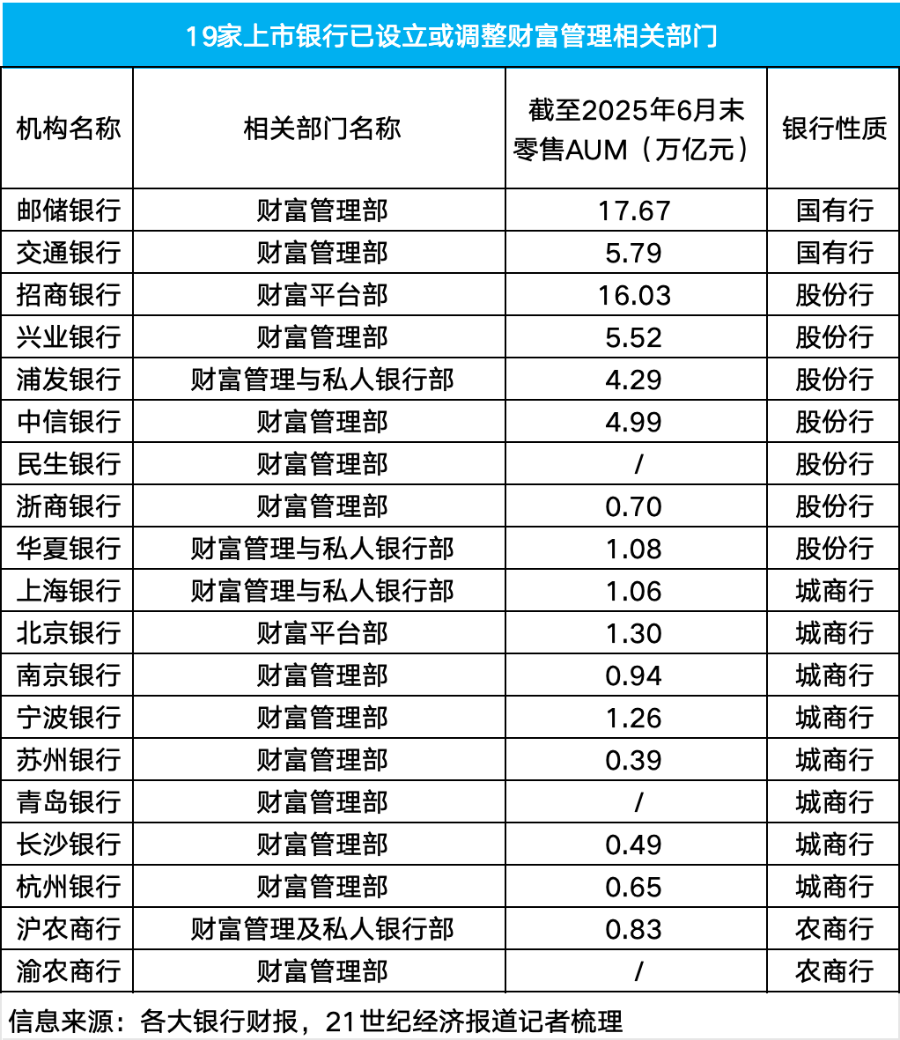
Core Insights - The wealth management market is heating up, with banks accelerating the integration of their wealth management departments to capture this promising market [1][2] - By June 2025, China's investable assets are expected to exceed 300 trillion yuan, indicating significant growth potential in wealth management as many assets remain "asleep" [1] - Major banks are restructuring their organizational frameworks to enhance their wealth management strategies and business layouts [1] Group 1: Bank Actions and Adjustments - In 2025, several major banks, including Bank of Communications and Postal Savings Bank, announced the establishment of wealth management departments at the head office level [3] - As of June 2025, 19 listed banks have established or adjusted their wealth management-related departments, including 2 state-owned banks, 7 joint-stock banks, 8 city commercial banks, and 2 rural commercial banks [3][4] - The establishment of these departments is seen as a key move for state-owned banks to deepen their wealth management strategies and promote digital transformation [3] Group 2: Strategic Focus and Market Dynamics - Different banks are focusing on various aspects of wealth management, with some emphasizing the establishment of wealth management departments as a core strategy [5] - The restructuring of wealth management departments signals a strategic shift in response to narrowing interest margins and evolving customer demands for diversified asset allocation [6][7] - The actions of major state-owned banks serve as a bellwether for the industry, indicating a shift from incremental competition to in-depth management of existing clients [8] Group 3: Wealth Management Market Landscape - As of June 2025, the retail asset management scale (AUM) among 42 listed banks shows a clear tiered structure, with state-owned banks leading the market [11] - The first tier includes major state-owned banks like ICBC, ABC, and CCB, with AUMs of 24 trillion yuan, 23.68 trillion yuan, and 22 trillion yuan respectively [11] - The second tier consists mainly of joint-stock banks, while the third tier includes city commercial banks and rural commercial banks, which are crucial for local wealth management ecosystems [11] Group 4: Future Competition and Technological Integration - Future competition in wealth management will focus on service quality, technological capabilities, and comprehensive financial ecosystems [13] - The establishment of wealth management departments aims to shift banks from product-driven to customer-driven models, enhancing service consistency and customer loyalty [13] - Financial technology is expected to play a critical role in enhancing service depth and breadth, with AI being utilized for investment advisory and customer experience management [14][15]
家庭资配视角:日本存款也搬家了吗?
NORTHEAST SECURITIES· 2026-01-15 14:42
Investment Rating - The report assigns an "Outperform" rating for the banking sector, indicating that the sector is expected to outperform the market benchmark in the next six months [5]. Core Insights - The core insight of the report is that the allocation of household assets in Japan is primarily influenced by the risk-return ratio. Even with declining deposit rates, the proportion of cash and deposits in household asset allocation tends to increase when risk aversion rises. There is no systemic shift of deposits towards riskier assets observed in the long term [1][10][16]. Summary by Sections Household Asset Allocation - The report examines the changes in household asset allocation in Japan since 1990, highlighting that the core factor influencing this allocation is the risk-return ratio. When risk aversion increases, the proportion of cash and deposits rises despite falling interest rates [1][10]. - The report suggests that household wealth allocation behavior aligns with the "Merton Rule," where the proportion of risk assets depends on expected returns, excess returns over risk-free rates, risk levels, and the household's risk aversion coefficient [2][12]. Financial Asset Flow and Structure - From a short-term perspective, the net flow of equity and fund investments is closely correlated with stock market performance. Positive net inflows occur during strong market performance, while negative outflows happen during weak performance [3][13]. - Long-term observations show that from 1994 to 2002, the proportion of deposits and cash increased from 49% to 54%, despite a shift in the structure of deposits where time deposits saw negative net flows while demand deposits increased [14][15]. Investment Outlook for 2026 - The report anticipates that high real interest rates will continue to suppress credit demand from private enterprises and retail sectors, with local state-owned enterprises expected to drive growth due to increased investment in larger provinces as per the "14th Five-Year Plan" [26]. - It is expected that there will be a significant interest rate cut in the first quarter of 2026, which may improve bank interest margins in the latter half of the year [26].
上海银行(601229) - 上海银行关于“上银转债”2026年付息公告
2026-01-15 10:32
关于"上银转债"2026 年付息公告 上海银行股份有限公司(以下简称"公司")董事会及全体董事保证本公告 内容不存在任何虚假记载、误导性陈述或者重大遗漏,并对其内容的真实性、准 确性和完整性承担法律责任。 1 可转债付息债权登记日:2026 年 1 月 23 日 可转债除息日:2026 年 1 月 26 日 可转债兑息日:2026 年 1 月 26 日(由于 2026 年 1 月 25 日为非交易日, 可转债付息日顺延至 2026 年 1 月 26 日) 证券代码:601229 证券简称:上海银行 公告编号:临 2026-002 可转债代码:113042 可转债简称:上银转债 上海银行股份有限公司 重要内容提示: 公司于 2021 年 1 月 25 日公开发行的 200 亿元 A 股可转换公司债券(以下简 称"可转债""本期债券""上银转债")将于 2026 年 1 月 26 日开始支付自 2025 年 1 月 25 日至 2026 年 1 月 24 日期间的利息。根据《上海银行股份有限公 司公开发行 A 股可转换公司债券募集说明书》(以下简称"《募集说明书》") 有关条款的规定,现将有关事项公告如下: 一、 ...
城商行板块1月15日跌0.59%,青岛银行领跌,主力资金净流入2.21亿元
Zheng Xing Xing Ye Ri Bao· 2026-01-15 08:59
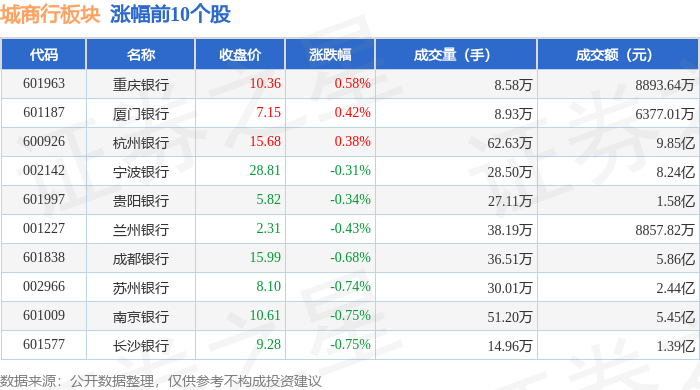
Market Performance - The city commercial bank sector declined by 0.59% on January 15, with Qingdao Bank leading the decline [1] - The Shanghai Composite Index closed at 4112.6, down 0.33%, while the Shenzhen Component Index closed at 14306.73, up 0.41% [1] Individual Stock Performance - Chongqing Bank closed at 10.36, up 0.58% with a trading volume of 85,800 shares and a transaction value of 88.94 million [1] - Xiamen Bank closed at 7.15, up 0.42% with a trading volume of 89,300 shares and a transaction value of 63.77 million [1] - Hangzhou Bank closed at 15.68, up 0.38% with a trading volume of 626,300 shares and a transaction value of 9.85 billion [1] - Ningbo Bank closed at 28.81, down 0.31% with a trading volume of 285,000 shares and a transaction value of 824 million [1] - Chengdu Bank closed at 15.99, down 0.68% with a trading volume of 365,100 shares and a transaction value of 586 million [1] Capital Flow Analysis - The city commercial bank sector saw a net inflow of 221 million from institutional investors and a net inflow of 296 million from speculative funds, while retail investors experienced a net outflow of 517 million [2] - Hangzhou Bank had a net inflow of 123 million from institutional investors, accounting for 12.51% of its total [3] - Shanghai Bank had a net inflow of 97.02 million from institutional investors, representing 20.87% of its total [3] - Nanjing Bank had a net inflow of 37.40 million from institutional investors, making up 6.86% of its total [3]