XREAL

Search documents
市场调研机构洛图科技:一季度中国AR设备销量同比增长116%
Sou Hu Cai Jing· 2025-05-20 07:45
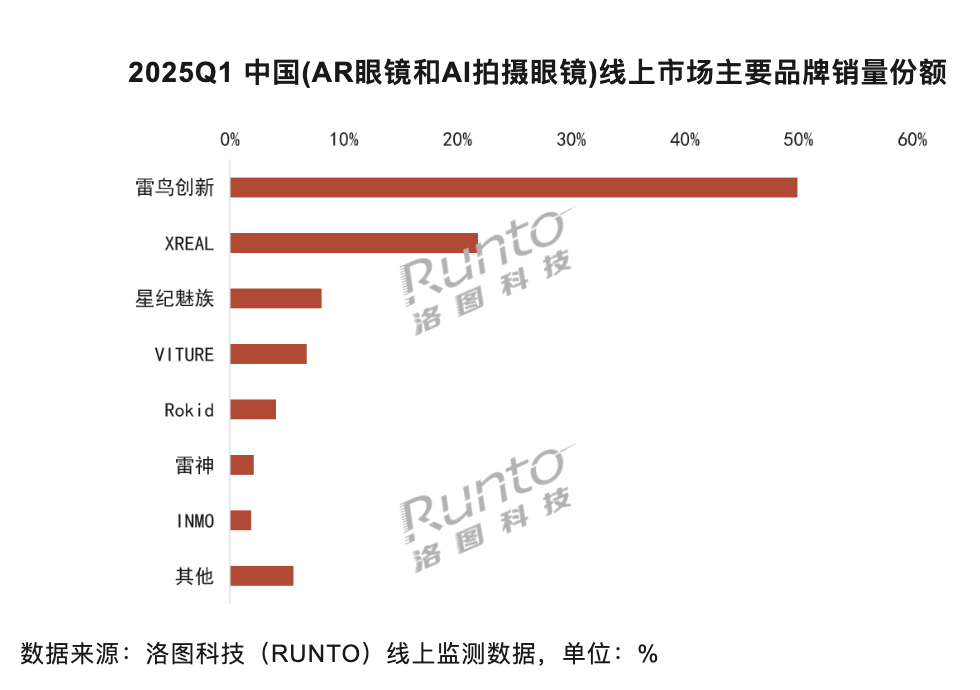
Group 1 - The core viewpoint of the articles highlights the significant growth in the Chinese XR device market, with a projected 26.7% increase in unit sales and a 25.5% increase in sales revenue for Q1 2025 [1] - The total sales volume of consumer-grade XR devices in China is expected to reach 147,000 units, with AR devices alone accounting for 91,000 units, reflecting a remarkable year-on-year growth of 116% [1] - Leading brands in the AR glasses and AI shooting glasses market include Thunderbird Innovation, XREAL, Starry Sky Meizu, VITURE, and Rokid, with Thunderbird Innovation holding a dominant market share of 50% [1] Group 2 - The wearable smart device market is showing positive trends, with a 3% increase in manufacturing prices for these devices reported in April [4] - The market potential for AR and smart glasses is increasingly recognized, driven by the accelerated integration of AI and AR technologies, indicating a new growth cycle [4] - Major tech companies like Meta, Samsung, Apple, and Google are intensifying their R&D efforts in key technologies for glasses, with Google reportedly collaborating with domestic AR glasses manufacturers for new product launches [4] - Thunderbird Innovation is set to launch the ThunderX3 Pro, a full-color MicroLED AR glasses model, on May 27, featuring advanced display technologies and a strategic partnership with Alibaba Cloud for AI and AR glasses [4]

CINNO Research:一季度国内消费级AI/AR眼镜市场销量达9.6万台 同比增长45%
Zhi Tong Cai Jing· 2025-05-20 00:30
Core Insights - The domestic consumer-grade AI/AR glasses market saw sales reach 96,000 units in Q1 2025, marking a 45% year-on-year growth, with screen-based AR glasses accounting for 80% of the market share and non-screen AI glasses making up 20% [1][2] Market Drivers - The growth is driven by three core factors: 1. The benchmark effect from overseas products like Ray-Ban Stories, which activated domestic demand through a "hardware + ecosystem" model [2] 2. Technological iterations leading to a shift in consumer preferences towards lightweight AI glasses with real-time translation and voice interaction capabilities [2] 3. National policy subsidies injecting vitality into the market, particularly for non-screen AI glasses priced under 1,000 yuan [2] Market Structure - The market is characterized by significant structural differentiation, with the Birdbath + Micro OLED solution holding 85% of the AR glasses market share, while non-screen AI glasses are emerging as market leaders due to their cost-effectiveness [3] Competitive Landscape - Leading brand Thunderbird Innovation holds a dominant 45% market share, showcasing its strength in "hardware + algorithm + ecosystem" vertical integration [4][5] - XREAL ranks second with an 18% market share, leveraging its self-developed X1 spatial computing chip for enhanced user experiences [7] - Starry Meizu, with a 14% market share, capitalizes on its smartphone heritage to offer competitive AR glasses [8] - VITURE targets the high-end gaming segment, despite a smaller market share, by delivering superior visual experiences [9] - Rokid is shifting focus towards AI + AR glasses, aiming to establish a strong presence in both consumer and industrial markets [10] Industry Trends - The AI/AR glasses market is witnessing a surge in cross-industry participation, with major consumer electronics brands like Xiaomi and Huawei entering the space, emphasizing ecosystem integration over immediate sales [10] - Internet giants such as Baidu and Alibaba are also accelerating their entry into the market with self-developed AI glasses, contributing to a diversified competitive landscape [10] Market Outlook - The AI/AR glasses market is on the brink of a breakthrough, transitioning from niche products to essential tools for productivity, reshaping human-computer interaction and becoming a key entry point in the metaverse era [11]
Q1’25 国内消费级AI/AR市场销量同比涨45%,结构性变革加速
CINNO Research· 2025-05-19 16:51
Core Viewpoint - The domestic consumer-grade AI/AR glasses market is experiencing significant growth, with sales reaching 96,000 units in Q1 2025, a year-on-year increase of 45%, indicating a shift from novelty to necessity in smart living hardware [2] Market Overview - The market for consumer-grade AI/AR glasses is characterized by a structural differentiation, with screen-based AR glasses accounting for 80% of the market share and non-screen AI glasses making up 20% [2] - The growth is driven by three main factors: the benchmark effect from overseas products, technological iterations leading to replacement demand, and government subsidies supporting market vitality [2] Key Drivers of Growth - Benchmark Effect: The success of Ray-Ban Stories smart glasses has activated domestic demand for AI glasses through its "hardware + ecosystem" model [2] - Technological Iteration: The Birdbath + Micro OLED solution holds 85% of the AR glasses market, but lack of innovation is pushing consumers towards lightweight AI glasses with real-time translation and voice interaction features [2] - Government Support: Subsidies are energizing the market, particularly for non-screen AI glasses priced under 1,000 yuan and screen-based AR glasses priced between 1,000 to 4,000 yuan [2] Competitive Landscape - Leading brand Ray-Ban Innovation holds a dominant 45% market share, showcasing strong vertical integration of hardware, algorithms, and ecosystem [4][6] - XREAL follows with an 18% market share, leveraging its self-developed X1 spatial computing chip for enhanced user experiences [8] - Starry Meizu ranks third with a 14% market share, utilizing its smartphone brand influence to penetrate the AR glasses market [9] Product Innovations - Ray-Ban Innovation's flagship products, including the V3 AI shooting glasses, have rapidly gained market share, achieving 80% in the AI glasses segment [7] - XREAL's XREAL One glasses provide immersive AR experiences, while Starry Meizu's products benefit from cross-device synergy with its Flyme AIOS operating system [8][9] Future Outlook - The AI/AR glasses market is on the brink of a breakthrough, transitioning from niche products to essential tools for productivity, reshaping human-computer interaction [15] - The next three years are expected to see a significant evolution in the market, with AI/AR glasses becoming a key component of smart living [15]

2024年消费级AR眼镜市场动态与行业趋势洞察
艾瑞咨询· 2025-05-14 12:41
Core Insights - The report highlights the rapid evolution of consumer-grade AR glasses, driven by advancements in optical display and AI integration, leading to a competitive landscape among various manufacturers [1][2][4]. Industry Status - Continuous R&D investment in the AR sector by domestic and international companies is fostering technological innovation and product development. Major players include internet giants, smartphone manufacturers, and AR startups, with a significant shift towards AI integration in AR glasses [2][19]. - The domestic AR glasses market is characterized by a strong presence of local brands such as Starry Sky Meizu, Thunderbird Innovation, XREAL, Rokid, and INMO, collectively referred to as the "Five Little Dragons" of AR glasses, which are rapidly gaining market share against foreign competitors [2][19][21]. Market Overview - In 2024, AR glasses sales reached 286,000 units, with Q4 witnessing record-high sales due to new product launches. Leading brands dominate the market, each carving out niches based on specific advantages [2][23][26]. - The market is expected to maintain momentum into 2025, with ongoing product innovations enhancing portability, functionality, and technology [23][29]. Company Analysis - The report provides an in-depth analysis of leading brands such as Starry Sky Meizu, Thunderbird Innovation, and XREAL, focusing on their product launches, technological advancements, and ecosystem collaborations [3][34][46]. - Starry Sky Meizu is noted for its significant investment in optical waveguide technology and AI integration, positioning itself as a leader in the AR glasses market [42][44]. Technological Trends - Optical waveguide technology is identified as a key driver for the future of consumer-grade AR glasses, offering advantages in lightweight design, high transparency, and display quality [8][50]. - The integration of AI into AR glasses is enhancing user experience and expanding application scenarios, making these devices more appealing to consumers [51][52]. Competitive Landscape - The competitive dynamics of the AR glasses market are influenced by short-term hardware specifications and popular products, while long-term success will depend on cross-device collaboration, developer ecosystems, and data asset depth [55].

8年融了11轮的AR独角兽,落地上海
3 6 Ke· 2025-05-14 07:21
Core Insights - Shanghai's Pudong Venture Capital Group has made a significant investment of 200 million yuan in XREAL, a leading AR unicorn, to support its headquarters establishment in Pudong and enhance its technological and production capabilities [1][12] - XREAL, founded in 2017 by former employees of major tech companies, has become a dominant player in the consumer AR glasses market, achieving top sales on Amazon and leading global market share for three consecutive years [1][10] - The collaboration between XREAL and Pudong is expected to create a robust AR industry ecosystem, leveraging Shanghai's resources, policies, and talent [2][11] Company Overview - XREAL, originally named "nreal.ai," was established in Beijing and has raised over 300 million USD through multiple funding rounds, with notable investors including Sequoia China and Alibaba [7][10] - The company focuses on mixed reality technology and AR glasses production, with a strong emphasis on innovation and technological advancement [1][4] - XREAL's leadership team, primarily composed of Zhejiang University alumni, has a strong technical background, contributing to the company's rapid growth and market leadership [4][8] Industry Context - The global AR market is projected to grow significantly, with IDC estimating that the smart glasses market will ship 12.05 million units by 2025, reflecting an 18.3% year-on-year increase [11] - Shanghai is positioning itself as a global innovation hub, with initiatives like the establishment of mother funds for key industries, including integrated circuits and AI, to foster long-term investment in hard technology [3][17] - The collaboration among Zhejiang University alumni in the AI/AR sector aims to enhance technological innovation and create a competitive edge in the industry [8][9]
领益智造连续5个季度双位数增长,AI眼镜业务“百镜大战镜镜有我”
Xin Lang Cai Jing· 2025-04-28 12:21
Core Insights - The company reported a revenue of 11.494 billion yuan for Q1 2025, marking a year-on-year growth of 17.11% [1] - Net profit attributable to shareholders reached 565 million yuan, up 23.52% year-on-year, while the net profit excluding stock incentive expenses was 641 million yuan, reflecting a 37.59% increase [1] - The company has achieved over 100 billion yuan in quarterly revenue for three consecutive quarters and has maintained double-digit year-on-year growth for five consecutive quarters [1] Group 1: Company Performance - The company has made significant progress in various innovative fields, including robotics, AI glasses, foldable screens, and servers, contributing to its revenue and profit growth [1] - The AI glasses market is expected to experience explosive growth in 2025, with the company positioned to leverage its manufacturing capabilities and strategic foresight [1] Group 2: Industry Trends - In 2024, the company generated 4.041 billion yuan in revenue from AI glasses and XR wearable devices, focusing on core components and technology development for AR, VR, MR, and AI glasses [2] - The company is a long-term strategic partner of XREAL, contributing to the production of AR glasses and providing essential components and assembly services [2] - Global AI glasses shipments are projected to reach 6.86 million units in 2025, a 265% increase from 2024, indicating a rapidly growing market [3] - The AI glasses industry is expected to evolve into the next major computing platform, with significant sales growth anticipated through 2035 [3][4]

博士眼镜2024年营收12.03亿元 积极拥抱智能眼镜浪潮
Zheng Quan Ri Bao· 2025-04-15 11:38
Group 1 - The core viewpoint of the article highlights the performance of 博士眼镜 in 2024, with a revenue of 1.203 billion yuan, representing a year-on-year growth of 2.29%, while the net profit attributable to shareholders decreased by 19.08% to 104 million yuan [2] - 博士眼镜 operates in the eyewear retail industry, focusing on the downstream segment of the eyewear supply chain, and has expanded its offline sales channels and brand promotion efforts [2] - As of December 31, 2024, 博士眼镜 had a total of 557 stores, including 510 direct-operated stores and 47 franchised stores [2] Group 2 - The company is actively embracing the wave of smart technology, aiming to integrate traditional eyewear with smart solutions, particularly in the fitting services for smart glasses [3] - In August 2024, 博士眼镜 signed a cooperation agreement with 雷鸟创新 to jointly establish a company for the development of smart eyewear products, with the 雷鸟 V3 AI shooting glasses set to launch on January 7, 2025 [3] - 博士眼镜 is upgrading its retail stores, having installed smart eyewear showcases in over 100 locations to enhance consumer experience and increase product conversion rates through a "try before you buy" model [3]

中国AR眼镜热销海外 跨境电商助高科技产品“走出去”
Huan Qiu Wang Zi Xun· 2025-04-02 14:44
来源:中国新闻网 中新社北京4月2日电 (记者 夏宾)中国跨境电商的生意出现变化:高科技、高单价商品的需求持续高 涨。 "去年我们的AR眼镜全球销售额约6亿元(人民币,下同),海外业务占比接近70%,海外业务销售额同比 增长了30%。"消费级AR眼镜公司XREAL全球销售业务负责人张龙杰介绍。由于需求旺盛,该公司去年 12月发售的新品XREAL One在日本、北美等市场一度因供不应求,导致渠道断货两个月。 2024年,速卖通针对中国品牌海外认知度低、营销推广成本高、本地化能力不足等痛点,推出了"百亿 补贴品牌出海"计划,挖掘商机、营销推广,为商家提供了全链路的出海解决方案。 XREAL于当年加入"百亿补贴品牌出海",类目趋势的爆发加上"百亿补贴"的带动,XREAL在平台的年 销售额突破1000万元,大促节点更是不断攀升新高。 近日,速卖通透露了其"百亿补贴品牌出海"的最新计划,今年帮助1000个新品牌实现百万美元销量的突 破,在其发布的2025年品牌出海十大机会类目中,智能机器人、储能电池、AR眼镜等类目上榜。(完) 中新社记者2日了解到,在中国"出海四小龙"之一速卖通刚刚结束的3月周年庆大促中,以XREAL ...
AR眼镜海外销量暴增600% 跨境电商平台成中国科技品牌“出海跳板”
Sou Hu Cai Jing· 2025-04-02 07:00
Group 1 - The demand for high-tech and high-priced products, particularly AR/VR glasses, is experiencing significant growth, with a 600% increase in daily sales during the March promotion on platforms like AliExpress [1] - XREAL reported a global sales revenue of approximately 600 million RMB for AR glasses last year, with nearly 70% of sales coming from overseas markets, which saw a year-on-year growth of 30% [3] - The AR glasses market faces challenges such as low penetration rates, the need for market education, compliance certification across different countries, high R&D costs, and technical limitations like battery life [3] Group 2 - Cross-border e-commerce platforms are seen as essential partners for brands looking to expand internationally, addressing issues like low brand awareness, high marketing costs, localization challenges, and compliance hurdles [3][4] - The "100 billion subsidy" initiative has significantly boosted sales for XREAL, with annual sales on AliExpress surpassing 10 million RMB, and sales during promotional events continually reaching new highs [4] - XREAL aims to strengthen collaboration with cross-border e-commerce platforms, particularly in marketing resources, to further enhance sales and market expansion [4]
AI大家说 | AI眼镜,物理外挂还是时尚挂件?
红杉汇· 2025-03-30 02:55
Core Viewpoint - AI glasses are evolving from a niche product to a necessity in the AI era, integrating various functionalities and enhancing digital social experiences [2][3] Market Trends - The global shipment of AI glasses is projected to reach 4 million units by 2025, with a significant increase in the Chinese market, expected to hit 2.8 million units, reflecting a year-on-year growth of 107% [2] - IDC forecasts a total of 12.8 million units globally by 2025, marking a 26% increase [2] Product Development - Current mainstream AI glasses include audio, photography, and AR+AI models, featuring multi-modal interaction capabilities [3] - The market is currently dominated by AI glasses focused on photography and audio interaction, but advancements in MEMS micro-projection and waveguide display technologies are expected to drive deeper integration of AI and AR [3] Historical Context - The journey of AI glasses began in 2012 with Google, followed by products from Epson and Microsoft, leading to consumer-focused models from 2017 to 2022 [6] - The introduction of RayBan Meta in 2023 marked a turning point, combining AI technology with user-friendly features, resulting in significant sales [6][7] Challenges and Opportunities - The industry faces challenges such as product weight, battery life, and functionality, which are critical for increasing shipment volumes [11][12] - The need for improved comfort and extended battery life is essential for the growth of the AI glasses market [12] Competitive Landscape - As more companies enter the AI glasses market, product homogeneity is becoming a concern, making unique interactive experiences a key competitive advantage [13] - The perception of AI functionality among consumers remains low, with a focus on basic attributes like comfort and image quality [13] Privacy and Security - The increase in AI glasses functionality raises concerns about user data privacy and security, necessitating careful consideration in product design [14] Future Insights - The integration of audio and photography capabilities is expected to accelerate the application of AI models in wearable devices [15] - Collaboration among various market players, including internet firms and traditional eyewear manufacturers, will be crucial for market growth [15]