
天合光能

Search documents
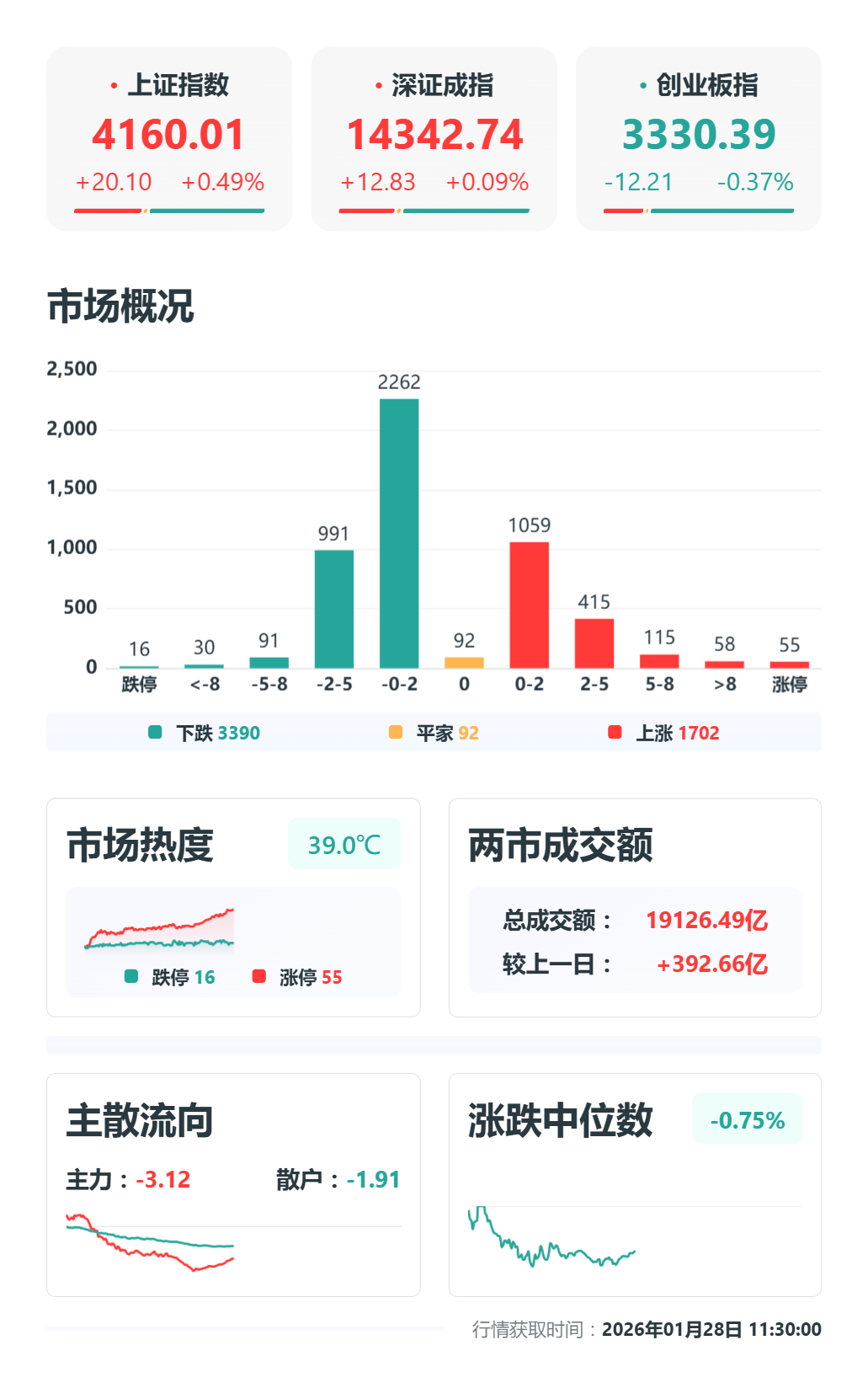
午评:沪指涨0.49%,创业板指跌0.37%,贵金属、油气方向领涨, 光伏股集体下跌
Jin Rong Jie· 2026-01-28 03:54
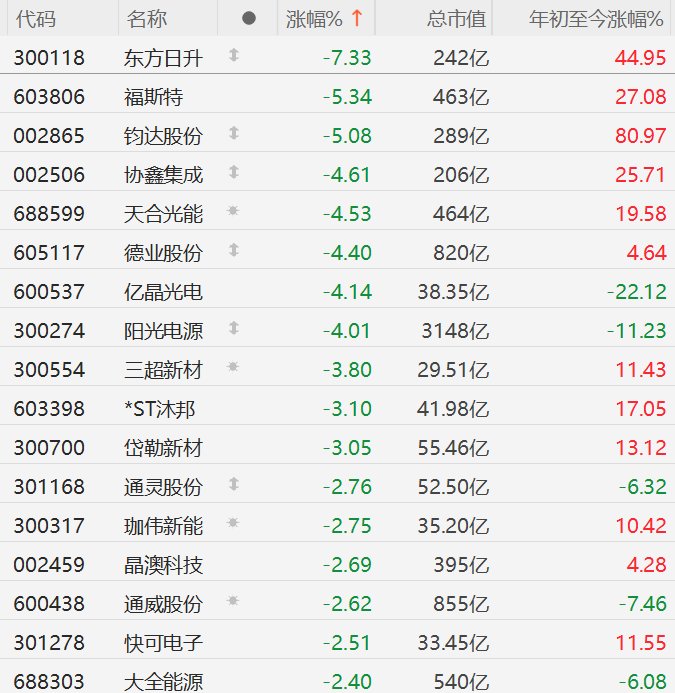
截至午间收盘,沪指涨0.49%,报4160.01点,深成指涨0.09%,报14342.74点,创业板指跌0.37%,报3330.39点,科创50指数跌0.73%,报1544.62 点。沪深两市合计成交额19126.49亿元,全市场超3300只个股下跌。 责任编辑:栎树 资源股集体爆发,贵金属、油气方向领涨,中国黄金4连板,湖南黄金3连板,四川黄金10天6板,招金黄金8天5板,中国海油涨超7%续创历史新 高,石化油服、准油股份涨停。 分散染料概念集体走高,浙江龙盛、闰土股份、亚邦股份涨停。存储芯片概念表现活跃,普冉股份涨超15%续创历史新高,气派科技20CM涨停。 下跌方面,病毒防治概念集体下挫,之江生物跌超9%。 光伏股集体下跌,东方日升跌超7%,福斯特、钧达股份跌超5%,协鑫集成、天合光能、德业股份、亿晶光电、阳光电源跌超4%。 国内商品期货多数上涨,集运欧线涨超5%,沪铝、沥青、铝合金涨超4%,氧化铝涨超3%,沪金涨近3%,沪银、原油、燃料油、沪锌、沪锡涨超 2%,纯苯、尿素、甲醇、豆油涨超1%。跌幅方面,碳酸锂跌超2%,不锈钢、沪镍、多晶硅跌超1%。 股票频道更多独家策划、专家专栏,免费查阅>> ...


A股光伏股集体下跌,阳光电源跌超4%
Ge Long Hui A P P· 2026-01-28 03:50
| 代码 | 名称 | | 涨幅% ↑ | 总市值 | 年初至今涨幅%。 | | --- | --- | --- | --- | --- | --- | | 300118 | 东方日升 | 1 | -7.33 | 242亿 | 44.95 | | 603806 | 福斯特 | | -5.34 | 463亿 | 27.08 | | 002865 | 钧达股份 | 1 | -5.08 | 289亿 | 80.97 | | 002506 | 协鑫集成 | 1 | -4.61 | 206亿 | 25.71 | | 688599 | 天合光能 | 长 | -4.53 | 464亿 | 19.58 | | 605117 | 德业股份 | 1 | -4.40 | 820亿 | 4.64 | | 600537 | 亿闘米甲 | | -4.14 | 38.35亿 | -22.12 | | 300274 | 阳光电源 | 1 | -4.01 | 3148亿 | -11.23 | | 300554 | 三超新材 | 报 | -3.80 | 29.51亿 | 11.43 | | 603398 | *ST沐邦 | | -3.10 | ...




东吴证券:卫星目前关键能源、火箭运力或迎非线性增长 太空算力空间远大
智通财经网· 2026-01-28 02:21
海外运力加速、太空算力落地在即 近期马斯克陆续表态:1)特斯拉和SpaceX未来三年计划各自建设100GW/年产能,马斯克预计2-3年内 规模化太空算力成为现实;2)星舰今年目标完全复用、进入太空成本将下降100倍。三年内星舰发射频 率将超每小时1次,终极目标每年生产1万艘星舰。按星舰100吨次的近地运力计算,年运载量可达100万 吨;若按1吨/颗卫星计算,3年内年发射量可达百万颗,较当前3000颗/年实现非线性增长,空间远大。 智通财经APP获悉,东吴证券发布研报称,太空商业活动迎来爆发期。海外方面,马斯克提出星舰将实 现完全复用并大幅提升发射频率。国内进程同步加速,已提交超20万颗卫星频轨申请,中国星网等星座 计划将进入密集发射阶段。技术层面,柔性钙钛矿组件因其高效轻薄的特性,成为太空光伏供能的关键 路径。相关产业链有望迎来高速发展机遇。 东吴证券主要观点如下: 国内产业化提速、战略重视度高 投资建议:商业航天+低轨卫星加速发展背景下,太空光伏供能最优、或有望迎来高速发展。1)推荐 太空电源:钧达股份(合作尚翼布局卫星钙钛矿+CPI膜)、明阳智能(布局钙钛矿、HJT技术及砷化 镓)、关注东方日升(P型HJ ...

1个月内3家光伏企业被"追债"上亿元,原因何在
Di Yi Cai Jing· 2026-01-28 02:10
Core Viewpoint - The photovoltaic industry is transitioning from assembly-based growth to a focus on technology, cost, and cash flow, leading to challenges in fulfilling expansion project commitments, as evidenced by recent developments involving companies like *ST Muban and Yijing Photovoltaic [1][2]. Group 1: Company Developments - *ST Muban was ordered by the Wuzhou Municipal Government to return a total of 510 million yuan in project financial subsidies and construction support funds, along with a penalty of 51 million yuan, due to delays in project construction [1]. - Yijing Photovoltaic announced that its project in Chuzhou faced potential termination and a demand for the return of 14 million yuan due to construction delays [1]. - Bangjie Co. is undergoing pre-restructuring initiated by a state-owned enterprise, with claims amounting to 326 million yuan due to the company's failure to complete a buyback on time [2]. Group 2: Industry Context - The photovoltaic industry experienced significant growth in 2022, with total output value exceeding 1.4 trillion yuan, a year-on-year increase of over 95%, and production across various segments rising by more than 55% [2]. - Local governments have heavily supported the photovoltaic sector through financial subsidies, tax incentives, and land guarantees, which have facilitated rapid scale production and technological advancements [3]. - However, the rapid expansion has led to issues of overcapacity and risks associated with companies lacking relevant industry experience, as seen with *ST Muban and Bangjie Co., which both transitioned from unrelated sectors [4]. Group 3: Recommendations for Future Development - Experts suggest that local governments should shift from "universal subsidies" to "innovation incentives," focusing resources on advanced technologies and mature smart manufacturing enterprises [5]. - There is a call for a transition from "administrative intervention" to "market guidance" to create a fair competitive environment and eliminate local protectionism [5]. - The central government plans to address issues of excessive local incentives in investment attraction by establishing clear guidelines for permissible and prohibited practices [6].


电力设备行业点评报告:太空光伏:卫星目前关键能源、火箭运力或迎非线性增长,太空算力空间远大
Soochow Securities· 2026-01-28 01:50
Investment Rating - The report maintains an "Overweight" rating for the power equipment industry [1][4]. Core Insights - The space photovoltaic sector is expected to experience significant growth due to advancements in satellite energy and rocket capacity, with a potential for non-linear growth in space computing capabilities [4]. - Recent statements from Elon Musk indicate plans for Tesla and SpaceX to establish 100GW annual production capacity each within three years, with a projected 100-fold reduction in space launch costs [4]. - China is accelerating its satellite deployment, with a record application for frequency resources for 203,000 satellites, and plans to launch 13,000 low-orbit satellites between 2026 and 2030 [4]. - Continuous technological advancements are being made, particularly with the introduction of perovskite solar cells, which are expected to penetrate the market rapidly due to their energy-to-weight ratio advantages [4]. - The report suggests investment opportunities in companies involved in space power supply and equipment manufacturing, highlighting specific firms such as JunDa Co., MingYang Smart Energy, and others [4]. Summary by Sections Industry Trends - The report outlines a significant increase in satellite launches, projecting a rise from 3,000 to 1 million launches annually within three years, indicating a vast market potential [4]. - The domestic industry is gaining momentum with strategic importance placed on space computing and satellite deployment [4]. Technological Developments - The introduction of flexible perovskite solar cells is highlighted, with successful deliveries and planned launches aboard SpaceX rockets [4]. - Major manufacturers are progressively adopting perovskite technology, which is expected to enhance market penetration [4]. Investment Recommendations - The report recommends investing in companies that are positioned to benefit from the growth in commercial space and low-orbit satellites, including those involved in advanced solar technologies and equipment manufacturing [4].
startrader:白银月涨超60% 产业链冷暖不均
Sou Hu Cai Jing· 2026-01-28 01:47
谨慎派则警示多重风险,当前白银技术面已处于极端超买状态,短期回调压力累积。若光伏替代技术落 地进度超预期,可能修正白银需求预期;美联储降息进程不及预期或美元走强,将压制其金融属性。此 外,交易所可能通过提高保证金等措施抑制投机,叠加获利盘了结,均可能引发价格剧烈震荡。影响后 续走势的关键变量,集中在技术替代节奏、货币政策落地及供需缺口修复速度上。 2026年开年不到一个月,国际白银市场迎来疯狂涨势,伦敦现货白银价格最高突破117美元/盎司,累计 涨幅超60%,凌厉走势远超黄金,金银比一度跌至50附近,创下近13年新低。这场行情既改写了产业链 利润分配格局,也呈现出"上游欢腾、下游承压"的分化态势,背后是供需、产业与金融属性的多重共 振,市场对后续走势的博弈持续升温。 价格狂欢之下,白银产业链上下游呈现出截然不同的境遇。上游矿企赚得盆满钵满,盛达资源2025年前 三季度净利润同比增长61.97%,湖南白银、白银有色等企业股价开年以来涨幅均超100%,多家企业加 速推进涉银矿产项目开发与并购,加码布局抢占红利。中游银浆企业凭借"银价+加工费"的背靠背定价 模式,基本规避银价波动风险,维持稳定盈利。 下游终端行业则 ...

1个月内3家光伏企业被“追债”上亿元
Di Yi Cai Jing Zi Xun· 2026-01-27 15:57
Core Viewpoint - The photovoltaic industry is transitioning from assembly to a focus on technology, cost, and cash flow, leading to challenges in fulfilling expansion project commitments, as evidenced by recent financial disputes involving companies like *ST Muban and Yijing Photovoltaics [2][3]. Group 1: Company-Specific Issues - *ST Muban was ordered to return a total of 5.1 billion yuan in project financial subsidies and construction support funds to the Wuzhou government due to delays in project construction [2]. - Yijing Photovoltaics faced a similar situation where its project in Chuzhou was delayed, leading to a potential termination of investment agreements and a demand to return 140 million yuan [3]. - Bangjie Co. is undergoing pre-restructuring due to failure to complete a buyback agreement, resulting in a claim for 326 million yuan from a state-owned enterprise [3]. Group 2: Industry Trends - The photovoltaic industry experienced explosive growth in 2022, with total output value exceeding 1.4 trillion yuan, a year-on-year increase of over 95%, and production across various segments rising by more than 55% [3]. - Local governments have heavily supported the photovoltaic sector through financial subsidies, tax incentives, and land guarantees, which have played a crucial role in the industry's rapid scale-up [5]. - However, the rapid expansion has led to issues of overcapacity and risks associated with companies lacking relevant industry experience, as seen with *ST Muban and Bangjie Co. [6]. Group 3: Recommendations for Future Development - Experts suggest that local governments should shift from broad subsidies to innovation incentives, focusing resources on advanced technologies and mature smart manufacturing [7]. - There is a call for a transition from administrative intervention to market guidance, emphasizing the need for a fair competitive environment and the establishment of a standard system [7]. - The central government plans to address issues related to improper incentives in local investment attraction, aiming to create a unified national market and mitigate "involution" competition by clarifying regulations [7].

1个月内3家光伏企业被“追债”上亿元
第一财经· 2026-01-27 15:50
Core Viewpoint - The photovoltaic industry is transitioning from a phase of rapid expansion to one focused on technology, cost, and cash flow, leading to challenges in project fulfillment and increased scrutiny of expansion projects [3][4]. Group 1: Company Issues - *ST Muban (603398.SH) was ordered by the Wuzhou Municipal Government to return a total of 510 million yuan in project financial subsidies and construction support funds due to delays in project construction [3]. - Yichin Photovoltaic (600537.SH) faced a similar situation where its project in Chuzhou was delayed, leading to a notice from the local government to potentially terminate the investment agreement and reclaim 140 million yuan [4]. - Bangjie Co., Ltd. (002634.SZ) is undergoing pre-restructuring due to failure to complete a buyback agreement, resulting in a claim for 326 million yuan from a state-owned enterprise [4][5]. Group 2: Industry Context - The photovoltaic industry saw a significant boom in 2022, with total output value exceeding 1.4 trillion yuan, a year-on-year increase of over 95%, and production across various segments increasing by more than 55% [5]. - Local governments heavily supported the photovoltaic sector through financial subsidies, tax incentives, and land guarantees, which played a crucial role in the rapid scaling and technological advancement of the industry [6]. Group 3: Market Challenges - The rapid expansion led to issues of overcapacity and risks associated with companies lacking relevant industry experience, as seen with *ST Muban and Bangjie, which both entered the photovoltaic sector without prior expertise [7]. - Calls for production cuts and capacity control have emerged as the industry faces excess supply, highlighting the consequences of aggressive local government investment strategies [7]. Group 4: Recommendations for Future Development - Experts suggest that local governments should shift from broad subsidies to innovation incentives, focusing resources on advanced technologies and mature smart manufacturing enterprises [8]. - There is a need for a transition from administrative intervention to market guidance, establishing a fair competitive environment through improved standards and regulations [8]. - The central government plans to address issues of improper incentives in local investment strategies by clarifying guidelines for招商引资 (investment attraction) practices [8].

疯狂的白银:不到一个月暴涨超60% 产业链“有人欢喜有人忧”
证券时报· 2026-01-27 15:10
白银,无疑是2026年以来最"风光"的金属品种,其风头不仅盖过了铜、铝等基本金属,也盖过了黄金等贵金属。 证券时报记者近日调查与采访发现,在白银价格猛烈上涨之际,却是"有人欢喜有人忧"。白银由于在工业上有广泛应用,其价格的大幅上涨已对相 关产业链带来深刻影响。 疯狂的白银:不到一个月暴涨超60% 白银价格涨势正在加速。 上游矿企"喜上眉梢" 下游光伏感受寒意 在白银价格连续大幅上涨之际,产业链上游的银矿企业自然成为其中的受益者。 比如,在银价走强等因素推动下,盛达资源2025年前三季度实现营业收入16.52亿元,同比增长18.29%,归属于上市公司股东的净利润3.23亿元, 同比增长61.97%。 以国际市场上的伦敦银现价格为例,行情数据显示,伦敦银现价格日前最高已突破每盎司117美元,这意味着在2026年以来不到一个月的时间里, 伦敦银现价格累计最大涨幅已经超过60%,如此快速且巨大的涨幅令人瞠目结舌,而且这还是在白银价格已经大涨的基础上实现。2025年,伦敦银 现价格全年累计涨幅超过140%,创下本世纪以来最大的年度涨幅。 (投资银条 吴家明/摄) 供需失衡被认为是白银价格连续大幅上涨的主要原因之一。华联 ...

1个月内3家光伏企业被“追债”上亿元 原因何在
Di Yi Cai Jing· 2026-01-27 13:49
Core Insights - The photovoltaic industry is transitioning from assembly-based growth to a focus on technology, cost, and cash flow, leading to challenges in fulfilling expansion project commitments [1] - Local governments have historically supported the photovoltaic sector through financial subsidies, tax incentives, and land guarantees, but this has led to overcapacity and risks for companies [3][4] Group 1: Company-Specific Developments - *ST Muban (603398.SH) was ordered by the Wuzhou Municipal Government to return a total of 5.1 billion yuan in project financial subsidies and construction support funds due to delays in project construction [1] - Yijing Photovoltaic (600537.SH) faced a similar situation where its project in Chuzhou was at risk of being terminated, with a potential recovery of 140 million yuan from the company due to construction delays [1] - Bangjie Co., Ltd. (002634.SZ) is undergoing pre-restructuring initiated by a state-owned enterprise due to its inability to complete a buyback, leading to a claim of 326 million yuan [2] Group 2: Industry Trends and Challenges - The photovoltaic industry saw a significant boom in 2022, with total output value exceeding 1.4 trillion yuan, a year-on-year increase of over 95%, and production across the supply chain rising by more than 55% [2] - The rapid expansion of the industry has led to overcapacity issues, with calls for production cuts and concerns about excessive local government investment in the sector [4] - The industry is shifting from a phase of scale expansion to one dominated by technology, necessitating a change in local government strategies from providing incentives to selecting viable projects and managing risks [6] Group 3: Recommendations for Future Development - Experts suggest that local governments should transition from "universal subsidies" to "innovation incentives," focusing resources on advanced technologies and mature smart manufacturing enterprises [5] - There is a need for a shift from "administrative intervention" to "market guidance" to create a fair competitive environment and eliminate local protectionism [5] - The central government plans to establish clear guidelines for local governments regarding investment incentives to prevent excessive and inappropriate subsidies [6]