Temu

Search documents
北美互联网流量趋势分析,对 META、AMZN、DASH、UBER、WBA、Y、GDDY 的积极趋势
2025-08-25 01:38
Summary of Key Points from the Conference Call Industry Overview - **Industry**: North America Internet - **Key Companies**: META, AMZN, DASH, UBER, EBAY, W, GDDY Core Insights and Arguments 1. **Positive Traffic Trends**: July website traffic data indicates positive trends for META, AMZN, DASH, UBER, EBAY, W, and GDDY, while online travel and SMB servicers show mixed trends [1][2] 2. **META Performance**: Instagram's minutes per daily active user (DAU) increased by 12% year-over-year (Y/Y) to approximately 53 minutes, attributed to AI ranking and recommendation improvements [1][2] 3. **eCommerce Traffic**: eCommerce web traffic remained soft in July, but app trends were more favorable, with Amazon's global monthly active users (MAUs) up 9% Y/Y and eBay's MAUs up 8% Y/Y [1][2] 4. **DASH and UBER Growth**: DoorDash's U.S. MAU growth accelerated to 21% Y/Y, while Uber's U.S. MAU grew by 5% Y/Y [1][2] 5. **App Download Trends**: ChatGPT remained the most downloaded app in the U.S. for the seventh consecutive month, despite a 6% month-over-month (M/M) decline in downloads [4][9] 6. **Digital Advertising**: Social media time spent in the U.S. increased by 1% Y/Y, with META's U.S. MAUs growing by 2.4% Y/Y in July [4][10] 7. **Streaming vs. Linear TV**: Streaming now accounts for 47.3% of TV viewing time, surpassing linear TV's 40.6% share, indicating a shift in consumer behavior [5][6] 8. **Google Search Stability**: Google's global search market share remained stable at 89.5% M/M in July, although it declined by 150 basis points Y/Y [5][6] 9. **GenAI App Usage**: ChatGPT's web unique visitors rose by 79% Y/Y to approximately 430-440 million in July, indicating strong growth in generative AI applications [5][6] 10. **eCommerce App Trends**: Positive app trends were noted for Amazon, Temu, eBay, and Wayfair, with significant growth in downloads and MAUs [6][7] Additional Important Insights 1. **Online Marketplaces**: DoorDash and Uber showed positive trends in app MAUs, while Instacart's MAU declined by 2% Y/Y [7][8] 2. **Online Travel Performance**: Mixed growth in mobile app and web traffic for online travel companies, with Airbnb's MAUs up 12% Y/Y [7][8] 3. **SMB Servicers**: GoDaddy's U.S. traffic grew by 7% Y/Y, while Wix's traffic decline improved to -5% Y/Y [7][8] 4. **Online Real Estate**: Zillow outperformed peers with a smaller decline in web traffic compared to Redfin and Realtor.com [7][8] 5. **Online Dating Trends**: Hinge showed positive growth, while Tinder and Bumble faced challenges with MAU declines [7][8] This summary encapsulates the key points from the conference call, highlighting the performance of major companies within the North American internet sector and the overall trends affecting the industry.



Tariffs Still A Wildcard For Five Below As Growth Story Evolves, Says Analyst
Benzinga· 2025-08-22 17:07
Core Viewpoint - Five Below, Inc. is demonstrating signs of regaining momentum with stronger sales growth, robust same-store performance, and an accelerating store expansion strategy [1] Sales and Growth Projections - Analyst Joseph Feldman projects sales growth of approximately 20% to $994 million, driven by 30 new store openings, which represents an 11.3% unit growth [4] - For the second quarter of 2025, comps are expected to rise by 9.0%, surpassing FactSet's estimate of 8.6% [3] - The company is expected to benefit from a favorable comparison to last year's comp decline of 5.7% [4] Profitability and Margin Expectations - Feldman forecasts a contraction in operating margin of 19 basis points to 4.3%, with gross margin down 20 basis points to 32.5% due to tariff pressures [6] - SG&A expenses are expected to remain flat at 28.3%, as strong comps offset higher labor and incentive compensation costs [6] Strategic Focus and Market Position - Five Below is focusing on core customers, trend-right merchandising, and price-point adjustments, with most items priced in the $1–$5 range [5] - The company is likely to gain from the U.S. government's closure of the de minimis exemption loophole, which previously favored low-cost competitors [5] Analyst Ratings and Price Forecasts - Telsey Advisory Group reaffirmed a Market Perform rating and raised the 12-month price forecast by $16 to $144 [2] - Other analysts have also raised their price forecasts, with Citigroup increasing its forecast from $135 to $142, and Mizuho from $115 to $132 [7][8] - Loop Capital upgraded the stock from Hold to Buy, boosting its forecast from $130 to $165, the highest among the group [8]



对美“低价直邮+小额免税”时代终结,纺织外贸当如何应对?
Sou Hu Cai Jing· 2025-08-22 10:17
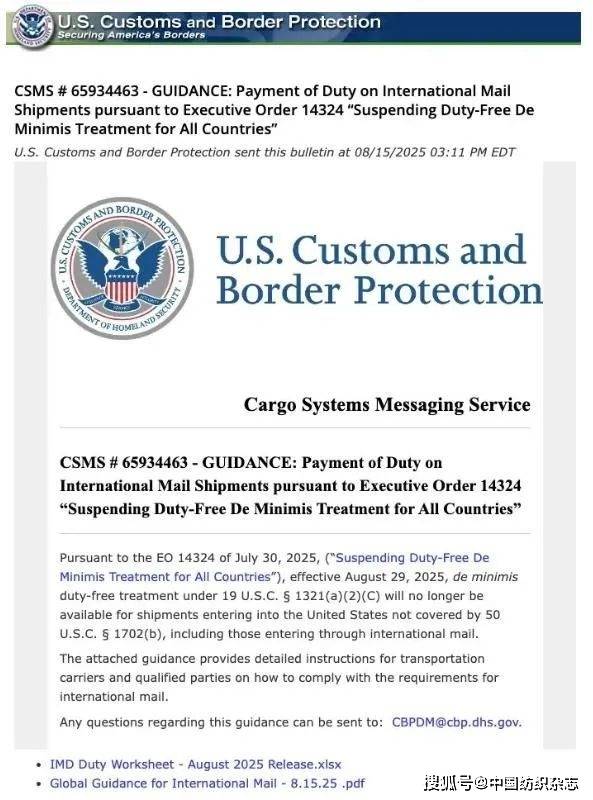
当地时间8月15日,美国海关和边境保护局(CBP)发布公告,根据2025年7月30日特朗普签署的第14324号行政命令("暂停所有国家的最低免税额待 遇"),8月29日起,美国正式取消针对所有国家的低价值商品免税待遇。 自2025年8月29日起,所有国家/地区通过邮递出口至美国的货物包裹不再享受免税待遇,必须通过标准海关申报程序进入美国,提交完整的进口文件,并 根据美国进口关税表(HTSUS)缴纳适用的关税,包括额外加征的关税。 税怎么交? 先说一下外贸人最关心的话题——新规生效后,低值商品寄到美国去,税该怎么交。 在2026年2月28日,有两种方法可以计税(以下详解),每个月只能选一种方法;在2026年2月28日之后,所有通过国际邮政网络运往美国的涵盖货物必须 使用从价关税法(方法1)计算关税。 方法1:从价关税法 按货物原产国有效IEEPA关税税率(对等关税、芬太尼关税),对每件应税包裹价值征收等额关税 中国商品的IEEPA有效税率为10%对等关税+20%芬太尼关税。 该方法需要填写《CBP国际邮件报关工作表》,如下所示: | CBP International Mail Duty Worksheet | ...
亚马逊Q2财报:零售巨头真正的生意不在“卖货”?
3 6 Ke· 2025-08-22 08:53
Core Insights - Amazon is transitioning from being labeled solely as a "retail company" to a diversified technology giant, with advertising, AWS, and seller services becoming the main profit drivers [1][14]. Group 1: Retail Business Performance - In Q2 2025, Amazon's online store sales grew by 11% year-over-year, reaching $61.5 billion, while physical store sales increased by 7% to $5.6 billion [4]. - Despite the growth in retail, its profit margins remain low due to intense price competition, making it less significant in terms of overall profitability [6][10]. - Competitors like Shein and Temu are impacting the U.S. market with low prices, increasing competitive pressure on Amazon's retail segment [7][8]. Group 2: Revenue Breakdown - Total revenue for Amazon reached $167.7 billion, a 13% year-over-year increase, with operating income at $19.17 billion, up 31% [9]. - AWS generated nearly $31 billion in revenue, growing 17.5% year-over-year, maintaining a significant market share in cloud services [12]. - Advertising revenue surged to $15.7 billion, marking a 23% increase, positioning Amazon as the third-largest digital advertising platform globally [11]. Group 3: Strategic Shifts - Amazon is focusing on rural and small-town markets, planning to expand same-day and next-day delivery services to over 4,000 locations by the end of the year [14]. - The company is investing over $4 billion by 2026 to enhance logistics and distribution networks in rural areas, aiming to establish a competitive edge in underserved markets [14]. Group 4: Future Outlook - The shift from retail to a mixed structure of low-margin retail and high-margin services is seen as essential for Amazon's long-term growth [12][14]. - The evolving business model reflects a transition from "selling goods" to "selling traffic" and "selling technology," indicating a profound structural transformation [14].
日本跨境电商入门指南!三大主流平台+爆款选品推荐
Sou Hu Cai Jing· 2025-08-21 10:23
Market & Consumer Analysis - The Japanese cross-border e-commerce market is experiencing rapid growth and transformation, with a projected market size of $191.9 billion in 2024 and expected to exceed $260 billion by 2029, indicating stable growth [2] - The consumer demographic in Japan is diverse, with significant segments including the elderly population, which accounts for nearly 30% of the population aged 65 and above, holding over half of the national wealth and prioritizing quality and service [3] - The rise of the "solo economy" is notable, with over half of Tokyo's population living alone, leading to increased demand for small appliances and minimalist home products [4] - Working women in Japan seek efficiency in their purchases, favoring time-saving products in beauty, convenience foods, and home cleaning [5] - Generation Z, born between 1997 and 2012, is a key demographic, being digital natives who are active on social media and prefer personalized, niche brands [5] Major Platforms - The Japanese e-commerce market is dominated by three major platforms: - Rakuten, the largest local e-commerce platform, holds a market share of 28.8% with over 120 million members, known for high user loyalty [5] - Yahoo! Shopping, with an approximate market share of 18%, offers stable traffic and strong search capabilities, particularly for second-hand goods [7] - Amazon Japan, which has a market share of about 25%, is recognized for its diverse product categories and high consumer trust [9] - New emerging platforms such as Temu, TK, and Mercari are also gaining traction, suggesting sellers should test the market on a small scale before deeper engagement [10] Product Selection Recommendations - Popular product categories for sellers to consider include: - Home and living products that are eco-friendly, convenient, multifunctional, and storage-efficient, such as collapsible storage boxes and smart small appliances [11] - Fashion items, particularly workplace attire, with a preference for minimalist designs, indicating a trend towards simple yet professional clothing [13] - Beauty and skincare products, where Japanese consumers show a strong interest in quality and efficacy, particularly in skincare with whitening, moisturizing, and anti-aging properties [15] Conclusion - The Japanese cross-border market presents both opportunities and challenges, emphasizing the importance of selecting the right platform and adhering to precise product selection strategies for sellers of all sizes to find their niche and achieve growth [15]

“习惯赚快钱”的中国企业,怎么做好日本市场?
3 6 Ke· 2025-08-20 08:53
Group 1: Market Dynamics - The increase in Chinese exports to Japan reached $157.52 billion in 2023, accounting for nearly 25% of Japan's total imports, making Japan China's second-largest export market [1] - The aging population in Japan, with 29.1% of the population aged 65 and above in 2023, creates significant demand for products catering to older adults, including eyewear and home medical facilities [2][3] - The rise of e-commerce in Japan, accelerated by the pandemic, has led to a projected online shopping penetration rate of 89% by 2025, providing opportunities for Chinese cross-border e-commerce platforms [3][4] Group 2: Consumer Behavior - Japanese consumers are known for their high standards and loyalty, which can lead to long-term profitability for brands that successfully build trust [6][7] - The demand for affordable products has surged as Japan emerges from a prolonged economic stagnation, with rising prices further amplifying this need [4][5] - Chinese brands are leveraging supply chain advantages to offer competitive pricing, with some products priced at half that of leading Japanese brands [5] Group 3: Challenges and Strategies - Entering the Japanese market requires patience and a long-term commitment, as quick returns are often unrealistic due to the unique consumer expectations [6][7] - Establishing trust and local relationships is crucial for success, as Japanese business culture emphasizes long-term partnerships [7][9] - The "three-person four-legged" model, which involves forming joint ventures with local companies, can enhance competitiveness and facilitate market entry for Chinese firms [9]
美国正式取消低值商品免税待遇,一文看懂8月29日之后如何交税!
Sou Hu Cai Jing· 2025-08-20 02:41
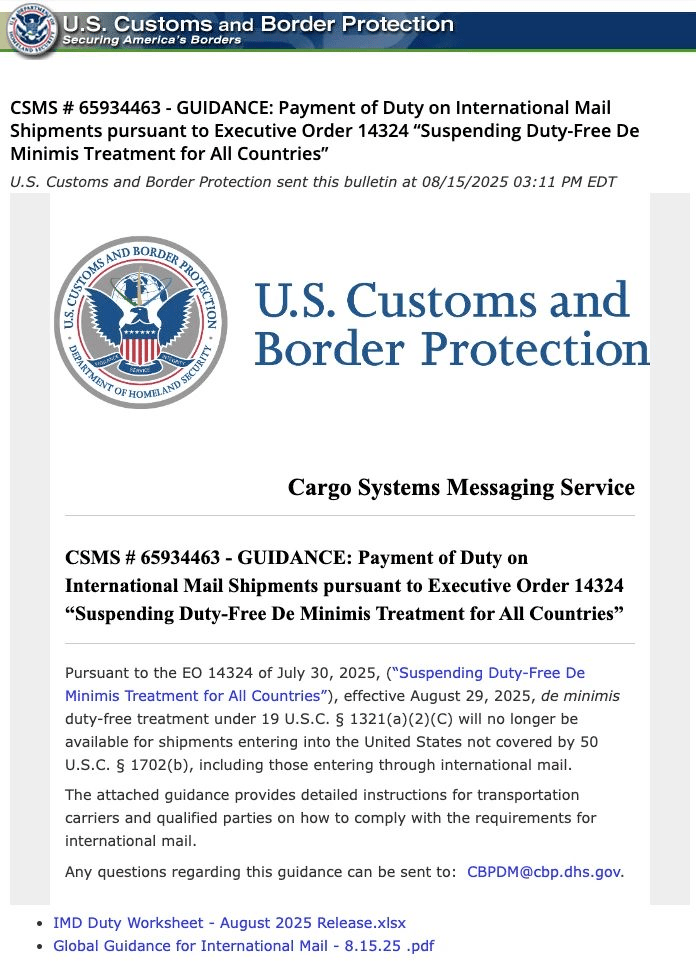
Core Viewpoint - The U.S. Customs and Border Protection (CBP) announced the cancellation of low-value goods tax exemptions for all countries starting August 29, 2025, following Executive Order 14324 signed by Trump on July 30, 2025 [1][3]. Group 1: Tax Regulations - From August 29, 2025, all goods exported to the U.S. via mail will no longer enjoy tax exemptions and must go through standard customs declaration procedures [3]. - Two methods for calculating taxes will be available starting February 28, 2026, with a requirement to choose one method per month [4]. - Method 1 involves the ad valorem tariff system, where duties are calculated based on the declared value of the goods, with specific rates for Chinese goods being 10% and an additional 20% for fentanyl [5][8]. Group 2: Compliance and Payment - The ad valorem method requires the completion of the CBP International Mail Duty Worksheet for customs declaration [6]. - Method 2, the specific tariff method, will impose duties based on the effective IEEPA tariff rate, with additional compliance requirements for goods exceeding $2,500 in value [8]. - Duties must be paid by the 7th business day of the month following the customs declaration, with penalties for late payments [8]. Group 3: Market Impact - The increase in small package import limits from $200 to $800 in 2016 led to a tenfold increase in small package imports to 1.36 billion items by 2023, significantly benefiting Chinese e-commerce platforms like Shein and Temu [9]. - Amazon has responded to the competitive pressure by launching its low-cost e-commerce platform, Haul, which will allow third-party sellers to ship directly from China to U.S. consumers starting in 2025 [9]. - The new regulations are expected to impact the growth strategies of Chinese e-commerce platforms, with companies like Temu and Shein emphasizing compliance with U.S. import regulations [9].
Shein 大动作:拟迁回中国,为港股 IPO 铺路?
阿尔法工场研究院· 2025-08-20 00:04
Core Viewpoint - Shein Group Ltd. is considering relocating its headquarters back to China to facilitate regulatory approval for its IPO plans in Hong Kong, following unsuccessful attempts to list in New York and London [2][3]. Group 1: IPO Plans and Regulatory Challenges - Shein has been facing difficulties in its IPO journey, particularly after failing to secure regulatory approval from the China Securities Regulatory Commission (CSRC) for a London listing, which has shifted its focus to Hong Kong [3][7]. - The company has submitted a confidential application for a Hong Kong IPO, which requires approval from Chinese regulatory authorities due to its substantial ties to China [2][3]. - The potential relocation to China could help Shein gain approval from Chinese regulators, as it would allow the company’s revenues to be taxed by Chinese authorities [4][6]. Group 2: Business Structure and Tax Implications - If Shein establishes a parent company in mainland China, its current Singapore headquarters and all overseas operations would become subsidiaries [5]. - The move back to China is also seen as a way to comply with new data security regulations that require local government oversight before an overseas IPO [6]. Group 3: Market Position and Valuation - Shein's valuation has significantly decreased from $100 billion three years ago to approximately $30 billion, largely due to competitive pressures from rivals like Temu and regulatory challenges in key markets [6]. - The company has faced scrutiny over allegations of forced labor in Xinjiang, which contributed to the abandonment of its New York listing plans [7]. - The Hong Kong IPO, if successful, would mark a significant milestone in a year where the market has become increasingly attractive for IPOs [8].

零售巨头“守门”,谁能撕开固化的德国电商体系?
Xin Lang Cai Jing· 2025-08-19 21:15
Core Insights - The German e-commerce market is experiencing a shift as Chinese platforms like Temu, SHEIN, and AliExpress penetrate the market with low prices and a wide range of products, challenging the dominance of local players like Amazon.de and Otto [11][12][13] Group 1: Market Dynamics - Kaufland.de has emerged as the third-largest e-commerce platform in Germany, with annual sales exceeding €1.5 billion and a continuous double-digit growth in GMV [3][6] - The integration of Kaufland's supermarket model with e-commerce has been recognized as a "German-style e-commerce template," showcasing a unique path for digital transformation in European retail [3][4] - The overall e-commerce growth in Germany is relatively slow, with local platforms experiencing only about 5.6% annual growth, while online retailers face a decline of approximately 1.2% [8][10] Group 2: Competitive Landscape - Chinese e-commerce players have gained significant traction in Germany, with Temu achieving a GMV of approximately $750 million in its first year, making it the 13th largest e-commerce platform [13] - The price sensitivity of German consumers has increased, with 35% preferring low-priced products and 68% comparing prices while shopping online, creating a favorable environment for Chinese platforms [13][14] - Kaufland has responded to the competitive pressure by launching the "Global Marketplace" initiative, allowing international sellers to join its platform, which now includes over 11,000 merchants [15][16] Group 3: Consumer Behavior - German consumers are increasingly open to using non-German sellers, with 15%-20% of young consumers trying cross-border e-commerce platforms, primarily valuing price and product variety [14] - The traditional shopping habits of German consumers, which emphasize quality assurance and after-sales service, are being challenged by the rapid growth of Chinese e-commerce platforms [12][17] - The shift in consumer preferences indicates a potential long-term change in the German e-commerce landscape, as exemplified by the experiences of consumers like Anna Müller, who appreciate the convenience and affordability of Chinese products [11][17]

Temu跻身美国电商前三!跨境卖家如何借势突围
Sou Hu Cai Jing· 2025-08-19 09:41
Core Insights - Temu has officially surpassed eBay in Q2 2024, ranking among the top three e-commerce platforms in the U.S. market, indicating a significant shift in the competitive landscape [1][4]. Market Overview - The current e-commerce landscape in the U.S. is dominated by Amazon as the leading platform, followed by Shein in second place, and now Temu has taken the third spot, pushing eBay down [2][3][5]. Temu's Advantages - **Massive Traffic Benefits**: Temu's daily active users have exceeded 1.2 million, providing substantial organic traffic opportunities for sellers, unlike Amazon where advertising costs are high [10]. - **Low Price Positioning**: Temu targets price-sensitive consumers with average order values between $10 and $15, making it easier to generate sales if prices are competitive [11]. - **Efficient New Product Testing**: New products can see sales within days on Temu, allowing sellers to quickly test and iterate their offerings [12]. - **High Brand Recognition**: Temu's aggressive advertising strategy, including Super Bowl ads, has established a strong brand identity as a low-cost shopping destination [13]. Challenges for Sellers - **Limited Profit Margins**: The low-price strategy results in thin profit margins, requiring sellers to have a stable supply chain to maintain profitability [14]. - **Intense Competition**: The influx of new sellers leads to rapid product imitation and short product life cycles, necessitating quick adaptation and innovation [15][16]. - **Tighter Platform Regulations**: Stricter seller requirements and penalties for violations have been implemented, increasing operational challenges [17]. - **Strict Account Management**: New restrictions on the number of stores per business entity complicate operations for sellers relying on multiple accounts [18]. Strategic Recommendations - **Multi-Platform Strategy**: Companies should maintain a presence on Amazon for high-ticket items while leveraging Temu for quick sales of lower-priced products [20]. - **Product Selection Strategy**: Focus on small, low-cost items initially to minimize risk and test market response [20]. - **Data Monitoring**: Regularly analyze platform data to optimize product offerings and quickly eliminate underperforming items [22]. - **Account Security**: Utilize tools like cross-browser solutions to maintain account integrity and avoid penalties [23]. Conclusion - The rise of Temu presents new opportunities for cross-border sellers, emphasizing the need for strategic positioning, risk management, and adaptability in a rapidly changing e-commerce environment [24].