京北方

Search documents
超四成资金用于项目场地投入 京北方11.30亿元再融资引关注
Xin Hua Wang· 2025-08-12 05:47
Core Viewpoint - The company, Jingbeifang, is planning to issue convertible bonds to raise up to 1.13 billion yuan for multiple projects and to supplement working capital, amidst concerns regarding the necessity and feasibility of simultaneous project implementation [1][5]. Group 1: Financing and Project Plans - Jingbeifang intends to issue convertible bonds totaling no more than 1.13 billion yuan, with over 40% of the funds allocated for project site investments [1][5]. - The company has faced delays and terminations in its initial public offering (IPO) fundraising projects, including the termination of the service base project, which will permanently supplement working capital by 14.25 million yuan [2][3]. - The company has changed the implementation method of its financial IT and innovation technology center projects from purchasing office buildings to self-building, extending the project timeline by three years [4]. Group 2: Financial Performance - Jingbeifang has shown steady revenue growth, with reported revenues of 2.29 billion yuan, 3.05 billion yuan, 3.67 billion yuan, and 3.12 billion yuan from 2020 to 2023, reflecting year-on-year growth rates of 35.90%, 33.22%, 20.27%, and 15.36% respectively [7]. - The company's accounts receivable have increased significantly, with balances of 563.48 million yuan, 772.55 million yuan, 777.19 million yuan, and 1.23 billion yuan over the same period, indicating a rising trend in accounts receivable as a proportion of total assets [8]. Group 3: Regulatory Scrutiny - The Shenzhen Stock Exchange has raised multiple inquiries regarding the necessity of refinancing, the termination of the service base project, and the company's ability to manage multiple projects simultaneously [3][6]. - Concerns have been expressed about the high proportion of outsourced service personnel, which accounted for 59.89% of the total workforce, prompting regulatory questions about the rationale behind this staffing strategy [9].


京北方(002987)8月11日主力资金净流出1693.69万元
Sou Hu Cai Jing· 2025-08-11 12:29
天眼查商业履历信息显示,京北方信息技术股份有限公司,成立于2009年,位于北京市,是一家以从事 软件和信息技术服务业为主的企业。企业注册资本86735.7451万人民币,实缴资本10200万人民币。公 司法定代表人为费振勇。 金融界消息 截至2025年8月11日收盘,京北方(002987)报收于20.15元,上涨0.7%,换手率2.92%,成 交量24.67万手,成交金额4.97亿元。 资金流向方面,今日主力资金净流出1693.69万元,占比成交额3.41%。其中,超大单净流出2073.27万 元、占成交额4.18%,大单净流入379.58万元、占成交额0.76%,中单净流出流入1308.67万元、占成交 额2.64%,小单净流入385.02万元、占成交额0.78%。 京北方最新一期业绩显示,截至2025一季报,公司营业总收入11.57亿元、同比增长3.74%,归属净利润 4673.23万元,同比减少3.71%,扣非净利润3833.77万元,同比减少18.98%,流动比率5.439、速动比率 5.361、资产负债率15.99%。 通过天眼查大数据分析,京北方信息技术股份有限公司共对外投资了7家企业,参与招投标 ...
金融IT深度报告:牛市复盘,金融IT何时发力
ZHESHANG SECURITIES· 2025-08-11 08:02
Investment Rating - The industry investment rating is optimistic [1] Core Insights - The financial IT sector shows significant elasticity during the initial stages of a bull market, with notable price increases and valuation expansions [3] - The combination of technology and finance attributes leads to a "Davis Double Play" effect during bull markets, particularly highlighted in 2015 [4] - Current advancements in AI and new business developments are expected to drive further growth in the financial IT sector [5] Summary by Sections 2014-2015: Liquidity Explosion, Financial Technology Leads - The bull market from 2014 to 2015 was driven by ample liquidity and the rise of mobile internet, leading to significant gains in financial technology stocks [15][19] - Financial technology stocks experienced substantial price increases, with some stocks seeing gains close to 450% compared to mid-2014 levels [4] - The financial IT sector benefited from increased investor participation and software usage during the bull market [33] 2016-2018: Structural Bull Market, Varied Performance in Financial Technology - The period from 2016 to 2018 was characterized by a structural bull market influenced by supply-side reforms and foreign capital inflows [43] - Financial technology stocks underperformed compared to the broader market during this period, primarily due to high valuations and changing market preferences [46][52] - The financial IT sector faced challenges as the market shifted focus towards blue-chip and consumer stocks, leading to a decline in growth stocks [56] 2019-2021: Core Assets Drive Structural Bull Market - The financial technology sector saw a resurgence from 2019 to 2021, driven by global liquidity and domestic industrial upgrades [70] - The introduction of the Sci-Tech Innovation Board in 2019 significantly boosted the financial technology sector, with strong performance noted in various market phases [76][81] - Financial technology stocks outperformed the market during key periods, reflecting the sector's recovery and growth potential [82]



打造金融科技新高地,金融科技ETF华夏(516100)持续强势,涨2.71%
Mei Ri Jing Ji Xin Wen· 2025-08-11 06:42
Core Viewpoint - The financial technology sector is experiencing significant growth, driven by strong performance in related stocks and supportive government initiatives aimed at fostering innovation and development in the industry [1]. Group 1: Market Performance - As of August 11, the financial technology ETF Huaxia (516100) rose by 2.71%, with key holdings such as Zhongke Jincai and Tonghuashun increasing by over 8% [1]. - Other leading stocks in the sector include Dazhihui, Hengbao, Guiding Compass, Wealth Trend, and Xinghuan Technology, all showing strong performance [1]. Group 2: Government Initiatives - The "AI Empowerment · Financial Technology Innovation Development Salon" was held in the Bund, where Huangpu District's Science and Technology Committee Director Wu Shuchun highlighted efforts to create a "Bund Financial Cluster + Central Innovation Zone" development model [1]. - The district aims to accelerate the establishment of a financial technology cluster through policy optimization, spatial expansion, and enhanced innovation activities [1]. Group 3: ETF Composition - The Huaxia financial technology ETF tracks the CSI Financial Technology Theme Index, which includes sectors such as software development, internet finance, and the digital currency industry [1]. - Major holdings in the index feature industry leaders like Tonghuashun, Dongfang Wealth, Hengsheng Electronics, and Runhe Software, along with stablecoin-related stocks, which constitute 22.59% of the ETF [1].



行业点评报告:GPT-5推升商业化加速,利好AI应用发展
ZHESHANG SECURITIES· 2025-08-08 13:48
Investment Rating - The industry investment rating is "Positive" (maintained) [3] Core Insights - The release of GPT-5 accelerates commercialization and benefits AI application development, showcasing significant improvements in user interaction and reliability [4][6] - GPT-5 integrates multiple models into a single intelligent system, enhancing user experience by automatically adjusting to user needs without manual intervention [4][5] - The reduction in hallucination rates (approximately 45% lower than GPT-4o and 80% lower than OpenAI o3) is crucial for AI applications in high-risk fields, enabling broader use cases [5][6] Summary by Sections GPT-5 Release Highlights - OpenAI officially launched GPT-5 on August 8, 2025, featuring model integration, lower hallucination rates, and reduced costs [4] - GPT-5 demonstrates superior performance in various benchmarks, including SWEBench (74.9% score) and HELP-Bench (97% in clinical tests), significantly outperforming previous models [4][6] Cost Reduction and Accessibility - GPT-5's strategies include free access to core capabilities, significantly reduced API pricing, and unlimited calls for enterprise users, lowering integration barriers for small developers and companies [7] - The API pricing is set at $1.25 per million tokens for input and $10 for output, making it more affordable than previous models [7] Investment Recommendations - The report suggests focusing on AI Agent applications, industry-specific applications, multi-modal applications, and AI in healthcare as key investment opportunities [7] - Companies to watch include those in enterprise services, education, marketing, finance, and healthcare sectors, which are expected to benefit from the advancements in AI technology [7]
OpenAI重磅发布GPT-5,同规模最大信创ETF(562570)迎配置时机!
Mei Ri Jing Ji Xin Wen· 2025-08-08 03:32
Group 1 - The China Securities Information Technology Application Innovation Industry Index decreased by 2.05% as of August 8, 2025, with mixed performance among constituent stocks [1] - The top-performing stocks included Nantian Information, which rose by 1.80%, and Hengsheng Electronics, which increased by 1.08%, while Zhuoyi Information led the decline with a drop of 8.26% [1] - The Xinchang ETF (562570) fell by 2.06%, with a latest price of 1.33 yuan, but saw a cumulative increase of 1.42% over the past week [1] Group 2 - OpenAI launched a new AI model named GPT-5, which offers enhanced capabilities in coding, creative writing, and complex query reasoning, described as a significant upgrade from previous models [2] - The model will be available to all free users and many paid ChatGPT subscribers, with paid users receiving higher usage limits, particularly benefiting computer programming [2] - Dongwu Securities highlighted that advanced packaging is fundamental to the development of domestic computing power, with increasing importance in the context of limited production capacity [2] Group 3 - The Xinchang ETF (562570) tracks the China Securities Information Technology Application Innovation Industry Index, focusing on leading companies in AI, data computing, industrial software, and information security [3] - It is the largest ETF tracking this index, which emphasizes self-controlled leading companies in cutting-edge technology sectors [3]
AI人才争夺战愈演愈烈 上市公司开高薪招贤纳士
Zheng Quan Ri Bao Zhi Sheng· 2025-08-06 16:10
Group 1 - The capital market is experiencing a "talent war" as companies like Pinduoduo actively recruit AI-related talent, with positions such as CUDA/GPU developers and AIGC algorithm engineers being in high demand [1] - Third-party recruitment platforms indicate that the monthly salary for AI-related positions can reach up to 60,000 yuan, with a minimum experience requirement of one year [1] - Other companies, including Beijing Four-Dimensional Map Technology Co., Great Wall Motors, and Beijing North Information Technology Co., are also seeking to hire AI talent, particularly in large model algorithm engineering [1] Group 2 - Many listed companies are intensifying their efforts to recruit AI talent this year, with China Unicom emphasizing the importance of talent in technology innovation and offering personalized services to attract top AI professionals [2] - China Telecom is also focusing on providing platforms for various talents and granting them autonomy in their work [2] - Kunlun Wanwei Technology Co. plans to increase its human resource costs to attract algorithm engineers and other AI-related positions [2] Group 3 - The demand for AI talent is significantly increasing across various sectors, including e-commerce, new life services, and new energy vehicles, with some leading e-commerce companies experiencing a surge in AI job openings [3] - The recruitment demand for positions such as AI product managers and large model algorithm engineers has seen a dramatic increase, with job postings rising several times compared to the previous year [3] - Average monthly salaries for new AI positions reached 53,500 yuan, with high-performance computing engineers earning over 79,000 yuan on average [3] Group 4 - The increase in salaries for R&D personnel reflects the intensifying competition in technological innovation, as companies must keep pace with global AI development trends to avoid being eliminated [4] - The strong emphasis on AI development in China, along with the ongoing "AI+" initiatives, indicates a robust willingness among companies to undergo digital transformation [4] - The rapid growth of AI applications has created a talent gap due to the relatively short development time in the field [4]

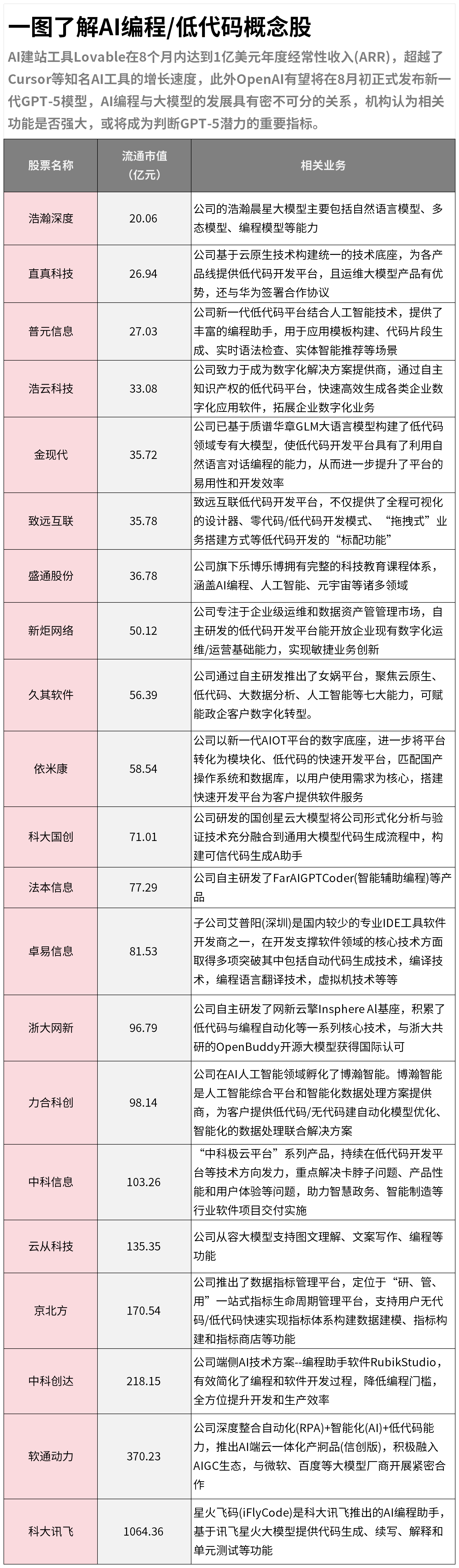
一图了解AI编程/低代码概念股
Xuan Gu Bao· 2025-08-04 05:40
Group 1 - AI programming tool Lovable reached a valuation of $100 million within 8 months [1] - The growth rate of well-known AI tools like Cursor is notable, indicating a strong market demand [1] - The development of AI programming and large models is closely tied to the capabilities of the upcoming GPT-5 model [1] Group 2 - Companies like Haohan Deep and Zhizhen Technology are focusing on low-code solutions, with market capitalizations of 2.006 billion and 2.694 billion respectively [2] - Puyuan Information and Haoyun Technology are also investing in low-code platforms, with market capitalizations of 2.703 billion and 3.308 billion respectively [2] - The low-code market is seeing significant participation from various companies, indicating a trend towards simplified development processes [2] Group 3 - Companies such as Yimikon and Keda Guokai are developing modular operating systems and rapid development platforms, with market capitalizations of 5.854 billion and 7.101 billion respectively [3] - Zheda Wangxin and Lihua Kexin are focusing on AI and low-code solutions, with market capitalizations of 9.679 billion and 9.814 billion respectively [3] - The integration of AI technologies into low-code platforms is becoming a key focus for many companies [3] Group 4 - Zhongke Information and Yuncong Technology are advancing in low-code and AI technologies, with market capitalizations of 10.326 billion and 13.535 billion respectively [4] - Companies like Jingbeifang and Zhongke Chuangda are launching comprehensive low-code solutions, with market capitalizations of 17.054 billion and 21.815 billion respectively [4] - The trend towards AI integration in development processes is evident, with companies like Ruantong Power leading in this area with a market capitalization of 37.023 billion [4] Group 5 - iFlytek, with a market capitalization of 106.436 billion, is leveraging its AI capabilities for unit testing and other functionalities [5]
散户百万一夜归零,稳定币成了收割机?你正在替美国还债
Sou Hu Cai Jing· 2025-08-03 07:48
Core Insights - The recent turmoil in the stablecoin market is primarily driven by regulatory changes, particularly the Hong Kong Stablecoin Regulation effective from August 1, 2025, which limits retail trading to licensed institutions, resulting in a significant market crash [1][3] - The U.S. GENIUS Act mandates that for every dollar of stablecoin issued, $1 must be backed by short-term U.S. Treasury bonds, forcing major issuers like Tether to acquire substantial amounts of U.S. debt [3] - The capital-driven nature of the market has led to significant stock price volatility, with companies like Lakala and Circle experiencing drastic fluctuations in their stock values due to regulatory news and insider trading activities [4][5] Regulatory Impact - The Hong Kong regulation has drastically reduced the number of licensed stablecoin issuers from 46 to just 5, leading to a collapse in the digital currency sector, with stocks like Yao Cai Securities plummeting by 20% [1] - The U.S. GENIUS Act has compelled Tether to purchase $90.8 billion in U.S. Treasury bonds, making it the 19th largest creditor to the U.S. government [3] - The EU's MiCA regulation has also forced non-compliant stablecoins out of the market, further tightening the regulatory landscape [3] Market Dynamics - The average daily transaction volume of global stablecoins is $27.6 trillion, with a total market capitalization of $2.4 trillion, but Tether's reserves are heavily reliant on U.S. debt, which poses a risk in case of a market downturn [5] - The volatility in stock prices has been exacerbated by insider trading, with companies like Lenovo and Jinke Technology profiting from timely stock sales amidst regulatory announcements [4] - The market is characterized by a "death spiral" risk, where rising U.S. Treasury yields could trigger a sell-off of stablecoins, leading to a liquidity crisis [5] Investor Sentiment - Investor confidence has been severely shaken, as evidenced by the drastic price drops in stocks related to digital currencies, with some companies experiencing losses of up to 69% in profits [7] - The perception of digital currencies as a future asset class is being challenged by the current market realities, leading to widespread disillusionment among retail investors [7] - The situation has created a stark contrast between the potential of digital currencies and the immediate risks posed by regulatory changes and market manipulation [7]
香港《稳定币条例》正式实施,沾“币”即涨的“十倍股”!稳定币泡沫化,监管喊话“降温”
Sou Hu Cai Jing· 2025-08-01 13:52
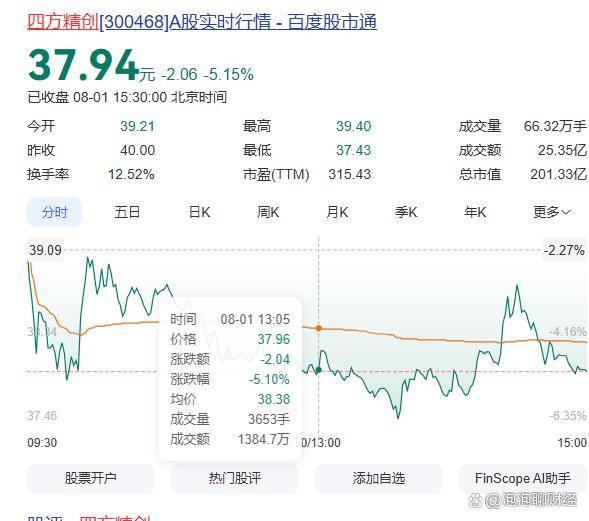
Core Points - The Hong Kong "Stablecoin Regulation" has officially come into effect, establishing the world's first comprehensive regulatory framework for fiat-backed stablecoins [2][6] - The implementation of the regulation is seen as a milestone for the sustainable development of Hong Kong's stablecoin and digital asset ecosystem, igniting investment enthusiasm in the capital markets [3][20] - Despite the positive outlook, many companies are still in the early stages of stablecoin-related business and have not yet generated actual performance [3][17] Regulation Details - The regulation requires any institution issuing or promoting fiat stablecoins in Hong Kong to operate under a license, with severe penalties for non-compliance [7] - The initial licensing process is expected to issue only a limited number of licenses, with stringent requirements including a minimum paid-up capital of HKD 25 million and sufficient liquid assets [7][10] - The Hong Kong Monetary Authority (HKMA) plans to launch a "Stablecoin Issuer Sandbox" in March 2024 to allow participants to demonstrate feasible stablecoin issuance processes [8] Market Performance - The stablecoin index has risen by 60% year-to-date as of August 1, with several stablecoin concept stocks in both A-shares and Hong Kong stocks seeing significant price increases [3][14] - Notable stocks include Hengbao Co., Sifang Jingchuang, and Jingbeifang, which have doubled in price this year [3][15] - However, on the day the regulation was implemented, many stablecoin concept stocks experienced a decline, indicating market volatility [3][17] Future Outlook - The total market capitalization of stablecoins has exceeded USD 260 billion, with projections suggesting it could reach USD 3.7 trillion by 2030 [4][20] - Major companies like Ant Group and JD.com are expected to apply for stablecoin licenses, leveraging their blockchain technology and application scenarios [9][10] - The cautious approach of the HKMA in issuing licenses may lead to disappointment among many applicants, as only a few licenses are anticipated in the initial phase [10][17] Risks and Concerns - The market has shown signs of over-excitement regarding stablecoins, with concerns about the potential for excessive conceptualization and bubble formation [16][17] - Instances of illegal financial activities related to stablecoins have been reported, highlighting the need for regulatory vigilance [18][19]