中国进出口银行

Search documents
中国信保等四方联合发布中小微外贸企业纯信用、全线上保单融资产品“微贸贷”
Sou Hu Cai Jing· 2025-06-12 13:20
Core Viewpoint - The launch of "Micro Trade Loan" is aimed at providing pure credit, fully online financing solutions tailored for small and micro foreign trade enterprises, breaking traditional financing limitations [1][3]. Group 1: Product Features - "Micro Trade Loan" is an innovative product that operates purely on credit and is available online 24/7, allowing small and micro foreign trade enterprises to access funding conveniently anytime and anywhere [3]. - The product eliminates the need for collateral, enabling enterprises to apply for loans online after obtaining insurance policies through Shenzhen's "Single Window" [3]. - The service leverages data from the Shenzhen "Single Window" to connect trade data with financial institutions, enhancing risk control models for banks [3]. Group 2: Policy Support - Shenzhen has introduced multiple supportive policies, including the "2025 Shenzhen Stabilizing Foreign Trade Support Policy" and the "Work Plan for Deepening Financial Support for Small and Micro Enterprises," creating a robust policy framework [3]. - The combination of these policies and innovative financial products like "Micro Trade Loan" is expected to significantly boost the high-quality development of foreign trade in Shenzhen [3].


新型政策性金融工具渐近 多地“摩拳擦掌”
证券时报· 2025-06-12 02:56
Core Viewpoint - The article discusses the anticipation and preparation surrounding the upcoming announcement of a new type of policy financial tool by local governments, which is expected to enhance investment and leverage financial resources in underfunded areas [1][2]. Group 1: Background and Context - As of June 11, 2023, 12 provinces, including Shandong, Hunan, and Hubei, have held meetings to interpret policies and facilitate project applications for the new financial tool, indicating a proactive approach to secure funding [2]. - In 2022, three policy financial institutions created and deployed approximately 740 billion yuan in policy and developmental financial tools to support major projects and bridge funding gaps for special bond projects [2]. Group 2: Expected Impact and Areas of Focus - The new financial tool is anticipated to target significant projects in areas such as new urbanization, agriculture, artificial intelligence, digital economy, and infrastructure for consumer sectors [3]. - Local governments are focusing on specific sectors, with Anhui province planning to concentrate on industrial, cultural tourism, agriculture, and urban construction projects [3]. Group 3: Implementation and Support Mechanisms - The new financial tool will be supported by fiscal and monetary policies, with the People's Bank of China expected to provide funding through mechanisms like the pledged supplementary lending (PSL) to address capital shortages in key projects [3]. - Major policy financial institutions, including the China Development Bank and Agricultural Development Bank, are actively involved in the promotion and explanation of the new tool's operational framework and eligibility criteria [4]. Group 4: Strategic Planning by Local Governments - Local governments are conducting project scheduling meetings to prepare and reserve projects ahead of the official announcement of the new tool, emphasizing the importance of seizing the application window [4]. - Officials highlight the tool's potential to mobilize social capital and expand effective investment, urging the identification and implementation of high-quality projects [4].

新型政策性金融工具渐近多地“摩拳擦掌”
Zheng Quan Shi Bao· 2025-06-11 17:25
Core Viewpoint - The anticipation for the official announcement of the "new type of policy financial tools" is building, with local governments already conducting policy interpretation and project application meetings, indicating that the official announcement is imminent [1][2]. Group 1: Policy Financial Tools Overview - Local governments in 12 provinces, including Shandong, Hunan, and Hubei, have held meetings to discuss the new policy financial tools, aiming to seize opportunities in the upcoming policy framework [1]. - In 2022, three policy financial institutions created and deployed approximately 740 billion yuan (about 740 billion) in policy and development financial tools to support major project capital and bridge funding for special bond projects [1]. - The new tools are expected to be officially launched in the second quarter of 2023, as indicated by market research institutions [1]. Group 2: Support and Funding Mechanisms - The new tools are designed to address funding gaps in key areas such as new urbanization, agriculture, artificial intelligence, digital economy, and consumer infrastructure [3]. - Historical experience suggests that fiscal and monetary policies will provide necessary support for the new tools, with a focus on using monetary policy to supplement fiscal efforts, particularly through mechanisms like the Pledged Supplementary Lending (PSL) [2]. - Local governments are actively planning and reserving projects to maximize the benefits of the new tools, emphasizing the importance of leveraging social capital and expanding effective investment [4]. Group 3: Project Focus and Implementation - Specific areas of focus for project applications include industrial development, cultural tourism, agriculture, and urban construction, with local governments identifying priority projects in these sectors [3]. - The three main policy financial institutions involved in the new tools—China Development Bank, Agricultural Development Bank, and China Export-Import Bank—are actively participating in policy interpretation sessions to clarify eligibility and operational models [3]. - Local governments are urged to take advantage of the project application window to implement high-quality projects that translate policy potential into tangible development outcomes [4].
多地项目储备提速,新型政策性金融工具有望撬动6万亿投资
Di Yi Cai Jing· 2025-06-10 10:37
Core Insights - The establishment of new policy financial tools aims to transform policy dividends into development momentum, with an expected scale of around 500 billion yuan, potentially leveraging 6 to 6.5 trillion yuan in effective investment [1][9]. Group 1: Project Acceleration - Multiple provinces, including Anhui, Henan, and Hunan, have quickly responded to the new policy financial tools by holding meetings to interpret policies and plan projects [2]. - In Hunan, a meeting emphasized the importance of policy banks in facilitating project approvals and ensuring timely implementation of land consolidation projects [2]. - Anhui's meetings focused on key sectors such as industry, culture, agriculture, and urban construction, aiming to systematically identify and plan projects [2]. Group 2: Investment Direction - The new policy financial tools are expected to diversify investment directions, particularly towards strategic emerging sectors like technology innovation and consumer infrastructure, differing from traditional tools that mainly focused on infrastructure [4]. - The tools are designed to address capital shortages in key project areas, with a focus on digital economy, artificial intelligence, and low-altitude economy [4][6]. Group 3: Financial Mechanism - The new tools are characterized as "quasi-fiscal" instruments, primarily initiated by policy banks to address capital shortages in project construction, with a maximum capital injection of 50% of total project capital [7]. - The operational model of these tools is designed to enhance funding efficiency while minimizing fiscal burdens, as they rely on financial bond issuance and fiscal subsidies to lower financing costs [7][8]. Group 4: Expected Impact - The anticipated impact of the new policy financial tools includes a significant investment leverage effect, with projections suggesting they could drive 6 to 6.5 trillion yuan in effective investment, representing about 12% of the expected fixed asset investment in 2024 [9]. - Historical data indicates that previous policy financial tools have successfully mobilized substantial investments, demonstrating the potential effectiveness of the new tools [9].
加力支持 精准滴灌 多方协同——金融护航外贸发展观察
Xin Hua Wang· 2025-06-06 12:19
Core Viewpoint - The article emphasizes the strong resilience and international competitiveness of China's foreign trade in the face of external shocks, highlighting the increased support from financial institutions to ensure stable growth in foreign trade [1]. Group 1: Financial Support Measures - Financial institutions are intensifying support for foreign trade, implementing various measures to assist struggling enterprises, enhance financing support, and promote the integration of domestic and foreign trade [2][3]. - The Export-Import Bank has issued 37 billion yuan in financial bonds specifically for foreign trade credit, with 460 billion yuan in loans allocated to the foreign trade sector in the first five months of the year [3]. Group 2: Product Innovation - Banks are innovating products to cater to the unique needs of small and micro foreign trade enterprises, such as the "Yi Payment Credit Loan" which provides quick financing based on foreign exchange settlement records [4]. - Digitalization is enhancing loan efficiency, with banks like Citic Bank and the Export-Import Bank launching fully online financing products tailored for small and micro foreign trade enterprises [4]. Group 3: Trade Facilitation - Recent measures have improved trade facilitation, significantly reducing the time and effort required for processing trade commission payments, as evidenced by a cross-border trade enterprise in Fuzhou [5]. Group 4: Collaborative Efforts - Collaborative efforts between banks, government, and enterprises are strengthening financial services for foreign trade, with initiatives like the partnership between the Export-Import Bank and retail giants to support the domestic sales of export products [6]. - From January to April, China's total goods import and export volume increased by 2.4% year-on-year, indicating the resilience of foreign trade amid supportive measures [6]. Group 5: Future Policy Directions - The People's Bank of China is focusing on precise measures to stabilize foreign trade, including the creation of new structural monetary policy tools to support investment in technology innovation and consumption [7].


50亿,进出口银行出手
Zhong Guo Ji Jin Bao· 2025-06-06 08:37
Group 1 - China Export-Import Bank successfully issued financial bonds worth 5 billion yuan to support the foreign trade development of private enterprises, with a maturity of 1 year [1] - The funds raised from this bond issuance will be specifically used for credit loans in the foreign trade sector for private enterprises, indicating strong market participation and positive subscription from investors [1] - This issuance is part of the bank's efforts to enhance its policy-oriented financial functions and support the international economic cooperation and competitive advantages of private enterprises [1] Group 2 - In 2023, China Export-Import Bank has cumulatively issued 32 billion yuan in themed financial bonds for the foreign trade sector, including 27 billion yuan for enhancing foreign trade quality and 5 billion yuan for supporting foreign trade infrastructure [1] - Private enterprises are recognized as the main force in stabilizing foreign trade growth, with customs in regions like Shanghai and Guangdong implementing measures to reduce burdens and enhance efficiency for these enterprises [1][2] - Shanghai Customs introduced 33 measures to promote cross-border trade facilitation, focusing on accelerating customs clearance for key products and implementing pilot programs for smart inspections [2] Group 3 - Financial institutions are increasing support for foreign trade enterprises, with the Ningbo branch of the People's Bank of China allocating 10 billion yuan for targeted financing to support 13,000 export enterprises [3] - Ningbo Bank has launched various measures to assist foreign trade enterprises in financing, including a 24/7 online service platform for foreign exchange settlement and risk management [3]
中国进出口银行前5个月投放对外贸易领域贷款4600亿元
news flash· 2025-06-06 03:16
Group 1 - The Export-Import Bank of China has issued loans totaling 460 billion yuan to support foreign trade stability in the first five months of this year [1] - Multiple special plans have been introduced by the Export-Import Bank to promote stable development in foreign trade, with increased support for private and small to medium-sized foreign trade enterprises [1] - Since April, the Export-Import Bank has actively conducted special actions to support specialized and innovative small and micro foreign trade enterprises, facilitating multiple business transactions [1] Group 2 - The Export-Import Bank has issued themed financial bonds in the foreign trade sector, including 27 billion yuan for enhancing the quality and efficiency of foreign trade, 5 billion yuan for supporting infrastructure connectivity, and 5 billion yuan for the development of private enterprise foreign trade [1] - These financial instruments are aimed at providing strong support for the stable growth of foreign trade [1]
交易商协会公布!多家承销商被评为D类





证券时报· 2025-06-05 08:03
连续2年认定为D档的机构,将取消业务资格。 交易商协会评价规则迎修后,近日首次公布非金融企业债务融资工具一般主承销商2024年度主承销业务 执业情况市场评价结果。其中,D类承销商有3家。 交易商协会将持续优化承销机构市场化评价机制的大幕拉起,敦促主承销商不断提升执业能力、加强执业 质量。 多家承销商被评为D类 为持续提升银行间债券市场主承销商执业水平,推动市场高质量发展,根据相关规定规则,交易商协会组 织开展了2024年度一般主承销商执业情况市场评价工作,并已形成评价结果。本次评价有两类,一是一 般主承销商执业情况市场评价结果;二 是特色主承销商评价结果。 2024年一般主承销商执业情况市场评价对象为截至2024年12月31日取得一般主承销业务资格的72家主 承销类会员,开展主承销业务未满一年的不评定分档结果。 全国展业银行有26家,其中A类7家,B类17家, C类2家 。地方展业银行28家,其中A类5家,B类18 家,C类2家,D类3家。证券公司18家,A类5家,B类10家,C类3家。 | 5 | 兴业银行股份有限公司 | A | | --- | --- | --- | | 6 | 上海浦东发展银行股份有限 ...

进出口行发行1年期债券,规模50亿元,发行利率1.2800%,预期1.5000%,投标倍数3.71倍,边际倍数1.18倍;进出口行发行3年期债券,规模15亿元,发行利率1.6711%,预期1.6500%,投标倍数4.81倍,边际倍数15.00倍。
news flash· 2025-06-04 02:40
Group 1 - The Export-Import Bank issued a 1-year bond with a scale of 5 billion, an issuance rate of 1.2800%, and a bid-to-cover ratio of 3.71 times [1] - The Export-Import Bank also issued a 3-year bond with a scale of 1.5 billion, an issuance rate of 1.6711%, and a bid-to-cover ratio of 4.81 times [1] - The marginal bid-to-cover ratio for the 3-year bond was significantly high at 15.00 times, indicating strong investor demand [1]
货币市场日报:6月3日
Xin Hua Cai Jing· 2025-06-03 13:47
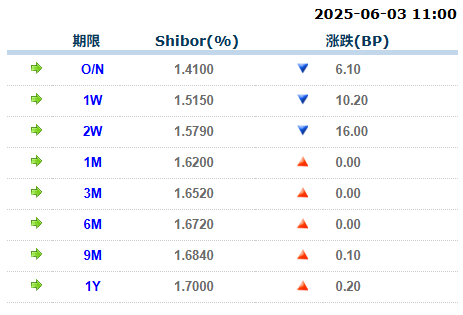
Group 1 - The People's Bank of China conducted a 454.5 billion yuan 7-day reverse repurchase operation at an interest rate of 1.40%, maintaining the previous rate, resulting in a net withdrawal of 375.5 billion yuan due to 830 billion yuan of reverse repos maturing on the same day [1] - The Shanghai Interbank Offered Rate (Shibor) for 7-day and 14-day tenors significantly declined to around 1.5%, with overnight Shibor dropping by 6.10 basis points to 1.4100%, 7-day Shibor down by 10.20 basis points to 1.5150%, and 14-day Shibor down by 16.00 basis points to 1.5790% [1][2] - In the interbank pledged repo market, short-term funding prices fell across the board, with R007 transaction volume rising to 13%. The weighted average rates for DR001 and R001 decreased by 6.9 basis points and 10.3 basis points, respectively, while DR007 and R007 rates fell by 11.5 basis points and 11.0 basis points [6] Group 2 - The funding environment on June 3 was characterized by a loose stance, with overnight rates stabilizing around 1.55% and 7-day repo rates also falling to approximately 1.55%. By the end of the day, some major banks offered overnight rates as low as 1.45% [10] - On the interbank certificate of deposit front, 19 certificates were issued on June 3, with a total issuance amount of 3.67 billion yuan. The secondary market saw a relatively quiet trading day, with yields rising compared to the pre-holiday period [11] - The People's Bank of China reported that during the Dragon Boat Festival holiday, UnionPay and NetUnion processed 14.05 billion transactions worth 4.8 trillion yuan, marking a year-on-year increase of 13% and 3.4%, respectively [13]