
丸美生物

Search documents
贝泰妮5000万元押注10亿级产业基金,意图何在?丨美妆变局
2 1 Shi Ji Jing Ji Bao Dao· 2025-10-16 08:41
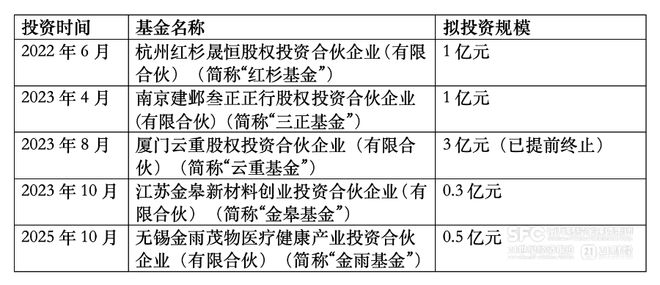
Core Viewpoint - Betaini, known as the "first stock in functional skincare," is intensifying its capital market strategy by establishing a new investment fund focused on healthcare and medical industries [1][3]. Investment Fund Overview - Betaini plans to invest as a limited partner in the Wuxi Jinyu Maowu Medical Health Industry Investment Partnership, with a total fund size of 1 billion yuan, focusing on consumer healthcare, pharmaceuticals, medical devices, and AI in drug development [1][3]. - The company will contribute 50 million yuan, acquiring a 5% stake in the fund, which has a 10-year partnership duration [2][3]. Historical Investment Activities - Over the past three years, Betaini has invested approximately 280 million yuan across various funds, including Sequoia Fund and San Zheng Fund, indicating a strategic shift towards capital investments beyond its core beauty business [2][4]. - Specific investments include 100 million yuan in Sequoia Fund in June 2022, 100 million yuan in San Zheng Fund in April 2023, and 30 million yuan in Jiangsu Jinguo New Materials Fund in October 2023 [2][4]. Financial Performance and Strategic Concerns - Betaini's revenue growth has been declining, with revenues of 4.022 billion yuan in 2021, 5.014 billion yuan in 2022, 5.522 billion yuan in 2023, and 5.736 billion yuan in 2024, showing a decreasing growth rate from 52.57% to 3.87% [6]. - The company's net profit has also decreased significantly, from 8.63 billion yuan in 2021 to 5.03 billion yuan in 2024, reflecting a trend of increasing revenue but declining profitability [6]. Brand Diversification Efforts - To mitigate reliance on its core brand Winona, which accounted for approximately 86% of total revenue in 2024, Betaini is expanding its brand portfolio by acquiring stakes in other brands and developing a multi-brand strategy [6][7]. - The company has invested 536 million yuan to acquire a 51% stake in Yuejiang (Guangzhou) Investment Co., aiming to integrate brands like Za and Pure&Mild into its offerings [6]. Industry Trends - Other major beauty brands, such as Proya and Marubi, are also increasing their capital investments to seek growth opportunities amid slowing sales, indicating a broader trend in the beauty industry towards capital market engagement [7][8].

申万宏源:预计25Q3化妆医美整体表现符合预期 Q4持续向上
Zhi Tong Cai Jing· 2025-10-16 06:19
Group 1: Cosmetics and Aesthetic Medicine Sector - The cosmetics retail sales growth in July and August 2025 was 4.5% and 5.1%, outperforming the overall retail market growth of 3.7% and 3.4%, indicating strong demand recovery [1][2] - The Q4 growth is expected to be boosted by the Double Eleven shopping festival and a relatively low base from the previous year, leading to further increases in cosmetics retail sales [1][2] - Domestic brands are leveraging online channels effectively, with notable performances from brands like Mao Geping and others on platforms like Taobao and Douyin [2] Group 2: Company Performance and Trends - Companies like Shuiyang and Beitaini are expected to turn profitable in Q3 2025, showing significant improvement compared to Q3 2024, which was affected by macroeconomic factors [3] - The performance of the aesthetic medicine sector is anticipated to be slightly weak due to macroeconomic influences, with both upstream and downstream segments facing challenges [4] - The mother and baby sector is gaining attention due to government subsidies, with companies like Kid King expected to see substantial profit growth [5] Group 3: Investment Recommendations - Recommended companies in the cosmetics sector include Mao Geping, Shangmei, and Shanghai Jahwa, which have strong growth in GMV [6] - Companies like Aimeike are highlighted for their strong profitability and product pipeline in the aesthetic medicine sector [6] - In the e-commerce and personal care brand space, companies like Ruoyuchen and Shuiyang are suggested for attention [7]

全国最大电商SaaSERP提供商将上市!
Sou Hu Cai Jing· 2025-10-16 05:12
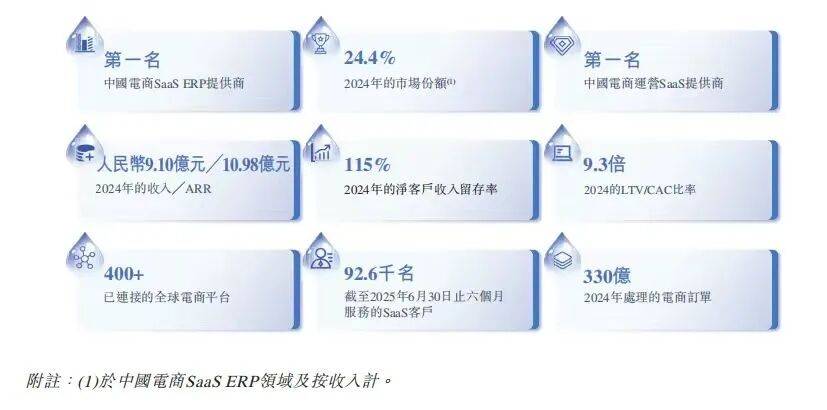
Core Viewpoint - After multiple attempts, the largest e-commerce SaaS ERP provider in China, Jushuitan Group, is set to go public, with an IPO valuation of approximately HKD 13 billion (around RMB 11.93 billion) and total fundraising of HKD 2.086 billion (approximately RMB 1.915 billion) [1][6]. Group 1: Company Overview - Jushuitan was established in 2014 and focuses on providing a one-stop SaaS product and service centered around its core product, "Jushuitan ERP" [2]. - The company is recognized as the largest e-commerce SaaS ERP provider in China, holding a market share of 24.4% as of 2024, and also the largest e-commerce operation SaaS supplier with an 8.7% market share [3]. Group 2: Financial Performance - Jushuitan reported revenues of RMB 5.23 billion, RMB 6.97 billion, and RMB 9.10 billion for the years 2022, 2023, and 2024 respectively, with gross margins increasing from 52.3% to 68.5% during the same period [9][10]. - Despite revenue growth, the company faced significant losses, totaling approximately RMB 1.604 billion over five years, with a net profit of RMB 10.58 million in 2024, followed by a loss of RMB 39.54 million in the first half of 2025 [10][12]. Group 3: IPO Challenges and Agreements - Jushuitan has faced challenges in its IPO journey, having submitted applications multiple times without success until recently, with the latest submission approved in September 2024 [6][7]. - The company has entered into a "betting agreement" with investors, which includes provisions for share buybacks if the IPO is unsuccessful, indicating pressure to complete the listing [7][8]. Group 4: Market Context - The company serves notable clients in the beauty and personal care sector, including Marubi, Oushiman, and Kose, highlighting its strong position in the e-commerce SaaS market [13]. - The trend of beauty-related companies seeking to list on the Hong Kong Stock Exchange has increased, with at least 15 such companies planning to go public in 2025, driven by favorable market conditions and regulatory changes [15][16].
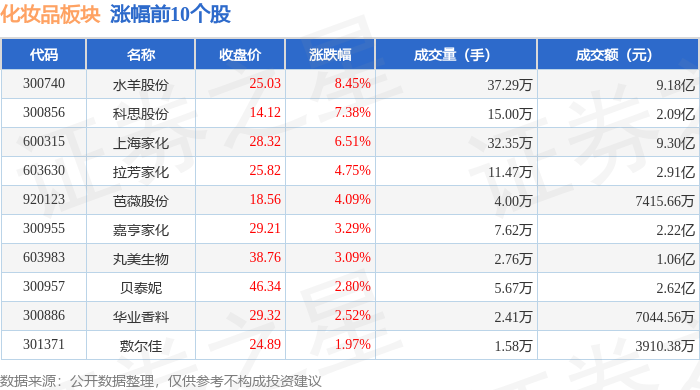
化妆品板块10月15日涨3.35%,水羊股份领涨,主力资金净流入2.19亿元
Zheng Xing Xing Ye Ri Bao· 2025-10-15 08:33
Group 1 - The cosmetics sector experienced a significant increase of 3.35% on October 15, with Shuiyang Co., Ltd. leading the gains [1] - The Shanghai Composite Index closed at 3912.21, up 1.22%, while the Shenzhen Component Index closed at 13118.75, up 1.73% [1] - Major stocks in the cosmetics sector showed notable price increases, with Shuiyang Co., Ltd. rising by 8.45% to a closing price of 25.03 [1] Group 2 - The net inflow of main funds in the cosmetics sector was 219 million yuan, while retail investors saw a net outflow of 222 million yuan [1] - Shanghai Jahwa's main fund net inflow was 85.02 million yuan, with a retail net outflow of 66.90 million yuan [2] - Shuiyang Co., Ltd. had a main fund net inflow of 46.76 million yuan, but a retail net outflow of 69.20 million yuan [2]



丸美生物涨2.02%,成交额1800.68万元,主力资金净流出170.88万元
Xin Lang Cai Jing· 2025-10-15 02:20
Core Insights - Marubi Biotech's stock price increased by 2.02% on October 15, reaching 38.36 CNY per share, with a total market capitalization of 15.382 billion CNY [1] - The company has seen a year-to-date stock price increase of 20.78%, but has experienced declines of 3.62% over the past five trading days, 3.91% over the past twenty days, and 5.26% over the past sixty days [1] - Marubi Biotech's main business includes the research, design, production, sales, and service of various skincare products, with revenue composition as follows: skincare 39.20%, beauty and others 29.30%, eye care 23.75%, cleansing 7.66%, and others 0.10% [1] Financial Performance - For the first half of 2025, Marubi Biotech achieved revenue of 1.769 billion CNY, representing a year-on-year growth of 30.83%, and a net profit attributable to shareholders of 186 million CNY, up 5.21% year-on-year [2] - The company has distributed a total of 983 million CNY in dividends since its A-share listing, with 610 million CNY distributed over the past three years [3] Shareholder Information - As of June 30, 2025, the number of shareholders increased by 36.85% to 17,400, while the average number of tradable shares per person decreased by 26.93% to 23,084 shares [2] - Among the top ten circulating shareholders, Hong Kong Central Clearing Limited holds 4.85 million shares, an increase of 1.485 million shares compared to the previous period [3]

宝洁供应商维琪科技闯关北交所 将复制下一个“玻尿酸神话”?
Mei Ri Jing Ji Xin Wen· 2025-10-14 15:21
Core Viewpoint - Shenzhen Weiqi Technology Co., Ltd. is pursuing an IPO on the Beijing Stock Exchange, driven by the rising popularity of peptide-based cosmetics, with a strong performance forecast for 2022-2024 [1][3]. Company Overview - Weiqi Technology is a supplier of cosmetic raw materials, primarily focusing on peptide cosmetics and finished products, with significant partnerships with brands like Procter & Gamble and Unilever [1][3]. - The actual controllers of the company, Ding Wenfeng and Lai Yanmin, hold approximately 62.07% of the shares [1][2]. Financial Performance - Revenue for Weiqi Technology is projected to grow from 135 million yuan in 2022 to 248 million yuan in 2024, with net profits increasing from 35.13 million yuan to 70.64 million yuan during the same period [3]. - The company has seen a decrease in revenue contribution from its top five clients, which accounted for 36.14% in 2022, dropping to 29.48% in 2023, and then rising to 38.76% in 2024 [3][4]. Market Trends - The rise of peptide ingredients in cosmetics has led to increased consumer awareness and brand adoption, with Weiqi Technology collaborating with major brands for new ingredient development [3][5]. - The cosmetic industry is characterized by rapid shifts in trends, as evidenced by the decline of hyaluronic acid's market dominance, raising questions about the sustainability of the current "peptide" trend [5][6]. Business Strategy - Weiqi Technology acknowledges the volatility in client orders due to changes in market conditions and client strategies, which could impact financial performance [5][6]. - The company is expanding its finished product business, which accounted for 47.05% of its main revenue in 2024, primarily through ODM (Original Design Manufacturer) operations [6]. Investment and Shareholder Dynamics - The IPO has attracted notable institutional investors, with specific agreements in place regarding performance and potential buyback obligations if the company fails to list successfully by the end of 2028 [2][3]. - A former sales director holds 4.61% of the shares, raising regulatory scrutiny regarding the rationale behind his continued ownership post-employment [2].
宝洁供应商维琪科技闯关北交所,将复制下一个“玻尿酸神话”?
Mei Ri Jing Ji Xin Wen· 2025-10-14 13:23
Core Viewpoint - Shenzhen Weiqi Technology Co., Ltd. is preparing for an IPO on the Beijing Stock Exchange, driven by the rising popularity of peptide-based cosmetics and its partnerships with major brands like Procter & Gamble and Unilever [1][3]. Company Overview - Weiqi Technology is a supplier of cosmetic raw materials, primarily focusing on peptide ingredients and finished cosmetic products [1][5]. - The company is controlled by Ding Wenfeng and Lai Yanmin, who together hold approximately 62.07% of the shares [1][2]. Financial Performance - The company's revenue for 2022, 2023, and 2024 was reported as 135 million, 165 million, and 248 million yuan respectively, with net profits of 35.13 million, 42.29 million, and 70.64 million yuan [3]. - The growth in performance is attributed to the increasing application of active peptide ingredients in cosmetics, leading to heightened consumer awareness and brand adoption [3][5]. Client Dependency - The revenue contribution from the top five clients was 36.14%, 29.48%, and 38.76% for the respective years, indicating a decrease in reliance on these clients [3][4]. - Notably, all but one of the second to fifth largest clients in 2022 have exited the top five list by 2023 and 2024 [3]. Market Dynamics - The cosmetic industry is characterized by rapid shifts in trends, as evidenced by the decline of hyaluronic acid products and the potential volatility surrounding peptide ingredients [5][6]. - Weiqi Technology acknowledges that the sustainability of peptide ingredients depends on market promotion by influential brands and consumer acceptance [6]. Business Strategy - The company is increasing its share of finished cosmetic products, which accounted for 47.05% of its main revenue by 2024, with a significant portion coming from ODM (Original Design Manufacturer) business [6]. - The ODM business is strategically aimed at promoting and selling raw materials, while the company remains cautious about its own brand (OBM) operations to avoid negative impacts on raw material sales [6].
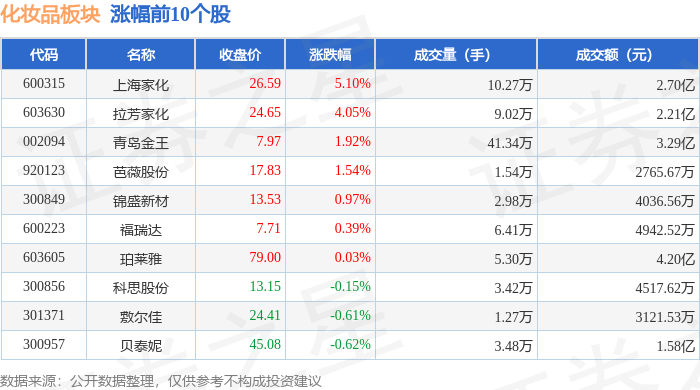
化妆品板块10月14日涨0.31%,上海家化领涨,主力资金净流出1328.42万元
Zheng Xing Xing Ye Ri Bao· 2025-10-14 08:46
Core Insights - The cosmetics sector experienced a slight increase of 0.31% on October 14, with Shanghai Jahwa leading the gains [1] - The Shanghai Composite Index closed at 3865.23, down 0.62%, while the Shenzhen Component Index closed at 12895.11, down 2.54% [1] Company Performance - Shanghai Jahwa (600315) closed at 26.59, up 5.10%, with a trading volume of 102,700 shares and a transaction value of 270 million yuan [1] - Lafang (603630) closed at 24.65, up 4.05%, with a trading volume of 90,200 shares and a transaction value of 221 million yuan [1] - Qingdao Kingway (002094) closed at 7.97, up 1.92%, with a trading volume of 413,400 shares and a transaction value of 329 million yuan [1] - Other notable performers include Bawei (920123) at 17.83 (+1.54%) and Jinsong New Materials (300849) at 13.53 (+0.97%) [1] Fund Flow Analysis - The cosmetics sector saw a net outflow of 13.28 million yuan from institutional investors, while retail investors experienced a net outflow of 46.69 million yuan [2] - Conversely, speculative funds recorded a net inflow of 59.98 million yuan [2] Individual Stock Fund Flow - Shanghai Jahwa had a net inflow of 29.86 million yuan from institutional investors, while retail investors saw a net outflow of 24.90 million yuan [3] - Lafang recorded a net inflow of 21.89 million yuan from institutional investors, with retail investors experiencing a net outflow of 21.61 million yuan [3] - Qingdao Kingway had a net inflow of 16.80 million yuan from institutional investors, while retail investors saw a net outflow of 18.67 million yuan [3]


华源证券:9月抖音美妆类目GMV同比增长20% 国货自营表现亮眼
Zhi Tong Cai Jing· 2025-10-14 06:56
Core Insights - Douyin's beauty category GMV increased by 19.7% year-on-year in September 2025, but saw a quarter-on-quarter decline of 10.4% [1] - Domestic brands showed strong performance in self-operated sales, with 60% of the top 20 beauty brands having a higher GMV contribution from self-operated channels than from influencers [2] - The trend of domestic brands replacing foreign ones continues, suggesting a focus on domestic brands that are expanding their market presence and brand influence [1] Group 1: Market Performance - The total GMV of the top 20 beauty brands on Douyin reached over 3 billion yuan in September, marking a year-on-year growth of 38.59% [1] - Han Shu maintained the top position with a GMV exceeding 500 million yuan, with 40% of brands experiencing over 100% growth [1] - Seven new brands entered the top 20 list, accounting for 35%, including Meishi, Shiseido, and Afu, with significant ranking improvements [1] Group 2: Price Distribution - The price distribution in the beauty and skincare category is relatively balanced, with products priced under 150 yuan holding the largest market share at 49.54% [3] - The GMV contribution from products priced under 300 yuan increased by 2.54 percentage points, while the share of products priced over 1,000 yuan decreased by 1.09 percentage points [3] - In the color cosmetics and fragrance category, 74% of GMV comes from products priced under 150 yuan, indicating a concentration in lower price ranges [3] Group 3: Investment Recommendations - Recommended stocks include: 1. Mao Ge Ping (01318), a leading domestic high-end beauty brand with strong product and channel expansion [4] 2. Proya (603605), known for its mature organizational structure and industry-leading marketing capabilities [4] 3. Marubi Biological (603983), which continues to release strong single product potential [4] 4. Shangmei Co. (02145), benefiting from the trend of affordable consumption with multi-category and multi-channel development [4] 5. Runben Co. (603193), a quality domestic brand in the mosquito repellent and baby products sector with significant growth potential [4]
2025年9月抖音美妆数据点评:9月抖音美妆类目GMV同增20%,国货自营表现亮眼
Hua Yuan Zheng Quan· 2025-10-14 05:07
Investment Rating - The investment rating for the beauty care industry is "Positive" (maintained) [4] Core Insights - In September 2025, the GMV (Gross Merchandise Value) of the beauty category on Douyin increased by 19.7% year-on-year, although it saw a month-on-month decline of 10.4% [4] - The top 20 beauty brands on Douyin achieved a total GMV exceeding 3 billion yuan, with a year-on-year growth of 38.59%. Notably, the brand Han Shu maintained its leading position with over 500 million yuan in GMV, and 40% of brands in the top 20 experienced more than double growth [4] - Domestic brands showed strong performance, with 60% of the top 20 brands having a higher GMV contribution from self-operated channels than from influencer promotions. Brands like Han Shu and Bai Que Ling had over 70% of their GMV from self-operated channels, indicating a competitive advantage for domestic brands in self-operated channels [4] Summary by Sections Market Performance - The beauty and skincare product price distribution is relatively balanced, while the color cosmetics and fragrance categories heavily rely on affordable products. The price segment under 150 yuan accounted for 49.54% of the market share in September, marking it as the main price segment [4] - Products priced under 150 yuan made up 36.23% of the skincare category, while products priced over 1,000 yuan contributed over 10% to GMV. In contrast, 74% of the GMV in the color cosmetics and fragrance category came from products priced under 150 yuan, indicating a more concentrated price distribution [4] Investment Recommendations - The report suggests focusing on domestic brands that are continuously enhancing their market scale and brand influence through mainstream channels. Recommended stocks include: 1. Mao Ge Ping, a leading high-end domestic beauty brand with strong product and channel expansion capabilities 2. Po Lai Ya, known for its mature organizational structure and industry-leading marketing and management capabilities 3. Wan Mei Biological, which is experiencing accelerated brand growth through its flagship products 4. Shang Mei Co., benefiting from the trend of affordable consumption with multi-category and multi-channel development [4]