
华大智造

Search documents
医疗器械研究框架深度解析
2025-09-26 02:29
Summary of Key Points from the Conference Call Industry Overview - The Chinese medical device market is expected to reach a scale of 1.875 trillion yuan by 2025, with a compound annual growth rate (CAGR) exceeding 10% over the past decade [1][5] - The ratio of drug to medical device spending in China is approximately 2.9, significantly higher than the global average of 1.4, indicating substantial growth potential in the market [5][6] Core Insights and Arguments - The domestic medical device industry is benefiting from advancements in underlying technologies and the maturation of supporting industrial chains, with significant clusters forming in regions like the Pearl River Delta and Yangtze River Delta [2] - Domestic medical devices are gradually overcoming technical barriers, particularly in emerging fields such as surgical robots and brain-machine interfaces, which require core components like industrial control computers and flexible electrodes [3][4] - The implementation of centralized procurement policies is exerting pressure on the valuations of medical device companies by lowering factory prices, which may impact market size expectations but could also increase surgical penetration rates [1][9][10] - The national new infrastructure policy is expected to drive a 25% increase in equipment investment in seven key areas by 2027, with a CAGR of about 7%, benefiting sectors like medical imaging and surgical robots [1][12] Challenges and Opportunities - The penetration of medical devices in grassroots markets faces challenges such as high skill requirements for doctors and insufficient hospital hardware conditions [7] - The internationalization of the medical device industry is evident, with a shift from original design manufacturing (ODM) to self-owned brands, leading to increased overseas revenue and profit contributions for many companies [3][29][30] - Companies need to focus on two core prices: factory price and terminal price, to effectively respond to the challenges posed by centralized procurement policies [9][10] Market Dynamics - The medical device industry has maintained significant growth since the implementation of national centralized procurement policies in 2020, with double-digit growth rates [11] - The competitive landscape is relatively fragmented, with leading companies often achieving market shares of 30% to 40% in stable conditions [11] - The medical device and consumables payment models differ significantly, with devices typically funded by hospitals or local government, while consumables require direct payment from patients or insurance [15] Technological Advancements - Domestic companies have made notable progress in medical device technology, with some products in fields like electrophysiology matching or exceeding foreign counterparts [25] - The valve intervention field is expanding, with developments from simple repairs to complete valve replacements [26] - In the surgical robot sector, domestic companies are increasingly challenging imported products, achieving comparable performance in key areas [28] Conclusion - The Chinese medical device market presents significant growth opportunities driven by technological advancements, supportive government policies, and increasing domestic demand. However, companies must navigate challenges related to pricing strategies and market penetration while capitalizing on internationalization trends to enhance their competitive positioning.
华大智造(688114):2025Q2业绩季度环比改善,装机量快速提升
Huaan Securities· 2025-09-25 01:31
Investment Rating - The investment rating for the company is "Buy" (maintained) [2] Core Views - The company reported a year-on-year revenue decline of 7.90% for the first half of 2025, with total revenue of 1.114 billion yuan and a net loss attributable to shareholders of 104 million yuan. However, the second quarter of 2025 showed improvement with revenue of 659 million yuan, a year-on-year decline of only 2.93%, and a net profit of approximately 29.77 million yuan, marking a year-on-year increase of 130.62% [5][6] Summary by Sections Financial Performance - In Q1 2025, the company achieved revenue of 455 million yuan (yoy -14.26%), while Q2 2025 saw revenue of 659 million yuan (yoy -2.93%). The net profits for Q1 and Q2 were -133 million yuan and 29.77 million yuan respectively, indicating a return to profitability in Q2 2025 [6] - The company’s expense ratios significantly decreased in Q2 2025, with sales, management, and R&D expense ratios at 25.71%, 16.39%, and 20.57% respectively, showing substantial reductions both year-on-year and quarter-on-quarter [6] Product and Market Development - The company’s full-length sequencing business generated revenue of 894 million yuan in H1 2025, a year-on-year decline of 12.15%. Instrument revenue was 298 million yuan (yoy -23.18%), while reagent revenue was 555 million yuan (yoy -6.30%). This decline was attributed to intensified industry competition and strategic price adjustments [7] - The global sales of the company’s sequencing instruments exceeded 700 units in H1 2025, a year-on-year increase of 60.35%, marking a historical high for the same period. The company has also entered the mass production phase for nanopore sequencers, adding nearly 50 new installations [7] - As of August 15, 2025, the company had approximately 900 million yuan in orders on hand, with 700 million yuan specifically for the full-length sequencing business, indicating a robust order backlog [7] International Business Performance - In H1 2025, the company’s sequencing instrument revenue in the Asia-Pacific region was 80 million yuan, a year-on-year decline of 29%, primarily due to geopolitical conflicts affecting procurement processes. Conversely, revenue in the Europe and Africa region was 140 million yuan, a year-on-year increase of 3%, driven by local operational acceleration and project collaborations [8] - Revenue in the Americas region was 80 million yuan, a year-on-year decline of 3%, influenced by significant cuts in research funding and regional instability [8] Future Projections - The company is expected to achieve revenues of 2.824 billion yuan, 3.341 billion yuan, and 3.943 billion yuan for the years 2025 to 2027, with year-on-year growth rates of -6.3%, 18.3%, and 18.0% respectively. The net profit attributable to shareholders is projected to be -98 million yuan, 50 million yuan, and 162 million yuan for the same period, with significant year-on-year growth anticipated [9]

2025华为全联接大会解读:昇腾铸芯、超节点织网,华为算力跃升新纪元
NORTHEAST SECURITIES· 2025-09-19 02:41
Investment Rating - The report maintains an "Outperform" rating for the industry [6] Core Insights - Huawei's new products, including Ascend chips and supernodes, are set to lead a new era in computing power, with a clear roadmap for product iterations from 2025 to 2028 [1][14] - The introduction of self-developed HBM technology marks a significant advancement in memory bandwidth, enhancing the efficiency of large model training [3][23] - The supernode architecture is designed to integrate hundreds of processors, reshaping the competitive landscape in AI infrastructure [22][24] Summary by Sections 1. Huawei Computing Power Product Launch - Ascend chips will follow a yearly iteration schedule, with the 910C launching in Q1 2025 and subsequent models (950PR, 950DT, 960, 970) planned through 2028 [14][15] - The Ascend 950 series introduces low-precision data formats and self-developed HBM, enhancing training efficiency for large models [15][16] - The Ascend 960 and 970 are expected to double performance metrics across various parameters, including computing power and memory bandwidth [18][19] 2. Supernode Products - The supernode data center (Atlas 900/950/960 SuperPoD) is designed for large-scale AI training, achieving EFLOPS-level computing power with high bandwidth and low latency [2][27] - The supernode cluster (Atlas 950/960 SuperCluster) enhances network performance and energy efficiency, reaching ZFLOPS-level computing power [2][37] - The enterprise-grade air-cooled supernode server (Atlas 850) is tailored for post-training and multi-scenario inference, supporting flexible scaling [2][38] 3. Related Investment Targets - Key investment targets include hardware partners for Ascend, domestic wafer foundries, and companies involved in copper connections, optical connections, power supplies, PCBs, and cooling solutions [4][46]
电子行业涨幅居前,大湾区ETF(512970)盘中有折价,相关投资机会受关注
Xin Lang Cai Jing· 2025-09-19 02:04
Core Viewpoint - The performance of the China Securities Guangdong-Hong Kong-Macao Greater Bay Area Development Theme Index and its related ETF indicates a positive trend, with significant gains in individual stocks and overall index performance, reflecting the growth potential in the Greater Bay Area market. Group 1: Index Performance - As of September 19, 2025, the China Securities Guangdong-Hong Kong-Macao Greater Bay Area Development Theme Index (931000) increased by 0.68% [1] - The top-performing constituent stocks include Jiangbolong (301308) up 10.00%, Guangdong Hongda (002683) up 6.58%, and Bawei Storage (688525) up 4.64% [1] - The Greater Bay Area ETF (512970) experienced a slight decline of 0.13%, with a latest price of 1.49 yuan [1] Group 2: ETF Performance Metrics - The Greater Bay Area ETF has shown a 53.68% increase in net value over the past year as of September 18, 2025 [1] - The ETF's highest single-month return since inception was 21.99%, with the longest consecutive monthly gain being 4 months and a maximum increase of 26.18% [1] - The ETF's average monthly return during rising months is 5.38% [1] Group 3: Trading and Liquidity - The trading volume for the Greater Bay Area ETF was 4315.20 yuan with a turnover rate of 0.01% [1] - The average daily trading volume over the past month was 779,100 yuan [1] Group 4: Risk and Recovery - The Greater Bay Area ETF has a relative benchmark drawdown of 0.43% year-to-date, with a recovery period of 108 days [2] Group 5: Fees and Tracking Accuracy - The management fee for the Greater Bay Area ETF is 0.15%, and the custody fee is 0.05% [3] - The tracking error for the ETF over the past two months is 0.028%, indicating close tracking of the underlying index [4] Group 6: Top Holdings - As of August 29, 2025, the top ten weighted stocks in the index include China Ping An (601318), BYD (002594), and China Merchants Bank (600036), collectively accounting for 49.06% of the index [5]
华大智造20250917
2025-09-17 14:59
Summary of the Conference Call for 华大智造 Company Overview - 华大智造 is a leading domestic gene sequencing instrument company listed on the Shanghai Stock Exchange's Sci-Tech Innovation Board, controlled by the founder of 华大集团, 汪建 [2][3] - The company operates in three main business segments: gene sequencing instruments, laboratory automation, and emerging businesses [4][5] Financial Performance - The company's revenue was significantly impacted by the pandemic but has returned to normal levels post-2023, with a decline in revenue in the first half of 2025 due to price competition, although profitability has improved with a significant reduction in losses [2][6] - The company achieved breakeven in the first half of 2025, with expectations for revenue improvement in the second half [6][8] Market Dynamics - The global gene sequencing market is projected to grow rapidly, reaching over $60 billion by 2030, with the upstream sequencing instruments and consumables market estimated at around $14 billion [2][7] - Approximately 70% of the company's revenue comes from the domestic market, with overseas markets seen as future growth points, despite potential short-term geopolitical disruptions [2][8] Industry Trends - The gene sequencing industry is significantly affected by geopolitical factors, which have hindered project development and international trade, resulting in slower-than-expected growth rates [9] - The second-generation sequencing technology remains the mainstream, with 华大智造's DMBSEQ technology providing a competitive edge [10][13] Competitive Landscape - The company has maintained a leading market share in domestic new installations for three consecutive years, outperforming Illumina [4][11] - The inclusion of Illumina in China's unreliable entity list has created opportunities for domestic companies, although it has also sparked price wars among local manufacturers [12][14] Future Growth Potential - The company is focusing on expanding its laboratory automation and emerging business segments, which are expected to maintain double-digit growth rates [15][16] - The overall growth of the company is primarily driven by its gene sequencing business, with a projected market value range of 32 to 35.5 billion yuan, and a reasonable stock price range of 77 to 82 yuan, indicating significant upside potential [17] Conclusion - 华大智造 is positioned well within the gene sequencing industry, with strong domestic performance and potential for international expansion, despite facing challenges from geopolitical factors and competition. The company's innovative technology and strategic focus on emerging markets and automation present promising growth opportunities moving forward [2][9][15]
招商证券国际:医疗器械行业扰动因素逐步改善 关注国产替代与出海拓展两大主线
智通财经网· 2025-09-17 09:04
Core Viewpoint - The medical device industry is expected to experience a structural recovery and differentiation in the first half of 2025, with overall revenue declining by 3.8% year-on-year and net profit attributable to the parent company decreasing by 12.8% [1][2]. Industry Overview - In the first half of 2025, over 53% of the 129 analyzed medical device companies reported revenue growth, with 16% exceeding 20% growth [2]. - The overall gross margin for the medical device industry was 50.7%, a decrease of 1.6 percentage points year-on-year, while the operating cash flow fell by 5.4% [2]. Future Outlook - The medical device industry in China is anticipated to enter a new development phase from the second half of 2025 to 2026, driven by improved internal policies and external market expansion [3]. - Policy improvements include rationalization of procurement rules and increased support for medical equipment upgrades, which are expected to boost demand for domestic mid-to-high-end equipment [3]. Global Expansion - Chinese medical devices are transitioning from a cost advantage to a combination of technological and cost-effectiveness advantages, with significant breakthroughs in overseas markets [4]. - Companies are enhancing their overseas operations through localized strategies, leading to an increase in overseas revenue share [4]. Investment Recommendations - Companies with low valuations and clear performance improvements are recommended, such as Mindray Medical and New Industries, which are positioned to benefit from policy changes and post-pandemic demand recovery [6][7]. - Long-term growth opportunities are highlighted for companies like United Imaging and MicroPort, which have strong technological barriers and clear growth paths [6][7]. Sector-Specific Insights - The medical equipment sector is driven by procurement recovery and domestic substitution, with key players including United Imaging and MicroPort [8]. - High-value consumables are benefiting from reduced procurement impacts and innovation, with companies like Huatai Medical and MicroPort leading the way [8]. - In vitro diagnostics are seeing growth from overseas markets and domestic recovery, with Mindray Medical and New Industries as key players [8]. Catalysts - Key events to watch include the rollout of new equipment upgrade policies, procurement adjustments, and trade negotiations [9].

招商证券国际:内地医疗器械行业业绩有望触底反弹 建议关注国产替代与出海拓展两大主线
智通财经网· 2025-09-17 03:16
Core Viewpoint - The report from China Merchants Securities International indicates a decline in the mainland medical device industry, with a projected revenue drop of 3.8% and a net profit decrease of 12.8% year-on-year for the first half of 2025, suggesting a potential recovery phase starting in late 2025 to 2026 [1] Industry Summary - The overall revenue of the mainland medical device industry is expected to decline by 3.8% year-on-year in the first half of 2025, with a net profit drop of 12.8% and a non-recurring net profit decrease of 14.5% [1] - In the second quarter, the revenue is projected to fall by 5.5% year-on-year, with a net profit decline of 20.3% and a non-recurring net profit drop of 25% [1] - Approximately 53% of the 129 medical device companies analyzed reported revenue growth year-on-year, with 16% experiencing growth rates exceeding 20% and 37% within the 0-20% growth range [1] Future Outlook - The industry is anticipated to reach a turning point with a rebound in revenue and profit levels following disruptions from the pandemic and domestic procurement policies [1] - A new development phase for the mainland medical device industry is expected from the second half of 2025 to 2026, driven by improved internal policy environments and external market expansion [1] - The report suggests focusing on two main themes: domestic substitution and international expansion, with short-term attention on undervalued stocks showing clear performance improvement and long-term investment in high-growth sectors driven by innovation [1] Recommended Companies - The report highlights several companies for potential investment: Mindray Medical (300760.SZ), United Imaging Healthcare (688271.SH), MicroPort Scientific Corporation-B (02252), Huaitai Medical (688617.SH), and BGI Genomics (688114.SH) [1]
华大智造跌2.01%,成交额1.14亿元,主力资金净流出1021.98万元
Xin Lang Cai Jing· 2025-09-16 03:25
Core Viewpoint - 华大智造's stock has experienced fluctuations, with a year-to-date increase of 47.04%, but recent declines in the short term [1][2] Financial Performance - For the first half of 2025, 华大智造 reported revenue of 1.114 billion yuan, a year-on-year decrease of 7.90%, while the net profit attributable to shareholders was -104 million yuan, an increase of 65.28% compared to the previous year [2] Stock Market Activity - As of September 16, 华大智造's stock price was 68.80 yuan per share, with a market capitalization of 28.656 billion yuan. The stock saw a net outflow of 10.2198 million yuan in principal funds [1] - The company has appeared on the龙虎榜 twice this year, with the most recent appearance on March 4, where it recorded a net buy of -44.7653 million yuan [1] Shareholder Information - As of June 30, 2025, 华大智造 had 13,500 shareholders, an increase of 7.64% from the previous period, with an average of 15,766 circulating shares per shareholder, a decrease of 7.09% [2] - The top ten circulating shareholders include various ETFs, with notable changes in holdings among them [3]
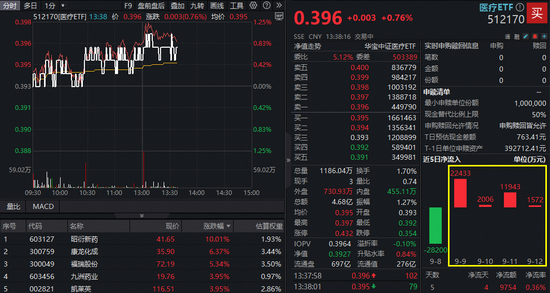
CXO龙头集体走强,昭衍新药涨停!A股最大医疗ETF(512170)盘中涨逾1%,近4日大举吸金3.8亿元
Xin Lang Ji Jin· 2025-09-15 06:03
Core Viewpoint - The medical sector is experiencing significant growth, with the largest medical ETF in A-shares (512170) showing a notable increase and attracting substantial investment recently [1][3]. Group 1: ETF Performance - The medical ETF (512170) rose over 1% on September 15, with a trading volume exceeding 460 million yuan [1]. - The ETF has attracted a total of 380 million yuan over four consecutive days leading up to September 12, bringing its total size to 27.584 billion yuan, ranking first among similar ETFs [1]. Group 2: Stock Performance - CXO stocks performed well, with notable gains from companies such as Zhaoyan New Drug, which hit the daily limit, and Kanglong Chemical and Jiuzhou Pharmaceutical, with increases of 6.37% and 3.95% respectively [3]. - Conversely, companies like BGI Genomics, Weining Health, and BGI Intelligent Manufacturing saw declines of 2.91%, 2.38%, and 1.93% respectively [3]. Group 3: Industry Outlook - According to Wanlian Securities, the overall revenue of the medical R&D outsourcing CXO sector is expected to grow by 13.77% year-on-year in the first half of 2025, with net profit attributable to shareholders increasing by 63.82% [3]. - The period from September 1 to 15, 2025, saw over 400 new Class I drugs in clinical trials and more than 1,800 Class II and III medical devices approved for market [3]. - Xinda Securities highlighted that the recovery of in-hospital procurement in the high-end medical device sector is driving growth, alongside a gradual recovery in consumer medical demand and increased penetration of high-end consumables [3]. Group 4: ETF Composition - The ETF (512170) and its off-market linked fund (012323) passively track the CSI Medical Index, with the top ten weighted stocks including WuXi AppTec, Mindray Medical, and United Imaging Healthcare [4][5].


华源证券:PD1/VEGF/IL-2 潜力可期 坚持创新药作为全年主线
智通财经网· 2025-09-15 03:49
Core Viewpoint - The pharmaceutical industry is expected to experience a marginal improvement in 2025, with further operational performance enhancements anticipated in 2026, particularly in structurally high-growth segments and individual stocks [1] Group 1: Industry Trends - The focus on "innovation" will be the main theme for 2025, with attention on "going overseas" and "aging" assets that are relatively undervalued in the second half of the year [1] - The Chinese pharmaceutical industry has largely completed the transition from old to new growth drivers, with innovation replacing generics and enhanced overseas capabilities [3] - The demand side is being driven by an accelerating aging population, leading to increased needs for chronic disease treatments such as cardiovascular, endocrine, and orthopedic care [4] Group 2: Investment Opportunities - The report suggests focusing on Shanghai Yizhong (688091.SH) due to its complementary mechanisms involving PD1, VEGF, and IL-2, which are integrated into a single molecule for enhanced therapeutic efficacy [2] - The Chinese innovative pharmaceutical sector has gained significant scale, with companies like Heng Rui Medicine (600276.SH, 01276) and Hansoh Pharmaceutical (03692) successfully transitioning to innovation [3] - The medical device and home care equipment sectors are expected to stabilize and recover in performance starting from Q3 2025, with a focus on the aging population and outpatient consumption [4] Group 3: Market Dynamics - The healthcare payment system is experiencing steady growth, with the National Healthcare Security Administration actively promoting the development of commercial insurance to create a multi-tiered payment system [4] - New technologies, particularly AI, are anticipated to accelerate industry transformation, providing new growth logic for the pharmaceutical sector [4]
