
联影医疗

Search documents
2025年中国医疗AI解决方案行业政策、产业链、市场规模、细分产品结构、竞争格局、代表企业经营现状及发展趋势分析研判:应用广泛且持续深入,市场格局愈加多元化[图]
Chan Ye Xin Xi Wang· 2025-12-11 01:34
Core Insights - China is a significant market for global medical AI solutions, benefiting from technological advancements, high-quality medical data accumulation, supportive national policies, and growing market demand, leading to rapid growth in AI applications in healthcare [1][4]. Market Size and Growth - The market size for medical AI solutions in China is projected to grow from 9.1 billion yuan in 2021 to 16.4 billion yuan in 2024, with L1 solutions increasing from 5.8 billion yuan to 9.4 billion yuan, L2 solutions from 3.3 billion yuan to 6.9 billion yuan, and L3 solutions at 0.1 billion yuan [1][4]. - By 2025, the market size is expected to reach 18.2 billion yuan, with L1 solutions at 9.8 billion yuan, L2 solutions at 7.8 billion yuan, and L3 solutions at 0.6 billion yuan [1][4]. Industry Definition and Applications - Medical AI solutions utilize AI technologies such as machine learning, deep learning, natural language processing, and big data analysis to enhance various medical processes, including diagnosis, treatment, drug development, and hospital management [2][3]. - The industry is evolving from L1 and L2 solutions, which provide supportive insights, to L3 and L4 autonomous agents capable of executing tasks independently [2][3]. Industry Development Status - The integration of general large model capabilities with medical knowledge bases is driving the transition of medical AI solutions towards higher levels of autonomy [3][4]. - The global market for medical AI solutions is expected to grow from 23.2 billion yuan in 2021 to 40 billion yuan in 2024, with L1 solutions increasing from 13.9 billion yuan to 21.1 billion yuan, L2 solutions from 9.3 billion yuan to 18.7 billion yuan, and L3 solutions at 0.2 billion yuan [4]. Industry Chain - The medical AI solutions industry chain includes upstream data supply, hardware providers (chips, servers), cloud services, operating systems, and algorithms, with midstream companies providing AI solutions and downstream applications in healthcare institutions, pharmaceutical companies, and individual patients [5]. Policy Environment - The Chinese government has prioritized the application of AI in healthcare, implementing policies to support AI in medical diagnosis, health management, and insurance regulation, which are expected to accelerate the development of AI in healthcare [5]. Competitive Landscape - The industry features a competitive landscape with local giants, vertical startups, and multinational companies. Key players include iFlytek Medical, Baidu, United Imaging, CloudWalk, Weining Health, and Mindray Medical [7]. - iFlytek Medical is a leading company in the AI healthcare sector, leveraging its large model to empower various healthcare stakeholders and has developed comprehensive AI solutions for hospitals and primary care institutions [9][11]. Revenue Structure of Key Players - iFlytek Medical reported a revenue of 299 million yuan in the first half of 2025, with contributions from various solutions: 84 million yuan from primary care solutions, 58 million yuan from regional solutions, 53 million yuan from hospital solutions, and 104 million yuan from patient management services [11]. - The company aims to build a robust B-end ecosystem to strengthen its commercial channels [9]. Future Trends - The development of the medical AI industry will be driven by a combination of technology, data, scenarios, and regulation, leading to a more mature, deeper, and broader market landscape [12].





政策拉动国内市场有效复苏,医疗设备招采保持快速增长
GUOTAI HAITONG SECURITIES· 2025-12-10 15:07
Investment Rating - The report maintains an "Overweight" rating for the industry [1][5]. Core Insights - The medical device procurement scale continues to grow, driven by ongoing equipment update policies, which are expected to lead to a long-term increase in procurement levels. The report recommends medical device companies that are likely to benefit from these policies, including Mindray Medical, United Imaging, Kaili Medical, and Aohua Endoscopy [3][5]. - In November 2025, the new equipment procurement scale showed significant year-on-year growth: MRI increased by 11.1%, CT by 26.4%, DR by 47.2%, ultrasound by 17.0%, while endoscopes declined by 4.9%, and surgical robots grew by 8.6%. Cumulatively, from January to November 2025, MRI grew by 50.4%, CT by 72.7%, DR by 74.0%, ultrasound by 56.1%, endoscopes by 19.7%, and surgical robots by 32.8% [5]. - The equipment update policy is expected to drive procurement levels significantly, with a target of over 25% growth in medical equipment investment by 2027 compared to 2023. This policy is expected to enhance the configuration of high-end equipment to levels comparable to middle-income countries [5]. - The domestic market is showing signs of recovery, with a notable increase in procurement demand from medical institutions, reflecting a positive trend in the medical equipment industry. For instance, United Imaging reported a revenue of 6.866 billion yuan in the domestic market for the first three quarters of 2025, representing a year-on-year growth of 23.7% [5]. Summary by Sections - **Investment Recommendations**: The report suggests maintaining an "Overweight" rating and recommends companies likely to benefit from the equipment update policies [5]. - **Market Trends**: The report highlights the growth in procurement scale for various medical devices, indicating a robust market environment [5]. - **Policy Impact**: The ongoing implementation of equipment update policies is expected to significantly enhance procurement levels in the medical sector [5].

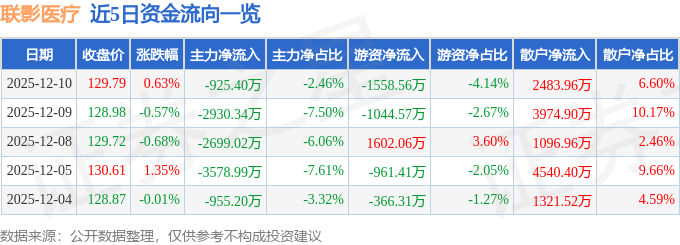
股票行情快报:联影医疗(688271)12月10日主力资金净卖出925.40万元
Sou Hu Cai Jing· 2025-12-10 12:32
Group 1 - The core stock price of United Imaging Healthcare (688271) closed at 129.79 yuan on December 10, 2025, with a slight increase of 0.63% and a trading volume of 29,100 hands, resulting in a total transaction amount of 376 million yuan [1] - The net outflow of main funds on December 10 was 9.254 million yuan, accounting for 2.46% of the total transaction amount, while retail investors saw a net inflow of 24.8396 million yuan, representing 6.6% of the total transaction amount [1][2] Group 2 - Over the past five days, the stock has experienced fluctuations, with the highest closing price being 130.61 yuan and the lowest at 128.87 yuan, alongside varying net inflows and outflows from different investor categories [2] - The company reported a total market value of 106.967 billion yuan, with a net asset value of 20.805 billion yuan and a net profit of 1.12 billion yuan, ranking 2nd, 3rd, and 5th respectively in the medical device industry [3] - The company's revenue for the first three quarters of 2025 was 8.859 billion yuan, a year-on-year increase of 27.39%, with a net profit increase of 66.91% to 1.12 billion yuan [3] Group 3 - The average target price set by 25 institutions over the last 90 days is 173.12 yuan, with 18 institutions giving a buy rating and 7 an increase rating [4]
联影医疗中标:[正在公示]寿县人民医院医学影像科大型医疗设备维保服务采购(二包,二次)成交结果公告
Sou Hu Cai Jing· 2025-12-10 04:36
Group 1 - The core point of the article is that Shanghai United Imaging Healthcare Co., Ltd. has won a bid for the maintenance service procurement of large medical equipment at Shouxian People's Hospital, with a bid amount of 685,000.00 [1][2] - The procurement was officially announced on December 7, 2025, indicating the ongoing investment in healthcare infrastructure in Anhui Province [2] - Shanghai United Imaging Healthcare Co., Ltd. has a significant presence in the market, having participated in 8,516 bidding projects and invested in 21 companies [1] Group 2 - The company holds a substantial amount of intellectual property, including 894 trademark registrations, 5,562 patents, and 109 copyrights, which reflects its innovation capabilities [1] - Additionally, the company has obtained 457 administrative licenses, indicating compliance with regulatory requirements in the healthcare sector [1]
关于“第十八届寰宇生产力论坛”的通知
DT新材料· 2025-12-09 16:05
各有关单位: 为 推动 两岸 四地新质生产力发展,通过科技创新和产业创新深化融合,以新型工业化 助力两岸 四地 企业 转型升级 , 中国生产力 促进中心协会 与 香港生产力促进局、澳门生产力暨科技转移中心、全国台湾同胞投资企业联谊会定 于 2025 年 12 月 18 日在北京举办 第十八届寰宇生产力论坛。论坛以" 人工智能助力产业,两岸共创新质未来 "为主题, 发挥人工智能、新材料领域的链主单位优势,聚集 两个领域的产业链、供应链主要骨干企业,共同研讨 产业创新发展和企业转型升级的路径 。 具体通知如下: 一、 会议安排 3 、会议报到: 2025 年 12 月 17 日 14:00-21:00 ,北京铁道大厦大堂 主办单位致辞 申长江 中国生产力促进中心协会理事长 毕坚文 香港生产力促进局总裁 关治平 澳门生产力暨科技转移中心理事长 领导讲话 李政宏 全国台湾同胞投资企业联谊会会长 2 、 主旨演讲嘉宾 徐锭明 国务院原参事、国家发展改革委能源局原局长、国家能源领导小组办公室原副主任 陶 飞 北京航空航天大学 国际前沿交叉科学研究院院长、国家智能制造专家委员会委员 、 " 十四五 " 国家重点研发计划工业 ...
生物医药行业:2025年医保及首版商保目录公布,中国药品价格登记系统上线,助力创新药发展
Ping An Securities· 2025-12-09 04:53
Investment Rating - The industry investment rating is "Outperform the Market," indicating that the industry index is expected to perform better than the market by more than 5% over the next six months [36]. Core Insights - The 2025 National Basic Medical Insurance, Maternity Insurance, and Work Injury Insurance Drug List, along with the first version of the Commercial Health Insurance Innovative Drug List, was released on December 7, 2025. This adjustment includes 114 new drugs, of which 50 are classified as Class 1 innovative drugs [3]. - The newly launched Chinese Drug Price Registration System aims to facilitate the global pricing system for innovative drugs and attract high-quality foreign drugs to the Chinese market, benefiting patients [4][5]. - The innovative drug sector is expected to continue its rise, with recommendations to focus on companies with rich pipeline layouts, high-potential innovative drugs, and leading technology platforms [11]. Summary by Sections Industry Developments - The 2025 drug list adjustment marks the eighth update since the establishment of the National Medical Insurance Bureau, reflecting ongoing efforts to enhance drug accessibility and innovation in China [3]. - The Chinese Drug Price Registration System, launched on December 2, 2025, allows pharmaceutical companies to independently declare drug prices, promoting a more transparent and globalized pricing structure [4][5]. Company Highlights - Yino Pharmaceutical has rapidly emerged in the metabolic disease treatment field since its establishment in 2014, with its core product, Isupreglutide α, receiving approval as a Class 1 innovative drug and entering commercialization [7]. Investment Strategy - The report suggests focusing on companies with diverse pipelines, such as Heng Rui Medicine, BeiGene, and China National Pharmaceutical Group, as well as those with high-potential innovative drugs like Sanofi and Kaiyin Technology [11]. - It also highlights the importance of companies with leading technology platforms, such as Dongcheng Pharmaceutical and WuXi AppTec, as well as upstream companies benefiting from overseas expansion [11]. Market Performance - The pharmaceutical sector experienced a decline of 0.74% last week, ranking 19th among 28 industries, while the Shanghai and Shenzhen 300 Index rose by 1.28% [14][24]. - As of December 5, 2025, the pharmaceutical sector's valuation stands at 29.30 times (TTM), with a premium of 17.46% over the overall A-share market [27].
医疗数智化建设驶入快车道 机构看好概念股成长空间
Zheng Quan Shi Bao· 2025-12-08 18:12
Group 1 - Huawei officially launched the AI data platform for the medical field on December 7, which is built on the OceanStor A800 storage and includes three core technologies: knowledge generation and retrieval, memory extraction and recall, and UCM inference acceleration [1] - The successful implementation of Huawei's AI data platform at West China Hospital exemplifies the empowerment of AI technology in the medical sector, addressing the long-standing "triangle constraint" of cost, quality, and accessibility [1] - The Chinese AI medical industry is projected to reach a market size of 115.7 billion yuan by 2025 and is expected to grow to 159.8 billion yuan by 2028, with a compound annual growth rate of 10.5% from 2022 to 2028 [1] Group 2 - The AI medical imaging and AI pharmaceutical sectors are experiencing rapid growth, with the AI medical imaging market expected to exceed 15 billion yuan by 2025 and reach 23.57 billion yuan by 2026 [2] - The AI pharmaceutical market is projected to grow from 730 million yuan in 2024 to 5.86 billion yuan by 2028, with a compound annual growth rate of 68.5% [2] - There are currently 33 concept stocks in the A-share market related to AI medical, with 10 companies disclosing collaborations with Huawei in AI medical applications, including RunDa Medical, Weining Health, and Dian Diagnostics [2] Group 3 - United Imaging Healthcare stated that all its imaging diagnostic equipment has been empowered by AI platforms, enhancing various aspects such as hardware, software, applications, and workflows [3] - Among the 14 AI medical concept stocks that received significant institutional attention, 13 are expected to see profit growth by 2025, with companies like Hongbo Pharmaceutical, Dian Diagnostics, and Weining Health projected to have profit increases exceeding 100% or to turn profitable [3]
上市公司多维创新 竞逐“人工智能+医疗”赛道
Zheng Quan Ri Bao· 2025-12-08 17:12
Core Insights - The application of artificial intelligence (AI) in the medical field is rapidly advancing, with significant developments showcased at the first Greater Bay Area Medical AI Conference in Guangzhou [1] - Companies like Guangzhou Kingmed Diagnostics Group Co., Ltd. are leading the way in AI medical testing, having developed various AI products and models that enhance diagnostic efficiency [1][2] - The Chinese government is actively supporting the integration of AI in healthcare, aiming to establish high-quality data sets and intelligent applications by 2027 [3][4] Company Developments - Kingmed Diagnostics has been focusing on AI in medical testing since 2020, creating the first large model "Yujian Yiyan" and the intelligent agent "Xiaoyuyue," interpreting nearly 8 million reports [1] - The company has developed specialized AI models for cervical cancer pathology and multimodal pathology genetics, significantly improving diagnostic efficiency [1] - Kingmed's cloud testing platform supports 86,000 active doctors and 168,000 active users with clinical and research assistance [1] Industry Trends - Other companies, such as Shanghai United Imaging Healthcare Co., Ltd. and Shenzhen Mindray Bio-Medical Electronics Co., Ltd., are also innovating in the "AI + healthcare" sector [2] - Mindray has launched the "Ruiying AI+" solution to enhance ultrasound capabilities through AI, while United Imaging has integrated AI into medical imaging and radiotherapy equipment since around 2018 [2] - The integration of AI in medical imaging is currently one of the most mature applications, significantly improving diagnostic accuracy and efficiency [3] Policy and Market Dynamics - The Chinese government has issued guidelines to promote and regulate the application of AI in healthcare, aiming for widespread use of intelligent decision-making tools in clinical settings by 2027 [3] - The healthcare sector, characterized by vast data and essential public needs, is a critical area for AI implementation [4] - Challenges such as inconsistent data quality, lack of standardization, and insufficient cross-institutional sharing mechanisms need to be addressed to ensure high-quality development of AI in healthcare [4]

医药行业2026年投资策略:寻找医药硬科技,从新出发
2025-12-08 15:36
Summary of the Conference Call on the Pharmaceutical Industry Investment Strategy for 2026 Industry Overview - The pharmaceutical market in 2025 is characterized by a "one rises, five remain stable" trend, with innovative drugs benefiting from valuation recovery, policy support, overseas business development (BD) transactions, and improved domestic data [1][3] - The Chinese innovative drug sector has cost and efficiency advantages in global competition, with significantly lower R&D labor costs, clinical research costs, and drug procurement costs compared to the US [1][6] Key Insights and Arguments - **Growth of Innovative Drugs**: The significant growth of innovative drugs in 2025 is attributed to low historical valuations, favorable policy changes, and substantial overseas BD transactions that have stimulated market sentiment and improved cash flow and pipeline valuations [4][5] - **Future of Medical Reform**: Continued deepening of medical reform is expected, with potential advancements in the Diagnosis-Related Group (DRG) reforms and more supportive policies for the innovative industry chain [7] - **Changes in Procurement Rules**: Future procurement rules are anticipated to gradually optimize, reducing extreme price suppression phenomena and promoting the overseas expansion of Chinese companies [8] Notable Trends in 2026 - **Focus Areas for Innovative Drugs**: Key areas to watch in the biopharmaceutical sector include bispecific antibodies, antibody-drug conjugates (ADC), small nucleic acid drugs, and precision therapies (cell and gene therapy) [10][12] - **CRO Industry Growth**: The CRO (Contract Research Organization) sector is experiencing accelerated order growth, with leading companies like WuXi AppTec and Tigermed seeing upward revisions in profit forecasts [11] - **Medical Device Industry**: The medical device sector is recovering, with high-end imaging products growing faster than the industry average, and companies expanding their overseas revenue significantly [15] Challenges and Opportunities - **Challenges in the Pharmaceutical Commercial Sector**: The pharmaceutical commercial sector faces extended accounts receivable cycles, impacting profitability despite stable revenues. However, leading companies with low valuations present buying opportunities for conservative investors [21] - **Impact of US Policies**: Recent restrictive US government policies pose challenges for the Chinese pharmaceutical industry, but the overall impact is expected to be manageable due to improved US-China relations [9] Future Investment Strategies - **Investment Focus for 2026**: The investment strategy for 2026 emphasizes identifying segments with predictable growth, including innovative drugs, innovative devices, and overseas expansion. Specific attention is given to "best in class" and "first in class" pipeline leaders in innovative drugs [24] - **Long-term Value Areas**: Areas such as pharmaceutical consumption, medical aesthetics, beauty brands, traditional Chinese medicine, and ophthalmology are highlighted as having long-term investment value [24] Additional Insights - **Synthetic Biology**: As a key focus of the 14th Five-Year Plan, synthetic biology is expected to achieve revolutionary breakthroughs in the coming years [2][14] - **Medical AI Development**: The development of medical AI is gaining traction, with applications in diagnostics, health check-ups, and industrial upgrades, expected to see significant advancements in 2026 [22][23]
健信超导(688805):注册制新股纵览:全球领先的专业磁共振核心部件供应商
Shenwan Hongyuan Securities· 2025-12-08 14:48
Group 1 - Investment Rating: The report assigns an AHP score of 2.38 to the company, placing it in the 39.2% and 41.4% percentiles of the AHP model, indicating a below-average position in the market [9][10] - Core Viewpoint: The company is a leading global supplier of MRI core components, having broken the overseas monopoly in zero-evaporation superconducting magnets, with over 50% of its revenue coming from superconducting products [4][15] - The company has established a strong presence in the MRI market, with a global market share of 4.2% in superconducting magnets and 61% in permanent magnets, making it the largest independent supplier of MRI permanent magnets [4][21] Group 2 - The company is focusing on the development of helium-free and high-field superconducting products, with plans to increase production capacity through fundraising projects [17][19] - The company has achieved significant sales growth in helium-free superconducting products, with orders reaching 54 units by mid-2025, indicating a strong market demand [18] - The company’s revenue and net profit are expected to grow by over 30% in 2025, with a compound annual growth rate of 26.91% from 2022 to 2025 [25] Group 3 - The company’s gross margin and net margin are relatively low compared to comparable companies, with gross margins ranging from 23% to 27% and net margins between 9% and 13% during the reporting period [29][30] - The company’s R&D expense ratio is increasing but remains lower than that of comparable companies, indicating potential room for improvement in innovation [33] - The company has experienced a decline in inventory turnover, which is attributed to increased raw material procurement and production preparation for anticipated demand [36] Group 4 - The fundraising will be allocated to projects aimed at increasing production capacity for helium-free superconducting magnets and developing new superconducting technologies, which aligns with industry trends [40][41] - The company plans to enhance its core technology in the MRI sector and expand its applications in new fields, indicating a forward-looking growth strategy [40]