
京东方

Search documents
CES 2026 | “科技+绿色”双引擎,京东方精电推动生态协同与可持续创新
Ge Long Hui· 2026-01-14 05:01
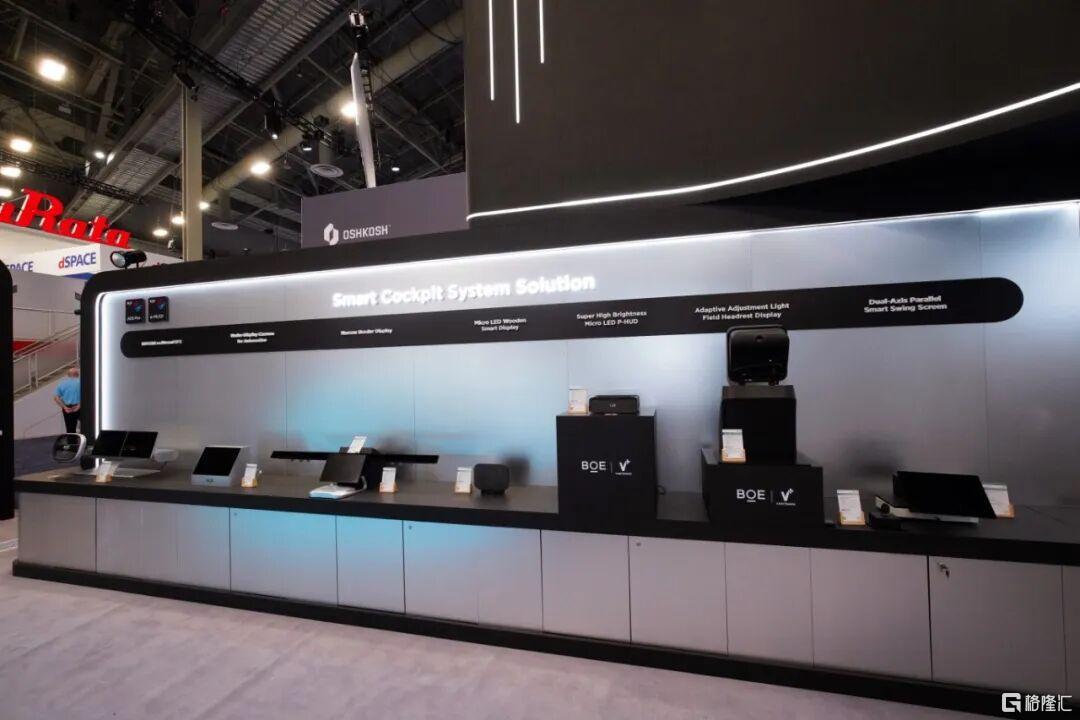
Core Insights - BOE Technology Group showcased over 22 green products at CES 2026, marking a historical high for the company [2][3] - The company emphasizes its commitment to sustainable innovation and ecological collaboration, presenting 11 collaborative products with various partners [7][12] Group 1: Green Product Innovations - The company introduced HERO2.0 smart cockpit and over 20 green technology products, highlighting its global influence in sustainable innovation [1] - In the smart mobility sector, BOE's OLED technology enhances visual clarity and driving safety while optimizing energy efficiency, with a 50% reduction in power consumption and carbon emissions for its 14.6-inch IGZO display [4] - The photovoltaic dimming curtain wall utilizes advanced perovskite photovoltaic technology, showcasing unique advantages in low-light power generation [5] Group 2: Commitment to Sustainability - BOE aims to achieve carbon neutrality in its operations by 2050, supported by a governance structure that promotes carbon accounting and energy-saving initiatives [6] - The company has established dual certification systems for energy management (ISO 50001) and environmental management (ISO 14001), extending its green development philosophy to its supply chain [6] - BOE's manufacturing bases in Chengdu and Heyuan have been recognized as provincial green factories, with Chengdu recently named a "near-zero carbon emission industrial enterprise" [6] Group 3: Ecological Collaboration - BOE partnered with various ecological partners to present 11 collaborative products across multiple fields, including smart cockpits and smart homes, demonstrating its global ecological influence [7][12] - The company has expanded its business network to cover 16 countries and regions, collaborating with nearly 600 ecological partners [9] - During CES, BOE engaged in deep discussions with over 40 partners, including top luxury automotive brands, enhancing its brand influence and technical strength in the global market [9][10]



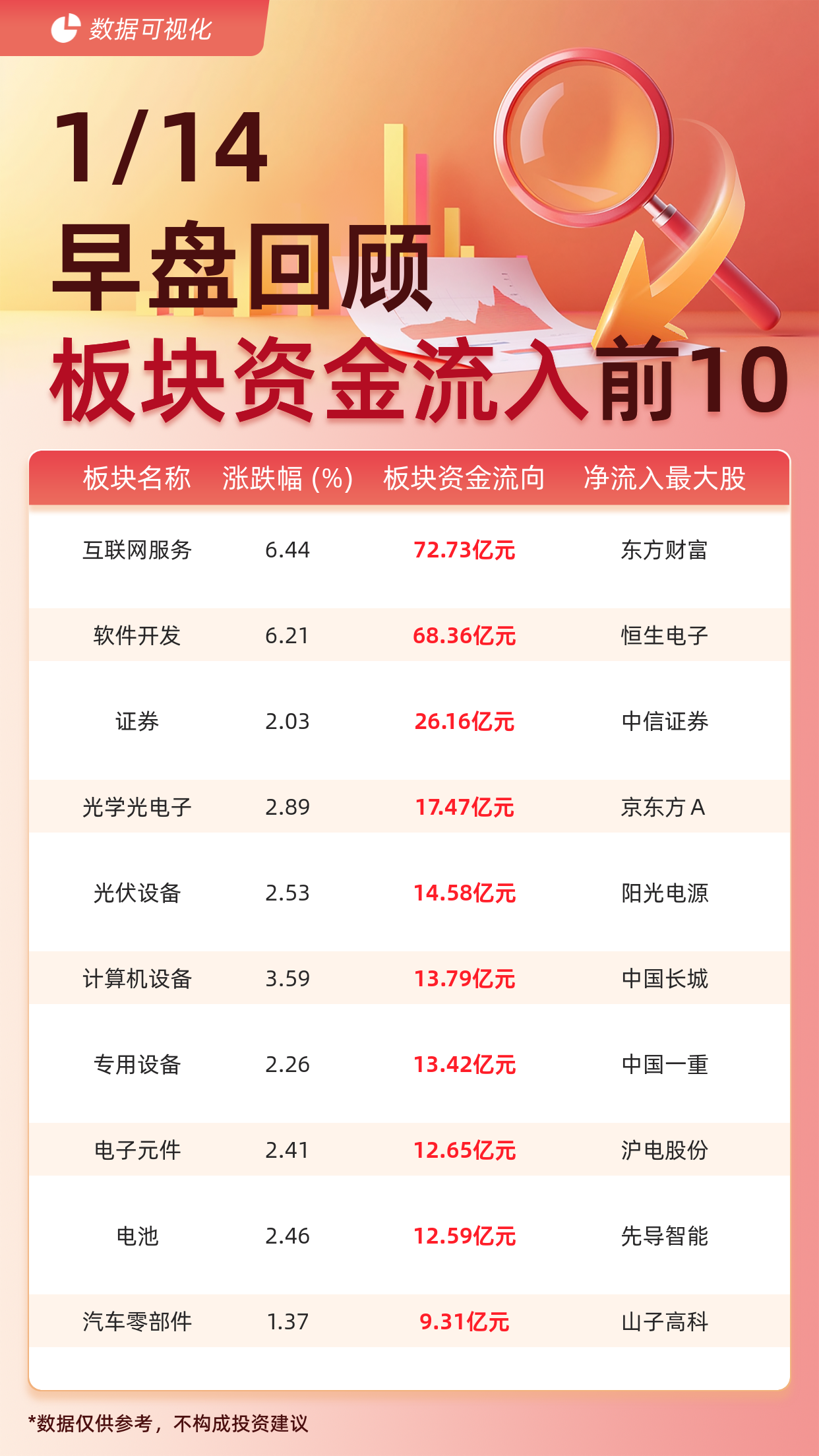
主力板块资金流入前10:互联网服务流入72.73亿元、软件开发流入68.36亿元
Jin Rong Jie· 2026-01-14 04:04
Core Insights - The main market saw a net inflow of 19.182 billion yuan as of January 14, with significant capital flowing into various sectors [1] Group 1: Sector Performance - The top sectors by net capital inflow were: - Internet Services with 7.273 billion yuan and a growth of 6.44% [2] - Software Development with 6.836 billion yuan and a growth of 6.21% [2] - Securities with 2.616 billion yuan and a growth of 2.03% [2] - Optical and Electronic with 1.747 billion yuan and a growth of 2.89% [2] - Photovoltaic Equipment with 1.458 billion yuan and a growth of 2.53% [2] - Computer Equipment with 1.379 billion yuan and a growth of 3.59% [2] - Specialized Equipment with 1.342 billion yuan and a growth of 2.26% [3] - Electronic Components with 1.265 billion yuan and a growth of 2.41% [3] - Batteries with 1.259 billion yuan and a growth of 2.46% [3] - Automotive Parts with 0.931 billion yuan and a growth of 1.37% [3]





2025年中国硅基OLED微显示屏行业进入壁垒、发展历程、产业链图谱、市场规模、竞争格局及发展趋势分析:XR领域需求高达50.39%[图]
Chan Ye Xin Xi Wang· 2026-01-14 01:27
Core Insights - The silicon-based OLED microdisplay has become the core display solution for XR (AR/VR) devices due to its high resolution, high contrast, low power consumption, and miniaturization advantages, with applications expanding from consumer to industrial and medical fields as AI and XR technologies converge [1][10] - The global shipment of silicon-based OLED microdisplays is expected to reach 6.365 million units in 2024, a year-on-year increase of 25.1%, with a market size of $1.27 billion, growing by 13.4% year-on-year [10] Industry Overview - Microdisplays are defined as screens smaller than 2 inches with pixel sizes under 10 micrometers, with silicon-based OLED microdisplays utilizing single-crystal silicon wafers as driving backplanes and OLEDs as light-emitting units, offering high resolution, brightness, contrast, and rapid response [2][3] - The main technologies in the microdisplay market include Fast-LCD, LCoS, and silicon-based OLED, with silicon-based OLED showing significant advantages in contrast, response speed, and pixel density, particularly in VR and AR applications [3][4] Industry Barriers - The production of silicon-based OLED involves multiple processes requiring high technical precision, combining semiconductor and OLED display technologies, which creates significant entry barriers due to the need for breakthroughs in key processes [4][5] Development History - The development of China's silicon-based OLED microdisplay industry can be divided into four stages: laboratory exploration, technological breakthroughs, industrialization, and global competition, with leading companies achieving breakthroughs in performance metrics since 2024 [5][6] Industry Chain - The upstream of the silicon-based OLED microdisplay industry includes suppliers of raw materials, production equipment, and testing equipment, while the midstream focuses on R&D, design, and production, and the downstream encompasses application markets such as XR, electronic viewfinders, and infrared thermal imaging [7][8] Current Market Status - The XR field is the core demand market for silicon-based OLED microdisplays, expected to account for 50.39% of the market in 2024, driven by the need for high information density and immersive display effects [8][10] Competitive Landscape - The XR market is primarily dominated by Sony and Visionox, with Sony holding a 50.8% share of global shipments in 2024, while Visionox ranks second with a 35.2% share [11][12] Company Analysis - Visionox is a leading provider of microdisplay solutions, with a diverse product range and a strong focus on R&D, achieving a production rate of 95.33% in the first half of 2025 [12] - Suzhou Qingyue Technology specializes in OLED and silicon-based OLED microdisplays, with a revenue of 0.13 billion yuan from its silicon-based OLED business in 2024, accounting for 1.69% of total revenue [13] Future Trends - The silicon-based OLED microdisplay industry is expected to focus on continuous performance upgrades, with advancements in brightness, optical efficiency, and power consumption [14] - The industry will accelerate the localization of the supply chain, enhancing collaboration and innovation across upstream and downstream sectors [15] - The integration of AI and XR technologies will drive the development of a cohesive ecosystem, enhancing global competitiveness and shifting the industry from a "follower" to a "leader" position [15]

25年总营收约500亿,群创光电将持续加注FOPLP
势银芯链· 2026-01-14 01:02
Core Viewpoint - The article discusses the significant growth and transformation of the display panel industry in mainland China, highlighting the shift towards advanced packaging technologies like FOPLP (Fan-Out Panel Level Packaging) as companies seek new growth opportunities amidst declining traditional panel sales [2][4]. Group 1: Industry Overview - Mainland China has become the largest display panel manufacturing center globally, with a projected LCD panel capacity market share of 75% by 2028 [2]. - In 2025, the total shipment of television sets in China is expected to decline by 8.5% year-on-year, with a notable drop of 16.9% in the second half of the year [2]. - Taiwanese and Japanese/Korean LCD panel companies are optimizing their capacities and exploring new growth areas due to the impact of government subsidies and market conditions [2]. Group 2: Company Focus - Innolux Corporation - Innolux Corporation is shifting part of its focus to non-display panel businesses, particularly FOPLP technology, which has begun mass production with monthly output in the millions [2][5]. - The company aims to achieve a non-panel revenue share of approximately 11-15% by 2025 [5]. - Innolux's revenue for December 2025 is reported at NT$ 214 billion (approximately RMB 47.18 billion), marking a 25.18% month-on-month increase and a 19.22% year-on-year increase [7]. Group 3: FOPLP Technology Insights - FOPLP technology allows for higher chip placement efficiency, with theoretical board-level substrate utilization rates exceeding 95%, leading to significant cost advantages, with packaging costs potentially reduced by at least 50% compared to wafer-level packaging [9]. - The technology is primarily based on glass substrates, with applications in power management and RF chips, and is expected to expand into AI chip markets in the coming years [9][10]. - Challenges include compatibility issues due to the lack of standardization in panel sizes and technical difficulties related to panel warping and precision during the packaging process [10]. Group 4: Market Trends and Competitors - Major companies like NVIDIA and AMD are showing strong interest in FOPLP technology, indicating a growing market demand [10]. - A comprehensive overview of companies involved in FOPLP technology development includes major players like TSMC, ASE, and BOE, each with specific advancements and timelines for production [10][11].

电子行业周报:半导体景气超预期,多环节陆续提价,AI 眼镜放量在即-20260114
Guoxin Securities· 2026-01-14 00:57
Investment Rating - The report maintains an "Outperform" rating for the electronics industry [1][10]. Core Insights - The semiconductor sector is experiencing better-than-expected conditions, with price increases across multiple segments driven by rising AI demand. The industry is seeing a recovery in profitability as price hikes are being passed on to consumers [1]. - The CES 2026 event has showcased significant advancements in AR glasses, indicating a year of hardware innovation. Companies are encouraged to focus on AR glasses as they become independent smart devices with enhanced communication and computing capabilities [3]. - NVIDIA has introduced a new storage architecture that redefines the role of NAND Flash, significantly increasing its demand and value in AI applications. This shift is expected to benefit companies in the storage industry [4]. Summary by Sections Semiconductor Industry - The semiconductor industry is witnessing a supply-demand imbalance, particularly in storage and high-end PCB segments. Price increases are anticipated across various manufacturing stages, including wafer foundries and high-end packaging [1]. - The report highlights the potential for domestic semiconductor materials to replace imports, particularly in light of recent anti-dumping investigations against Japanese products [2]. AR Glasses and Consumer Electronics - CES 2026 has seen a variety of AR glasses, with advancements in full-color display technology enhancing user experience and application scenarios. Companies are advised to monitor developments in this area [3]. - The report emphasizes the importance of AR glasses as a platform for AI technology, suggesting a growing market for these devices [3]. Storage Industry - The introduction of NVIDIA's new storage processor platform is expected to revolutionize the role of NAND Flash, making it a critical component in AI processing. This change is likely to drive demand for storage-related companies [4]. - The storage industry is projected to benefit from ongoing AI demand, with a positive outlook for companies involved in NAND Flash production [4]. Key Companies and Recommendations - The report recommends several companies for investment, including: - Semiconductor: 中芯国际 (SMIC), 翱捷科技 (Aojie Technology), 德明利 (Demingli), 蓝思科技 (Lens Technology) [10]. - Storage: 德明利 (Demingli), 江波龙 (Jiangbolong), 佰维存储 (Baiwei Storage) [4][10]. - AR Glasses: 蓝特光学 (Lante Optics), 水晶光电 (Crystal Optoelectronics) [3].




从两座城市,日媒看见中国底气
Xin Lang Cai Jing· 2026-01-13 23:58
Group 1 - Deepseek, a Chinese AI startup, launched a generative AI model in January 2025 that rivals the performance of ChatGPT without using NVIDIA chips, which are banned for export to China [2][3] - The founder of Deepseek, Liang Wenfeng, was recognized as one of the "Top 10 People in Science and Technology" by Nature magazine in 2025, yet he remains largely out of the public eye [2] - China is positioning artificial intelligence at the core of its national strategy to compete with the United States [2] Group 2 - Chengdu is becoming a central hub for China's supply chain strategy, with significant investments in manufacturing [3] - BOE Technology Group, a leading global LCD panel manufacturer, is constructing a new factory in Chengdu, aiming to become a leader in the OLED sector by 2026 [2][3] - Contemporary Amperex Technology Co., Ltd. (CATL), a major player in the global electric vehicle battery market, has a production base in Sichuan, holding nearly 40% market share [2][3] Group 3 - There is a significant shift of factories from coastal regions to inland provinces like Sichuan, aligning with China's strategy to enhance its share in global supply chains amid the trade war with the U.S. [3] - The competition between China and the U.S. in 2025 will intensify in the fields of artificial intelligence and supply chains [3] - Political analysts suggest that 2025 will be a turning point in international politics, influenced by the changing dynamics of U.S. foreign policy under President Trump [3]
北京东方园林环境股份有限公司关于变更公司名称、证券简称暨完成工商变更登记的公告
Shang Hai Zheng Quan Bao· 2026-01-13 19:02
Group 1 - The company has changed its name to Beijing Orient EcoEnergy Co., Ltd. to better align with its current business focus on renewable energy, particularly solar and wind power [1][2] - The name change was approved during board meetings held on December 15, 2025, and January 6, 2026, reflecting the company's strategic shift towards renewable energy as its core growth engine [1][2] - The new securities abbreviation will be "东方新能" (Orient EcoEnergy), effective from January 14, 2026, while the securities code "002310" remains unchanged [2][3] Group 2 - The company's solar power business accounted for 82.00% of its revenue in the first half of 2025 and 90.91% for the entire year of 2024, meeting the requirements for a name change due to a shift in main business operations [2] - The company has completed the registration of its new name and updated its business license with the relevant authorities in Beijing [2][3] - The company’s registered capital is approximately 599.93 million yuan [2]

【职教实践进行时】技工教育从这里“远渡重洋”
Xin Lang Cai Jing· 2026-01-13 18:48
(来源:工人日报) 在中德合作领域,注重引进融合德国先进教育理念、教学模式和行业标准。平度市技师学院成立全省首 个"中德工匠学院",率先实现中德智能制造人才的国际化培养。青岛市技师学院成立了机电一体化中德 实验班,构建"工学一体化"与"德国双元制"融合课程体系,推进德国认证标准本土化转化,提升专业国 际竞争力,培养支撑制造业转型升级的高素质人才。 依托青岛区位优势,锚定建设"国际门户枢纽城市"目标,青岛以技工教育国际合作为突破口,构建技能 人才国际培养平台,推动与全球20多个国家和地区的教育机构开展合作,高质量推进"技能出海"。 "使用钳子剥除电线外皮,利用万用表检测线路通断,再通过电脑编程控制电器开关、调节设备运行速 度……"青岛市技师学院实训车间内,来自老挝琅勃拉邦职业技术学院电气专业的教师莫达·奔永正在反 复练习,额头汗珠滑落却丝毫不敢分心。几天后,他通过了中国电工三级(高级工)职业技能等级考试 并获取证书。这张证书不仅是对他技能的认可,更寄托着他回国后推动本土教学标准提升的期望。 莫达·奔永的国际求学经历,是青岛技工教育"请进来"与"走出去"相结合的生动写照。 近年来,青岛以技工教育为纽带,持续深化多 ...
光学光电子板块1月13日跌2.79%,联建光电领跌,主力资金净流出23.89亿元
Zheng Xing Xing Ye Ri Bao· 2026-01-13 08:56
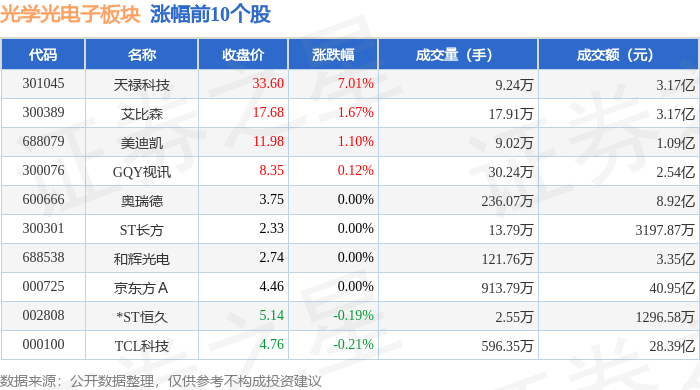
Market Overview - The optical and optoelectronic sector experienced a decline of 2.79% on January 13, with Lianjian Optoelectronics leading the drop [1] - The Shanghai Composite Index closed at 4138.76, down 0.64%, while the Shenzhen Component Index closed at 14169.4, down 1.37% [1] Stock Performance - Major stocks in the optical and optoelectronic sector showed varied performance, with Dalu Technology rising by 7.01% to a closing price of 33.60 [1] - Lianjian Optoelectronics saw a significant drop of 10.81%, closing at 8.42 [2] - Other notable declines included Dongtian Micro (-9.75%), Fumi Co. (-8.91%), and Sanan Optoelectronics (-8.67%) [2] Trading Volume and Capital Flow - The optical and optoelectronic sector had a net outflow of 2.389 billion yuan from institutional investors, while retail investors saw a net inflow of 2.026 billion yuan [2] - The trading volume for Lianjian Optoelectronics was 1.4719 million shares, contributing to a total transaction value of 1.274 billion yuan [2] Individual Stock Capital Flow - Among the stocks, BOE Technology had a net inflow of 364 million yuan from institutional investors, while retail investors experienced a net outflow of 2.09 billion yuan [3] - TCL Technology also reported a net inflow of 174 million yuan from institutional investors, with a net outflow of 1.89 billion yuan from retail investors [3]


电子行业1月13日资金流向日报
Zheng Quan Shi Bao Wang· 2026-01-13 08:54
主力资金净流出的行业有27个,电子行业主力资金净流出规模居首,全天净流出资金370.10亿元,其次 是计算机行业,净流出资金为231.07亿元,净流出资金较多的还有国防军工、通信、电力设备等行业。 资金面上看,两市主力资金全天净流出1627.43亿元,今日有4个行业主力资金净流入,医药生物行业主 力资金净流入规模居首,该行业今日上涨1.21%,全天净流入资金43.48亿元,其次是石油石化行业,日 涨幅为1.62%,净流入资金为5.86亿元。 电子行业今日下跌3.30%,全天主力资金净流出370.10亿元,该行业所属的个股共476只,今日上涨的有 34只,涨停的有1只;下跌的有435只。以资金流向数据进行统计,该行业资金净流入的个股有92只,其 中,净流入资金超亿元的有9只,净流入资金居首的是兆易创新,今日净流入资金5.26亿元,紧随其后 的是京东方A、赛微电子,净流入资金分别为3.77亿元、2.85亿元。电子行业资金净流出个股中,资金 净流出超亿元的有93只,净流出资金居前的有领益智造、寒武纪-U、工业富联,净流出资金分别为 23.47亿元、22.80亿元、18.81亿元。(数据宝) 电子行业资金流入榜 | ...