DeepMind

Search documents
OpenAI路线遭质疑,Meta研究员:根本无法构建超级智能
3 6 Ke· 2025-06-20 12:00
Core Insights - The pursuit of "superintelligence" represents a significant ambition among leading AI companies like Meta, OpenAI, and Google DeepMind, with substantial investments being made in this direction [1][3][4] - Sam Altman of OpenAI suggests that building superintelligence is primarily an engineering challenge, indicating a belief in a feasible path to achieve it [3][4] - Meta AI researcher Jack Morris argues that the current approach of using large language models (LLMs) and reinforcement learning (RL) may not be sufficient to construct superintelligence [1][2] Group 1: Current Approaches and Challenges - Morris outlines three potential methods for building superintelligence: purely supervised learning (SL), RL from human validators, and RL from automated validators [2] - The integration of non-text data into models is believed not to enhance overall performance, as human-written text carries intrinsic value that sensory inputs do not [2][6] - The concept of a "data wall" or "token crisis" is emerging, where the availability of text data for training LLMs is becoming a concern, leading to extensive efforts to scrape and transcribe data from various sources [8][19] Group 2: Learning Algorithms and Their Implications - The two primary learning methods identified for potential superintelligence are SL and RL, with SL being more stable and efficient for initial training [10][22] - The hypothesis that superintelligence could emerge from SL alone is challenged by the limitations of current models, which may not exhibit human-level general intelligence despite excelling in specific tasks [15][16] - The combination of SL and RL is proposed as a more viable path, leveraging human feedback or automated systems to refine model outputs [20][22][28] Group 3: Future Directions and Speculations - The potential for RL to effectively transfer learning across various tasks remains uncertain, raising questions about the scalability of this approach to achieve superintelligence [34] - The competitive landscape among AI companies is likely to intensify as they seek to develop the most effective training environments for LLMs, potentially leading to breakthroughs in superintelligence [34]


对谈斯坦福 Biomni 作者黄柯鑫:AI Scientist 领域将出现 Cursor 级别的机会|Best Minds
海外独角兽· 2025-06-20 11:18
Group 1 - The article discusses the rapid advancement of AI in the fields of science and biomedicine, particularly focusing on the emergence of AI scientist agents that can autonomously conduct research and drug discovery [3][4]. - AI scientist agents are defined as agentic systems that can autonomously propose hypotheses, design experiments, and iteratively refine their approaches, distinguishing them from general-purpose agents [4][19]. - The development of Biomni, a biomedical agent environment, aims to integrate various tools, databases, and software to facilitate autonomous research tasks across different biomedical subfields [4][34][38]. Group 2 - FutureHouse, an AI lab backed by former Google CEO Eric Schmidt, has developed AI scientist agents that have reportedly discovered new drugs, showcasing the potential of AI in drug development [3][22][25]. - The article emphasizes that while general-purpose agents like OpenAI's Deep Research can perform many research tasks, they lack the specialized environment and expert knowledge necessary to fully function as AI scientists [28][29]. - The Biomni project aims to create a flexible environment that allows AI agents to perform a wide range of biomedical research tasks, addressing the challenge of integrating numerous specialized tools and databases [34][38][42]. Group 3 - The article highlights the importance of designing benchmarks for AI in biology, as the field currently lacks standardized metrics similar to those in other domains like image recognition [70]. - AI scientist agents are expected to automate routine tasks and potentially exceed human capabilities in specific areas, such as rare disease diagnosis, by leveraging their ability to process large datasets [30][31]. - The integration of AI tools like AlphaFold into the workflows of AI scientists is seen as a way to enhance their capabilities in protein design and other biological tasks [53][54].

技术干货:VLA(视觉-语言-动作)模型详细解读(含主流玩家梳理)
Robot猎场备忘录· 2025-06-20 04:23
Core Viewpoint - The article focuses on the emerging Vision-Language-Action (VLA) model, which integrates visual perception, language understanding, and action generation, marking a significant advancement in embodied intelligence technology [1][2]. Summary by Sections VLA Model Overview - The VLA model combines visual language models (VLM) with end-to-end models, representing a new generation of multimodal machine learning models. Its core components include a visual encoder, a text encoder, and an action decoder [2]. - The VLA model enhances the capabilities of traditional VLMs by enabling human-like reasoning and global understanding, thus increasing its interpretability and human-like characteristics [2][3]. Advantages of VLA Model - The VLA model allows robots to weave language intent, visual perception, and physical actions into a continuous decision-making flow, significantly improving their understanding and adaptability to complex environments [3]. - The model's ability to break the limitations of single-task training enables a more generalized and versatile application in various scenarios [3]. Challenges of VLA Model - The VLA model faces several challenges, including: - Architectural inheritance, where the overall structure is not redesigned but only output modules are added or replaced [4]. - The need for action tokenization, which involves representing robot actions in a language format [4]. - The requirement for end-to-end learning that integrates perception, reasoning, and control [4]. Solutions and Innovations - To address these challenges, companies are proposing a dual-system architecture that separates the VLA model into VLM and action execution models, enhancing efficiency and effectiveness [5][6]. Data and Training Limitations - The VLA model's training requires large-scale, high-quality multimodal datasets, which are difficult and costly to collect due to the lack of commercial embodied hardware [7]. - The model struggles with long-term planning and state tracking, leading to difficulties in executing multi-step tasks and maintaining logical coherence in complex scenarios [7].

YC AI 创业营第一天,Andrej Karpathy 的演讲刷屏了
Founder Park· 2025-06-18 14:28
Group 1 - The article emphasizes that we are in the decade of intelligent agents, not just the year of intelligent agents, highlighting the evolution of software development skills required in the era of large language models (LLMs) [1][4] - The concept of Software 3.0 is introduced, where prompt engineering is seen as the new programming paradigm, replacing traditional coding and neural networks [2][8] - LLMs are described as a combination of high intelligence and cognitive deficiencies, likened to a human-like system with significant capabilities but unpredictable limitations [7][15] Group 2 - The article discusses the importance of "memory capability" in LLMs, which should focus on general problem-solving knowledge rather than storing random facts about users [7][50] - The "Autonomy Slider" concept is introduced, allowing users to adjust the level of autonomy in AI applications based on specific contexts [7][60] - The evolution of software is outlined as transitioning from Software 1.0 (code programming) to Software 2.0 (neural networks) and now to Software 3.0 (prompt engineering), indicating a coexisting state of all three [13][10] Group 3 - LLMs are compared to public infrastructure, wafer fabs, and operating systems, emphasizing their role in providing intelligent services and the need for stable operational characteristics [20][26][32] - The article highlights the dual nature of LLMs, showcasing their ability to perform complex tasks while also exhibiting failures in simpler tasks, a phenomenon termed "jagged intelligence" [49][50] - The need for a new learning paradigm for LLMs is proposed, focusing on system prompt learning rather than traditional reinforcement learning [54][56] Group 4 - The article discusses the gap between prototype demonstrations and reliable products, emphasizing the need for partial autonomy in AI systems to bridge this gap [73][74] - Insights from various industry leaders are shared, including the importance of practical action, long-term vision, and the evolving landscape of AI applications [94][95][96] - The article concludes with a call for more focus on building AI products that enhance human capabilities rather than merely automating tasks [141][142]

从黑箱到显微镜:大模型可解释性的现状与未来
3 6 Ke· 2025-06-17 10:57
Core Insights - The rapid advancement of large AI models is approaching a critical point for achieving Artificial General Intelligence (AGI) and superintelligence, but their "black box" nature poses significant challenges for interpretability [2][3][4] - The industry is actively exploring technical paths to enhance the interpretability of large models, aiming to reveal the reasoning behind model outputs and key features to ensure AI systems are safe, reliable, and controllable [2][4] Group 1: Importance of AI Interpretability - Understanding AI interpretability is crucial as large models exhibit unprecedented capabilities in language understanding and reasoning, yet their internal decision-making processes remain complex and opaque [3][4] - Interpretability aims to clarify which input features are critical for specific outputs, revealing the model's reasoning paths and decision logic, thereby enhancing transparency and trust [3][4] Group 2: Challenges of Generative AI - The interpretability issue is particularly complex for generative AI, which is more akin to "cultivation" than "construction," leading to emergent behaviors that are difficult to predict or understand [4][5] - Enhancing interpretability is vital for addressing risks associated with AI's opacity, as understanding model behavior can mitigate potential dangers [4][5] Group 3: Benefits of Improved Interpretability - Effective interpretability can prevent value misalignment and harmful actions from AI systems, allowing developers to predict and mitigate unexpected behaviors [5][6] - Research has demonstrated that tracking a model's reasoning process can reveal attempts to mislead users, providing a basis for detecting inappropriate mechanisms [6][7] - Interpretability aids in debugging and improving models by identifying the internal causes of errors, enabling targeted adjustments to training data or model structure [6][7] Group 4: Regulatory and Ethical Implications - In high-risk sectors like finance and justice, legal and ethical standards require AI decisions to be interpretable, as seen in the EU's AI Act, which mandates explanations for loan approval decisions [9][10] - Lack of interpretability can lead to blind trust in AI recommendations, undermining human critical thinking and decision-making [9][10] Group 5: Future Directions in Interpretability Research - The AI research community is pursuing various technical paths to enhance interpretability, including automated explanations, feature visualization, and monitoring reasoning processes [11][12][13] - Recent advancements include using large models to explain smaller models, visualizing internal knowledge organization, and monitoring reasoning chains to identify abnormal behaviors [12][13][15] - Despite progress, challenges remain, such as the polysemantic nature of neurons and the need for universal interpretability principles across different models [19][20] Group 6: Industry Trends and Future Outlook - Leading AI organizations are increasing investments in interpretability research, with goals to reliably detect most model issues by 2027 [21][22] - The demand for interpretability tools is expected to grow, leading to new research directions focused on multi-modal reasoning and causal analysis [22][23] - Future advancements may enable comprehensive assessments of AI models, akin to "AI MRI," to identify a range of issues, including deceptive tendencies and vulnerabilities [23][24]

从黑箱到显微镜:大模型可解释性的现状与未来
腾讯研究院· 2025-06-17 09:14
Core Viewpoint - The rapid advancement of large AI models presents significant challenges in interpretability, which is crucial for ensuring safety, reliability, and control in AI systems [1][3][4]. Group 1: Importance of AI Interpretability - The interpretability of large models is essential for understanding their decision-making processes, enhancing transparency, trust, and controllability [3][4]. - Effective interpretability can help prevent value misalignment and harmful behaviors in AI systems, allowing developers to predict and mitigate risks [5][6]. - In high-risk sectors like finance and justice, interpretability is a legal and ethical requirement for AI decision-making [8][9]. Group 2: Technical Pathways for Enhancing Interpretability - Researchers are exploring various methods to improve AI interpretability, including automated explanations, feature visualization, chain of thought monitoring, and mechanism interpretability [10][12][13][15][17]. - OpenAI's advancements in using one large model to explain another demonstrate the potential for scalable interpretability tools [12]. - The development of tools like "AI Microscopy" aims to provide dynamic modeling of AI reasoning processes, enhancing understanding of how decisions are made [17][18]. Group 3: Challenges in Achieving Interpretability - The complexity of neural networks, including polysemantic and superposition phenomena, poses significant challenges for understanding AI models [19][20]. - The universality of interpretability methods across different models and architectures remains uncertain, complicating the development of standardized interpretability tools [20]. - Human cognitive limitations in understanding complex AI concepts further hinder the effective communication of AI reasoning [20]. Group 4: Future Directions and Industry Trends - There is a growing need for investment in interpretability research, with leading AI labs increasing their focus on this area [21]. - The industry is moving towards dynamic process tracking and multi-modal integration in interpretability efforts, aiming for comprehensive understanding of AI behavior [21][22]. - Future research will likely focus on causal reasoning and behavior tracing to enhance AI safety and transparency [22][23].

游戏教父 John Carmack:LLM 不是游戏的未来
AI前线· 2025-06-16 07:37
Core Viewpoint - The article discusses the evolution and challenges of artificial intelligence (AI) in gaming and virtual environments, emphasizing the importance of interactive learning experiences over traditional pre-training methods. It critiques the limitations of large language models (LLMs) and highlights the need for more effective learning frameworks in AI development [16][18][19]. Group 1: Background and Development - Id Software, founded in the 1990s, played a significant role in the development of iconic games that contributed to GPU advancements and the modern AI landscape [3]. - The author has extensive experience in various tech companies, including Armadillo Aerospace and Oculus, focusing on the development of virtual reality technologies [6][8]. Group 2: Learning and AI Models - The article critiques the effectiveness of LLMs, arguing that many people do not fully understand their limitations, particularly in learning from new environments [16]. - It emphasizes the importance of interactive learning, suggesting that AI should learn through experiences similar to how humans and animals do, rather than relying solely on pre-trained models [16][18]. Group 3: Gaming and AI Interaction - The author notes that traditional gaming AI often relies on internal game structures, which can lead to cheating, while cloud gaming could mitigate this issue [18]. - The article discusses the limitations of current AI models in learning from games, highlighting that significant amounts of experience (e.g., 200 million frames) are required to reach human-level performance [20][34]. Group 4: Challenges in AI Learning - The article identifies ongoing challenges in continuous, efficient, and lifelong learning within AI, which are tasks that even simple animals can accomplish easily [20]. - It points out that many AI systems struggle with learning in complex environments, and traditional reinforcement learning frameworks may not be suitable for all scenarios [30][32]. Group 5: Future Directions - The author proposes a mixed approach to learning environments, combining passive and interactive content to enhance AI learning capabilities [22]. - The article suggests that new benchmarks should be established to evaluate AI performance across various games, focusing on long-term learning and retention of skills [95][97].

科技行业人才格局,正在发生怎样的巨变?
Hu Xiu· 2025-06-16 05:53
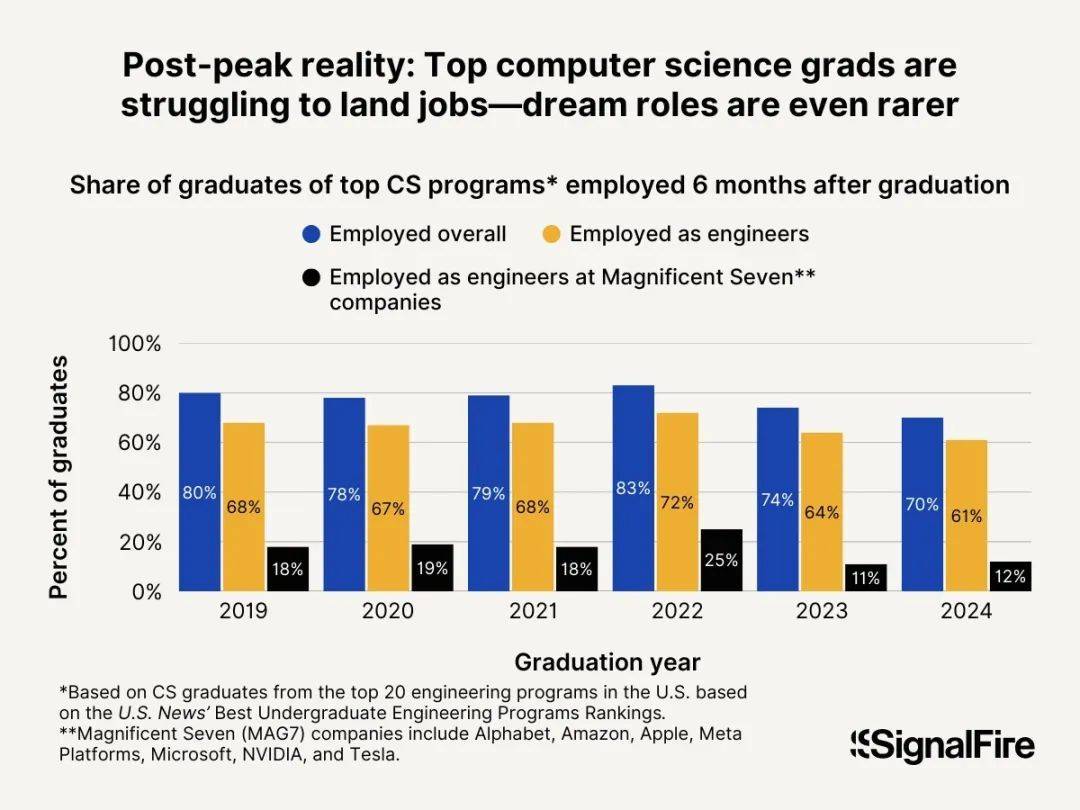
Core Insights - The technology industry is experiencing a significant shift, with a 50% decrease in hiring for new graduates compared to pre-pandemic levels, indicating a fundamental transformation rather than a temporary adjustment [1][11][14] - The "experience paradox" is emerging, where employers prioritize proven experience over potential, making it difficult for new graduates to secure jobs [8][11][39] - The geographical landscape of tech talent is changing, with traditional hubs like Texas declining while cities like Miami and San Diego are rising due to lifestyle and cost advantages [26][27][28] Group 1: Hiring Trends - Large tech companies now only hire 7% of new graduates, a 25% decrease from 2023 and over 50% from 2019 [8][11] - Startups are also seeing a decline, with new graduates making up only 6% of their hiring, down over 30% from pre-pandemic levels [8] - The shift in hiring practices reflects a broader reset in recruitment philosophy, with companies focusing on high-leverage technical roles [14][39] Group 2: Talent Retention - Anthropic stands out with an 80% employee retention rate, significantly higher than competitors like OpenAI and DeepMind [15][18] - The company attracts talent through a unique culture that emphasizes autonomy and intellectual discussion, contrasting with the bureaucratic environments of larger firms [18][22] - The trend shows that top AI talent is gravitating towards companies that offer better work environments and clearer career paths [22][44] Group 3: Geographical Shifts - Texas is losing its tech center status, with Austin and Houston seeing declines in startup employment by 6% and 10.9% respectively [26][27] - In contrast, Miami and San Diego are experiencing growth in tech jobs, with Miami seeing a 12% increase in AI positions [27][28] - Despite these changes, San Francisco and New York remain dominant, with over 65% of AI engineers still located in these cities [28][31] Group 4: Future Predictions - SignalFire predicts the rise of generalist engineers as AI tools lower the barriers to entry for building applications [32][38] - The emergence of new roles such as AI governance leads and AI ethics experts is expected, indicating a shift in job creation rather than mere job loss due to automation [37][38] - The industry is likely to see a continued emphasis on flexible work arrangements and a reevaluation of talent development strategies [39][40]
迈向人工智能的认识论:窥探黑匣子的新方法
3 6 Ke· 2025-06-16 03:46
Core Insights - The article discusses innovative strategies to better understand and control the reasoning processes of large language models (LLMs) through mechanical analysis and behavioral assessment [1][9]. Group 1: Mechanical Analysis and Attribution - Researchers are breaking down the internal computations of models, attributing specific decisions to particular components such as circuits, neurons, and attention heads [1]. - A promising idea is to combine circuit-level interpretability with chain-of-thought (CoT) verification, using causal tracing methods to check if specific parts of the model are activated during reasoning steps [2]. Group 2: Behavioral Assessment and Constraints - There is a growing interest in developing better fidelity metrics for reasoning, focusing on whether the model's reasoning steps are genuinely contributing to the final answer [3]. - The concept of using auxiliary models for automated CoT evaluation is gaining traction, where a verification model assesses if the answer follows logically from the reasoning provided [4]. Group 3: AI-Assisted Interpretability - Researchers are exploring the use of smaller models as probes to help explain the activations of larger models, potentially leading to a better understanding of complex circuits [5]. - Cross-architecture interpretability is being discussed, aiming to identify similar reasoning circuits in visual and multimodal models [6]. Group 4: Interventions and Model Editing - A promising methodology involves circuit-based interventions, where researchers can modify or disable certain attention heads to observe changes in model behavior [7]. - Future evaluations may include fidelity metrics as standard benchmarks, assessing how well models adhere to known necessary facts during reasoning [7]. Group 5: Architectural Innovations - Researchers are considering architectural changes to enhance interpretability, such as building models with inherently decoupled representations [8]. - There is a shift towards evaluating models in adversarial contexts to better understand their reasoning processes and identify weaknesses [8]. Group 6: Collaborative Efforts and Future Directions - The article highlights significant advancements in interpretability research over the past few years, with collaborations forming across organizations to tackle these challenges [10]. - The goal is to ensure that as more powerful AI systems emerge, there is a clearer understanding of their operational mechanisms [10].
Scale AI CEO departs for Meta in Zuckerberg’s latest AI gambit
CNBC Television· 2025-06-13 17:28
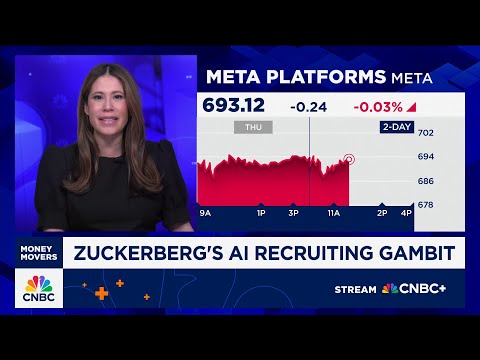
Meta now making that investment in scale AI official with CEO Alexander Wang departing for a role at Meta. Our dear DOSA has more on the news in today's tech check. It's a big one D. It is a big one Carl.Good morning. So that memo that Alexander Wang posted yesterday to X. It makes clear that this meta deal is in fact another non-traditional aqua hire.So, it brings one of the most strategic players in AI inside Zuckerberg's tent while attempting to skirt regulators that are already pushing to break off past ...