SAP

Search documents
Aleran Software's Digital Commerce Platform Is Certified by SAP as Built with SAP Business Technology Platform
GlobeNewswire News Room· 2025-05-15 18:06
Core Insights - Aleran Software's digital commerce platform has been certified by SAP as built with SAP Business Technology Platform (SAP BTP), enhancing its capabilities for the Intelligent Enterprise [1][6] - The platform is designed to assist mid-market B2B manufacturers, wholesalers, and distributors in managing omni-channel sales and commerce efficiently [3][7] Company Overview - Aleran Software provides a comprehensive commerce platform tailored for discrete manufacturing, industrial distribution, and wholesale sectors, enabling seamless integration with core business technologies like ERP, CRM, and WMS [7] - The platform simplifies complex product configuration and pricing, offering features such as customer portals, B2B eCommerce, and AI-powered catalog embedded buying [3][7] Key Features and Benefits - Aleran's platform includes automated configuration, order, quote management, and pricing functionalities aimed at accelerating the sales process [4] - The introduction of an AI Sales Agent and catalog-embedded buying has led to significant improvements in customer experience [5] - A global industrial manufacturing company reported a 20% increase in average customer spend and over 50% reduction in sales operations costs after implementing Aleran's platform [5] Integration with SAP - The certification from SAP Integration and Certification Center confirms that Aleran's platform extends the capabilities of SAP S/4HANA, facilitating tailored B2B e-commerce features [6] - SAP BTP enables companies to connect and integrate their business processes and data with SAP and third-party applications, supporting informed decision-making [6]



Saputo Inc.: Fiscal 2025 Fourth Quarter and Year-End Results
Globenewswire· 2025-05-15 14:00
Group 1 - Saputo will release its fiscal 2025 fourth quarter and full-year financial results on June 5, 2025, with a press release issued after market close [1] - A conference call to discuss the results is scheduled for June 6, 2025, at 8:00 a.m. Eastern Time, featuring Mr. Carl Colizza, President and CEO, and Mr. Maxime Therrien, CFO and Secretary [1] - The webcast presentation will be archived on Saputo's website for those unable to join the live call [3] Group 2 - Saputo is one of the top ten dairy processors globally, producing a wide range of dairy products including cheese, fluid milk, and dairy ingredients [4] - The company is a leading cheese manufacturer in Canada and ranks among the top three cheese producers in the USA, as well as being a top dairy processor in Australia and Argentina [4] - Saputo also produces dairy alternative products and sells its products under market-leading and private label brands in several countries [4]

单月涨幅 20%,为什么还是要坚定押注 AI?|AGIX Monthly
海外独角兽· 2025-05-15 13:04
Core Insights - The article emphasizes the resilience and growth potential of AGIX in the AI sector, highlighting its recent performance and the importance of companies effectively utilizing AI to drive revenue growth [1][4]. Group 1: AGIX Growth Review - AGIX has shown a significant increase of 23.15% over the past month, outperforming Nasdaq100, which grew by 11.76% [6]. - Among the 45 companies covered by AGIX, 36 companies (78%) exceeded the growth of Nasdaq100, with 14 companies achieving over 30% growth [6]. - The article notes that AGIX's maximum drawdown was -31.48%, which is within the typical volatility range for AI-related assets [1][19]. Group 2: AGIX as a Collection of High-Growth Stocks - The article identifies AGIX as a collection of high-growth stocks in the AI era, with a focus on mid-cap companies rather than just the largest tech firms [16]. - Companies like Duolingo and Palantir have demonstrated high volatility and growth potential, with Duolingo's stock doubling from its lowest point in two months [18][36]. - The article suggests that the high volatility of AGIX is a common characteristic of high-growth sectors, where short-term fluctuations are expected in pursuit of long-term growth [19][24]. Group 3: 1Q2025 Earnings Season: Dispel of AI Skepticism - The earnings season has shown that AI is creating tangible value, with companies like Applovin reporting significant revenue growth attributed to AI optimizations [34]. - Duolingo's AI-driven features have led to a 38% year-over-year revenue increase, showcasing the practical application of AI in enhancing user engagement [36]. - ServiceNow's focus on AI for business transformation highlights the growing demand for AI solutions to improve efficiency and reduce costs in various industries [46].

smartShift Revolutionizes SAP Modernization with AI-Powered Revert to Standard
GlobeNewswire News Room· 2025-05-14 19:55
Core Insights - smartShift has developed an AI-powered solution to assist SAP customers in transitioning to a Clean Core by identifying and replacing custom ABAP code with standard SAP functionality [1][3] - The need for simplification in ERP environments has made reverting to standard SAP processes a strategic imperative, although identifying alternatives for custom-built functionality remains a complex challenge [2][3] - The use of Large Language Model (LLM) agentic AI allows for the automation of legacy custom code analysis, enabling organizations to evaluate the necessity of custom logic versus modern SAP capabilities [3][4] Company Positioning - smartShift emphasizes that simplification is key to innovation, responding to customer demands for efficient elimination of unnecessary custom code while embracing SAP standards [4] - The company claims to have a long-standing history of addressing SAP custom code challenges, asserting that their platform has delivered thousands of solutions over more than a decade, well before the Clean Core concept gained traction [5] - With AI at the center of its strategy, smartShift aims to lead in enabling SAP customers to simplify and future-proof their ERP landscapes, turning Clean Core ambitions into operational realities [5][6] Market Impact - smartShift's automated AI solutions are designed to reduce technical debt, lower total cost of ownership, and accelerate digital transformation for SAP customers [4] - The company has modernized over 3,300 SAP systems and converted more than 3.5 billion lines of code, showcasing its proven track record in the industry [6]

英伟达豪赌“物理AI”:下一个风口,还是又一个GE Predix?
3 6 Ke· 2025-05-14 09:45
Core Insights - The article discusses the rapid advancement of "Physical AI," particularly through NVIDIA's ambitious strategy to create a platform-level infrastructure that integrates training, simulation, and deployment in physical systems [1][2][11] - It highlights the collaboration between NVIDIA and leading industrial giants like Siemens, BMW, and General Motors to incorporate AI into complex physical systems such as manufacturing and autonomous driving [1][11] Summary by Categories Definition and Differentiation - Physical AI, embodied intelligence, and spatial intelligence represent different pathways for AI to perceive, integrate, and alter the physical world [2][6] - Spatial intelligence focuses on AI's understanding of three-dimensional structures and relationships, while embodied intelligence emphasizes interaction with the environment through physical actions [3][4][9] - Physical AI serves as the central nervous system connecting perception and action, enabling AI to truly enter the physical realm [5][6] Technological Framework - The core of Physical AI is NVIDIA's "three computers" architecture, which includes training with real and synthetic data, creating high-fidelity virtual environments, and deploying trained models in real-world applications [14][16] - Key technologies supporting Physical AI include synthetic data generation, virtual simulation platforms, and model generalization capabilities [9][10][11] Historical Context and Comparison - The article draws parallels between NVIDIA's Physical AI strategy and GE's earlier industrial internet platform, Predix, which ultimately failed due to its closed ecosystem approach [15][19][21] - Unlike GE, NVIDIA's strategy emphasizes an open, developer-first approach, providing a comprehensive toolkit rather than a singular solution [23][24][27] Future Trends and Industry Implications - The integration of AI into physical systems is seen as a long-term evolution rather than a short-term trend, requiring patience and strategic investment in foundational capabilities [37][39] - Companies in the industry are advised to focus on building internal capabilities and understanding the underlying logic of the tools they use, rather than merely adopting them superficially [33][35][36]


中国制造业数字化转型行业发展研究报告
艾瑞咨询· 2025-05-10 09:05
尽管制造业的数字化已经进行了几年,但市场竞争格局尚未出现任何改变,未来在行业层面、市场打法层 面、产品及服务层面还有巨大的潜力,一切都是未知,一切也都有可能。 1)市场机会层面: 行业层面上, 离散制造业中的高技术产业是高潜力行业;打法层面上,垂直行业攻坚和信创/国产替代行业相对容易出现 领头企业。 2)产品层面: 大模型具有非常强的可探索性,但还处于非常早期的阶段,供需双方都在尝 试。大模型短期对市场竞争格局影响不大,但长期看,当大模型对实际应用场景具有支撑作用能力时,会加 速市场变化,故企业需把握大模型机会。 3)数据层面: 目前市场上数据交易、数据开放的声音出现比较 多,但企业无需纠结是否跟随,重要的是要基于数据(无论是自身数据还是外部数据)构建自己的行业认知 壁垒,即内化数据,完成数据-显性知识-隐性知识构建的完整链条。 需求市 场1 -具有强烈的地域特色 广东、江苏、浙江、山东等是制造业企业数TOP4省份,也是积极打造产业 集 群、 积极试行数字化转型的省份 制造业数字化转型丨 研究报告 核心摘要: 需求端的核心需求没有变,生产制造管理相关、供应链相关等是重点,也是离散制造业的核心诉求 。 只不 过 ...

“美国例外论”崩塌声中,全球股市踏向新纪元:欧洲携南美齐飞,中国异军突起
智通财经网· 2025-05-09 10:50
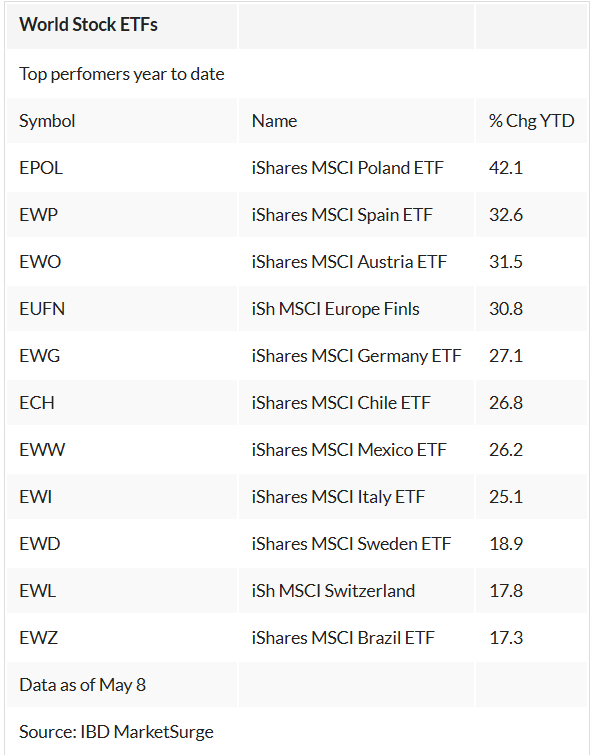
Group 1: Market Performance - The U.S. stock market is showing signs of weakness, with the S&P 500 and Nasdaq 100 indices down approximately 3% and 6% respectively this year, while many foreign markets, including Germany, Poland, Spain, and Brazil, have seen increases of up to 20% [1][2] - ETFs tracking foreign markets have outperformed U.S. indices, with many showing gains exceeding 20% [1] - The MSCI Emerging Markets Index has lagged behind the S&P 500 by an average of 3.8 percentage points every 100 days since 2015, but this year, the trend is reversing as foreign markets rise [4][5] Group 2: Investment Strategies - Investors are increasingly recognizing the value of geographic diversification, moving away from the "American exceptionalism" narrative that dominated for over a decade [2][3] - The shift in focus towards overseas markets is driven by lower valuations and more aggressive stimulus measures in countries like Germany compared to the U.S. [2][3] - Financial giants like BlackRock are advising investors to look beyond U.S. tech giants and consider European value stocks and Asian AI innovators [3] Group 3: Economic Factors - The uncertainty surrounding U.S. trade policies, particularly under the Trump administration, is contributing to a decline in investor confidence in the U.S. economy, leading to a weakening dollar and a shift towards foreign assets [5][7] - The European Central Bank has been more aggressive in its monetary policy compared to the Federal Reserve, providing a more favorable economic outlook for Europe [9][10] - Increased military spending in Europe is also seen as a significant driver for the region's stock market performance, with defense stocks gaining substantial investment [10][11] Group 4: Emerging Markets - China’s stock market is outperforming the U.S. market, with the Hang Seng Index up 13.5% and the Hang Seng Tech Index up 16% this year [20][22] - The rise of Chinese tech companies, particularly in AI, is attracting global investor interest, with DeepSeek leading a new paradigm in low-cost AI training and inference [22][23] - The influx of capital from the U.S. to China is expected to continue as investors seek better valuations and growth potential in the Chinese market [24]
SAP SE Q1 2025: Solid Start, But Real Work Still Ahead
Seeking Alpha· 2025-04-29 17:36
Group 1 - SAP SE reported Q1 revenue of €9.01 billion, reflecting a 12% year-over-year growth, slightly exceeding market expectations [1] - Cloud revenue for SAP grew by 27%, now representing a significant portion of total revenue [1] - The results support the ongoing transition to cloud services, which is a key narrative for the company's long-term strategy [1] Group 2 - The analyst has over 10 years of experience in the German small and mid-cap software market, indicating a strong background in the industry [1] - There is an intention to expand coverage to include other European and North American software companies, aiming to identify investment opportunities in the evolving SaaS and cloud landscape [1]

速递|AI代码调试Lightrun获7000万美元B轮融资,收入4倍增长,嵌入开发全流程
Z Potentials· 2025-04-29 02:57
基于 AI 的编码技术因其能让开发者工作更快速、更轻松的承诺而迅速走红。但 AI 编码也带来了另一个后果: 代码行数激增,进而导致因漏洞引发崩溃或其他事故的可能性大幅上升。 4月28日,一家名为 Lightrun 的以色列初创公司宣布完成 7000 万美元的 B 轮融资。 该公司开发了一个可观测性平台,旨在问题出现前识别并调试、修复代码。这笔融资不仅凸显了市场对此类工 具的迫切需求,也证明了 Lightrun 在满足这一需求上的强劲势头。 新投资方 Accel 与现有投资者 Insight Partners 共同领投本轮,花旗银行、 Glilot Capital 、 GTM Capital 及 Sorenson Capital 参与跟投。至此, Lightrun 已累计融资 1.1 亿美元,包括 2021 年报道过的由 Insight 领投的 A 轮融资。这家初创公司未公开其估值。 花旗银行作为战略支持者,与一系列知名客户并列,其中包括 ADP 、 AT&T 、 ICE/NYSE 、 Inditex 、微 软、 Priceline 、 Salesforce 和 SAP 等。 其产品及其在当前市场格局中的定位时 ...
Netcare International Commemorates Nearly 25 Years of Innovation and Growth in SAP Solutions
GlobeNewswire News Room· 2025-04-28 20:19
Copenhagen, Denmark, April 28, 2025 (GLOBE NEWSWIRE) -- Netcare International celebrates a journey of over two decades defined by innovation, technical excellence, and a dedication to collaborative success. Over the years, it has grown from a one-man consultancy into a global force, bringing comprehensive Systems, Applications, and Products in Data Processing (SAP) solutions across industries globally. The company, based in Hellerup, Denmark, was founded on the principle that expertise and genuine partnersh ...