
Shein

Search documents
欧盟“使绊”中国小包
Hu Xiu· 2025-05-22 10:26
小额包裹似乎在被全世界围剿。 当地时间5月20日,欧盟提出一项草案:针对邮递至个人消费者的小额包裹将征收每件2欧元的固定费 用,但对寄往欧盟仓库的商品则收取0.5欧元的较低费用。 欧盟贸易委员塞夫乔维奇表示,这些费用将由平台承担,以应对大量廉价商品涌入所带来的挑战。 目前,单价低于150欧元的小额包裹可免关税进入欧盟,是跨境卖家销往欧盟市场的重要通道。数据显 示,2024年共有46亿件此类包裹进入欧盟,平均每秒超过145个,其中91%来自中国。欧盟预计这一数 字还将上升。 如果该政策正式实施,无疑将对欧洲直邮小包市场造成打击。此前,由于美国取消了小额包裹免税,许 多跨境卖家选择开拓欧洲市场。数据显示,与 4 月相比,在 5 月的前 12 天,Temu和Shein在欧洲的广 告支出分别增长了 40% 和 30%。 "不知道还能去哪",有卖家心灰意懒说道。近几个月,由美国带来的数次关税反转,让跨境电商行业动 荡不安,而其中直邮小包或许是受伤最重的那个。 欧盟小包免税将终结? 此次征收固定关税提案,被视为欧盟全面取消小额包裹免税政策的先行步骤。 今年2月,欧盟委员会就提议取消自2010年设立的150欧元免税门槛,要 ...
欧盟、日本都准备对小包裹收税;一季度百度AI相关收入翻倍;香奈儿中国计划逆势开店丨百亿美元公司动向
晚点LatePost· 2025-05-22 05:45
Group 1: E-commerce and Taxation - The EU plans to eliminate the tax exemption for small packages valued under 150 euros, which accounted for approximately 4.6 billion packages last year, with over 90% originating from China [1] - Japan is also considering similar tax changes, potentially ending the exemption for imports valued under 10,000 yen by 2026 [1] - Cross-border e-commerce platforms like Shein and Temu are facing increased pressure as they seek growth outside the US market, which has already imposed taxes on packages valued under 800 USD [1] Group 2: Baidu's Financial Performance - Baidu's Q1 2025 core revenue reached 25.5 billion yuan, a 7% year-on-year increase, with net profit rising 48% to 7.63 billion yuan [2] - The company's cloud business grew by 42% year-on-year, and AI-related revenue saw over 100% growth due to the launch of a low-cost large model [2] - The autonomous vehicle service "Luobo Kuaipao" expanded to 15 cities globally, providing over 1.4 million rides in Q1, a 75% increase [2] Group 3: Great Wall Motors' Wei Brand - Great Wall Motors' Wei brand held an event emphasizing user-centric changes to enhance product strength and user experience [3] - The 2025 Wei brand Blue Mountain SUV was launched, priced between 299,800 and 326,800 yuan, maintaining the previous model's starting price [3] - The company aims to establish a stronger direct service system, expanding to 600 locations across over 200 cities this year [3] Group 4: New Blue Mountain SUV Features - The new Blue Mountain SUV features the latest Hi4 plug-in hybrid technology, with a total power output of 408 horsepower and a 0-100 km/h acceleration time of 4.9 seconds [4] - It offers two battery pack options with WLTC electric ranges of 185 km and 220 km, and a theoretical combined range of up to 1343 km [4] Group 5: Smart Features of the New Blue Mountain - The new Blue Mountain is equipped with the latest Coffee OS 3 and Qualcomm Snapdragon 8295 chip, supporting advanced driver assistance systems [5] - It includes over 30 sensors for full-scene navigation assistance, enhancing the driving experience [5] - Great Wall Motors announced a next-generation intelligent super platform compatible with various vehicle types and powertrains [5] Group 6: Chanel's Market Strategy - Chanel's revenue and operating profit fell by 4.3% and 30% respectively in 2024, marking the third consecutive year of profit decline [6] - The Asia-Pacific region saw the fastest revenue decline, with a 7.1% drop, particularly in mainland China [6] - Despite challenges, Chanel plans to open 15 flagship stores in China this year, focusing on second and third-tier cities [6] Group 7: Meitu's Investment from Alibaba - Meitu announced a $250 million investment from Alibaba in the form of convertible bonds, with a 1% annual interest rate [7] - This partnership will prioritize the promotion of Meitu's AI e-commerce tools within Alibaba's ecosystem [7] - Meitu commits to purchasing at least 560 million yuan in cloud services from Alibaba over the next three years [7] Group 8: Amer Sports' Performance - Amer Sports reported a 23% year-on-year revenue increase and a 196% rise in adjusted net profit in Q1, driven by strong performance across regions and product categories [8] - The company raised its full-year revenue growth guidance by 2 percentage points to 15%-17% [8] Group 9: Berkshire Hathaway's Exit from Kraft Heinz - Berkshire Hathaway's exit from the Kraft Heinz board suggests potential divestment of its 27.5% stake in the company [9] - Kraft Heinz is considering selling its meat brands amid a 4.7% decline in comparable revenue [9] - The company has lowered its full-year performance guidance due to macroeconomic challenges [9] Group 10: Google's AI Service Launch - Google introduced a new AI service, Google AI Ultra, priced at $249.99 per month, which includes 30TB of cloud storage and YouTube premium [10] - This service integrates advanced AI capabilities and is aimed at deep research applications [10] Group 11: Elon Musk's Plans for Tesla - Elon Musk confirmed he will continue as Tesla's CEO for the next five years unless unforeseen circumstances arise [11] - Tesla plans to expand its autonomous taxi service to Los Angeles and San Francisco following its initial launch in Austin [11] - Musk mentioned the potential for Starlink to become an independent publicly traded company [11] Group 12: XPeng's Financial Results - XPeng reported a Q1 gross margin of 15.6%, a year-on-year increase of 2.7 percentage points, despite a slight revenue decline [12] - The company delivered 94,008 vehicles in Q1, a 2500-unit increase from the previous quarter [12] - XPeng expects Q2 revenue between 17.5 billion and 18.7 billion yuan, representing a year-on-year growth of approximately 115.7% to 130.5% [12] Group 13: Li Auto's i8 Specifications - Li Auto's i8 SUV features two battery options with capacities of 90.1 kWh and 97.8 kWh, offering ranges of 670 km and 720 km respectively [13] - The vehicle supports fast charging capabilities, allowing for a 500 km range in just 10 minutes [13] Group 14: BYD Stock Performance - BYD's A and H shares both reached historical highs, with A shares hitting 404 yuan and H shares surpassing 460 HKD [14][15] - BYD's market capitalization reached 1.22 trillion yuan, with a year-to-date increase of approximately 40% [15] - The company is set to receive an estimated $2 billion in passive fund inflows following its inclusion in the Hang Seng Tech Index [15] Group 15: BMW's Stock Buyback Plan - BMW announced a stock buyback plan of up to 2 billion euros, marking its third major buyback in three years [16] - The plan includes repurchases of both common and preferred shares, with a maximum of 350 million euros allocated for preferred shares [16] Group 16: Alibaba's Entertainment Division Rebranding - Alibaba's entertainment division has been renamed to Whale Entertainment Group, with Alibaba Pictures rebranded as Damai Entertainment [17] - The rebranding aligns with Alibaba's strategy to refocus on its core mission of delivering happiness [17] - The division achieved positive adjusted EBITDA in Q1 2025, driven by a 12% revenue increase to 5.6 billion yuan [17]



“小额免税”或成历史 波及的不只卖家
Bei Jing Shang Bao· 2025-05-21 15:18
这一计划是继美国结束小额包裹关税豁免后,各国为打击低成本进口商品所做的最新尝试。 5月初,美国政府正式取消来自中国内地及香港的"小额进口包裹免税"政策。一夜之间,年均13.6亿件包裹失去 了"绿色通道"。小额豁免,这个曾经支撑中国跨境电商高速增长的关键机制被彻底关停。美国之后,欧盟、日本 又相继流露出对小额包裹加税的意向。虽然尚无最终定论,但不少曾经靠"小额免税"起家的电商正被迫重写出海 剧本。 美欧日相继"动手" 当地时间5月20日,据外媒报道欧盟宣布计划取消价值低于150欧元的小包裹免税政策。同时,对进入欧盟境内、 直邮至消费者家中的小包裹征收每件2欧元的统一费用。若小包裹先运送至欧盟境内仓库储存,则按每件0.5欧元 征收费用。 然而,这种"跑得太快"的增长,引发了监管的强烈反弹。美国两党轮番将小额免税称为"漏洞",斥其让廉价商品 大量涌入、冲击本土制造业与就业市场。另据欧盟委员会,欧盟去年有23亿件相关免税商品入境,主要源自中国 电商平台Shein、Temu和阿里巴巴全球速卖通的快速增长。一些当地零售商和行业组织控诉中国电商利用免税渠 道,售卖廉价和不合格商品。 日本市场方面,如果免税政策修改,从She ...
17大电商巨头齐聚,共建义乌全球数贸新生态
Sou Hu Cai Jing· 2025-05-21 12:40
Core Viewpoint - After the easing of the tariff war, Yiwu's orders from the U.S. are gradually recovering, but the international environment remains uncertain, leading Yiwu merchants to adopt a cautiously optimistic attitude [1] Group 1: Digital Trade Ecosystem - Yiwu China Small Commodities City launched the "Global Digital Trade Center E-commerce Gravity Acceleration Plan" on May 20, inviting 17 major global e-commerce platforms to accelerate the construction of a digital trade ecosystem [1][3] - The event attracted over 200,000 online and offline participants, marking a surge in digital e-commerce interest in Yiwu [3] - The plan aims to provide Yiwu merchants with policy support, traffic assistance, and methodological guidance to enhance their global presence [13] Group 2: Multi-Channel Strategy - Yiwu merchants learned from past trade wars that diversifying channels is essential to mitigate risks in a complex international environment [1] - The integration of AI and cross-border e-commerce platforms is crucial for merchants to proactively market their products and seize market opportunities [7][10] - The "Global Digital Trade Center" is set to open in October, featuring AI digital technology and innovative layouts to create a new digital trade ecosystem [13][15] Group 3: Global Collaboration - The event highlighted the collaboration between local insights from platforms like Alibaba and Tencent and international strategies from platforms like Walmart and Shopee, creating a bridge for trade between China and regions like Africa and Latin America [4] - Merchants expressed that the digital ecosystem in Yiwu provides them with the confidence to explore multiple procurement channels, reducing costs and risks associated with relying on single sources [8][10] - The acceleration plan is expected to break down trade barriers and simplify procurement processes for overseas buyers [10][15]


“小单快反”神话褪色,快时尚遭遇行业拐点
创业邦· 2025-05-21 10:34
Core Viewpoint - The fast fashion industry is facing significant challenges due to the abrupt end of the U.S. tax exemption policy for small packages, which has adversely affected China's new generation of fast fashion enterprises and their "small order quick return" business model [3][4]. Group 1: Challenges to the "Small Order Quick Return" Model - The "small order quick return" model, characterized by flexible supply chains and rapid response to market demands, is under threat from increased tariffs and longer customs clearance times [6][7]. - The recent changes in tariff policies have raised costs significantly, with tariffs on small packages increasing from 0% to 30%, which severely impacts the profitability of the "small order quick return" model [8][10]. - Customs clearance processes have become more complicated, extending the time required for goods to enter the market, which undermines the competitive advantage of fast fashion brands like Shein that rely on rapid turnover [11][16]. Group 2: Impact on Market Dynamics - The fast fashion market is expected to undergo a significant shift, with traditional brands like Inditex (ZARA's parent company) and Fast Retailing (Uniqlo's parent company) potentially benefiting from the challenges faced by Chinese fast fashion brands [4][24]. - Despite the potential for traditional brands to gain market share, they are unlikely to fully absorb the losses incurred by the "small order quick return" brands, leading to an overall decline in the industry's scale [24][26]. - Price sensitivity among consumers remains high, as evidenced by a 23% drop in Shein's sales in the U.S. following the tariff changes, indicating that higher prices could lead to reduced demand for fast fashion products [24][25]. Group 3: Long-term Outlook - The fast fashion industry is expected to experience a contraction in market size in the short term due to trade tensions and increased costs, although there may be a slight rebound for traditional brands [26][28]. - The long-term viability of the "small order quick return" model is uncertain, as the industry must adapt to new realities while maintaining its core competitive advantages [28][29].

跨境小包裹免税待遇取消,“补货潮”的成本挑战如何打破
Nan Fang Du Shi Bao· 2025-05-21 08:47
Core Viewpoint - The reduction of tariffs between China and the U.S. has initiated a "replenishment" order wave for cross-border e-commerce sellers, but the cancellation of tax exemptions for small packages poses significant cost challenges for sellers [1][3]. Group 1: Tariff Changes and Immediate Impact - The U.S. has revoked 91% of tariffs on Chinese goods and modified 34% of reciprocal tariff measures, with 24% of tariffs suspended for 90 days, retaining 10% [1]. - Sellers are racing against time to fulfill orders during the 90-day low tariff period, as U.S. customers are eager to replenish their stocks due to low inventory levels ahead of the summer sales peak [2]. Group 2: Cost Challenges for Cross-Border E-commerce - The cancellation of the small package tax exemption has led to increased costs for Chinese sellers, with average costs rising by approximately 1 yuan per item, which is significant for low-margin products like stationery [3][4]. - Prior to the tariff reductions, companies like Temu and Shein issued price increase warnings due to rising operational costs from changing trade rules and tariffs [3]. Group 3: Strategic Shifts and Future Opportunities - Sellers are exploring new markets and innovative branding strategies in response to the challenges posed by the cancellation of tax exemptions [4]. - A summit is scheduled to discuss the future of cross-border e-commerce, with over 1,000 exhibitors and industry leaders expected to attend, aiming to contribute to the high-quality development of the industry [4].
多国拟调整小额包裹免税政策,日本考虑跟进
Huan Qiu Wang· 2025-05-21 02:26
Core Insights - Japan is considering reviewing its tax exemption policy for small parcels, aiming to strengthen scrutiny on cross-border e-commerce tax channels, joining a global trend [1][3] - The Japanese government is discussing potential changes to the current exemption for imported goods valued under 10,000 yen (approximately 500 RMB), which may include a 10% consumption tax on small imports from platforms like Shein and Temu [3] Group 1 - The Japanese Cabinet Office has discussed the implications of the small parcel exemption policy, focusing on fair competition and the risk of illegal drugs and counterfeit goods entering Japan [3] - The Ministry of Finance plans to modify the tax system next year, with detailed new tax policies expected by 2026 [3] - In 2022, Japan imported approximately 169.66 million small parcels valued at 425.8 billion yen, marking a fivefold increase over the past five years, with Shein and Temu being significant contributors [3] Group 2 - Other countries, including the United States and several European nations, are also considering adjustments to their small parcel tax exemption policies [4] - The U.S. has recently ended its tax exemption for small parcels valued under $800 from China, leading to price increases for products from Shein and Temu [4] - The European Union has proposed to eliminate the exemption for parcels under 150 euros by 2027-2028, while the UK and France are also reviewing their respective small parcel tax rules [4]

集体出手围剿"免税包裹",日本欧盟又搞事?
Sou Hu Cai Jing· 2025-05-20 15:26
Group 1 - Japan's tax exemption for imported goods valued under 10,000 yen (approximately 495 RMB) may end in 2026, with 2023 seeing a surge in small package imports to 169.66 million, a fivefold increase compared to pre-pandemic levels, and total value exceeding 425.8 billion yen [2] - Chinese cross-border e-commerce platforms are driving this policy change, with Temu leading global e-commerce app downloads and Shein in second place, alongside Amazon's 67 million monthly active users in Japan, contributing to exponential growth in cross-border package numbers [4] - 83% of local Japanese businesses believe the tax exemption policy has led to "price inversion," diminishing the competitiveness of domestic products [4] Group 2 - In Europe, the EU is facing a significant influx of 4.6 billion small packages valued under 22 euros in 2024, with a daily processing volume of 12 million packages, leading to an estimated annual tax revenue loss of 2.9 billion euros due to issues like undervaluation and incorrect classification [7] - The EU plans to implement three key reforms: a fixed customs clearance fee for each cross-border package, the elimination of the long-standing 150 euro tax exemption threshold, and the establishment of a central customs authority (EUCA) for real-time data sharing among 27 countries [7] - The UK Treasury is also reviewing its tax policies, with the current 135-pound tax exemption threshold at risk, potentially increasing the overall cost of imported goods by 20%-30% due to combined VAT and customs duties [11] Group 3 - Major platforms are proactively preparing for the impending industry changes, with Temu increasing shipping subsidies for Japan by 30%, Shein accelerating local warehousing in Europe, and Amazon Japan launching a "compliance acceleration program" to help sellers adapt to new customs regulations [15] - This global tax reform represents a fundamental restructuring of international trade rules in the digital economy era, necessitating a shift for millions of cross-border sellers from "quick profits" to "brand building" as a survival imperative [15]

英媒:欧盟将对网上订购的小件商品征收统一税
news flash· 2025-05-20 13:01
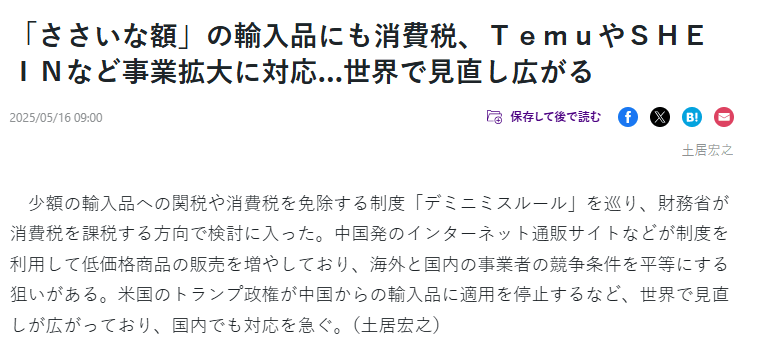
Core Viewpoint - The European Union plans to impose a unified fee on small parcels entering the EU, targeting online retailers like Temu and Shein, in response to pressure from member states facing overwhelming volumes of imported packages [1] Group 1: Proposal Details - The European Commission circulated a draft proposal for the fee, which is a response to customs agencies overwhelmed by up to 4.6 billion packages delivered directly to residents each year [1] - Although the proposal does not specify the fee amount, sources indicate it may be around €2 per package [1] Group 2: Financial Implications - Part of the collected fees will cover customs costs, while the remainder will contribute to the EU budget, potentially generating billions of euros in annual revenue for the EU [1]
别以为会用AI就安全了,真正的危机是技能贬值
3 6 Ke· 2025-05-19 12:00
Core Insights - The article emphasizes that the real challenge in the AI era is not merely about using AI tools but understanding how AI fundamentally reshapes work structures and organizational logic [3][17][66] - It argues that many common beliefs about AI's impact on work are misleading, as they focus on task-level improvements rather than systemic changes [4][18][45] Group 1: Misconceptions about AI - Misconception 1: Learning to use AI will keep individuals ahead. The article critiques this view as it overlooks the broader systemic changes that AI brings [4][18] - Misconception 2: AI allows individuals to do more work, thus increasing their value. However, this assumes that the work system remains unchanged, which is often not the case [18][20] - Misconception 3: Jobs will not disappear, only the way work is done will change. The article argues that jobs are not inherently fixed and can be redefined by changes in the system [24][28] Group 2: Systemic Changes and Value Creation - The article highlights that the true value in the AI era comes from understanding the new system dynamics rather than just optimizing existing tasks [10][15] - It points out that as productivity increases, the benefits may not flow to the workers but rather to those who control the new systems, leading to a disconnect between value creation and compensation [19][23] - The article stresses that AI is not just a tool but a force that redistributes power within organizations, changing who makes decisions and how tasks are executed [45][48] Group 3: The Future of Work - The article suggests that the future of work will require individuals to rethink their roles and the relevance of their skills in a rapidly evolving system [30][41] - It warns that simply being faster at using AI does not guarantee job security, as the underlying value systems may no longer reward those skills [32][38] - The article concludes that organizations must not just integrate AI into existing frameworks but fundamentally rethink their operational structures to remain competitive [62][66]