九龙仓集团

Search documents
超七成房企销售额环比增长!最新“成绩单”出炉,它仍是行业第一
Bei Jing Shang Bao· 2026-01-13 12:13
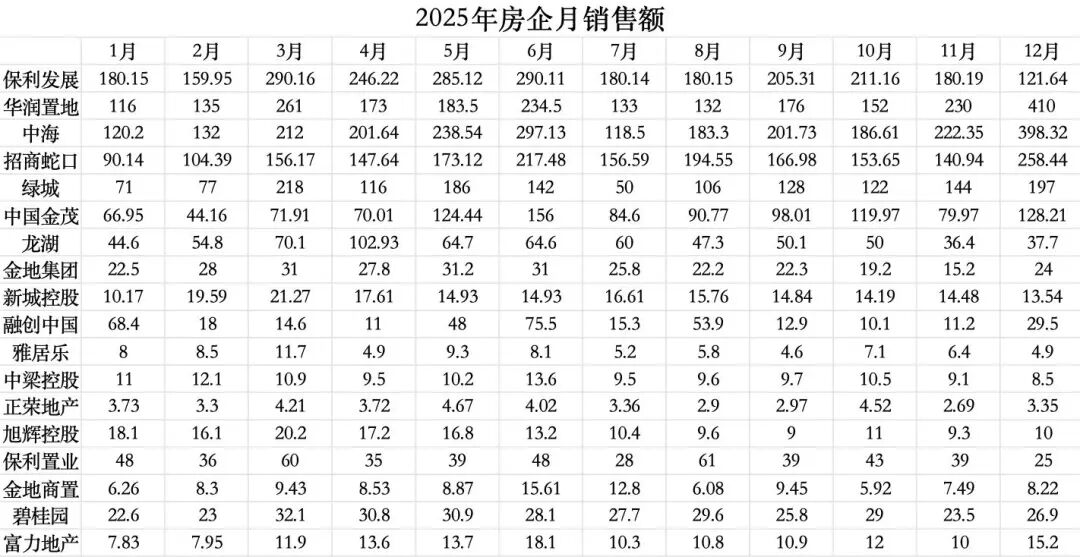
Core Viewpoint - The competitive landscape among leading real estate companies is stabilizing, with Poly Developments maintaining its position as the industry leader in sales for 2025, achieving a sales figure of 2530.3 billion yuan, despite a year-on-year decline of 21.67% from 2024 [1][6]. Sales Performance - Among the 18 real estate companies that disclosed their December 2025 sales data, 13 companies reported month-on-month growth, with China Overseas Development and China Resources Land achieving significant sales figures of 398.32 billion yuan and 410 billion yuan, respectively [4][5]. - Poly Developments led the sales with 121.64 billion yuan in December, while China Overseas and China Resources followed closely with 398.32 billion yuan and 410 billion yuan [4][6]. Market Trends - The sales growth in December 2025 indicates a positive trend for the real estate market, with companies like Sunac China and China Resources Land showing remarkable month-on-month increases of 163.39% and 78.26%, respectively [5][6]. - The overall sales performance of major companies suggests a solid foundation for the real estate market's stability and growth expectations in 2026 [5]. Land Acquisition Strategies - Poly Developments has focused heavily on the Guangzhou market, with land acquisition payments reaching 648.24 billion yuan from 2023 to 2025, significantly higher than in Beijing and Shanghai [1][10]. - China Overseas Development has also concentrated its land acquisition efforts in first-tier cities, with 60.6% of its sales coming from major cities like Hong Kong and the four first-tier cities [9]. Company Resilience - Despite facing challenges, companies with over 100 billion yuan in sales, such as Poly Developments and China Overseas, have demonstrated strong operational resilience and effective governance, allowing them to navigate market fluctuations [6][7]. - The restructuring of debts for companies like Sunac China and Country Garden has shown progress, indicating a potential for recovery and stability in the sector [8].



智通港股沽空统计|1月7日
智通财经网· 2026-01-07 00:25
Group 1 - The core point of the news highlights the short-selling ratios and amounts for several companies, indicating significant market sentiment against these stocks [1][2]. - Li Ning-R (82331) has the highest short-selling ratio at 97.53%, followed by Lenovo Group-R (80992) at 89.50% and Alibaba-WR (89988) at 78.66% [1][2]. - The top three companies by short-selling amount are Alibaba-W (09988) with 3.676 billion, China Ping An (02318) with 2.440 billion, and Tencent Holdings (00700) with 2.293 billion [1][2]. Group 2 - The top ten short-selling ratios include Li Ning-R (82331) at 97.53%, Lenovo Group-R (80992) at 89.50%, and Alibaba-WR (89988) at 78.66% [2]. - The top ten short-selling amounts show Alibaba-W (09988) leading with 3.676 billion, followed by China Ping An (02318) at 2.440 billion and Tencent Holdings (00700) at 2.293 billion [2]. - The highest deviation values in short-selling are led by Alibaba-WR (89988) at 38.29%, Li Ning-R (82331) at 30.88%, and Tencent Holdings-R (80700) at 29.97% [1][2].


京基智農(000048.SZ)12月生豬銷售收入2.99億元
智通财经网· 2026-01-06 10:24
智通財經APP訊,京基智農(000048.SZ)披露2025年12月生豬銷售情況,2025年12月,公司銷售生豬 20.16萬頭(其中仔豬1.49萬頭),銷售收入2.99億元;商品豬銷售均價12.21元/kg。 2025年1-12月,公司累計銷售生豬231.29萬頭(其中仔豬32.42萬頭),累計銷售收入37.63億元。 ...

九龙仓集团(00004) - 截至2025年12月31日的股份发行人的证券变动月报表
2026-01-06 08:48
股份發行人及根據《上市規則》第十九B章上市的香港預託證券發行人的證券變動月報表 | 截至月份: | 2025年12月31日 | 狀態: 新提交 | | --- | --- | --- | | 致:香港交易及結算所有限公司 | | | | 公司名稱: | 九龍倉集團有限公司 | | | 呈交日期: | 2026年1月6日 | | | I. 法定/註冊股本變動 不適用 | | | FF301 第 1 頁 共 10 頁 v 1.1.1 FF301 II. 已發行股份及/或庫存股份變動 | 1. 股份分類 | 普通股 | 股份類別 | 不適用 | | 於香港聯交所上市 (註1) | 是 | | | --- | --- | --- | --- | --- | --- | --- | --- | | 證券代號 (如上市) | 00004 | 說明 | | | | | | | | | 已發行股份(不包括庫存股份)數目 | | 庫存股份數目 | | 已發行股份總數 | | | 上月底結存 | | | 3,056,027,327 | | 0 | | 3,056,027,327 | | 增加 / 減少 (-) | | | 0 | ...
智通港股沽空统计|1月6日
智通财经网· 2026-01-06 00:28
Group 1 - The top short-selling ratios are led by China Resources Beer (100.00%), BYD Company (100.00%), and Xiaomi Group (75.49%) [1][2] - The highest short-selling amounts are recorded for Ping An Insurance (2.081 billion), Alibaba (1.871 billion), and Xiaomi Group (1.624 billion) [1][2] - The highest deviation values are for BYD Company (43.54%), CIFI Holdings (39.74%), and Xiaomi Group (34.28%) [1][2] Group 2 - The top short-selling amounts table shows Ping An Insurance at 2.081 billion, Alibaba at 1.871 billion, and Xiaomi Group at 1.624 billion [2] - The top short-selling ratios table lists China Resources Beer and BYD Company both at 100.00%, followed by Xiaomi Group at 75.49% [2] - The top short-selling deviation values table highlights BYD Company with a deviation of 43.54%, followed by CIFI Holdings at 39.74% and Xiaomi Group at 34.28% [2]


奢侈品抛弃高端商场,高端商场拥抱小登
远川研究所· 2026-01-04 13:16
Core Insights - The luxury retail sector in China is facing significant challenges, with high-end malls and luxury brands experiencing a decline in performance and store closures due to changing consumer behavior and economic conditions [4][18][24]. Group 1: Market Trends - High-end malls like One ITC and IFC have seen a wave of luxury brand withdrawals, including major names like LV, Celine, and Tiffany, leading to increased vacancy rates [4][10]. - The luxury market in mainland China is projected to experience a continuous decline, with sales expected to drop by 18%-20% in 2024, reverting to 2020 levels [19][21]. - The relationship between luxury brands and high-end malls, which was once mutually beneficial, is deteriorating as both sectors struggle to adapt to new market realities [12][17]. Group 2: Financial Performance - Hang Lung Properties reported an 18.7% year-on-year decline in revenue for the first half of the year, with net profits decreasing for two consecutive years [6][10]. - Other major players in the high-end real estate sector, such as Swire Properties and New World Development, are also facing financial difficulties, with Swire reporting a loss of HKD 1.202 billion [8][10]. - Rental income from luxury brands is becoming increasingly critical for high-end malls, with Hang Lung's rental income share rising from 58.8% to 70.3% [24]. Group 3: Strategic Shifts - In response to declining performance, high-end malls are exploring new strategies, such as introducing new consumer brands and shifting towards a more inclusive customer base [26][29]. - Companies like China Resources are successfully expanding their shopping centers by focusing on experiential retail and attracting a broader range of consumers through innovative marketing strategies [32][33]. - The shift from traditional luxury retail to a more experience-driven model is evident, with malls aiming to transform from mere shopping venues to lifestyle destinations [32][34].





智通港股沽空统计|1月1日
智通财经网· 2026-01-01 00:21
Group 1 - The top three companies with the highest short-selling ratios are Cheung Kong (00001), CLP Holdings (00002), and Hong Kong and China Gas (00003), all reporting a short-selling ratio of 0.00% [1][2] - The top three companies by short-selling amount are also Cheung Kong (00001), CLP Holdings (00002), and Hong Kong and China Gas (00003), with amounts not specified [1][2] - The companies with the highest deviation values are Energy and Energy Global (01142), Hu Shang Ayi (02589), and China Shipbuilding Defense (00317), with deviation values of -0.41%, -0.41%, and -0.66% respectively [1][2] Group 2 - The top ten short-selling ratios include Cheung Kong (00001), CLP Holdings (00002), and Hong Kong and China Gas (00003), all at 0.00%, with significant negative deviation values [2] - The top ten short-selling amounts also feature Cheung Kong (00001), CLP Holdings (00002), and Hong Kong and China Gas (00003), all at 0.00% short-selling ratio and notable negative deviation values [2] - The top ten companies with the highest deviation values include Energy and Energy Global (01142), Hu Shang Ayi (02589), and China Shipbuilding Defense (00317), with deviation values indicating a decline compared to their average short-selling ratios over the past 30 days [2][3]


智通港股沽空统计|12月30日
智通财经网· 2025-12-30 00:25
Group 1 - The core viewpoint of the news highlights the short-selling ratios and amounts of various companies, indicating significant market sentiment towards these stocks [1][2]. - AIA Group (81299) and Anta Sports (82020) have the highest short-selling ratios at 100.00%, while Lenovo Group (80992) follows closely with a ratio of 94.69% [1][2]. - The top three companies by short-selling amount are Xiaomi Group (01810) with 2.179 billion, Alibaba Group (09988) with 1.174 billion, and China Merchants Bank (03968) with 1.027 billion [1][2]. Group 2 - The top short-selling ratio rankings show that AIA Group and Anta Sports are at the forefront, both with a ratio of 100.00%, indicating a strong bearish sentiment [2]. - The short-selling amounts for the top companies reveal that Xiaomi Group leads with 21.79 billion, followed by Alibaba Group at 11.74 billion, and China Merchants Bank at 10.27 billion [2]. - The deviation values, which reflect the difference between current short-selling ratios and the average over the past 30 days, show China National Offshore Oil Corporation (80883) at 44.86%, Alibaba Group at 40.72%, and AIA Group at 37.45% [1][2].
港股分化,科技回撤、内房地。工商纷纷跟随,金融逆势走强
Ge Long Hui· 2025-12-26 14:09
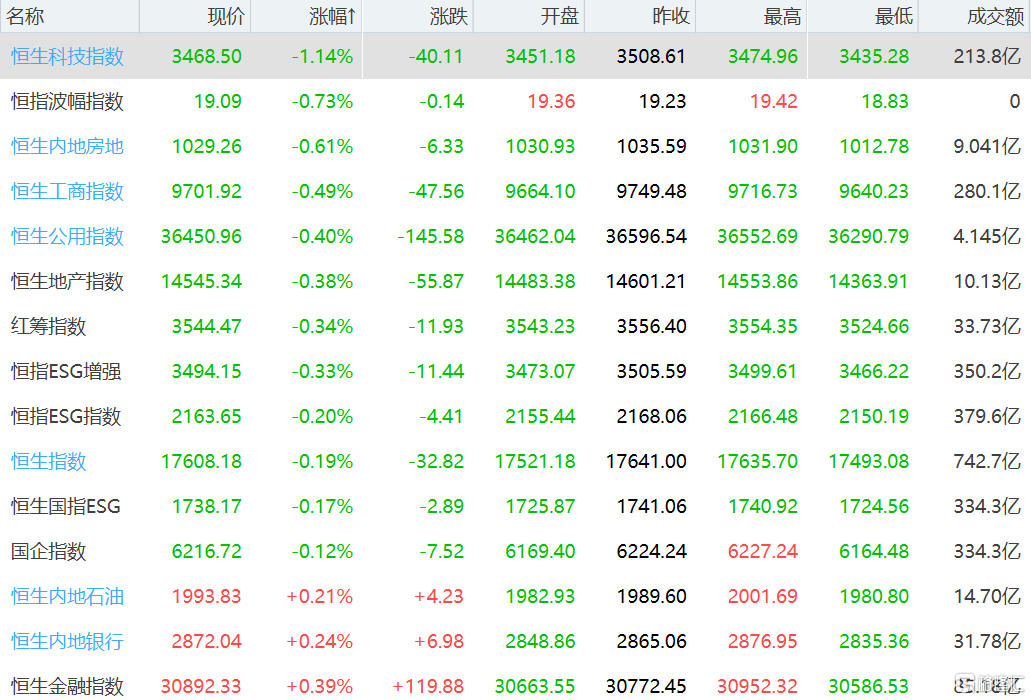
港股一日游,集体小幅低开后全天震荡反弹,但始终被中轴压制,恒生科技低开低走跌幅居前,恒生内房地、恒生工商等紧随其后,恒生金融指 数和恒生内石油逆势收涨。 | 名称 | 现价 | 涨幅1 | 涨跌 | 开盤 | 昨收 | 最高 | 最低 | 成交额 | | --- | --- | --- | --- | --- | --- | --- | --- | --- | | 恒生科技指数 | 3468.50 | -1.14% | -40.11 | 3451.18 | 3508.61 | 3474.96 | 3435.28 | 213.8亿 | | 恒指波幅指数 | 19.09 | -0.73% | -0.14 | 19.36 | 19.23 | 19.42 | 18.83 | 0 | | 恒生内地房地 | 1029.26 | -0.61% | -6.33 | 1030.93 | 1035.59 | 1031.90 | 1012.78 | 9.041亿 | | 恒生工商指数 | 9701.92 | -0.49% | -47.56 | 9664.10 | 9749.48 | 9716.73 | 9640.23 | 280. ...
加息周期开启,日本国债成家庭理财“新宠”:零售销售额创18年纪录
Zhi Tong Cai Jing· 2025-12-18 01:15
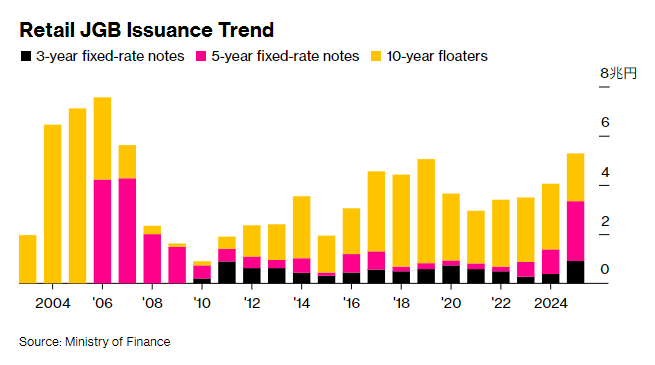
Core Insights - The Bank of Japan's tightening policy is driving household funds from bank deposits to the government bond market, with sales to individual investors surpassing 5 trillion yen (approximately 32 billion USD), marking the highest level since 2007 [1] - The total issuance of government bonds from January to December reached 5.28 trillion yen, with the five-year retail bond issued in November having a coupon rate of 1.22%, nearly 2.7 times the 0.46% rate from the previous year [1] Group 1 - The issuance of government bonds this year includes approximately 1.9 trillion yen of ten-year floating-rate bonds, which adjust their coupon rates based on overall market interest rates, providing unique investment value during the monetary tightening cycle [2] - A household investor expressed that government bond rates are higher than bank deposit rates, and the floating interest structure offers the potential for increasing returns over time, despite acknowledging that these returns may not outpace inflation [2] - The interest rate for ten-year fixed deposits at banks like Mizuho is only about 0.5%, explaining why some savers are shifting their funds to significantly higher-yielding government bonds [2] Group 2 - The coupon rates for retail government bonds set for settlement in January next year are confirmed: 1.1% for three-year fixed-rate bonds, 1.35% for five-year fixed-rate bonds, and 1.23% for ten-year floating-rate bonds, with the five-year rate reaching a new high since 2007 and the ten-year floating rate hitting the highest since its introduction in 2003 [2] - The final issuance scale of retail government bonds will be determined based on the cumulative subscription amounts from individual investors [2]