
货币政策紧缩

Search documents
流动性冲击再现,美元指数走强
Dong Zheng Qi Huo· 2026-03-15 08:14
1. Report Industry Investment Rating - The rating for the US dollar is "fluctuating" [6] 2. Core View of the Report - The ongoing US - Iran situation continues to pressure market risk appetite, leading to a decline in global stock markets and an increase in bond yields. The dollar index is strengthening, and non - US currencies are mostly depreciating. The supply disruption is bringing stagflation pressure to the global economy, and the short - term tightening expectation of monetary policy is causing a double - kill situation in the stock and bond markets. The situation in the Middle East will continue to dominate market trends [11] 3. Summary by Relevant Catalogs 3.1 Global Market Overview This Week - Market risk appetite has decreased, most stock markets have fallen, and most bond yields have risen. The US bond yield has reached 4.28%. The dollar index has risen 1.39% to 100.4, non - US currencies have mostly depreciated, the gold price has dropped 2.9% to $5019 per ounce, the VIX index has slightly dropped to 27, the spot commodity index has closed up, and Brent crude oil has risen 9.8% to $103.6 per barrel [2][9] 3.2 Market Trading Logic and Asset Performance 3.2.1 Stock Market - Global stock markets have mostly declined. The S&P 500 has fallen 1.6%, the Shanghai Composite Index has fallen 0.7%, the Eurozone stock market, emerging market stock markets, the Nikkei 225 Index, and the Hang Seng Index have all declined. The US - Iran situation, inflation pressure, and the dilemma of the Fed's monetary policy have suppressed market risk appetite. The situation in the Middle East will continue to dominate market trends, and the Chinese stock market will fluctuate [10][11][13] 3.2.2 Bond Market - Global bond yields have mostly risen. The 10 - year US bond yield has reached 4.28%. The Middle East situation has led to rising oil prices, a decrease in the Fed's interest - rate cut expectation, and an increase in the US bond yield. The risk of stagflation is negative for the bond market. The Chinese 10 - year bond yield has slightly risen to 1.83%, and the bond market is in a weak and volatile state in the short term [14][18][21] 3.2.3 Foreign Exchange Market - The dollar index has risen 1.39% to 100.4, and non - US currencies have mostly depreciated. Offshore RMB has depreciated 0.05%, the euro has depreciated 1.77%, the pound has depreciated 1.38%, the yen has depreciated 1.24%, the Swiss franc has depreciated 1.95%, and the New Zealand dollar and the rand have fallen by more than 2%. The Australian dollar, Korean won, peso, Canadian dollar, real, Thai baht, etc. have all depreciated [24][26] 3.2.4 Commodity Market - Spot gold has dropped 2.9% to $5019 per ounce, and its short - term trend is volatile. Brent crude oil has risen 9.8% to $103.6 per barrel, and the commodity spot index has closed up. The supply risk of crude oil and chemical products has increased, and the oil price remains strong [27][28] 3.3 Hotspot Tracking - The US - Iran war has once again triggered a liquidity shock. The situation is highly uncertain, and market volatility will remain high. Whether the US can control Kharg Island is a major variable in the war [29][32] 3.4 Next Week's Important Event Reminders - Monday: China's February retail sales and industrial added - value data - Tuesday: Reserve Bank of Australia interest - rate meeting decision - Wednesday: US February PPI, Bank of Canada interest - rate meeting decision - Thursday: Fed, ECB, and Bank of England interest - rate meetings - Friday: China's March LPR [34]
供应中断风险推高油价破百元关口,未来走势何去何从
第一财经· 2026-03-09 13:33
Core Viewpoint - The article discusses the ongoing uncertainties in the international oil market, particularly due to the recent U.S.-Iran conflict, which has led to significant fluctuations in oil prices and potential supply disruptions [3][5]. Group 1: Oil Price Movements - On March 9, WTI and Brent crude oil futures surged approximately 30%, reaching nearly $120 per barrel, the highest since the onset of the Russia-Ukraine conflict in March 2022 [3]. - By 6:20 PM, WTI and Brent prices settled at around $102 and $104 per barrel, respectively, with fluctuations of about 12% [3]. - The $100 per barrel mark is seen as a critical psychological threshold for market participants [3]. Group 2: Supply Chain Disruptions - The conflict has raised concerns about the safety of oil and LNG transport through the Strait of Hormuz, a vital route for approximately 20% of global energy supply, with about 15 million barrels per day passing through in 2025 [4]. - The shipping lane has reportedly been nearly stagnant for seven consecutive days, indicating severe disruptions in oil transport [4]. Group 3: Strategic Reserves and Economic Impact - The G7 is considering a coordinated release of strategic oil reserves to mitigate the impact of rising oil prices due to escalating tensions in the Middle East [5]. - The core economic impact of the U.S.-Iran conflict hinges on the operational status of the Strait of Hormuz, with potential supply chain disruptions leading to increased costs and inflationary pressures globally [5][6]. Group 4: Potential Scenarios - Three potential scenarios for the conflict's evolution and their impacts on the oil market are outlined: 1. **Short-term De-escalation**: If the conflict cools within a month, Brent prices may drop to $70-80 per barrel, but concerns over future supply may keep prices elevated [6]. 2. **Prolonged Low-Intensity Conflict**: If negotiations stall, the Strait may remain partially obstructed for 1-3 months, leading to a supply tightening of 2-4 million barrels per day, with WTI prices fluctuating between $91-100 per barrel [6]. 3. **Long-term High-Intensity Conflict**: A severe and prolonged conflict could result in a supply shock of 7-10 million barrels per day, pushing WTI prices to between $118-148 per barrel [6][7]. Group 5: Broader Economic Implications - Long-term high oil prices could exacerbate global inflation, leading to reduced consumer spending and economic downturns, similar to the impacts observed during the Russia-Ukraine conflict [7].

惊魂一周!金价、银价反弹:现货黄金日内涨超1%,现货白银日内涨幅扩大至3%
Sou Hu Cai Jing· 2026-02-10 16:57
Core Viewpoint - The precious metals market experienced extreme volatility in early February 2026, with gold and silver prices plummeting and then rebounding sharply, leading to significant market divergence regarding future trends [1][3]. Group 1: Market Dynamics - Gold reached a historical high of $5598.75 per ounce on January 29, 2026, before crashing to $4403.64 within three trading days, marking a single-day drop of over 10% [1]. - Silver saw an even more dramatic decline, falling from $120 to $71.31, with a maximum single-day drop of 35% [1]. - Following the crash, gold rebounded to over $5000, while silver experienced a daily increase of 3% [1]. Group 2: Triggers of Volatility - The volatility was triggered by the nomination of Kevin Walsh, known for his hawkish stance, as the next Federal Reserve Chair, leading to expectations of tighter monetary policy [3]. - The Chicago Mercantile Exchange raised margin requirements, forcing leveraged long positions to liquidate, which exacerbated the market downturn [3][4]. - A significant technical factor was the extreme concentration of long positions, with gold and silver having risen 67% and 120% respectively from December 2025 to January 2026 [3]. Group 3: Institutional Behavior - Institutional investors rapidly exited the market during the downturn, with many international banks significantly reducing their net long positions [6]. - Retail investors, lacking risk management tools, became passive victims of the liquidity crisis [6]. - The divergence in supply and demand fundamentals amplified the volatility, with silver's industrial demand increasing significantly, while gold remained more reliant on monetary attributes [6]. Group 4: Market Outlook - Analysts are divided on the future of gold prices, with some predicting a long-term decline to $4000 or even $3000 by 2027, while others maintain bullish forecasts, raising year-end price targets to $6300 [7]. - The market is experiencing a structural shift, with concerns about the independence of the Federal Reserve easing due to the nomination of a qualified candidate [11][14]. - The extreme volatility has led to a re-evaluation of asset pricing logic, with warnings about the fragility of the silver market compared to gold [16].

日央行放宽收益率控制引升值
Jin Tou Wang· 2026-02-03 03:20
Core Viewpoint - The Japanese yen has experienced significant fluctuations due to changes in the Bank of Japan's monetary policy, particularly the adjustment of the yield curve control policy, which has led to a short-term appreciation of the yen while long-term trends remain influenced by various factors [1][2]. Group 1: Monetary Policy Adjustments - On February 2, the Bank of Japan announced an adjustment to its core monetary policy, expanding the 10-year Japanese government bond yield fluctuation range from ±0.25% to ±0.5%, marking the first change in three years [1]. - This policy adjustment is aimed at addressing domestic inflation changes and enhancing monetary policy flexibility, with Japan's core CPI expected to rise by 2.3% in 2025, exceeding the central bank's 2% inflation target for four consecutive years [1][2]. Group 2: Inflation and Economic Indicators - The January Tokyo core CPI increased by 2.0% year-on-year, the lowest since March 2022, but still close to the central bank's target, indicating persistent inflationary pressures [2]. - The unemployment rate remains stable at 2.6%, providing a foundation for potential policy tightening, while December's industrial output growth rate exceeded expectations at 2.6%, suggesting some momentum in Japan's economic recovery [2]. Group 3: Currency Market Dynamics - Despite the Bank of Japan signaling a tightening stance, the divergence in monetary policies between the U.S. and Japan continues to support the yen in the long term, with the 10-year U.S.-Japan government bond yield spread at 198.8 basis points as of February 2 [3]. - The market anticipates that if inflation remains above 2%, the Bank of Japan will gradually raise interest rates in 2026, although the pace will be cautious [2][3]. Group 4: Political and Market Implications - The upcoming Japanese general election on February 8 is expected to influence currency policies, with the weak yen and rising living costs being key issues in the election [3][4]. - Concerns about potential official intervention in the currency market have increased, particularly if there are no substantial actions following the election, which could lead to the dollar-yen exchange rate entering a new range of fluctuations [4][5].
商品日报(2月2日):商品市场普遍下跌 贵金属、有色金属及原油等大面积跌停
Xin Hua Cai Jing· 2026-02-02 11:57
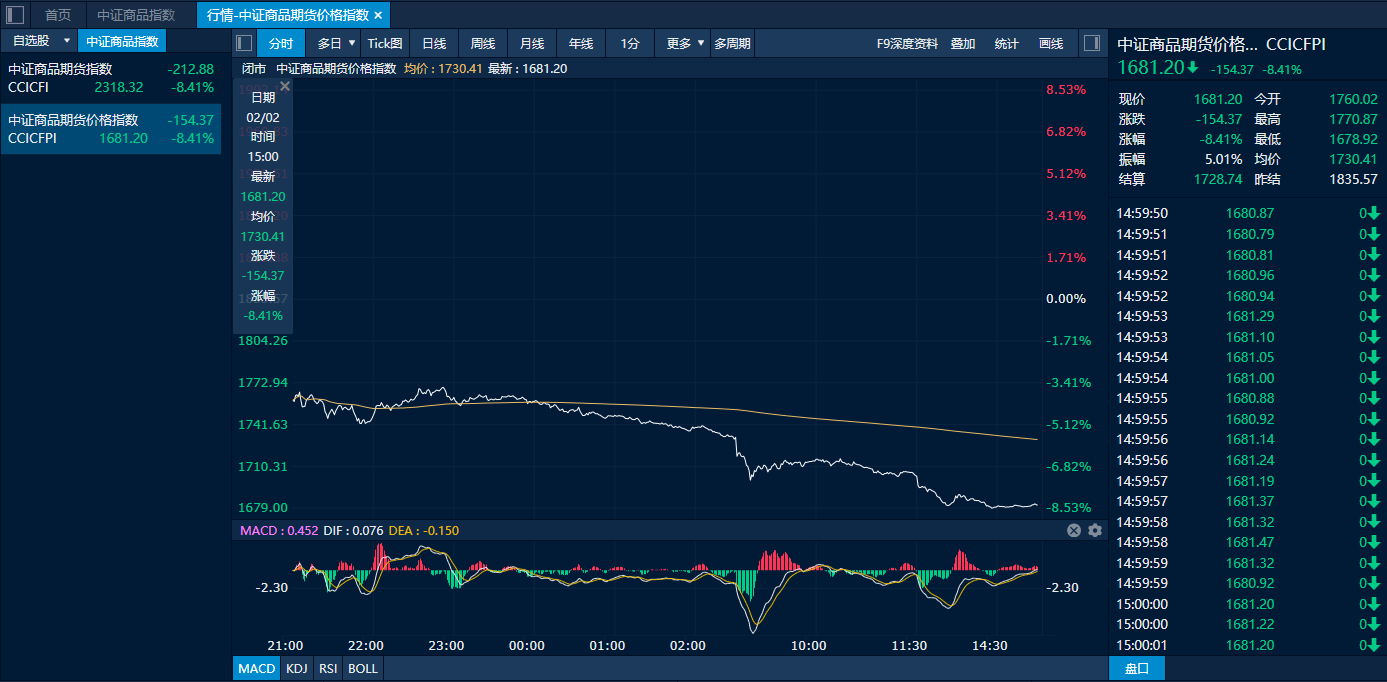
Group 1 - The domestic commodity futures market experienced a significant downturn on February 2, with nearly all contracts closing lower, including major contracts for silver, palladium, platinum, lithium carbonate, nickel, tin, copper, aluminum, and various oil products [1][2] - The China Securities Commodity Futures Price Index closed at 1681.20 points, down 154.37 points or 8.41% from the previous trading day, while the China Securities Commodity Futures Index fell to 2318.32 points, a decrease of 212.88 points or 8.41% [1] - The sharp decline in precious metals was attributed to a shift in market sentiment, influenced by the nomination of Kevin Warsh as the next Federal Reserve Chairman and higher-than-expected core PPI data, which reinforced expectations for a hawkish monetary policy [2][3] Group 2 - The easing geopolitical tensions, particularly regarding U.S.-Iran relations, contributed to a decline in market fears of supply disruptions, further pressuring oil prices as U.S. crude inventories increased [4] - Industrial metals also saw widespread declines, with contracts for lithium carbonate, nickel, tin, aluminum, copper, stainless steel, and aluminum alloy all hitting their daily limits [5] - In contrast, caustic soda futures rose over 2%, driven by cost support from falling liquid chlorine prices, although high inventory levels and weak demand continue to pose challenges for the sector [6]
黄金闪崩12%:泡沫破裂还是牛市急刹?
Sou Hu Cai Jing· 2026-02-02 08:51
Core Viewpoint - A sudden "flash crash" has led to a dramatic decline in gold and silver prices, with gold dropping over 10% and silver plummeting 36% within 24 hours, marking the worst single-day decline of the century [1][3]. Group 1: Market Reaction - On January 30, 2026, the London spot gold price fell from $5320 per ounce to a low of $4682, resulting in a 12% drop [1]. - The silver market experienced a catastrophic decline, with prices halving to $74.28 per ounce [1]. - The crash caused jewelry stores to reduce gold prices three times within an hour, and mining company stocks collectively plummeted [1]. Group 2: Causes of the Crash - The catalyst for the crash was the unexpected nomination of hawkish Kevin Walsh to the Federal Reserve, leading to a 1.8% rise in the dollar and a swift withdrawal of safe-haven funds from precious metals following disappointing earnings from Microsoft [3]. - The silver market's weak liquidity was a critical factor, with exchange inventories only able to meet 3% of demand, causing a market paralysis when algorithmic trading triggered stop-loss orders [3]. - The previous year's price surge of 300% in silver contrasted sharply with a mere 15% increase in physical demand, while gold saw an 11% increase in central bank purchases alongside a 35% price rise [3]. Group 3: Market Sentiment and Future Outlook - The market is divided, with bears citing indicators like the gold-silver ratio and oil-gold ratio to argue that precious metals are overvalued, while bulls point to persistent geopolitical risks and the trend of de-dollarization as long-term demand drivers [3]. - Technical analysts are watching the critical support level at $4650, hoping that buying during the Chinese New Year will stabilize the market [5]. - Concerns are rising about a potential repeat of the "Volcker moment," with the probability of interest rate hikes now at 35% [5]. Group 4: Investor Behavior and Regulatory Response - Ordinary investors are being warned as high-leverage products reveal their risks, with a surge in cases of paper silver positions being liquidated [7]. - The spread between buyback prices for physical gold has widened to 6%, indicating market stress [7]. - Institutional investors are adjusting strategies to mitigate risks through cross-market arbitrage and hedging, reducing the optimal weight of gold in investment portfolios to 6.2% [7]. - Regulatory bodies are responding by discussing new transparency measures for inventory disclosures and new circuit breaker mechanisms to prevent future crises [7].

金银遇史诗级风暴 贵金属板块将如何演绎?
Mei Ri Jing Ji Xin Wen· 2026-02-01 15:25
Core Viewpoint - The global precious metals market experienced an unprecedented sell-off, with gold prices dropping over 12% and silver prices plummeting by more than 35%, raising concerns about the end of the precious metals bull market [1][2]. Group 1: Market Performance - On January 31, gold prices fell from approximately $5400 to a low of $4700 per ounce, ultimately closing around $4907.5, marking a single-day decline of 9.3% [1]. - Silver prices saw an even more dramatic decline, crashing from $116 to around $74, with a maximum drop exceeding 35%, and closing at approximately $85.25, reflecting a single-day decrease of 26.37% [1]. - The A-share precious metals sector had already declined by 8.93% on January 30, with most stocks hitting the daily limit down, and the negative sentiment is expected to continue following the further declines on January 31 [3]. Group 2: Causes of the Sell-off - One of the triggers for the sell-off was the nomination of Kevin Warsh as the next Federal Reserve Chairman, which is perceived as a hawkish move that could lead to tighter monetary policy, diminishing the appeal of precious metals as a safe haven [1]. - The sell-off was exacerbated by a chain reaction of leveraged positions being liquidated, as rising margin requirements from exchanges increased pressure on traders, leading to a vicious cycle of selling and further price declines [2]. Group 3: Future Outlook - Short-term market sentiment remains fearful, with the possibility of continued declines in the precious metals sector [4]. - Analysts from various firms suggest that while short-term adjustments are expected, the long-term outlook for gold remains positive, driven by unresolved U.S. debt issues and a weakening dollar [5].
TMGM外汇平台:美联储人事变动预期与美元反弹施压金价
Sou Hu Cai Jing· 2026-01-30 07:26
Group 1 - Gold prices have declined approximately 3% after reaching a record high of $5,594.82 per ounce, with market focus shifting to potential changes in the Federal Reserve's leadership [1] - Speculation surrounds the nomination of Kevin Warsh as the new Federal Reserve Chair, which has raised concerns about a potential shift towards tighter monetary policy [1] - The strengthening of the US dollar has further pressured gold prices, making it more expensive for buyers holding other currencies, thus dampening demand [1] Group 2 - Despite a potential second consecutive week of decline for the dollar, its recovery from recent lows poses short-term resistance for gold [3] - The Federal Reserve's decision to maintain interest rates has not altered market expectations for potential rate cuts in 2026, providing some long-term support for gold [3] - Technical factors explain the recent market correction, as gold's rapid price increase led to profit-taking pressures, with traders noting an "overbought condition" as a reason for price adjustments [3] Group 3 - The recent price fluctuations reflect a temporary battle between immediate market reactions to sudden news and long-term trends, with potential changes in Federal Reserve leadership prompting a reassessment of policy paths [4] - Ongoing global tensions continue to reinforce gold's status as a safe-haven asset, indicating that the recent price correction has not undermined its core support logic [4]
日本央行释放明确紧缩信号 财政扩张与货币政策走向对峙
Xin Hua Cai Jing· 2026-01-28 05:49
Group 1 - The Bank of Japan (BOJ) is adopting a more cautious stance on inflation, with potential for gradual acceleration due to rising labor costs, distribution expenses, and a weak yen [1] - The BOJ's meeting minutes indicate that if economic and price trends align with forecasts, further interest rate hikes may become an option [1] - A committee member noted that recent food price increases are influenced by structural factors rather than temporary supply issues, suggesting a more persistent inflationary environment [1] Group 2 - Despite maintaining the benchmark interest rate at 0.75%, there are significant internal divisions regarding the pace of tightening, with some members advocating for immediate rate hikes due to potential imported inflation risks [2] - The BOJ's latest economic outlook predicts core CPI for fiscal years 2025 to 2027 at 2.7%, 1.9%, and 2.0%, with core-core CPI expectations even higher, indicating inflation pressures above the 2% target [2] - There is a tension between tightening monetary policy and expanding fiscal measures, as the government considers suspending the 8% food consumption tax to alleviate cost pressures, which could lead to significant revenue losses [3]
日本央行1月会议或释放鹰派信号以稳汇率
Xin Hua Cai Jing· 2026-01-22 07:52
Core Viewpoint - The Bank of Japan is expected to maintain its policy interest rate at 0.75% during the upcoming monetary policy meeting, while analysts warn of a potential hawkish stance in the policy statement due to recent economic signals and currency fluctuations [1][2]. Group 1: Monetary Policy Expectations - The Bank of Japan is likely to keep the interest rate unchanged at 0.75% as it awaits clearer economic signals, particularly from the spring labor negotiations and upcoming inflation data [1]. - Analysts suggest that if wage negotiations continue to show strong growth, the Bank may raise rates by 25 basis points as early as March [1]. - The recent depreciation of the yen, with the USD/JPY nearing 160, has raised concerns about inflation and the need for a hawkish policy response [1]. Group 2: Economic Indicators - The December Consumer Price Index (CPI) showed a significant cooling, complicating the policy path for the Bank of Japan [1]. - The market is closely monitoring the final CPI figures for December, as a substantial drop in inflation could lead the Bank to reassess its rate hike timeline [2]. - The sustainability of government debt is under scrutiny following the announcement of early elections aimed at expanding the ruling party's seats to promote more expansive fiscal policies [1]. Group 3: Future Projections - Analysts from ING believe that if core inflation stabilizes above 2%, supported by wage growth and government subsidies, the Bank may consider its next rate hike in the second half of 2026 [1]. - The potential for a hawkish tone in the upcoming policy statement could provide short-term support for the yen, while a more cautious approach may lead to further depreciation [2].