恒大

Search documents
王健林和许家印谁更惨?
Sou Hu Cai Jing· 2025-09-29 10:24
Core Insights - The contrasting fates of Wang Jianlin and Xu Jiayin highlight the divergent paths taken by two former real estate tycoons in China, with Wang struggling to manage debt while maintaining some dignity, and Xu facing severe legal repercussions and loss of reputation [1][4][6] Group 1: Wang Jianlin's Situation - Wang Jianlin has sold off assets worth 600 billion yuan since 2017, including 77 hotels and 85 Wanda Plazas, with recent sales of 48 core plazas for 50 billion yuan, reflecting a 40% depreciation in asset value [3] - His total debt has led to over 5.2 billion yuan in enforced payments, with core subsidiaries holding interest-bearing liabilities of 137.5 billion yuan, while cash reserves cover only a quarter of short-term debts [3] - Despite the challenges, Wang has not fled or transferred assets abroad, maintaining commitments to projects and employees, and has reduced Wanda's debt ratio from a peak of 90% to 65% [3][6] Group 2: Xu Jiayin's Situation - Xu Jiayin's financial troubles began with a staggering 2.4 trillion yuan in debt, exacerbated by self-serving actions such as transferring 42.7 billion yuan in assets through a "technical divorce" and hiding wealth overseas [4][5] - Legal actions have resulted in a global injunction freezing 7.7 billion USD of his assets, with liquidators pursuing 6 billion USD in illegal gains, and his former wife also embroiled in asset recovery efforts [4][5] - Xu faces severe legal consequences, including potential life imprisonment and confiscation of personal assets, marking a complete collapse of his reputation and financial standing [5][6] Group 3: Industry Implications - Wang's experience serves as a case study in risk management for the real estate sector, illustrating the importance of asset liquidity and project delivery as survival strategies [5][6] - In contrast, Xu's downfall exemplifies the consequences of neglecting regulatory frameworks and ethical standards, reinforcing the principle that asset liquidity and project completion are critical for maintaining credibility in the industry [5][6]

“王健林们”退场,万亿房地产消费遇冷,中国白酒未来增量在哪?
Sou Hu Cai Jing· 2025-09-29 07:49
Core Viewpoint - The decline of the real estate industry in China has significantly impacted the high-end liquor market, leading to a need for transformation and new consumption drivers in the liquor sector [1][4][7]. Group 1: Real Estate and Liquor Industry Interconnection - The real estate sector's growth has historically driven the high-end liquor market, with a notable increase in business-related consumption [2][4]. - From 2004 to 2013, real estate investment surged over 520%, while the liquor industry experienced a "golden decade" with production up 293%, revenue up 719%, and profits soaring 1272% [5]. - The collapse of major real estate companies like Evergrande and the subsequent economic downturn have led to a significant decline in the liquor industry, which is now facing intense competition and adjustment [7][8]. Group 2: Current State of the Liquor Industry - As of early 2025, the number of large-scale liquor enterprises has decreased to 887, with a slight revenue increase of 0.19% but a significant profit drop of 10.93% [8]. - Major liquor companies have initiated strategic transformations, focusing on new consumer demographics, international markets, and affordable product lines to adapt to changing market conditions [10][11][12]. Group 3: Strategic Transformations in the Liquor Industry - Companies like Moutai are targeting new consumer groups in emerging industries and enhancing personalized service offerings [10]. - The liquor industry is also expanding its international presence, with initiatives aimed at promoting Chinese liquor globally [10]. - There is a growing emphasis on affordable products, with several brands launching new offerings to capture the mass market [11][12]. Group 4: Future Outlook and Challenges - Despite initial successes in transformation, the liquor industry faces ongoing challenges, including the need to find new consumption drivers to replace the real estate sector [14]. - The export market for Chinese liquor is still in its infancy, and the profitability of mass-market products lags behind that of premium offerings [14].





帮主郑重:王健林被限高!1.86亿背后,咱唠唠地产行业的真寒气
Sou Hu Cai Jing· 2025-09-28 02:47
老铁们,这两天刷到王健林被限高的新闻没?财经圈里都炸了——前中国首富啊,突然就被法院给了"限高令",不能坐飞机、不能住星级酒店。我是帮主郑 重,干了二十年财经记者,专盯中长线投资里的门道。这事儿表面看就是万达欠了1.86亿工程款没还,但往深了扒,根本不是小打小闹,简直是当下房地产 行业的"冰山一角"。 先说说这1.86亿的由头——兰州中院执行的建设工程纠纷,万达还有旗下的关联公司没给钱,王健林作为法定代表人,按规矩连带被限了高。但咱得拎清 楚:这1.86亿看着是笔大数,跟万达的盘子比,真不算啥。翻2024年中的财报,万达总负债差不多2890亿,这1.86亿顶多算个"小数点后几位"。更要当心的 是连锁反应——要是其他债主也跟着起诉,搞不好就触发债务交叉违约,那麻烦就大了。 再看万达为了平事儿,拿出来的家底:武汉楚河汉街的12套房子,被法院强制拍卖。评估价3317万,结果只能打八折、2654万起拍,更尴尬的是,第一次拍 卖居然没人接。这可不是楚河汉街的房子不行,是现在商业地产想变现太难了——流动性快冻住了。这两年万达不是一直在卖万达广场自救嘛,但卖资产的 速度,压根赶不上债务到期的节奏,就像手里攥着东西,想扔出去 ...
多地有售楼处成短剧取景地,售楼处回应成短剧取景地
Di Yi Cai Jing· 2025-09-23 06:58
传统的售楼处大多装修豪华,视觉效果较好,这正契合部分"霸总"或职场短剧对场景的要求。不过,在 一众"地产+短剧"的结合中,最引人注目的是在河南郑州荥阳,当地有"烂尾楼"项目的售楼处,一度成 为短剧拍摄取景地。 【#多地有售楼处成短剧取景地#,#售楼处回应成短剧取景地#】以往看沙盘、看户型的售楼处,摇身一 变成为短剧取景地! 近来,多地都传出有售楼处成为短剧取景地的消息。在山东聊城,有一地产项目官微主动发文称,有部 短剧到营销中心取景,乍一看还以为"走进了片场"。 负责住宅门卫的工作人员表示,之前售楼处经常有拍短剧的,就在距离住宅门口不远的十字路口处。家 住荥阳的一位居民也告诉记者,这里有两个较知名的短剧取景地,一个是恒大养生谷,还有几公里外的 一别墅项目。 不过当天,该项目面积巨大的售楼处,却是大门紧锁、没有人烟。记者拨通了项目官方电话,工作人员 解释称,最近售楼处的场地有别的安排,暂时不接短剧拍摄的相关"预约",后续也可能租给其他企业进 行办公。 "这里接短剧拍摄业务已经一年多了,主要是提供场地租赁。但最近领导说有其他安排,后续何时重新 开放'接单',还要等通知。"工作人员称。 公开消息显示,位于郑州荥阳的 ...
恒大“债主”心酸事:核心资产股价涨了120%,控股权却被迫法拍
第一财经· 2025-09-18 13:34
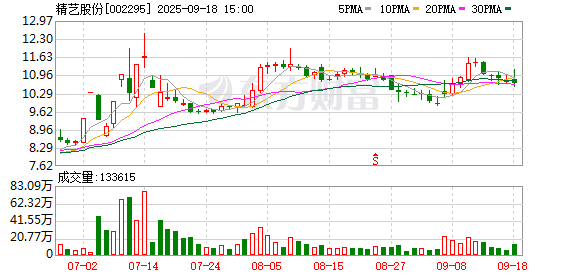
Core Viewpoint - The shares of Jingyi Co., Ltd. (002295.SZ), held by Nantong Sanjian Holdings Co., Ltd., are set for judicial auction with a starting price of 725 million yuan, raising concerns about potential changes in the company's controlling shareholder and actual controller [2][4]. Group 1: Auction Details - Nantong Sanjian's 75,184,700 shares in Jingyi Co., representing approximately 29.9996% of the total share capital, are being auctioned, with the auction date scheduled for October 9 [2]. - The initial auction price of 725 million yuan is only 60% of the 1.2 billion yuan paid by Nantong Sanjian in 2018 for these shares [2][4]. - The final auction price will be determined based on the average closing price of the stock over the 20 trading days prior to the auction, multiplied by the number of shares, and then discounted by 10% [3]. Group 2: Company Performance - Jingyi Co., Ltd. is a leading player in China's copper processing industry, with a reported revenue of 3.754 billion yuan in 2024, reflecting a year-on-year growth of 38.43%, and a net profit of 27.7063 million yuan, up 15.57% [4]. - The stock price of Jingyi Co. surged from 5.7 yuan per share in January to a peak of 12.49 yuan in July, marking a 120% increase, driven by demand from the new energy sector [4]. Group 3: Nantong Sanjian's Financial Issues - Nantong Sanjian has faced significant financial difficulties, being included in the list of dishonest entities in July 2024 due to multiple overdue debts and failure to disclose timely information [5]. - The company is involved in several legal cases with a total amount of approximately 1.4 billion yuan, leading to the freezing of its shares in Jingyi Co. [5].

恒大“债主”心酸事:核心资产股价涨了120% 控股权却被迫法拍
Di Yi Cai Jing· 2025-09-18 12:12
Group 1 - Nantong Sanjian Holdings Co., Ltd. is facing a judicial auction of its shares in Jingyi Co., Ltd. (002295.SZ), with an initial auction price of 725 million yuan for 75.1847 million shares, scheduled for October 9 [2] - The shares represent approximately 29.9996% of Jingyi's total equity, and if successfully auctioned, it will lead to a change in the controlling shareholder and actual controller of the company [2] - The initial auction price is only 60% of the 1.2 billion yuan that Nantong Sanjian paid for the shares in November 2018 [2] Group 2 - Jingyi Co., Ltd. is a leading company in China's copper processing industry, established in 1999, with products widely used in home appliances, automotive, communication, and new energy sectors [3] - The company reported a revenue of 3.754 billion yuan in 2024, a year-on-year increase of 38.43%, and a net profit of 27.7063 million yuan, up 15.57% [3] - The stock price of Jingyi surged from 5.7 yuan per share in January to a peak of 12.49 yuan in July, marking a 120% increase due to demand from the new energy industry [3] Group 3 - Nantong Sanjian was listed among the "Top 500 Chinese Enterprises" in 2018, ranking 157th, and was the second highest revenue-generating private enterprise in Nantong, with annual revenue exceeding 100 billion yuan [3] - The company has faced financial difficulties since the Evergrande crisis in 2022, leading to a series of defaults and being listed as a dishonest entity [4][5] - The shares of Jingyi held by Nantong Sanjian have been frozen by the court, involving multiple cases with a total amount of approximately 1.4 billion yuan [5]
恒大“债主”心酸事:核心资产股价涨了120%,控股权却被迫法拍
Di Yi Cai Jing· 2025-09-18 11:58
Group 1 - Nantong Sanjian Holdings Co., Ltd. is auctioning its stake in Jingyi Co., Ltd. on JD Asset Disposal Platform, with a starting price of 725 million yuan [1] - The stake being auctioned amounts to 75,184,700 shares, representing approximately 30% of Jingyi's total share capital [1] - The auction is scheduled for October 9, and the final starting price will be determined based on the average closing price of the stock over the 20 trading days prior to the auction [1] Group 2 - Jingyi Co., Ltd. is a leading company in China's copper processing industry, with a reported revenue of 3.754 billion yuan in 2024, marking a 38.43% year-on-year increase [2] - The net profit attributable to shareholders for Jingyi in 2024 was 27.7063 million yuan, reflecting a 15.57% increase compared to the previous year [2] - The stock price of Jingyi surged from 5.7 yuan per share in January to a peak of 12.49 yuan per share in July, representing a 120% increase [2] Group 3 - Nantong Sanjian was once ranked first among Jiangsu's top 100 construction companies and was included in the "China Top 500 Enterprises" list in 2018 [2] - The company faced financial difficulties following the crisis of Evergrande in 2022, leading to a series of defaults and loss of creditworthiness [3] - Nantong Sanjian's equity in Jingyi has been frozen by the court, with related cases involving a total amount of approximately 1.4 billion yuan [3]
陆家嘴财经早餐2025年9月13日星期六
Wind万得· 2025-09-12 23:10
Group 1 - The Chinese government is set to discuss trade issues with the U.S., including unilateral tariffs and the TikTok situation, emphasizing the protection of domestic companies' rights [2] - As of August, M2 and M1 growth rates are reported at 8.8% and 6% respectively, with a narrowing M1-M2 gap, indicating a focus on optimizing monetary policy structure [2] - The Ministry of Finance anticipates general public budget revenue to reach 106 trillion yuan during the 14th Five-Year Plan, with spending exceeding 136 trillion yuan, indicating ample fiscal policy space [3] Group 2 - The State Council is implementing measures to promote private investment, focusing on easing market access and addressing key concerns of enterprises [4] - International investment institutions express optimism about China's economic prospects and market potential, indicating a willingness to leverage their expertise for mutual growth [4] - The People's Bank of China is conducting a 600 billion yuan reverse repurchase operation, marking the fourth consecutive month of increased liquidity [5] Group 3 - The A-share market experienced slight adjustments, with the semiconductor industry showing strong performance, while certain sectors like insurance faced declines [6] - The Hong Kong Hang Seng Index reached a new high, driven by gains in technology and pharmaceutical stocks, with significant net buying from southbound funds [6] - Regulatory actions are being taken against companies like *ST Dongtong for financial misconduct, highlighting ongoing scrutiny in the market [6][7] Group 4 - The central bank is seeking public input on new regulations to support cross-border financing in RMB, aiming to enhance liquidity in offshore markets [5] - The National Development and Reform Commission and the National Energy Administration have set a target for new energy storage capacity to reach 180 million kilowatts by 2027, driving investment in the sector [10][11] - The Ministry of Industry and Information Technology plans to solicit opinions on standards for intelligent connected vehicles, indicating a push for regulatory clarity in the automotive sector [10] Group 5 - Companies like TCL Technology are investing significantly in new production lines, indicating a trend towards advanced manufacturing capabilities [9] - The market is witnessing a surge in interest in stablecoins, with firms exploring innovative payment solutions, reflecting a shift in financial technology [12] - The U.S. Federal Reserve is expected to implement a series of interest rate cuts, influencing global market dynamics and investment strategies [14]
又一上市房企被清盘
Sou Hu Cai Jing· 2025-09-08 02:24
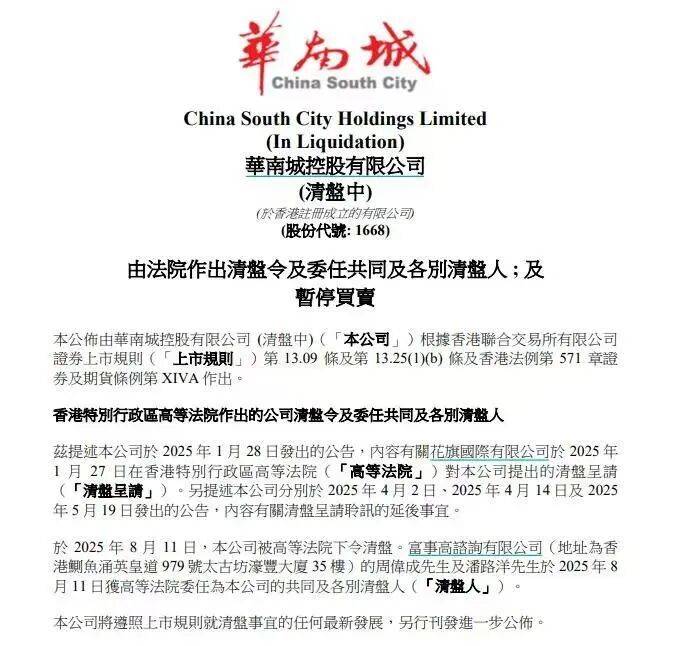
Group 1 - The core point of the article is the collapse of Huazhong City, which has declared bankruptcy with a debt of HKD 60.9 billion and only HKD 41.14 million in cash remaining, despite previous financial support from state-owned enterprises totaling nearly HKD 7 billion [2][3][6] - The company was ordered into liquidation by the Hong Kong High Court on August 11, following a petition from Citigroup for a debt of approximately HKD 23.9 billion, which is part of a USD 306 million bond due in April 2024 with a 9% interest rate [3][5] - Huazhong City reported a record loss of HKD 89.86 billion for the fiscal year 2024, with cash and cash equivalents at only HKD 41.14 million against a defaulted loan of HKD 157.42 billion, indicating a severe cash flow crisis [5][6] Group 2 - The financial structure of Huazhong City is alarming, with total liabilities around HKD 609.44 billion and interest-bearing debt at HKD 302.2 billion, including a current portion of HKD 182.41 billion, leading to a significant liquidity issue [5][6] - Despite receiving nearly HKD 7 billion in financial support from Shenzhen state-owned enterprises, including equity purchases and loans, these efforts failed to prevent the company's collapse [6][19] - The company's business model, heavily reliant on real estate, has become obsolete in the face of a shift towards lighter asset models, with rental income declining and maintenance costs rising, leading to a cash flow deficit [8][19] Group 3 - The liquidation of Huazhong City reveals critical truths about the real estate sector, emphasizing that the ability to generate cash flow is more important than the amount of financial support received [19][20] - The judicial liquidation process serves as a final warning, with the court only accepting full repayment plans or sufficient asset collateral, dismissing other debt resolution strategies as mere delays [20][21] - The event signifies the end of the era of reckless growth in the real estate sector, indicating that even state-backed enterprises are not immune to failure without inherent cash-generating capabilities [22]
2025年是抓紧卖房,还是咬牙买房?曹德旺建议没错:方向很明确
Sou Hu Cai Jing· 2025-09-04 21:04
Core Viewpoint - Despite favorable policies and reduced mortgage rates, the Chinese real estate market continues to experience a downward trend in prices, raising concerns about oversupply and the long-term viability of property investments [1][2][3] Policy Environment - In May 2025, the central bank announced a 0.5% reduction in the reserve requirement ratio and a 0.1% decrease in loan rates, injecting approximately 1 trillion yuan into the market [2] - The housing provident fund loan rate has dropped to a historical low of 2.6%, down from 3.1% in 2023, significantly reducing monthly payments for homebuyers [2] - The down payment for second homes has been lowered from 25% to 15%, aligning it with first-home purchases, which could save buyers substantial amounts [2] Market Response - Despite policy incentives, only 24 out of 70 major cities saw new home prices increase in January 2025, indicating persistent downward pressure on the market [3] - Over the past three years, cities like Zhengzhou and Tianjin have seen home prices drop by as much as 30%, with some areas around Beijing experiencing declines exceeding 50% [5] Demographic Changes - The birth rate in China fell to 9.02 million in 2024, while the elderly population reached 290 million by the end of 2023, indicating a shrinking demand for new homes [7][14] - Young people's preferences are shifting towards experiences rather than homeownership, leading to a more active rental market in major cities [7][14] Investment Trends - The golden era of real estate investment is over, with average home prices rising from 2,000 yuan/sqm in 2000 to 11,000 yuan/sqm in 2021, a 5.5-fold increase [8] - The current market is transitioning from speculation to a focus on housing as a necessity, with government policies aimed at stabilizing the market rather than inflating prices [8][13] Financial Environment - Real estate investment accounted for less than 20% of fixed asset investment in the first half of 2025, marking a historical low [10] - Local governments are increasingly reliant on non-land revenue sources, with land sale income dropping from 870 billion yuan in 2021 to 320 billion yuan in 2024, reducing the incentive to inflate land prices [11] Corporate Challenges - Major real estate companies like Evergrande and Sunac are facing severe financial difficulties, with sales for even top firms like Vanke dropping over 40% from peak levels [13][17] - The market is characterized by a "three no's" state: developers are hesitant to acquire land, banks are reluctant to lend, and buyers are cautious about purchasing [13] Future Outlook - The real estate market is expected to undergo a long-term adjustment, with a focus on deleveraging and returning to rational investment practices [21][22] - The shift in consumer behavior towards renting and the increasing costs associated with property ownership suggest a fundamental change in the market dynamics [9][14]