房地产纾困

Search documents
东方资产与信达资产重仓拿地嵩明,已“战略接盘”瓜分超千亩地
Sou Hu Cai Jing· 2026-01-20 08:13
Market Overview - In the week of January 12-18, 2026, the Kunming real estate market saw an increase in both transaction volume and prices, with new regulations on residential and school district properties being the main focus for registrations [1] - According to CRIC, Kunming supplied approximately 45,500 square meters across four projects, a 95% increase week-on-week; transactions reached about 44,100 square meters, up 50% week-on-week, with an average transaction price of 11,854 yuan per square meter, a 1% increase [1] Key Projects and Sales - The second phase of the Bangtai Guanyun project continued to perform well, with sales amounting to approximately 36 million yuan, 11 units sold, and an average transaction price of 19,407 yuan per square meter, making it the highest-priced project [1] - High-end improvement projects such as Poly Tianjun and China Resources Center maintained strong sales, with approximately 29 million yuan and 28 million yuan in sales, and average transaction prices of 17,902 yuan per square meter and 15,431 yuan per square meter, respectively [2][3] - The Vanke 500 Li project in the exhibition area recorded sales of about 26 million yuan, with an average transaction price of 16,966 yuan per square meter [3] Land Transactions - No new land supply or transactions occurred in Kunming's main urban area last week; however, in the suburbs, Dongfang Asset acquired five commercial plots in Songming County for a total price of 120 million yuan, continuing its expansion in the area [1][4] - Dongfang Asset has previously acquired approximately 310 acres of land in the Songming Vocational Education New City, totaling 393 million yuan, indicating a strong presence in the local land market [4] Infrastructure Developments - The construction of two new schools in the Guandu District is set to begin, with a total investment of approximately 122 million yuan, aimed at addressing the educational resource shortage in the area [6][11] - The new schools will include an 18-class primary school and a 30-class nine-year school, which are expected to enhance the educational infrastructure in the rapidly developing regions of Kunming [11][12] Upcoming Projects - The Sam's Club project is set to launch in the core area of the Zhenchi International Exhibition District, with a total investment of approximately 314 million yuan, which is anticipated to boost the high-end retail market in Kunming [5] - The public resource trading platform in Kunming has announced plans for a membership-based warehouse supermarket, with a contract amount of approximately 230.67 million yuan, expected to be officially released on February 13 [4]

大摩闭门会-邢自强-Laura-Wang-2026开年宏观策略谈-纪要
2026-01-05 15:43
Summary of Key Points from Conference Call Records Industry Overview - **Geopolitical Landscape**: The global geopolitical situation is evolving, with a continued depreciation of the US dollar expected. The Chinese yuan may experience a mild appreciation against the dollar, but potential impacts on exports and deflation should be monitored [1][2][5]. - **Chinese Technology Innovation**: China's technological capabilities are improving, particularly in AI-related hardware and software, as well as domestic computing power replacements. This trend is expected to attract both domestic and international investors, benefiting A-shares and Hong Kong IPO financing [1][2][8]. - **Consumer Stimulus Policies**: The government is implementing targeted consumer stimulus policies, with an estimated 300 billion RMB allocated for the first quarter, primarily aimed at durable consumer goods. If consumption and employment do not meet expectations, the stimulus may expand to include service sector consumption vouchers [1][2][3]. Real Estate Market - **Real Estate Relief Measures**: Relief measures in the real estate sector will focus on inventory reduction and mortgage interest rate subsidies. Initial trials will be conducted in select cities, with the potential for expansion based on effectiveness [3][4]. Fiscal Policy - **Fiscal Policy Focus**: The fiscal policy in the first half of the year will emphasize the early issuance of local special bonds, targeting urban renewal, underground infrastructure, green transformation, smart grid storage, and AI computing infrastructure. Mid-term fiscal spending may increase by approximately 0.5% of GDP (around 700 billion RMB) to support technology applications and real estate relief [4][11]. Economic Growth Projections - **GDP Growth Expectations**: The actual GDP growth for China in 2025 is projected to be around 4.8%, with exports maintaining a mid-to-high single-digit growth rate. However, nominal GDP growth is expected to be lower than actual GDP growth, reflecting cautious private sector performance [1][16][17]. Stock Market Outlook - **Stock Market Trends**: The outlook for the Chinese stock market in 2026 is relatively optimistic, despite some volatility at the end of 2025. The market's performance will depend on the continuation of macroeconomic trends and appropriate policy support [7][8][15]. - **Investor Sentiment**: Factors influencing the stock market include macroeconomic data, corporate earnings, liquidity conditions, market valuation levels, and changes in investor sentiment. Recent positive developments in the IPO market, particularly for GPU-related companies, have increased market activity [9][10]. Currency and Investment - **Renminbi Strength**: The recent strengthening of the renminbi is attributed to a trade surplus exceeding 1 trillion USD and the central bank's allowance for a moderate appreciation. However, the broader context of US dollar depreciation and geopolitical uncertainties remains significant [5][6][19]. - **Foreign Investment in Chinese Stocks**: The appreciation of the renminbi against the dollar is favorable for foreign investors in Chinese stocks, making RMB-denominated assets more attractive [13][14][15]. AI Hardware Market - **AI Hardware Development**: The future of the AI hardware sector is optimistic, with significant demand expected for AI semiconductors. The approval of NVIDIA's export of H200 chips to China is anticipated to positively impact the Chinese AI computing chip market [20][23]. Automotive Industry Trends - **Automotive Market Dynamics**: The automotive industry is expected to face challenges and opportunities in globalization. Exports are projected to increase by 12% by 2026, but there are risks associated with traditional vehicle exports and potential trade barriers in developed markets [25][27]. - **New Energy Vehicle Development**: Key focuses for new energy vehicle technology development include smart driving and AI integration, with expectations for significant penetration of advanced driving technologies by 2030 [28][29].
4.5亿元资金如何盘活百亿元级“沉睡”资产?——中国东方资产管理股份有限公司为房企纾困样本调查
Zheng Quan Ri Bao· 2025-12-19 16:17
Core Insights - The "Hongkou Yuan·717" real estate project in Shanghai is undergoing construction after being dormant for three years due to financial issues faced by the developer, Shanghai Jubao Real Estate Development Co., Ltd. [1][2] - China Orient Asset Management Co., Ltd. has played a crucial role in revitalizing the project by providing 450 million yuan in common benefit debt, which has helped unlock assets worth over 10 billion yuan [1][6] - The project is part of a broader effort to stabilize the real estate market in China, as highlighted in recent government meetings [1][10] Financial Context - The project was initially halted due to a debt crisis at Xiangsheng Real Estate Group, leading to a total debt exceeding 10 billion yuan, with over 8.2 billion yuan in bank guarantees [2][3] - The Shanghai government has been actively involved in addressing the financial crisis, forming a special task force to manage the risk associated with the project [3][4] Policy and Regulatory Framework - The Chinese government has introduced several policies aimed at supporting the real estate market, including the "16 Financial Measures" to ensure stable development [3][10] - The project has benefited from a pre-restructuring process that allows for asset reorganization outside of court, which has been supported by local government and judicial authorities [5][9] Innovative Financial Solutions - China Orient's approach of providing common benefit debt during the pre-restructuring phase is a pioneering move that has expedited the project's revival [6][7] - The project has implemented a trust structure to protect the interests of creditors and ensure the safety of investments, allowing for a more secure financial environment [8][9] Market Implications - The successful revitalization of the project serves as a model for future real estate recovery efforts, demonstrating the potential for market-driven solutions to address financial distress in the sector [12][13] - The case highlights the importance of collaboration among stakeholders, including developers, creditors, and government entities, to achieve successful outcomes in troubled real estate projects [12]
重庆湾项目正式开工 中国长城资产激活城市核心资产
Zheng Quan Ri Bao Wang· 2025-12-12 10:18
Core Viewpoint - The Chongqing Bay project, led by China Great Wall Asset Management Co., is a significant real estate revitalization initiative in Chongqing, marking the largest investment in the city in three years and the first successful collaboration between a central enterprise and local government [1][2]. Group 1: Project Overview - The Chongqing Bay project is located in the core area of Chongqing's "Two Rivers and Four Banks," covering a total construction area of approximately 1 million square meters, making it a rare large-scale comprehensive project in the city's main area [2][3]. - The project aims to enhance the urban image of the Nanbin Road area and promote high-quality urban development in Chongqing, addressing previous stagnation due to market conditions [2][3]. Group 2: Financial Collaboration - In January 2023, China Great Wall Asset, in collaboration with partners like Sunac China and China Merchants Bank, reached a financing agreement for the Chongqing Bay project, with an investment of up to 2.476 billion yuan for debt restructuring and new financing [3]. - Sunac China plays a crucial role as a major shareholder and operator, leveraging its industry experience to support the project's relaunch and ensure the realization of its value [3]. Group 3: Asset Management and Risk Mitigation - China Great Wall Asset has accumulated extensive experience in real estate risk mitigation, managing over 2.35 trillion yuan in non-performing assets and aiding more than 1.5 million enterprises since 2024 [4][5]. - The company employs diverse rescue models, such as debt restructuring and operational intervention, to revitalize projects, as demonstrated in successful cases across various cities [4][5]. Group 4: Future Directions - China Great Wall Asset aims to continue its role as a key player in the financial and real estate sectors, focusing on the policy of "digesting stock and improving quality" to stabilize real estate risks and develop new models for the industry [6].

龙虎榜复盘丨海南再迎催化,房地产异动拉升,大消费活跃
Xuan Gu Bao· 2025-12-10 10:58
Group 1: Stock Market Activity - A total of 31 stocks were listed on the institutional trading leaderboard, with 13 stocks experiencing net buying and 18 stocks facing net selling [1] - The top three stocks with the highest net buying by institutions were: Shennong Agricultural Industry (265 million), Zhongci Electronics (157 million), and Longzhou Co., Ltd. (112 million) [1] Group 2: Key Stocks Performance - Shennong Agricultural Industry saw a price increase of 20.07% with 4 buyers and 2 sellers [2] - Zhongci Electronics experienced a price rise of 10.00% with 2 buyers and no sellers [2] - Longzhou Co., Ltd. had a price increase of 9.96% with 3 buyers and no sellers [2] Group 3: Economic Indicators and Consumer Trends - The National Bureau of Statistics reported that the Consumer Price Index (CPI) rose by 0.7% year-on-year in November, with the core CPI (excluding food and energy) increasing by 1.2% [3] - Hainan's duty-free shopping in November amounted to 2.38 billion, reflecting a year-on-year growth of 27.1% [3] - The restaurant sector's retail sales in October grew by 3.8%, marking the highest increase since June [3] Group 4: Real Estate Sector Developments - Vanke A held a bondholders' meeting to discuss the extension of its bonds, which is considered crucial for the company's financial relief [5] - Market expectations for fiscal support to stabilize the real estate market are strong, with a focus on reducing the likelihood of further defaults among real estate entities [5] - The approach to local debt emphasizes prioritizing development over debt resolution, suggesting a gradual easing of investment restrictions in previously constrained areas [5]





国家定调明年经济!重磅会议要开了,3个信号直接关系你的钱袋子
Sou Hu Cai Jing· 2025-12-08 11:46
Core Insights - The upcoming Central Economic Work Conference is viewed as a critical event for interpreting China's economic direction, especially as it coincides with key policy signals and development tasks [1][3] Economic Context - China's economy is currently facing challenges with a slowdown in traditional growth engines and emerging industries still in the early stages of development, compounded by global geopolitical tensions and shrinking external demand [3][5] - Economic indicators show significant pressure, with real estate development investment down 23% year-on-year in October and a 24.3% decline in commodity housing sales, indicating ongoing adjustments in the housing market [5][7] Policy Focus - The conference will address three core issues: adjustment of the deficit ratio, real estate relief, and support for emerging industries, as 2025 marks a transitional year between the 14th and 15th Five-Year Plans [5][9] - There is a strong emphasis on enhancing public spending through a potential increase in the deficit ratio, which could fund infrastructure, social welfare, and technological innovation, thereby stimulating economic growth [9][11] Monetary Policy - The continued issuance of ultra-long-term special government bonds aims to alleviate short-term fiscal pressures and direct social capital towards strategic emerging industries, achieving both growth stabilization and structural adjustment [11][12] - Monetary policy tools such as interest rate cuts and reserve requirement ratio reductions are anticipated to lower financing costs for businesses and stimulate consumer spending [11][12] Consumer and Housing Market - Consumer price index (CPI) showed a negative growth of 0.1% in the first half of the year, reflecting weak domestic demand, while the producer price index (PPI) has been in a downward trend for 33 consecutive months [7][9] - Housing policies may shift focus from stabilizing prices to supporting rigid and improved housing demand, potentially through relaxed purchasing and lending policies [16][20] Industry Development - The conference will outline policies to accelerate the industrialization of AI and support traditional industries' transformation, aiming to create a modern industrial system that balances emerging and traditional sectors [18][20] - A stable supply chain and enhanced innovation capabilities are expected to drive high-quality economic development and create more quality jobs, ultimately improving income levels [20][21] Conclusion - The conference serves as a guide for national economic development and a reference for families planning their futures, emphasizing the need for collaborative efforts among the government, businesses, and consumers to drive economic growth [20][21][25]
北方三城南下取经,保交楼“南宁模式”何以成为全国范本
2 1 Shi Ji Jing Ji Bao Dao· 2025-11-19 23:15
Core Insights - The establishment of the Kaifeng City Stabilization Fund marks the nationwide adoption of the "Nanning model" for ensuring housing delivery, indicating a replicable and promotable experience in addressing unfinished housing projects [1][3] Group 1: Background and Context - The "Nanning model" has been recognized as a successful case for addressing complex unfinished housing projects, which are often seen as "hard nuts to crack" due to issues like debt complexity and asset multiple pledges [2][4] - The stabilization fund in Nanning is the first of its kind in China, primarily funded by state-owned enterprises, and has inspired other regions to establish similar funds [2][3] Group 2: Challenges in Housing Delivery - Unfinished projects face three main challenges: "handover difficulties," "funding issues," and "management problems" [5][6] - Handover difficulties arise from bankrupt developers and the reluctance of original management teams to cooperate, complicating the transition to new management [5] - Funding issues stem from misappropriated pre-sale funds, leading to significant financial gaps that hinder market-based funding support [6] - Management problems include poor construction quality and incomplete infrastructure due to prolonged project halts [6] Group 3: Solutions and Innovations - The stabilization fund employs a dual isolation strategy to mitigate risks from original developers and management teams, ensuring that new funding is used exclusively for project completion [6][7] - To address funding gaps, the fund utilizes asset segmentation, special loans, and profits from commercial developments [6][7] - The fund emphasizes quality service and homeowner rights in project delivery, ensuring compliance with original construction plans [7] Group 4: Evolution of the Stabilization Fund - The stabilization fund is evolving into a 2.0 version, focusing on innovative funding sources and integrating economic development strategies [8][9] - The new model involves local governments contributing physical assets (land) to secure financing, reducing fiscal burdens while ensuring project initiation [9] - The fund's role has expanded from merely addressing housing delivery to becoming a platform for local asset management and industrial incubation [9][10] Group 5: Broader Implications - The successful practices of the stabilization fund are being replicated across regions, indicating a shift from localized solutions to a more standardized approach to real estate risk management [10] - The model creates a multi-win framework that balances government guidance, market leadership, and legal safeguards, promoting social stability and economic efficiency [10]
金科股份新董事会名单出炉,招行前行长马蔚华加盟
Di Yi Cai Jing Zi Xun· 2025-10-16 23:45
Core Insights - The largest judicial restructuring case in China's real estate industry has been completed, leading to a new board for Jinke Property Group Co., Ltd. (formerly known as "Jinke Shares") [1] - The restructuring process, which began in July 2023, involved over 8,400 creditors and a debt scale of 147 billion yuan [1] - Jinke has successfully unloaded over 100 billion yuan of debt and experienced a change in control, marking the end of the 27-year "Huang Hongyun era" [1] Company Leadership Changes - On October 16, Jinke announced the successful election of nine board candidates during its third extraordinary shareholders' meeting of 2025, with Guo Wei appointed as Chairman and President [1] - Wang Xiaoqing has been appointed as Vice Chairman, while former Chairman Zhou Da has been designated as Co-President [2] - Ma Weihua has taken on the role of Party Secretary and Honorary Chairman, while Feng Lun has been appointed as the Chairman of the Expert Advisory Committee [2] Key Personnel Backgrounds - Guo Wei, the new Chairman, has prior experience leading Xinda Real Estate and has been involved in multiple real estate relief projects [1][2] - Wang Xiaoqing previously served as Chairman of Hainan Yedao, and Li Gen, the new Executive Vice President, has held positions in various equity fund companies [2] - Ma Weihua, known for his role as the former President and CEO of China Merchants Bank, is also involved in several other companies and social organizations [2] Financial Support and Shareholder Structure - Jinke has secured over 3.3 billion yuan in funding support through a restructuring investment agreement with Shanghai Pinqi, a subsidiary of the restructuring investment party [2] - In September, 3 billion shares were transferred to designated accounts of the restructuring investors, representing 28.21% of the total share capital, with the new largest shareholder controlling 9.34% of the total shares [2]

破局三重难关,南宁形成可复制可推广的房地产纾困经验
2 1 Shi Ji Jing Ji Bao Dao· 2025-09-22 23:37
Core Insights - The Chinese real estate market is undergoing a deep adjustment period, with many unfinished projects posing significant challenges that need urgent solutions [1][3] - The Pingwen Fund in Nanning has emerged as a successful model for addressing these challenges, focusing on both "guaranteeing delivery" and "stabilizing assets" through market-oriented operations [1][4] Group 1: Pingwen Fund Overview - Established in May 2022, the Pingwen Fund is one of the earliest real estate relief funds in China, successfully delivering 5,127 housing units over three years [1][4] - The fund operates under principles of government guidance, market-oriented operations, and risk prevention, showcasing a unique approach to reviving stalled projects [4][7] Group 2: Challenges in Real Estate Delivery - Many projects face complex issues such as debt complications, asset freezes, and funding shortages, making traditional solutions inadequate [3][4] - Specific challenges include difficulties in project handover, funding disputes, and management issues due to prolonged construction halts [3][6] Group 3: Innovative Solutions by Pingwen Fund - The Pingwen Fund employs a dual isolation strategy involving equity transfer and asset transfer to mitigate risks associated with developer bankruptcies [5][7] - It has successfully navigated funding challenges by utilizing asset segmentation, special loans, and commercial development profits to cover funding gaps [6][8] Group 4: Replicable Model - The success of the Pingwen Fund has led to the development of a replicable model known as the "Nanning Experience," which emphasizes market-oriented and legal frameworks to resolve common industry issues [7][8] - This model highlights the importance of protecting homeowner rights throughout the entire process, from delivery to property management [8]
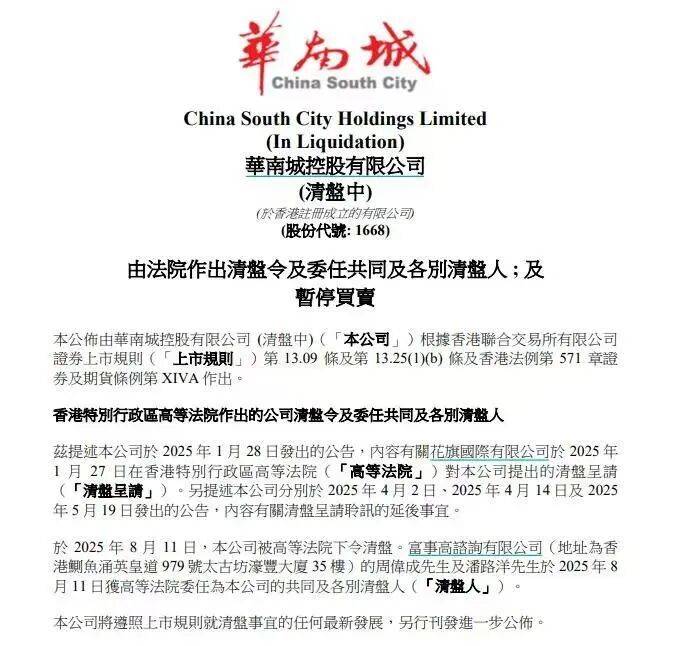
又一上市房企被清盘
Sou Hu Cai Jing· 2025-09-08 02:24
Group 1 - The core point of the article is the collapse of Huazhong City, which has declared bankruptcy with a debt of HKD 60.9 billion and only HKD 41.14 million in cash remaining, despite previous financial support from state-owned enterprises totaling nearly HKD 7 billion [2][3][6] - The company was ordered into liquidation by the Hong Kong High Court on August 11, following a petition from Citigroup for a debt of approximately HKD 23.9 billion, which is part of a USD 306 million bond due in April 2024 with a 9% interest rate [3][5] - Huazhong City reported a record loss of HKD 89.86 billion for the fiscal year 2024, with cash and cash equivalents at only HKD 41.14 million against a defaulted loan of HKD 157.42 billion, indicating a severe cash flow crisis [5][6] Group 2 - The financial structure of Huazhong City is alarming, with total liabilities around HKD 609.44 billion and interest-bearing debt at HKD 302.2 billion, including a current portion of HKD 182.41 billion, leading to a significant liquidity issue [5][6] - Despite receiving nearly HKD 7 billion in financial support from Shenzhen state-owned enterprises, including equity purchases and loans, these efforts failed to prevent the company's collapse [6][19] - The company's business model, heavily reliant on real estate, has become obsolete in the face of a shift towards lighter asset models, with rental income declining and maintenance costs rising, leading to a cash flow deficit [8][19] Group 3 - The liquidation of Huazhong City reveals critical truths about the real estate sector, emphasizing that the ability to generate cash flow is more important than the amount of financial support received [19][20] - The judicial liquidation process serves as a final warning, with the court only accepting full repayment plans or sufficient asset collateral, dismissing other debt resolution strategies as mere delays [20][21] - The event signifies the end of the era of reckless growth in the real estate sector, indicating that even state-backed enterprises are not immune to failure without inherent cash-generating capabilities [22]