古井贡酒

Search documents
今世缘酒业董事长顾祥悦入选“2025年度酒业十大杰出人物”
Sou Hu Cai Jing· 2026-01-16 02:10
Core Insights - The "Top Ten Outstanding Figures in the Liquor Industry for 2025" list was announced by Rui Finance, highlighting Gu Xiangyue, the chairman of Jinshiyuan Liquor, as a notable figure [2] - The selection criteria for the list included professional ability, performance, and industry influence [2] Group 1 - Gu Xiangyue, born in June 1968, serves as the chairman and general manager of Jinshiyuan [3] - Gu has a master's degree in agricultural promotion from Nanjing Agricultural University and has held various political positions before joining Jinshiyuan [3] - Under Gu's leadership, Jinshiyuan aims to enhance its product matrix, expand brand marketing, and accelerate national distribution in 2025 [3]


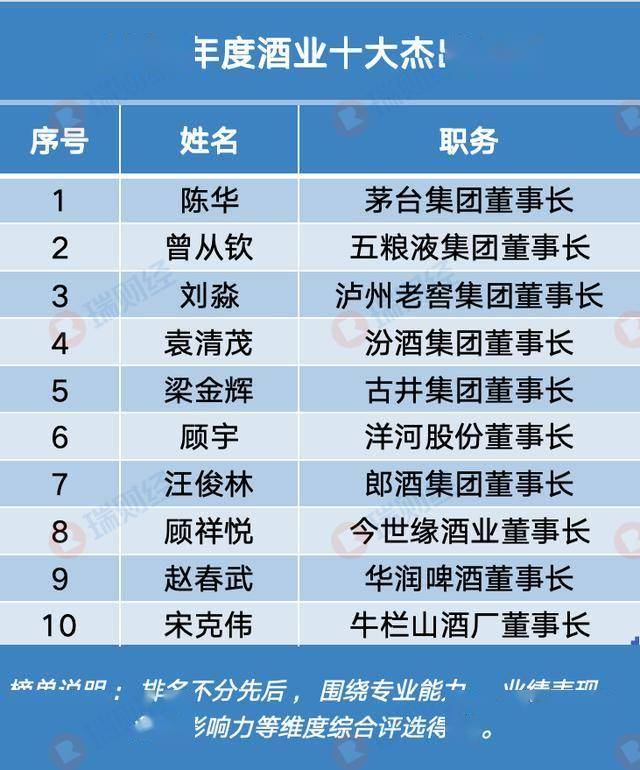
古井集团董事长梁金辉入选“2025年度酒业十大杰出人物”
Sou Hu Cai Jing· 2026-01-16 02:10
Group 1 - The "Top Ten Outstanding Figures in the Liquor Industry for 2025" list was announced by Rui Finance, with Liang Jinhui, Chairman of Gujing Group, being selected [2] - The selection criteria for the list included professional ability, performance, and industry influence [2] - Liang Jinhui has a background in business management and has held various leadership positions within Gujing Group, contributing to its growth and innovation [3] Group 2 - In 2025, under Liang Jinhui's leadership, the group aims to achieve breakthroughs in product innovation, flexible channel strategies, and deeper international expansion [3]

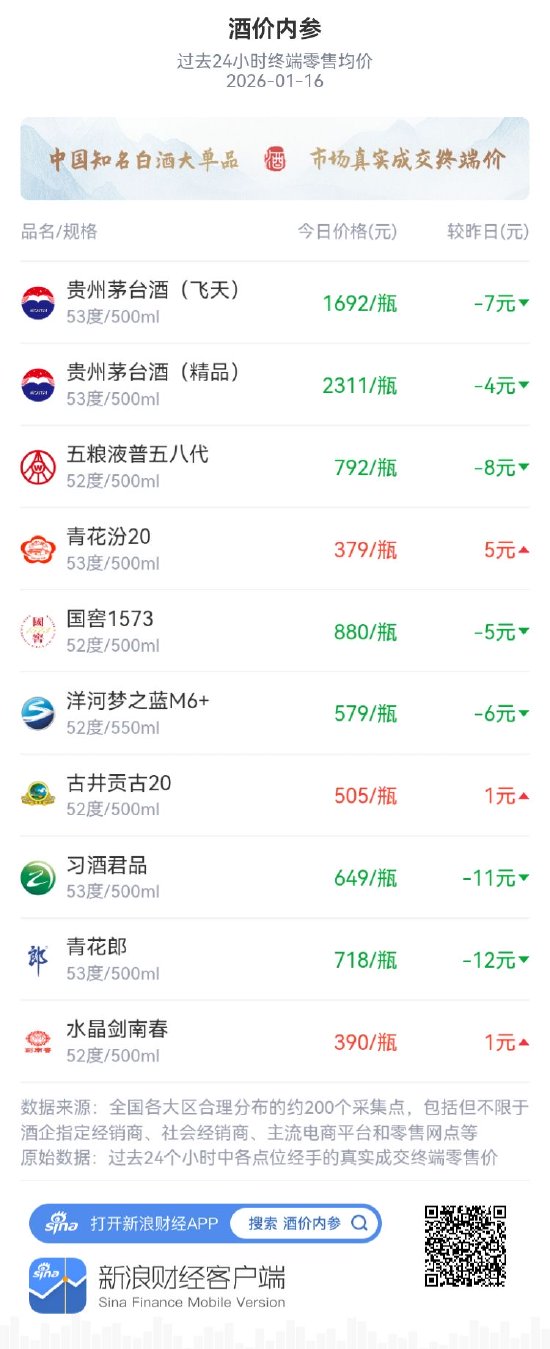
酒价内参1月16日价格发布 青花汾20上涨5元
Xin Lang Cai Jing· 2026-01-16 01:24
Core Insights - The core viewpoint of the article highlights a significant decline in the retail prices of major Chinese liquor brands, indicating ongoing inventory adjustments within the industry [1][7]. Price Trends - The average retail price of the top ten liquor products in China fell to 8,895 yuan on January 16, a decrease of 46 yuan from the previous day, marking the lowest price level in nearly two months [1][7]. - Among the ten products, seven experienced price drops while three saw increases, with key products collectively contributing to the decline in average prices [1][7]. Specific Product Price Changes - Leading the price declines were Qinghua Lang and Xijiu Junpin, which fell by 12 yuan and 11 yuan per bottle, respectively [1][7]. - Wuliangye Pu Wu Eight Generation decreased by 8 yuan, while Feitian Moutai dropped by 7 yuan, influenced by the iMoutai platform's pricing strategies and inventory adjustments [1][7]. - Other notable declines included Yanghe Dream Blue M6+ and Guojiao 1573, which fell by 6 yuan and 5 yuan, respectively [1][7]. - In contrast, Qinghua Fen 20 saw an increase of 5 yuan, while Gujing Gonggu 20 and Shuijing Jian Nan Chun rose by 1 yuan each [1][7]. Market Dynamics - The decline in prices is attributed to differentiated consumer demand and price adjustments by leading brands, reflecting the ongoing inventory reduction process in the liquor industry [1][7]. - The iMoutai platform's recent sales of Moutai products at competitive prices have had a magnetic effect on the market, contributing to the observed price changes [2][8]. Sales and Marketing Strategies - Moutai has been leveraging digital marketing through the iMoutai platform, which has seen significant engagement, including the rapid sell-out of new product releases [3][9]. - The platform's popularity surged, reaching the top of the Apple App Store's shopping category, with over 2.7 million new users added within nine days of launching a new product [3][9]. - Moutai's board has approved a market-oriented operational strategy, enhancing its sales model to include a dynamic pricing adjustment mechanism based on market conditions [3][9].





酒价内参1月14日价格发布 市场普跌回调价格中枢下探
Xin Lang Cai Jing· 2026-01-16 01:21
Core Viewpoint - The Chinese liquor market, particularly for the top ten baijiu products, has experienced a general price adjustment, with a moderate decline in retail prices as of January 14, indicating cautious market sentiment [1]. Price Trends - The total retail price for a package of the top ten baijiu products is 8925 yuan, down 44 yuan from the previous day [1]. - Eight out of the ten products have seen price declines, reflecting a bearish market trend [1]. - The leading product, Feitian Moutai, has decreased by 9 yuan per bottle, while other notable declines include Gujing Gonggu and Qinghua Lang, both down 8 yuan per bottle [1][2]. Individual Product Pricing - Feitian Moutai (53 degrees, 500ml) is priced at 1692 yuan, down 7 yuan [2]. - The premium Moutai variant is significantly down by 470 yuan, now at 2311 yuan [2]. - Wuliangye (Pu Wu 8th generation, 52 degrees, 500ml) is priced at 792 yuan, down 8 yuan [2]. - Other products like Guojiao 1573 and Yanghe Dream Blue M6+ have also seen minor declines of 5 yuan and 6 yuan respectively [2][3]. Market Dynamics - The market is characterized by a general decline in prices, with only Wuliangye showing a slight increase of 1 yuan, while Qinghua Fen remains stable [1]. - The overall market sentiment appears cautious, with a narrowing of trading volumes and a clear differentiation in product performance [1].
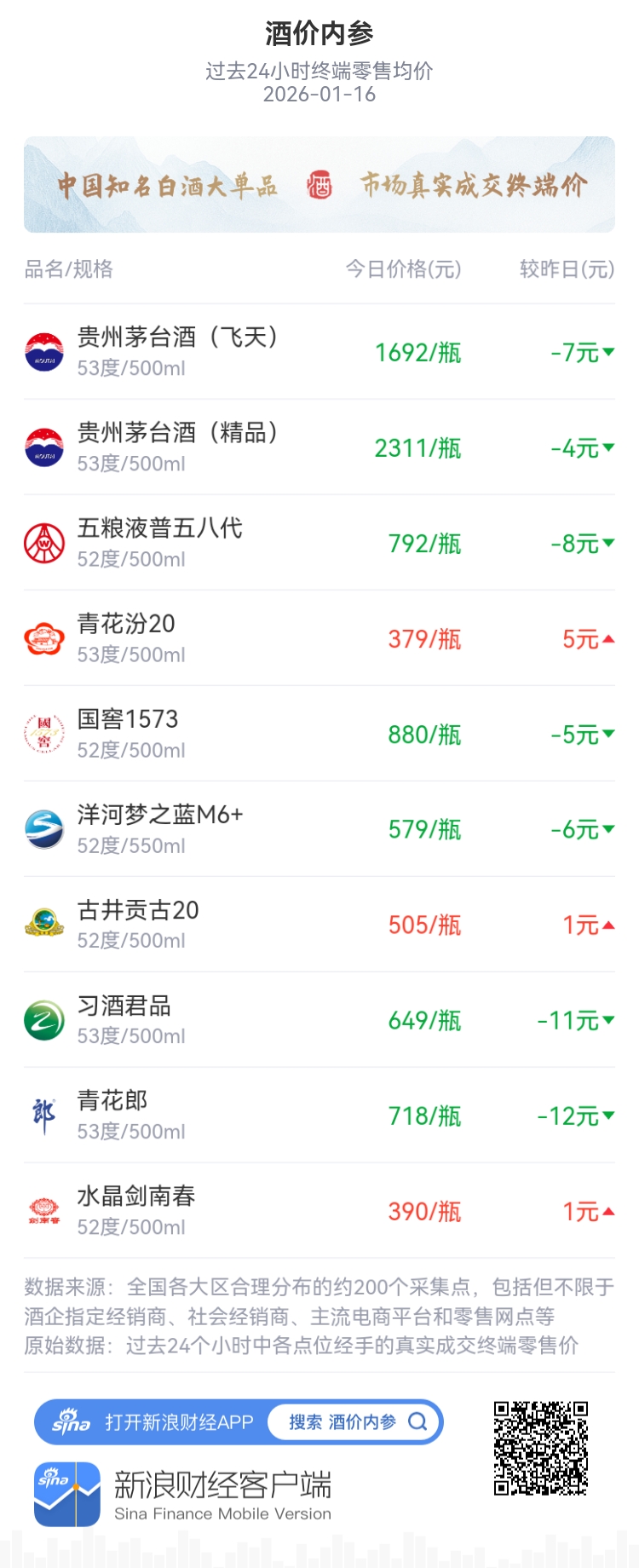
酒价内参1月16日价格发布 习酒君品下跌11元
Xin Lang Cai Jing· 2026-01-16 01:19
Core Insights - The article highlights a significant decline in the retail prices of major Chinese liquor brands, indicating a continued inventory adjustment process within the industry [1][7]. Price Trends - The average retail price of the top ten liquor products fell to 8,895 yuan on January 16, a decrease of 46 yuan from the previous day, marking the lowest price level in nearly two months [1][7]. - Out of the top ten products, seven experienced price drops while three saw increases, with key products collectively contributing to the decline in average prices [1][7]. Specific Price Changes - Major price declines were observed in products such as: - Qinghua Lang and Xijiu Junpin, both dropping over 12 yuan per bottle [1][7]. - Wuliangye Pu Wu Ba Dai decreased by 8 yuan per bottle [1][7]. - Feitian Moutai fell by 7 yuan per bottle, influenced by the iMoutai platform's pricing strategy [1][7]. - In contrast, Qinghua Fen 20 saw an increase of 5 yuan per bottle, while Gujing Gong Gu 20 and Shuijing Jian Nan Chun rose by 1 yuan each [1][7]. Data Collection Methodology - The "Liquor Price Reference" collects data from approximately 200 sampling points across various regions, including designated distributors and retail outlets, to provide an objective and traceable market price for well-known liquors [2][8]. Market Dynamics - The launch of new products on the iMoutai platform, including the 1,499 yuan Feitian Moutai and the 2,299 yuan premium Moutai, has begun to exert a magnetic influence on the market prices of these products [2][8]. - The iMoutai platform has seen a surge in popularity, reaching the top of the Apple App Store's shopping category, with over 2.7 million new users added within nine days of launching the 2026 Feitian Moutai [3][9]. Company Strategy - Moutai is advancing its market-oriented operations through digital marketing, with a new sales model that includes a dynamic pricing adjustment mechanism based on market conditions [3][9]. - As of 2024, Moutai's direct sales channel revenue has reached 43.87% of total revenue, reflecting a strategic shift towards a more collaborative sales approach [3][9].
茅台价格“松动”掀起连锁降价潮?酒商坦言:行业大洗牌在即
Nan Fang Du Shi Bao· 2026-01-15 11:45
Core Viewpoint - The white liquor market is experiencing unexpected price declines instead of the anticipated seasonal increase, driven by price adjustments of benchmark products like Feitian Moutai, leading to a widespread price reduction across various brands and price segments [1][13]. Price Trends - In major cities like Guangzhou, Shenzhen, Foshan, and Dongguan, the average retail prices of high-end white liquors have generally decreased, with many premium products, especially sauce-flavored liquors, seeing significant price drops [1][11]. - In Guangzhou, the average price of sauce-flavored liquors has fallen sharply, with products like Junpin Xijiu dropping from approximately 731 yuan to around 698 yuan [2][3]. - The average retail price of Feitian Moutai in Shenzhen is reported at 1734.21 yuan, with some channels offering it as low as 1699 yuan [5][6]. Market Dynamics - The price adjustments are attributed to high inventory pressures and a shift towards "price for volume" strategies among distributors, indicating a challenging market environment for the white liquor industry [1][13]. - The introduction of the "i Moutai" platform has intensified competition, causing price fluctuations across the market, particularly affecting products in the 1000 yuan price range [2][7]. Regional Insights - In Shenzhen, high-end products like the eighth-generation Wuliangye have seen a price drop of approximately 39 yuan, while Junpin Xijiu's price has decreased by 22 yuan [5][6]. - In Dongguan, 13 out of 16 comparable high-end liquors have experienced price declines, with the eighth-generation Wuliangye averaging 884.43 yuan, down 20.57 yuan [11][12]. Future Outlook - The current price reductions reflect a lack of market momentum and high inventory levels, with many distributors indicating that clearing stock remains a primary focus [1][13]. - As the Spring Festival approaches, the ability of white liquor prices to stabilize will be a key indicator of the industry's recovery trajectory, with companies demonstrating brand resilience and channel control likely to emerge stronger from this market adjustment [13].
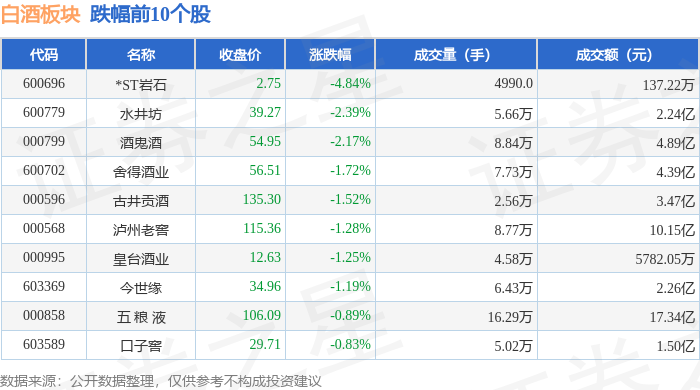
白酒板块1月15日跌0.77%,*ST岩石领跌,主力资金净流出11.52亿元
Zheng Xing Xing Ye Ri Bao· 2026-01-15 08:59
Group 1 - The liquor sector experienced a decline of 0.77% on January 15, with *ST Rock leading the drop [1] - The Shanghai Composite Index closed at 4112.6, down 0.33%, while the Shenzhen Component Index rose by 0.41% to 14306.73 [1] - Major liquor stocks showed varied performance, with *ST Rock down 4.84% to 2.75, and other notable declines including Shui Jing Fang down 2.39% and Moutai down 7.31% in net outflow [1][2] Group 2 - The liquor sector saw a net outflow of 1.152 billion yuan from main funds, while retail investors contributed a net inflow of 528 million yuan [1] - Specific stocks like Moutai and Wuliangye faced significant net outflows of 416 million yuan and 201 million yuan respectively, indicating a shift in investor sentiment [2] - The data indicates that retail investors are increasingly active, with a notable net inflow into stocks like Wuliangye, which saw 157 million yuan from retail investors [2]


中国消费板块 2026 展望:消费信心复苏是否已开启?-China Consumer Sector_ 2026 Outlook_ are we at the beginning of consumer confidence recovery_
2026-01-15 06:33
Summary of the Conference Call Transcript Industry Overview - **Industry**: China Consumer Sector - **Outlook**: The sector is believed to be in the early stage of a multi-year recovery cycle that began in Q3 2024, with expectations for gradual improvement in consumer sentiment and spending through 2026E [2][11][12] Key Insights - **Valuation**: MSCI China Consumer Discretionary and Staples are trading at 17x and 15x 12-month forward PE, approximately one standard deviation below the 10-year averages, indicating that current valuations do not reflect a potential consumption recovery [2][9] - **Consumer Confidence**: The China Consumer Confidence Index has been trending upwards since September 2024, suggesting a gradual restoration of consumer confidence despite ongoing challenges in the property market [12][19] - **K-shaped Recovery**: The recovery is characterized by a K-shaped trend, where mid- to high-income consumers in tier-1 cities are expected to lead spending, while lower-tier city consumers remain focused on value for money [3][48] Consumer Behavior Trends - **Shifting Preferences**: A UBS Evidence Lab survey indicates a divergence in consumer behavior, with over 50% of mid- to high-income consumers reporting investment gains and showing strong spending intentions, particularly in premium and experiential categories [3][37] - **Spending Intentions**: The strongest spending intentions are noted in beauty and skincare (41%) and tourism (37%), reflecting a shift towards experiential and premium spending [51] - **Investment Gains**: 64-74% of mid- to high-income consumers reported increased investment returns, with many planning to reinvest or spend on travel, health services, and consumer electronics [40][41] Stock Implications - **Company Ratings**: - Upgrades to Neutral for Fenjiu due to expected benefits from non-business baijiu consumption - Buy ratings maintained for companies like MIXUE, Guming, China Foods, CR Beer, and YUM China, among others [4] - **Dividend Payouts**: Premium baijiu companies are noted for their >75% dividend payout, which is expected to protect share prices from downside risks [4] Structural Growth Opportunities - **Emerging Themes**: Key investment themes for 2026E include changing consumer preferences, corporate restructuring, and industry consolidation, particularly in sectors like home appliances and mass-market consumption [14][50] - **Corporate Restructuring**: Companies are expected to adapt their business models to align with changing consumer behaviors, which may lead to sustainable long-term earnings growth [4][50] Risks and Challenges - **Property Market Downturn**: The ongoing downturn in the property market is anticipated to weigh on household balance sheets, potentially impacting consumer spending [13][48] - **Policy Support**: The pace of recovery is contingent on stabilizing the property market and effective policy implementation to boost consumption [13][48] Conclusion - The China consumer sector is poised for a recovery, driven by improving consumer confidence and shifting spending patterns. However, the recovery will be uneven across different income groups and city tiers, necessitating a nuanced investment approach to capture emerging opportunities while being mindful of potential risks associated with the property market downturn.



ETF盘中资讯|“i茅台”多款茅台酒今日开售!吃喝板块震荡盘整,机构高呼板块进入左侧布局阶段
Sou Hu Cai Jing· 2026-01-15 03:25
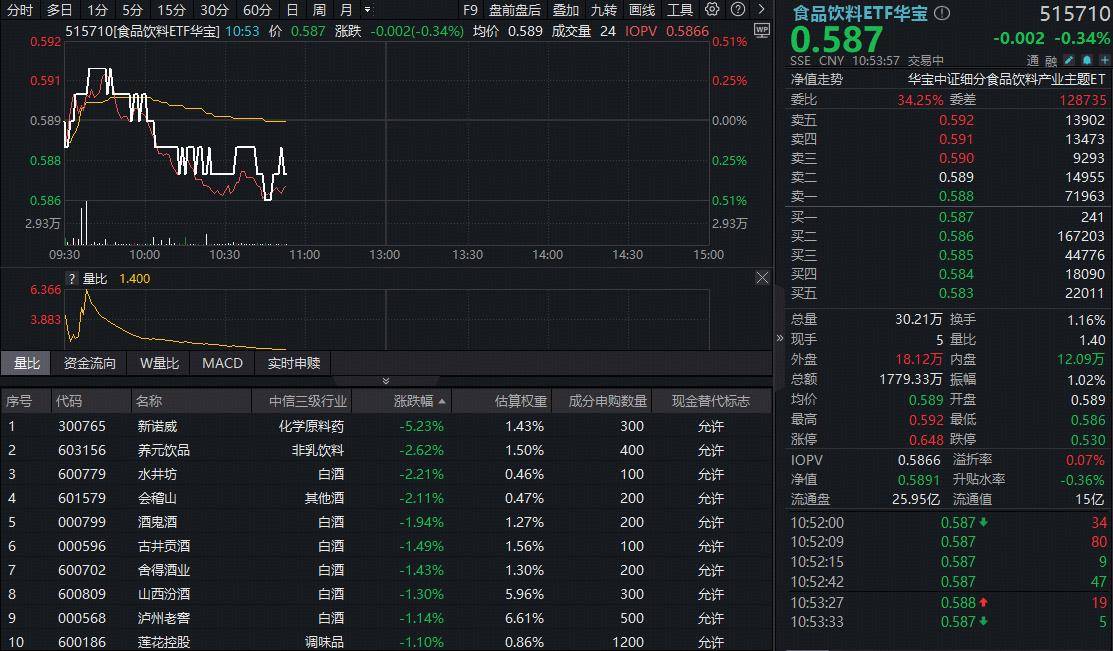
Group 1 - The food and beverage sector is experiencing a pullback, with the Huabao Food and Beverage ETF (515710) showing a decline of 0.34% as of the report time [1] - Major stocks in the liquor segment, such as Shui Jing Fang and Guo Jiu Jiu, are leading the declines, with Shui Jing Fang down over 2% and several others down more than 1% [1] - The valuation of the food and beverage sector is at a historical low, with the food and beverage ETF's price-to-earnings ratio at 20.07, which is in the 5.68% percentile of the last decade, indicating a potential opportunity for long-term investment [2] Group 2 - The market outlook suggests that the current adjustment phase for the liquor industry may be nearing its end, with expectations for a recovery as the Spring Festival approaches [3] - Recent market strategies from major liquor brands like Moutai and Wuliangye are being implemented, which may stabilize prices and reduce pressure on distributors [3] - The Huabao Food and Beverage ETF is heavily invested in leading high-end liquor stocks, with approximately 60% of its portfolio allocated to these stocks, indicating a strategic focus on premium products [4]
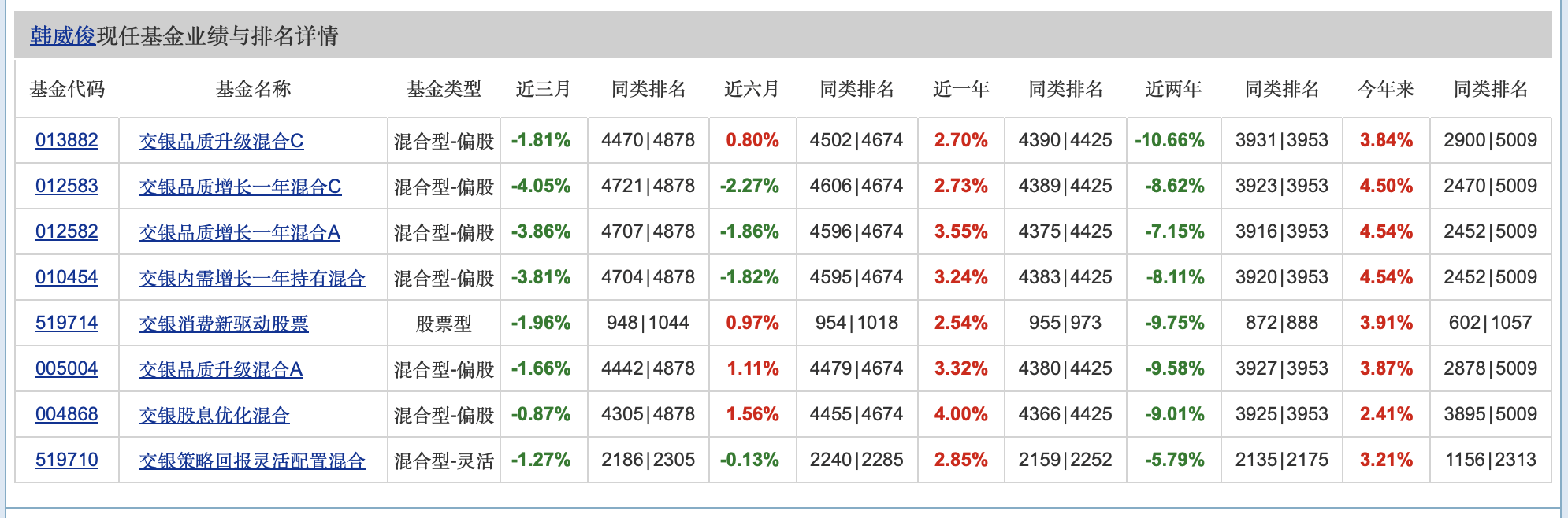
为何“躺平式投资”?交银施罗德“海豹”韩威俊旗下产品全线亏损引争议
Sou Hu Cai Jing· 2026-01-15 03:25
2026年1月,交银施罗德的韩威俊即将迎来担任基金经理的十年关口,但近年来围绕这位"老将"的舆论不再是"爆发"或者"进攻",而是"躺平":不追热点、 换手率低、重仓股高度稳定并且产品之间持仓趋同。 这带来的结果是,虽然2025年股市呈现"硬科技+创新药"双主线行情,带动权益类基金大面积飘红,超2000只权益类基金净值创历史新高,但韩威俊管理的 六只产品在2025年全部录得负收益,其代表性产品交银内需增长一年持有期混合基金已连续五年亏损。截至2025年底,韩威俊管理的6只基金合计规模仅剩 48.71亿元,相较于巅峰期近200亿元的规模,三年内缩水了75%以上。 | | 韩威俊现任基金业绩与排名详情 | | | | | | | --- | --- | --- | --- | --- | --- | --- | | 基金代码 | 基金名称 | 基金类型 | 近三月 | 同类排名 | 近六月 | 同类 | | 013882 | 交银品质升级混合C | 混合型-偏股 | -1.81% | 4470 4878 | 0.80% | 4502 - | | 012583 | 交银品质增长一年混合C | 混合型-偏股 | -4. ...