
新城控股

Search documents
新城控股集团股份有限公司 关于国金资管-吾悦广场持有型不动产资产支持专项计划成立的公告
Zhong Guo Zheng Quan Bao - Zhong Zheng Wang· 2025-11-29 00:06
Group 1 - The company has approved a direct financing plan not exceeding RMB 20 billion (including equivalent foreign currency) through various financial instruments [2] - The financing methods include corporate bonds, medium-term notes, short-term financing bonds, and other debt financing tools [2] - The board of directors is authorized to manage the specifics of the financing, including types of instruments, issuance conditions, and fundraising purposes [2] Group 2 - A real estate asset-backed securities plan managed by Guojin Securities Asset Management Co., Ltd. is set to issue RMB 616 million [3] - All subscription funds have been transferred to the custody account, meeting the target fundraising scale as per the plan's documentation [3] - The asset-backed securities plan is confirmed to meet the establishment conditions and will officially commence on November 28, 2025 [3]

新城控股集团股份有限公司关于国金资管-吾悦广场持有型不动产资产支持专项计划成立的公告
Shang Hai Zheng Quan Bao· 2025-11-28 20:13
Group 1 - The company has approved a direct financing plan not exceeding RMB 20 billion, which includes various financing instruments such as corporate bonds, asset-backed securities, and REITs [2] - The board of directors is authorized to manage the specifics of the direct financing, including types of instruments, issuance conditions, and fundraising purposes [2] - The "Guojin Asset Management - Wuyue Plaza Holding-type Real Estate Asset-backed Special Plan" has been established with a total issuance scale of RMB 616 million, and it meets the conditions for establishment [3] Group 2 - The special plan's establishment was confirmed by the Shanghai Stock Exchange, and all subscription funds have been transferred to the plan's custody account [3] - The total number of asset-backed securities subscribed has reached the target set in the plan's documentation [3]
新城控股吾悦广场持有型不动产资产支持专项计划成立
Bei Jing Shang Bao· 2025-11-28 14:37
Core Points - New City Holdings announced plans for direct financing not exceeding 20 billion yuan [1] - The company will hold board and shareholder meetings on March 27 and May 26, 2025, to approve the financing proposal [1] - Guojin Securities Asset Management plans to issue a real estate asset-backed special plan with a scale of 616 million yuan [1] - As of the announcement date, all subscription funds have been transferred to the special plan's custody account, meeting the target fundraising scale [1] - The special plan officially established on November 28, 2025 [1]
打通“投融管退” 新城控股发行全国首单消费类持有型ABS
Zheng Quan Ri Bao· 2025-11-28 10:45
Core Viewpoint - New City Holdings has successfully issued the first consumption-type real estate asset-backed securities (ABS) in China, marking a significant milestone in the industry with a total issuance scale of 616 million yuan and a debt portion of 410 million yuan, with a term of approximately 25 years [2][3][4]. Group 1: Asset and Market Position - The underlying asset for the ABS is the Wuyue Plaza located in the core area of the Qingpu District, which benefits from a large customer base of over 400,000 residents from more than 160 surrounding communities [3]. - Since its opening in 2014, Wuyue Plaza has maintained a high occupancy rate and has seen steady growth in key metrics such as foot traffic, revenue, and profit, establishing itself as a regional commercial leader [3][4]. - New City Holdings has a strategic presence in 141 cities with 205 comprehensive projects, achieving a high occupancy rate of 97.7% across 176 operational and managed properties [5][6]. Group 2: Financial Performance and Growth - In the first three quarters of the year, New City Holdings reported a total commercial operating revenue of approximately 10.511 billion yuan, reflecting a year-on-year growth of 10.82% [6]. - The total foot traffic at Wuyue Plaza reached 950 million visits, a year-on-year increase of 16%, with total sales exceeding 51.5 billion yuan, also up by 16.5% [6]. Group 3: Strategic Initiatives and Future Outlook - The issuance of the ABS aligns with New City Holdings' strategic shift from "real estate development and sales" to "asset operation," optimizing its asset-liability structure and enhancing the management of commercial real estate [4]. - The company has established a robust mechanism for continuous fundraising through the ABS, allowing for the acquisition of quality assets and promoting sustainable product development [5]. - The successful issuance of this ABS serves as a benchmark for private real estate companies, showcasing New City Holdings' leading capabilities in asset operation and innovative financing [4].


发行规模6.16亿元,全国首单消费类持有型不动产ABS成功设立
Zheng Quan Shi Bao Wang· 2025-11-28 08:50
Core Viewpoint - The establishment of the "Wuyue Plaza Holding-type ABS" marks a significant milestone as it is the first consumer-oriented holding-type real estate ABS in China and the first issued by a private enterprise listed on A-shares [1] Group 1 - The project was successfully established on November 28, with an issuance scale of 616 million yuan [1] - The underlying asset for this ABS is the Wuyue Plaza shopping center project located in Qingpu, Shanghai [1] - The issuer of this ABS is Xincheng Holdings (601155) [1]
新城控股(601155) - 新城控股关于国金资管-吾悦广场持有型不动产资产支持专项计划成立的公告
2025-11-28 08:45
专项计划的基本情况如下: 证券代码:601155 证券简称:新城控股 编号:2025-053 新城控股集团股份有限公司 关于国金资管-吾悦广场持有型不动产 资产支持专项计划成立的公告 本公司董事会及全体董事保证本公告内容不存在任何虚假记载、误导性陈述 或者重大遗漏,并对其内容的真实性、准确性和完整性承担法律责任。 新城控股集团股份有限公司(以下简称"公司"或"新城控股")于 2025 年 3 月 27 日召开第四届董事会第八次会议,并于 2025 年 5 月 26 日召开 2024 年年度股 东大会,审议通过了《关于公司开展直接融资工作的议案》,同意公司(含控股子 公司)进行规模不超过等额人民币 200 亿元(含境外等值外币)的直接融资,包括 但不限于企业债券、中期票据、短期融资券、超短期融资券、定向债务融资工具、 资产支持票据、资产支持证券、REITs、Pre-REITs、类 REITs、项目收益票据、永 续债等在中国银行间交易市场、境内外证券交易所等境内外合法的债券市场发行/ 举借的,以人民币或外币计价的各类权益融资及债务融资品种。同时,为保证直接 融资工作的顺利进行,股东大会同意授权董事会及其授权人士公 ...
最愿意逛商场的一代,正在退出舞台
3 6 Ke· 2025-11-28 02:47
Core Insights - The article highlights a significant structural change in consumer demographics, indicating that the generation most fond of shopping malls is gradually fading from the mainstream consumer group [1][8][31] - Predictions suggest a decline in birth rates, with estimates of around 4 million births in the first half of 2025 and potentially dropping below 9 million for the entire year [1] Group 1: Demographic Changes - The aging population and declining birth rates are becoming widely recognized societal issues, yet they still feel distant to individuals [2] - The shift in consumer demographics is particularly evident in the retail sector, where the traditional shopping mall experience is losing relevance among younger generations [3][11] Group 2: Evolution of Shopping Centers - Shopping centers have historically targeted the 25-45 age demographic, primarily supported by the 80s generation, which has driven the evolution of retail formats over the past 15 years [4][7] - The shopping center landscape has transformed through various phases, including the rise of fast fashion, themed dining, and the introduction of high-end beauty and leisure brands [5][10] Group 3: Future Consumer Trends - By 2025, the primary consumer group of 25-45 years old is expected to shrink by over 60 million, with a significant reduction in younger fashion consumers [10][17] - The 95/00 generation is characterized by a preference for self-expression, social interaction, and emotional value, leading to a decreased interest in traditional shopping malls [11][12] Group 4: Shift in Retail Formats - The future of retail will likely see a transition from large shopping centers to community-focused spaces that cater to essential needs rather than high-end fashion [19][20] - Traditional department stores are also expected to undergo significant changes, moving away from their historical ties to older consumer demographics [21][23] Group 5: Emergence of New Business Models - The article suggests a "renaissance" in physical retail, focusing on smaller, community-oriented formats that incorporate diverse, niche offerings [15][18] - As consumer preferences evolve, there will be a push towards non-standard commercial formats that meet the needs of younger consumers, emphasizing social spaces and unique experiences [25][26]

房地产开发板块11月26日跌0.44%,中国武夷领跌,主力资金净流出5.09亿元
Zheng Xing Xing Ye Ri Bao· 2025-11-26 09:05
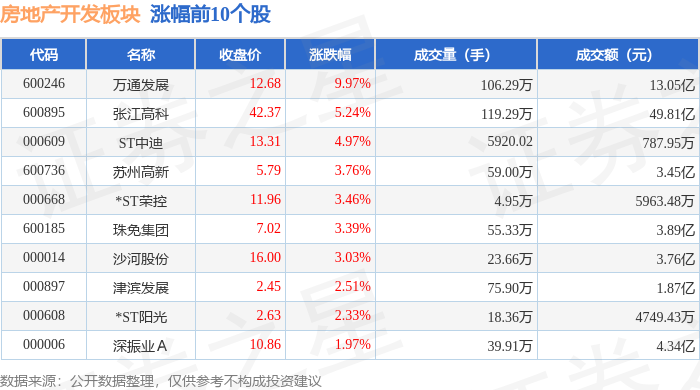
Market Overview - The real estate development sector experienced a decline of 0.44% on November 26, with China Wuyi leading the drop [1] - The Shanghai Composite Index closed at 3864.18, down 0.15%, while the Shenzhen Component Index closed at 12907.83, up 1.02% [1] Stock Performance - Notable gainers in the real estate sector included: - Wantong Development (600246) with a closing price of 12.68, up 9.97% [1] - Zhangjiang Hi-Tech (600895) at 42.37, up 5.24% [1] - ST Zhongdi (000609) at 13.31, up 4.97% [1] - Major decliners included: - China Wuyi (000797) at 3.44, down 6.78% [2] - Caixin Development (000838) at 3.43, down 4.99% [2] - Binhai Group (002244) at 10.07, down 4.73% [2] Capital Flow - The real estate development sector saw a net outflow of 509 million yuan from institutional investors, while retail investors contributed a net inflow of 342 million yuan [2] - The detailed capital flow for selected stocks showed: - Zhangjiang Hi-Tech (600895) had a net inflow of 3.75 billion yuan from institutional investors [3] - Wantong Development (600246) saw a net inflow of 3.14 billion yuan from institutional investors [3] - Tianjian Group (000090) had a net inflow of 4383.86 million yuan from institutional investors [3]


A股地产股下跌,滨江集团跌超5%
Ge Long Hui· 2025-11-26 05:57
Core Viewpoint - The A-share market has seen a decline in real estate stocks, with several companies experiencing significant drops in their share prices [1] Group 1: Company Performance - Binjiang Group and China Wuyi both fell over 5% [1] - Caixin Development dropped nearly 5% [1] - I Love My Home, Sanxiang Impression, and Hefei Urban Construction all decreased by over 3% [1] - Huaxia Happiness, Jindi Group, Te Fa Service, China National Trade, China Merchants Shekou, New Town Holdings, and Vanke A all saw declines exceeding 2% [1]


大摩闭门会:全球震荡,何去何从
2025-11-25 01:19
Summary of Conference Call Notes Industry or Company Involved - Focus on the global macroeconomic environment, particularly the AI sector and its implications for China and the US markets - Discussion on the real estate market in China and its impact on financial institutions Core Points and Arguments 1. **Global Market Dynamics** - The global market is experiencing significant volatility, but this is seen as a foundation for future productivity improvements driven by AI [1][4][5] - The investment levels in AI by major Chinese companies are projected to be only one-tenth of that in the US over the next two years, primarily due to lower costs in infrastructure, talent, and data in China [1][2] 2. **China vs. US AI Investment Strategies** - The US is heavily investing in high-end AI technologies, while China is focusing on a more lightweight approach aimed at expanding its industrial ecosystem [2][3] - Concerns about an AI bubble in the US are less applicable to China due to its different investment scale and market dynamics [2][25] 3. **Impact of US Market on China** - A significant adjustment in the US stock market is viewed as the biggest external risk to the Chinese market [3][4] - Despite concerns, the overall sentiment towards the Chinese market remains cautiously optimistic, with expectations of manageable impacts from US market fluctuations [4][12] 4. **Monetary Policy and Interest Rates** - The expectation for a rate cut in December has been revised, with predictions now suggesting cuts in January and April instead [5][6] - The changing dynamics of market participants, including increased retail investor participation and algorithm-driven trading, are influencing market behavior [6][7] 5. **US Stock Market Outlook** - The outlook for the US stock market is optimistic, driven by broad-based earnings growth rather than just AI-related companies [7][8] - Approximately 60% of US listed companies reported earnings that met or exceeded expectations, indicating a healthy market environment [8][9] 6. **Consumer Sector Analysis** - The consumer discretionary sector has been upgraded to overweight due to the anticipated positive market conditions [10] - Comparisons to the dot-com bubble suggest that current market valuations are more reasonable than in the past [10][11] 7. **Chinese Real Estate Market Concerns** - The real estate market in China is facing challenges, but the risks are deemed manageable, with banks maintaining stable mortgage delinquency rates [17][18][19] - The potential for policy measures to support the real estate market is being discussed, including interest subsidies for new housing loans [38][39] 8. **Financial Sector Stability** - The financial sector is expected to remain stable, with banks gradually digesting bad debts and real estate losses [20][24] - The overall risk in the financial sector is considered controllable, with a focus on maintaining a balanced approach to lending [21][22] 9. **AI Sector in China** - Chinese companies like Tencent and Alibaba are expected to continue investing in AI, with positive outlooks for their future performance [28][29][30] - The competitive landscape in AI is still evolving, with no immediate signs of a bubble similar to that in the US [25][27] Other Important but Possibly Overlooked Content - The discussion highlighted the importance of understanding the different trajectories of the US and Chinese markets, particularly in the context of AI and real estate [2][4][25] - The potential for policy interventions in the Chinese real estate market is seen as a critical factor in stabilizing the sector and supporting economic growth [38][39] - The overall sentiment towards the Chinese economy remains cautiously optimistic, with expectations of gradual recovery and growth despite current challenges [12][42]

