
新大陆

Search documents
江苏中亚中心架起苏企“西进”新桥梁
Xin Hua Ri Bao· 2025-08-12 23:12
Group 1 - The China-Central Asia Trade Facilitation Cooperation Platform was officially launched at the second China-Central Asia Summit, serving as a strategic hub for trade between China and Central Asian countries [1] - The Jiangsu Central Asia Center, established through a partnership between Suhao Holdings Group and Xuanwu District, aims to connect resources and demands between Jiangsu Province and the five Central Asian countries, enhancing supply chain stability and promoting integrated development of domestic and foreign trade [1][2] - The Jiangsu Central Asia Center has been operational for nine months, focusing on trade cooperation, cultural exchange, and market expansion services for enterprises, leveraging cross-border e-commerce to empower import and export trade [1] Group 2 - In April, the Ministry of Commerce approved the upgrade of the Jiangsu Central Asia Center project to a national strategic platform, highlighting its significant role in regional trade [2] - The 2025 Jiangsu (Astana) Import and Export Commodity Exhibition showcased Jiangsu enterprises, including Tuyuetech, which discovered new market opportunities in Central Asia during their visit [2] - As of April, trade between Jiangsu and Central Asian countries reached $1.41 billion, with 106 enterprises established by Central Asian countries in Jiangsu, and a total investment of $830 million from Jiangsu into Central Asia [3]
OpenAI 产品负责人谈AI PMF:别再用老地图,寻找 AI 这片新大陆
3 6 Ke· 2025-08-12 23:10
Core Insights - The traditional Product-Market Fit (PMF) framework is outdated in the AI era, necessitating a new approach to align with rapidly evolving user expectations and technological advancements [1][2][3] Group 1: AI PMF Paradox - Achieving PMF is simultaneously easier and harder in the AI era; AI enables faster iterations and deeper user insights, but user expectations have skyrocketed, making "good enough" no longer sufficient [2][3] - The concept of PMF has become a moving target, as users continuously interact with superior AI systems, altering their definitions of what constitutes an intelligent product [2][3] Group 2: Limitations of Traditional PMF Framework - Traditional PMF frameworks assume a stable problem-solution relationship, which is disrupted by AI products that often address unknown user problems or create new workflows [3][4] - AI solutions are not limited by traditional software constraints, leading to unpredictable user experiences due to varying capabilities in different areas [4] - User expectations grow exponentially once they experience effective AI, raising the bar for all AI products [5] Group 3: New AI PMF Framework - A new framework for AI PMF consists of four iterative, data-driven stages that require constant recalibration to meet evolving user needs [6][11] - The first stage involves identifying unique pain points that can only be addressed through AI capabilities, focusing on "invisible pain points" that users may not recognize as problems [7][10] Group 4: AI Product Development - The second stage emphasizes the need for an AI Product Requirements Document (PRD) that differs from traditional methods, focusing on probabilistic outcomes rather than deterministic behaviors [11][12] - The third stage involves strategic frameworks for scaling AI products, ensuring performance consistency and data quality across diverse user scenarios [16][19] Group 5: Sustainable Growth and Optimization - The final stage focuses on creating sustainable growth loops, where AI products improve over time through user interactions, enhancing both model performance and user trust [22][23] - Companies that master the new AI PMF framework will likely dominate their markets and expand rapidly into adjacent sectors due to their AI's increasing intelligence [24][25]

国泰海通|AI开花,科技自立·计算机20讲深度研究系列电话会
国泰海通证券研究· 2025-08-12 22:38
Core Viewpoint - The article outlines a series of research topics and events scheduled from August 11 to September 2, focusing on various aspects of technology, particularly AI and its impact on different industries, including finance and software [5]. Group 1: AI and Technology Trends - The research series includes discussions on how AI is reshaping enterprise service software and upgrading business models [5]. - There is a focus on the demand for AI computing power in China, indicating a growing market for AI technologies [5]. - The article highlights the historical development and future prospects of computing, emphasizing the importance of technological evolution [5]. Group 2: Industry Opportunities - The article discusses the significant development opportunities in cross-border payments, suggesting a transformative phase for the industry [5]. - It mentions the rise of domestic AI computing leaders, such as Haiguang Information, indicating potential investment opportunities in the sector [5]. - The research series also covers the investment opportunities arising from the digital transformation of enterprises, driven by AI applications [5]. Group 3: Global Perspectives - The article includes insights into the technology policies of the United States towards China, which could impact the tech landscape [5]. - It discusses the global competition among major tech companies in the AI healthcare sector, highlighting potential investment avenues [5]. - The series also addresses the current state and future of quantum technology, indicating its relevance in the broader tech ecosystem [5].

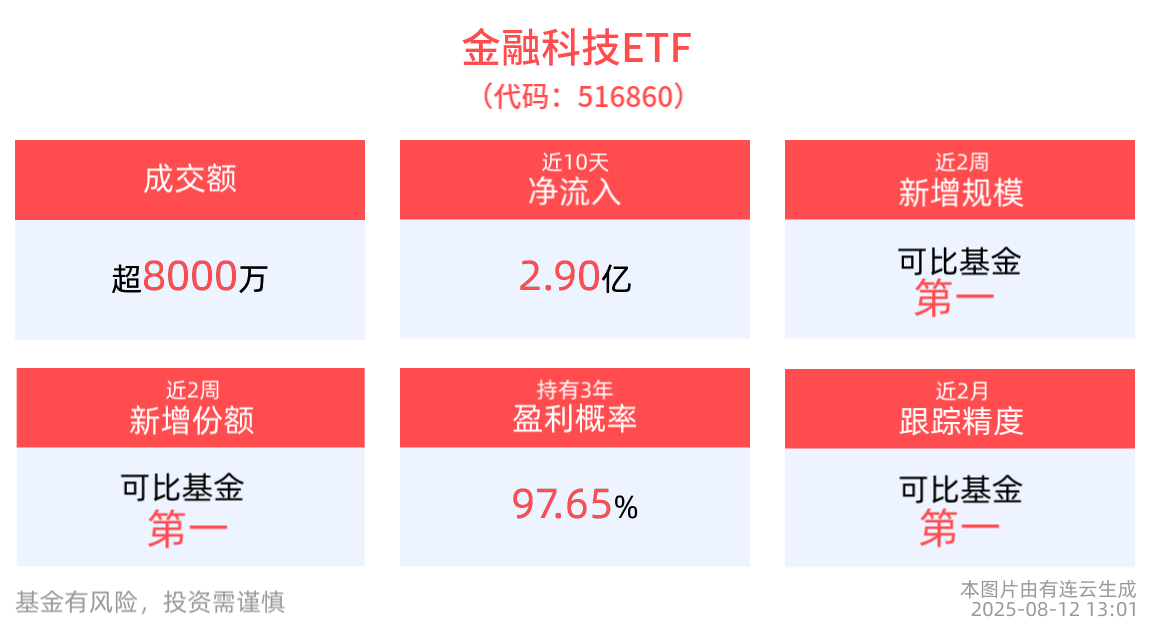
2025年上半年软件业继续稳健增长,金融科技ETF(516860)盘中翻红上扬,近2周新增规模、份额均居同类第一
Xin Lang Cai Jing· 2025-08-12 05:22
Group 1: Financial Technology ETF Performance - The China Securities Financial Technology Theme Index (930986) increased by 0.58% as of August 12, 2025, with notable gains in constituent stocks such as Cuiwei Co., Ltd. (5.71%) and Dongxin Peace (5.18%) [3] - The Financial Technology ETF (516860) rose by 0.41%, with a latest price of 1.46 yuan, and has accumulated a 2.39% increase over the past week [3] - The Financial Technology ETF's trading volume reached 81.18 million yuan, with a turnover rate of 5.05% [3] Group 2: Software Industry Growth - In the first half of 2025, China's software and information technology service industry generated revenues of 705.85 billion yuan, marking an 11.9% year-on-year growth, with total profits reaching 85.81 billion yuan, up 12.0% [4] - Information technology services accounted for 68.5% of the total industry revenue, with a revenue of 483.62 billion yuan, reflecting a 12.9% increase [4] - Cloud computing and big data services generated 74.34 billion yuan, growing by 12.1% [4] Group 3: AI Development Insights - CICC highlighted the dual scale effects of AI development, suggesting that algorithm innovation is necessary to overcome computational limitations in China [5] - The report emphasized the need for a "patient capital" ecosystem to integrate AI with the real economy, leveraging government funding and optimizing regulatory environments [5] - Financial Technology ETF saw a significant growth in scale, increasing by 263 million yuan over the past two weeks, ranking in the top third among comparable funds [5] Group 4: Financial Technology ETF Historical Performance - As of August 11, 2025, the Financial Technology ETF's net value increased by 132.04% over the past year, ranking 3rd out of 2954 index equity funds [6] - The ETF has recorded a maximum monthly return of 55.92% since inception, with an average monthly return of 10.10% [6] - The ETF's Sharpe ratio was 1.70 for the past year, indicating strong risk-adjusted returns [6] Group 5: Fund Characteristics and Tracking Accuracy - The Financial Technology ETF has the lowest management fee rate of 0.50% and a custody fee of 0.10% among comparable funds [7] - The ETF's tracking error over the past two months was 0.027%, the highest tracking precision among comparable funds [8] - The top ten weighted stocks in the index account for 51.26% of the total index, with companies like Dongfang Fortune and Tonghuashun leading the list [8]


国泰海通计算机 | 周观点第14期:GPT5 发布,成本大幅下降,长期利好AI应用
国泰海通证券研究· 2025-08-11 14:15
Core Viewpoints - The recent issuance of guidelines by the Ministry of Industry and Information Technology (MIIT) aims to promote the development of the brain-computer interface (BCI) industry, with a target to achieve breakthroughs in key technologies by 2027 and establish a reliable industrial system by 2030 [6][4] - The release of GPT-5 on August 8, 2025, marks a significant advancement in AI applications, with a notable reduction in costs and improvements in reliability, efficiency, and usability, which will accelerate the adoption of AI technologies across various sectors [7][4] - The 2025 World Robot Conference, held from August 8 to 12 in Beijing, showcases advancements in robotics and intelligent applications across multiple industries, highlighting the growing importance of robotics in industrial manufacturing and healthcare [8][4] Summary by Sections Brain-Computer Interface Industry - The MIIT and seven other departments have issued an implementation opinion to drive high-quality development in the BCI industry, aiming to form a new production capacity and support the modernization of the industrial system [6] - By 2027, the goal is to achieve breakthroughs in key BCI technologies and establish an advanced technical, industrial, and standard system, with products reaching international standards in performance [6] - By 2030, the aim is to cultivate 2 to 3 globally influential leading enterprises and a number of specialized small and medium-sized enterprises, creating a competitive industrial ecosystem [6] AI Applications and GPT-5 - GPT-5 has shown limited state-of-the-art (SOTA) performance, with improvements in user experience, reliability, and programming capabilities, significantly reducing hallucination rates and enhancing text generation [7] - The cost of API calls for GPT-5 is significantly lower than competitors, making it a competitive option for software development and content production [7] - The advancements in GPT-5 support the large-scale implementation of AI technologies across various industries, enhancing productivity and efficiency [7] Robotics and Industry Trends - The 2025 World Robot Conference features over 200 domestic and international companies, showcasing more than 1,500 exhibits and 100 new products, emphasizing the integration of robotics in various applications [8] - The conference includes forums focusing on industrial development, innovative applications, and technology integration, facilitating discussions among experts and entrepreneurs on cutting-edge technologies and industry trends [8]

解密主力资金出逃股 连续5日净流出469股


Zheng Quan Shi Bao Wang· 2025-08-11 09:32
| 证券代 | 证券简 | 主力资金净流出 | 主力资金净流出金额 | 主力资金净流出比例 | 累计涨跌幅 | | --- | --- | --- | --- | --- | --- | | 码 | 称 | 天数 | (亿元) | (%) | (%) | | 603300 | 海南华 | 12 | 21.13 | 10.06 | -14.07 | | | 铁 | | | | | | 601985 | 中国核 电 | 20 | 15.01 | 8.33 | -1.69 | | 000997 | 新大陆 | 19 | 12.72 | 11.25 | -12.31 | | | 易点天 | | | | | | 301171 | 下 | 7 | 12.41 | 7.76 | -6.98 | | 300378 | 鼎捷数 | 6 | 9.97 | 5.81 | -8.05 | | | 智 | | | | | | 002266 | 浙富控 股 | 13 | 9.53 | 7.42 | -18.34 | | 000558 | 天府文 | 6 | 9.52 | 8.54 | -22.39 | | | 旅 | | | | | | ...
金融IT深度报告:牛市复盘,金融IT何时发力
ZHESHANG SECURITIES· 2025-08-11 08:02
Investment Rating - The industry investment rating is optimistic [1] Core Insights - The financial IT sector shows significant elasticity during the initial stages of a bull market, with notable price increases and valuation expansions [3] - The combination of technology and finance attributes leads to a "Davis Double Play" effect during bull markets, particularly highlighted in 2015 [4] - Current advancements in AI and new business developments are expected to drive further growth in the financial IT sector [5] Summary by Sections 2014-2015: Liquidity Explosion, Financial Technology Leads - The bull market from 2014 to 2015 was driven by ample liquidity and the rise of mobile internet, leading to significant gains in financial technology stocks [15][19] - Financial technology stocks experienced substantial price increases, with some stocks seeing gains close to 450% compared to mid-2014 levels [4] - The financial IT sector benefited from increased investor participation and software usage during the bull market [33] 2016-2018: Structural Bull Market, Varied Performance in Financial Technology - The period from 2016 to 2018 was characterized by a structural bull market influenced by supply-side reforms and foreign capital inflows [43] - Financial technology stocks underperformed compared to the broader market during this period, primarily due to high valuations and changing market preferences [46][52] - The financial IT sector faced challenges as the market shifted focus towards blue-chip and consumer stocks, leading to a decline in growth stocks [56] 2019-2021: Core Assets Drive Structural Bull Market - The financial technology sector saw a resurgence from 2019 to 2021, driven by global liquidity and domestic industrial upgrades [70] - The introduction of the Sci-Tech Innovation Board in 2019 significantly boosted the financial technology sector, with strong performance noted in various market phases [76][81] - Financial technology stocks outperformed the market during key periods, reflecting the sector's recovery and growth potential [82]





大涨超3%!金融科技ETF(516860)近10日吸金2.98亿元,同花顺涨超8%
Xin Lang Cai Jing· 2025-08-11 05:53
Group 1 - The A-share market indices collectively strengthened, with significant gains in fintech stocks, particularly the Financial Technology ETF (516860), which rose over 3% in the afternoon session and had a trading volume exceeding 1 billion yuan [1] - As of August 8, the Financial Technology ETF has seen a cumulative increase of over 15% year-to-date and over 123% in the past year, with a net inflow of 298 million yuan in the last 10 trading days [1] - Major components of the fintech index experienced substantial gains, including Tonghuashun, which surged over 8%, and Hengbao Co., which rose over 7% [1] Group 2 - According to招商证券, the market remains active, with projected average daily trading volume for the entire A-share market reaching 16,336 billion yuan in July 2025, reflecting a month-on-month increase of 22.3% and a year-on-year increase of 149.1% [1] - The bullish market sentiment is expected to enhance risk appetite, with AI and finance being a promising area for investment opportunities [1] - 中信证券 highlighted that the emergence of new productivity driven by AI will be a key theme in technology investments in the second half of 2025, with significant advancements in domestic computing power and AI applications across various financial services [1][2] Group 3 - 中信建投证券 noted the release of GPT-5, which improves long text memory, reduces hallucination rates, and optimizes reasoning efficiency, providing a better environment for AI application growth [2] - The ongoing high trading volume in the market is expected to benefit internet finance stocks, with the Financial Technology ETF tracking the CSI Financial Technology Index, which includes leading companies in internet brokerage, financial IT, and mobile payments [2]



10日吸金2.98亿元,同指数第一!金融科技ETF(516860)涨2.96%,机构看好“牛市”旗手金融科技板块的投资机会
Ge Long Hui A P P· 2025-08-11 04:00
Core Insights - The financial technology sector is experiencing significant growth, with stocks like Tonghuashun rising over 9% and other companies like Dazhihui and Guidingzheng increasing by more than 5% [1] - The Financial Technology ETF (516860) has seen a net inflow of over 298 million yuan in the last 10 trading days, indicating strong market interest [1] - A-shares' financing balance has surged to 2 trillion yuan, marking the first time since the 2015 bull market that this level has been reached [1] - In July, the number of new A-share accounts reached 1.96 million, a year-on-year increase of 71% [1] Financial Technology ETF Performance - The Financial Technology ETF (516860) tracks the CSI Financial Technology Index, which includes various sectors such as internet brokerage, financial IT, and mobile payments [1] - Key stocks in the ETF include industry leaders like Dongfang Caifu, Tonghuashun, and Hengsheng Electronics [1] - The ETF's trading volume was notable, with a turnover rate of 8.98%, leading among its peers [1] Market Outlook - According to招商证券, the market remains active, with an estimated average daily trading volume of 1.6336 trillion yuan in July 2025, reflecting a month-on-month increase of 22.3% and a year-on-year increase of 149.1% [1] - The bullish sentiment in the market is expected to continue, particularly in the AI and financial sectors, which are seen as promising areas for investment [1]
计算机周报20250810:从GPT5、Genie3看中美AI产业发展现状-20250810
Minsheng Securities· 2025-08-10 12:22
Investment Rating - The report maintains a "Recommendation" rating for the industry [5] Core Insights - The latest models from major tech companies, such as GPT-5 and Genie 3, are driving advancements in the global AI frontier, while the potential approval of the H20 chip export license is expected to accelerate the development of China's AI industry [3][25] - The report suggests focusing on various sectors within the AI ecosystem, including internet giants, office software, programming, terminal AI, ERP/CRM, judicial, financial/taxation, education, healthcare, customer service, AIGC, agriculture, and data [3][25] Summary by Sections Market Review - During the week of August 4-9, the CSI 300 index rose by 1.23%, the small and medium-sized board index increased by 1.24%, and the ChiNext index grew by 0.49%. The computer sector (CITIC) saw a slight increase of 0.03% [32] Industry News - OpenAI announced the launch of GPT-5, which is touted as the most powerful AI system to date, surpassing previous models in various benchmark tests and demonstrating significant improvements in reducing hallucinations and enhancing instruction execution capabilities [26] - Genie 3, developed by Google, is the first world model supporting real-time interaction, capable of generating dynamic worlds at 720p resolution and 24 frames per second [14][15] Company News - Xiongdi Technology announced plans for a share reduction by a major shareholder, while Tianyima completed the registration of changes related to the repurchase and cancellation of restricted stock [30] Investment Suggestions - The report recommends focusing on key players in the AI ecosystem, including major internet companies like Alibaba and Tencent, as well as firms in various sectors such as office software, programming, terminal AI, ERP/CRM, and more [25]