洋河股份

Search documents
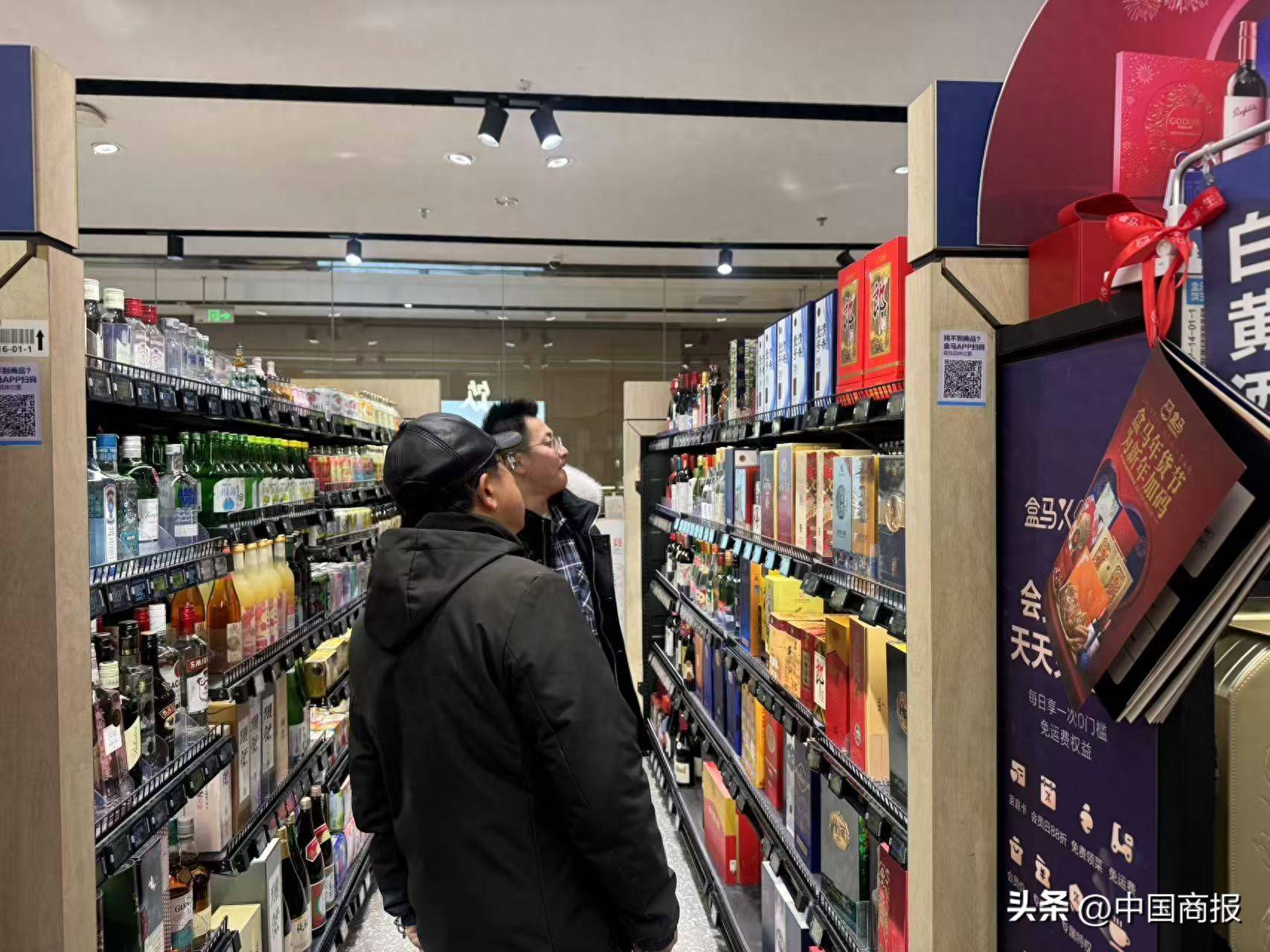
渠道商谈今年“春节档”白酒销售情况:会比平时好一些,但和往年没法比
Sou Hu Cai Jing· 2026-01-19 09:57
Core Insights - The white liquor market is expected to see better sales during the 2026 Spring Festival compared to regular periods, but it will not match previous years' performance [1] - Key issues in the 2025 market include high inventory levels and price inversion, with manufacturers and channels focusing on destocking as the market shows signs of recovery, albeit weakly [1] Group 1: Market Trends - The 2025 Spring Festival sales are anticipated to be influenced by low-alcohol beverages, instant retail, and health wines, although these segments may not dominate due to the unique consumption patterns during the festival [1] - The overall market recovery is characterized by a focus on destocking and price stabilization, which will remain the main theme for the industry in 2026 [1] Group 2: Marketing Strategies - Leading liquor companies are ramping up marketing efforts for the Spring Festival, with significant partnerships established for promotional activities, such as collaborations with major broadcasting networks [3][5] - The effectiveness of traditional marketing strategies, such as sponsoring the Spring Festival Gala, may be diminished this year due to changing consumer engagement patterns [6] Group 3: Sales Performance - Sales conversion rates for liquor brands are expected to be lower than in previous years, with analysts predicting a decline of 50-60% compared to the same period last year [6] - Despite increased marketing efforts, the actual sales performance during the Spring Festival is projected to be weaker than in previous years, with many products experiencing price reductions rather than increases [6] Group 4: Consumer Behavior - The extended holiday and revival of banquet scenarios may provide a short-term boost to liquor consumption, but the overall high inventory levels and sluggish sales raise concerns about sustainable growth [7] - Low-alcohol products are likely to see increased consumption during family gatherings, but instant retail may not significantly contribute to sales due to logistical challenges during the holiday [11] Group 5: Health Wine Segment - Health wines have gained popularity, particularly among younger consumers, but concerns about exaggerated health claims may limit their long-term appeal [13] - The health wine market is seen as one of the few segments benefiting from category expansion, although it may not be the primary choice for gift-giving during the Spring Festival [13]


白酒板块1月19日跌0.51%,*ST岩石领跌,主力资金净流出8.5亿元
Zheng Xing Xing Ye Ri Bao· 2026-01-19 08:52
Core Viewpoint - The liquor sector experienced a decline of 0.51% on January 19, with *ST Rock leading the drop, while the Shanghai Composite Index rose by 0.29% and the Shenzhen Component Index increased by 0.09% [1]. Group 1: Market Performance - The liquor sector's main stocks showed mixed performance, with notable declines in major brands such as *ST Rock, Shanxi Fenjiu, and Gujing Gongjiu [2]. - The trading volume for the liquor sector was significant, with major stocks like Wuliangye and Kweichow Moutai recording high transaction amounts of 19.08 billion and 58.34 billion yuan respectively [2]. Group 2: Capital Flow - The liquor sector saw a net outflow of 850 million yuan from institutional investors, while retail investors contributed a net inflow of 221 million yuan [2]. - Individual stocks like Yingjia Gongjiu and Jianshe Liquor experienced varying levels of net inflow and outflow from different investor categories, indicating diverse investor sentiment [3].
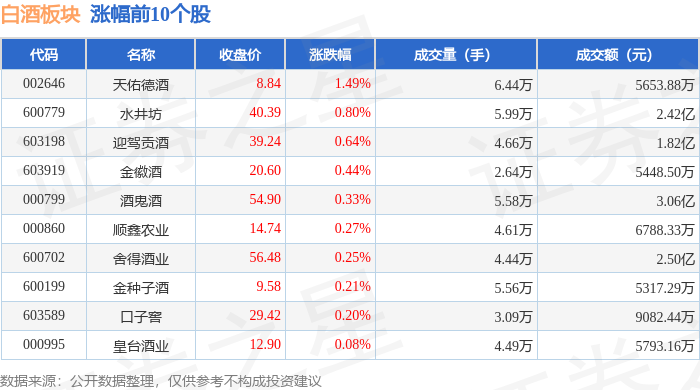
10只白酒股上涨 贵州茅台1376元/股收盘
Bei Jing Shang Bao· 2026-01-19 07:57
Core Viewpoint - The white liquor sector is showing signs of stabilization, with the current market conditions indicating that the industry fundamentals are nearing a bottom, despite recent price declines [1] Industry Summary - The Shanghai Composite Index closed at 4114.00 points, up 0.29%, while the white liquor sector index closed at 2214.03 points, up 0.74% [1] - Ten white liquor stocks experienced gains, but major players like Kweichow Moutai, Wuliangye, Shanxi Fenjiu, Luzhou Laojiao, and Yanghe all saw declines in their stock prices [1] - Kweichow Moutai closed at 1376.00 CNY per share, down 0.43%; Wuliangye at 104.55 CNY, down 0.58%; Shanxi Fenjiu at 169.36 CNY, down 1.75%; Luzhou Laojiao at 113.59 CNY, down 0.60%; and Yanghe at 61.99 CNY, down 0.02% [1] Company Insights - According to a report from Kaiyuan Securities, the white liquor industry is expected to see a recovery in sales during the 2026 Spring Festival, despite the current downward trend in prices [1] - The report emphasizes the importance of monitoring economic recovery, consumer confidence restoration, and the flexibility of brand policy adjustments in the medium to long term [1] - The current valuation of the white liquor sector is at a low point compared to recent years, with low market expectations and a favorable chip structure, indicating that the fundamentals are close to a bottom [1]




大变革时代的白酒行业如何发展?
Sou Hu Cai Jing· 2026-01-19 07:47
Core Insights - The Chinese liquor industry is facing both challenges and opportunities in the current transformative era, necessitating a reevaluation of its development strategies [1] Group 1: Consumer Trends - Consumers are increasingly prioritizing health, leading to a decline in the market share of high-alcohol, strong-flavored liquors. The market growth rate for low-alcohol and health-oriented liquors is rising annually [3] - Companies are encouraged to develop lower-alcohol and healthier liquor products to align with consumer preferences, as exemplified by Jiangxiaobai's introduction of a lower-alcohol product targeting younger consumers [3] Group 2: Marketing Strategies - Traditional marketing methods are becoming less effective; online shopping has emerged as a significant channel for liquor purchases. Companies should enhance their online marketing efforts through e-commerce platforms and social media [5] - Notable brands like Moutai and Wuliangye have established official flagship stores on e-commerce platforms and utilized live streaming and online promotions to attract consumers [5] Group 3: Cultural Integration - The liquor industry must balance the preservation of traditional culture with innovative integration. Companies can leverage historical stories and cultural references in product packaging and branding [7] - Collaborations with other cultural sectors, such as film, music, and art, can create unique liquor brands that resonate with modern consumers, as seen with Luzhou Laojiao's partnership with a fashion brand [7] Group 4: Industry Outlook - The liquor industry must adapt to changing consumer demands for health and youthfulness by developing new products, embracing online marketing, and merging traditional culture with contemporary elements [7] - Continuous adaptation to market changes is essential for the liquor industry to remain competitive and thrive in the future [7]
如何看待白酒VS白电的配置机会
2026-01-19 02:29
Summary of Key Points from Conference Call Industry Overview - The conference call primarily discusses the **Chinese liquor industry** and the **white goods (appliances) industry**. The liquor industry is expected to undergo an adjustment period until 2025, with a potential balance in the second and third quarters of 2026. The white goods industry has shown resilience due to strong domestic demand and contributions from overseas markets [1][9]. Key Insights on the Liquor Industry - The liquor industry is projected to experience significant pressure in the first half of the year, with a rebound expected in the second half due to lower baselines and inventory reduction efforts [1][2]. - The price of **Moutai** is relatively stable, with the income-to-price ratio for urban residents nearing historical extremes, indicating limited downward price potential [3]. - **Wuliangye** is reducing prices on non-standard products to clear inventory, which could shorten the inventory cycle if quotas are reduced [1][3]. - The demand for liquor is closely tied to the economic cycle, with monetary policy indicators like M1 and M2 being crucial for understanding demand trends [1][5]. - Recommendations include low-position allocations in high-end liquors (Moutai, Wuliangye), regional brands (Gujinggong, Yanghe), and mid-range Fenjiu, which are seen as having good investment value [1][6]. Inventory and Seasonal Trends - The liquor industry is currently experiencing low inventory levels, with a significant drop in prices leading to potential sales exceeding expectations during the upcoming Spring Festival [4][8]. - Historical data suggests that if sales during the Spring Festival exceed expectations, it could alleviate pressure in the latter part of the year [4]. Economic Indicators and Demand Stability - Key indicators such as CPI show signs of stabilizing, suggesting that the liquor industry may be nearing a bottom [7]. - The relationship between liquor demand and economic cycles is significant, with macroeconomic changes and monetary policy having a substantial impact on demand [5]. Insights on the White Goods Industry - The white goods industry has performed well in recent years, supported by strong domestic demand and growth in overseas markets [9][15]. - Challenges include the impact of subsidy policies on demand, rising raw material costs, and competition from brands like Xiaomi [10][12]. - Despite these challenges, the overall impact on the fundamentals is expected to be limited, with leading companies capable of managing cost increases through price adjustments and efficiency improvements [12][13]. Valuation and Investment Opportunities - The current public fund holdings in the white goods sector are at historical lows, suggesting potential for recovery and rebound in valuations [17]. - The white goods sector is viewed as a dividend play, with expected stable growth and increasing dividend rates, making it an attractive investment option [18]. Comparative Analysis - The white goods industry is seen as having advantages over the liquor industry, particularly in terms of overseas market performance and resilience against domestic economic fluctuations [15][19]. - The liquor industry is currently facing a challenging environment, while the white goods sector is positioned for stable growth, making it a more favorable investment choice at this time [19].
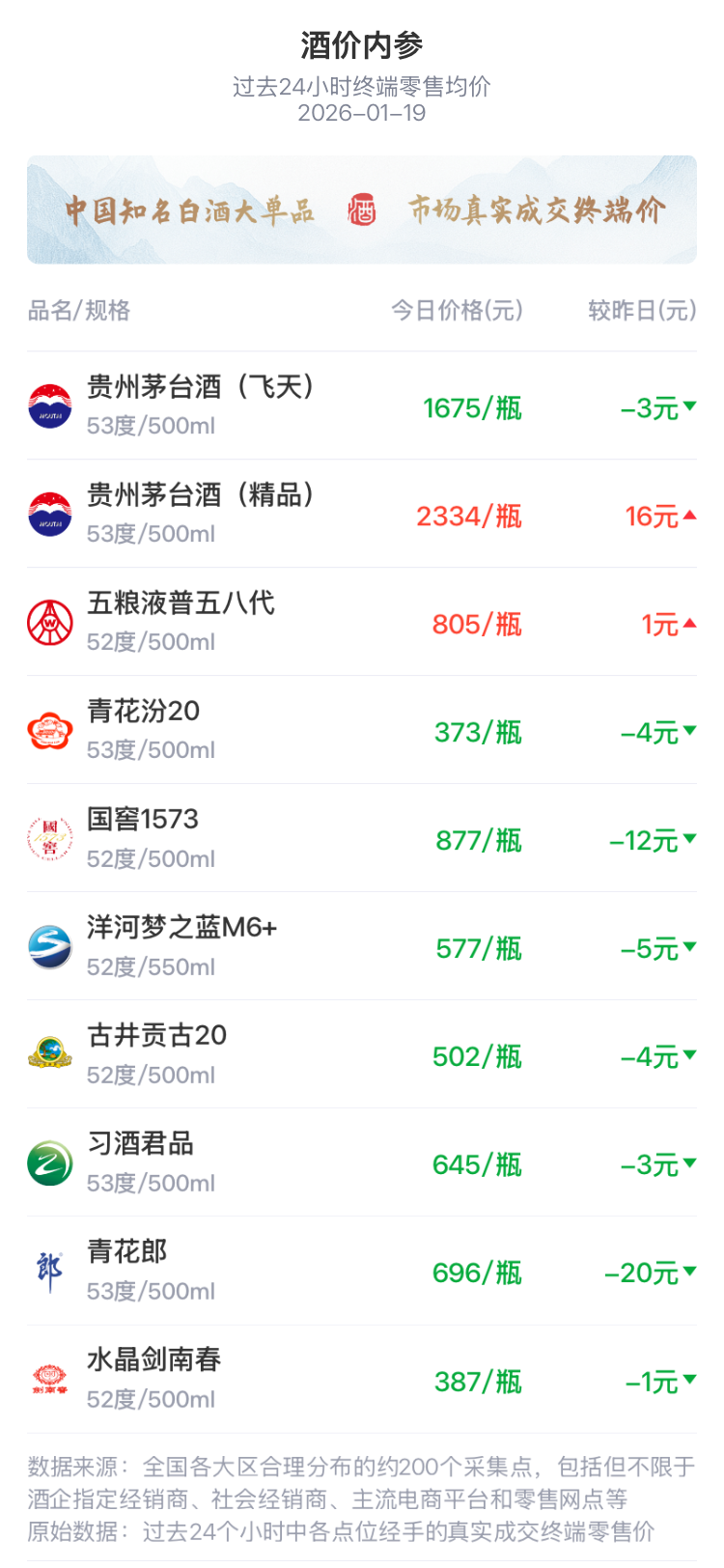
酒价内参1月19日价格发布,古井贡古20下跌4元
Xin Lang Cai Jing· 2026-01-19 01:36
Core Insights - The Chinese liquor market has seen a general decline in retail prices for the top ten products as of January 19, with an overall drop of 35 yuan, bringing the total price to 8,871 yuan, marking the third time in two months that prices have hit a low point [1] - The market experienced a widespread decline, with eight out of ten core products decreasing in price, while only two products saw an increase, indicating ongoing inventory pressure and price differentiation within the industry [1] Price Trends - The top ten core products showed a pattern of price decreases, with Qinghua Lang leading the decline at 20 yuan, followed by Guojiao 1573 at 12 yuan, and Yanghe Dream Blue M6+ at 5 yuan [1][5] - The only products that increased in price were Boutique Moutai, which rose by 16 yuan, and Wuliangye Pu 58th generation, which saw a modest increase of 1 yuan, suggesting resilience in high-end product pricing [1] Data Collection Methodology - The price data is sourced from approximately 200 collection points across various regions, including designated distributors, social distributors, e-commerce platforms, and retail outlets, aiming to provide an objective and traceable overview of the liquor market [2] - The data reflects real transaction prices from the past 24 hours, ensuring accuracy in the reported retail prices [2] Company Announcements - Kweichow Moutai Co., Ltd. issued a statement addressing the emergence of fraudulent recruitment information using the company's name, warning consumers to be cautious and only engage through official channels [3] - The company emphasized that it has not authorized any third parties to distribute such information and is cooperating with authorities to investigate these fraudulent activities [3]
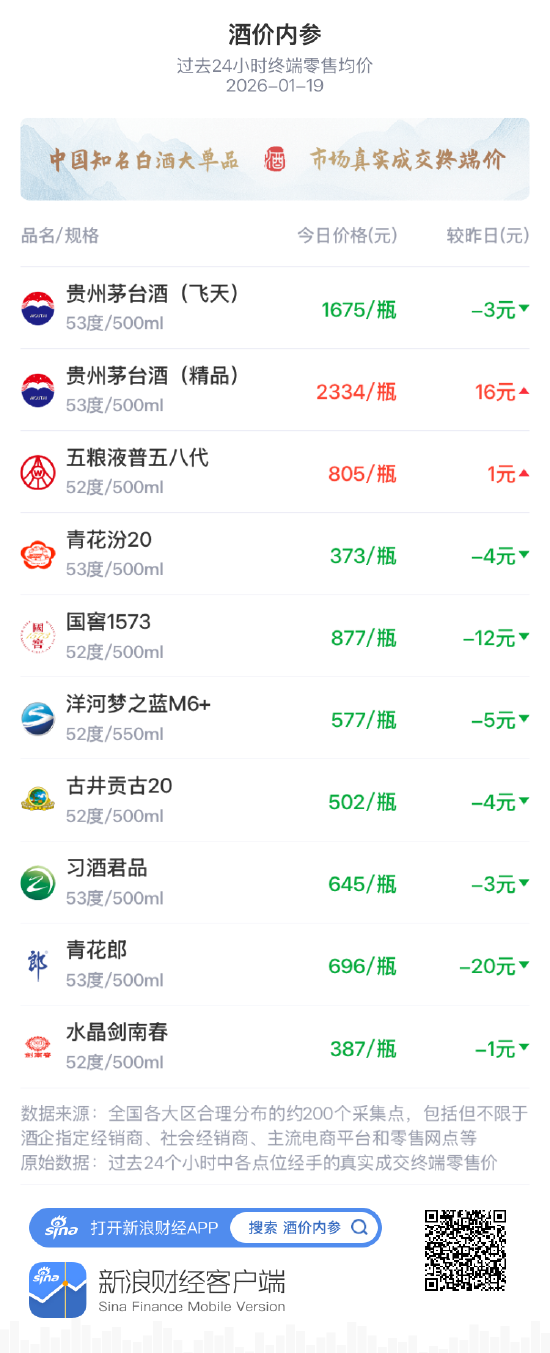
酒价内参1月19日价格发布,洋河梦之蓝M6+下跌5元
Xin Lang Cai Jing· 2026-01-19 01:33
Core Insights - The Chinese baijiu market has experienced a general decline in retail prices for its top ten products, with an overall average price drop of 35 yuan, bringing the total price to 8,871 yuan as of January 19 [1] - The market shows a pattern of price pressure, marking the third time in two months that prices have hit a low point, with eight products declining and only two increasing in price [1] Price Trends - The top ten core products exhibited a trend of eight price declines and two increases, with Qinghua Lang leading the decline at 20 yuan, followed by Guojiao 1573 at 12 yuan, and Yanghe Dream Blue M6+ at 5 yuan [1] - The only products that saw price increases were Boutique Moutai, which rose by 16 yuan, and Wuliangye Pu 58, which increased by 1 yuan, indicating some resilience in high-end product pricing amidst industry destocking pressures [1] Data Collection Methodology - The price data is sourced from approximately 200 collection points across various regions, including designated distributors, social distributors, e-commerce platforms, and retail outlets, ensuring a comprehensive and objective representation of the baijiu market [2] - The data reflects real transaction prices from the past 24 hours, aiming to provide accurate insights into the market dynamics [2] Company Announcements - Kweichow Moutai Co., Ltd. issued a statement warning against fraudulent recruitment information circulating online, emphasizing that they have not authorized any third parties to distribute such information and urging consumers to recognize official channels [3] - The company is actively cooperating with authorities to investigate these fraudulent activities and will pursue legal action against responsible parties to protect market order and consumer rights [3]
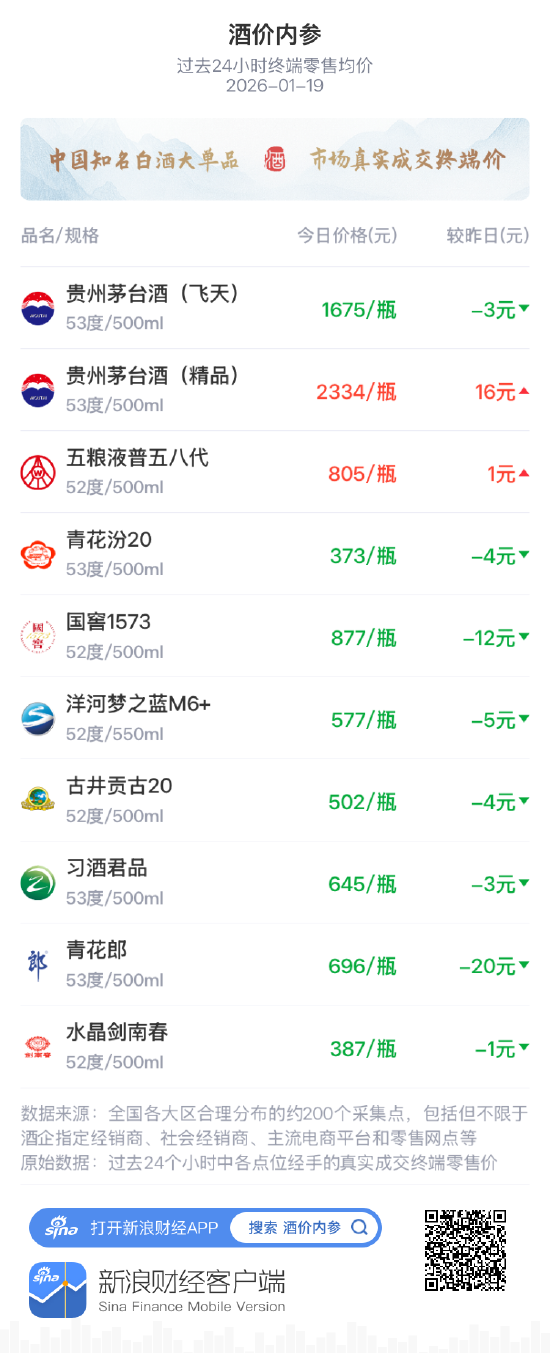
酒价内参1月19日价格发布,飞天茅台下跌3元
Xin Lang Cai Jing· 2026-01-19 01:20
Core Insights - The core viewpoint of the article highlights a recent decline in the retail prices of major Chinese liquor brands, indicating ongoing market pressure and a trend of price differentiation among products [1][8]. Price Trends - The average retail price of the top ten Chinese liquor products fell to 8,871 yuan on January 19, a decrease of 35 yuan from the previous day [1][7]. - This marks the third time in two months that prices have hit a near low, reflecting a sustained downward trend in the market [1][8]. - Among the ten core products, eight experienced price drops while only two saw increases, with Qinghua Lang leading the decline at 20 yuan [1][8]. Product-Specific Price Changes - Notable price changes include: - Qinghua Lang: down 20 yuan - Guojiao 1573: down 12 yuan - Yanghe Dream Blue M6+: down 5 yuan - Gujing Gonggu 20 and Qinghua Fen 20: down 4 yuan each - Xijiu Junpin and Feitian Moutai: down 3 yuan each - Shuijing Jianan Chun: down 1 yuan - Only the premium Moutai saw an increase of 16 yuan, while Wuliangye Pu Wu 8th generation rose by 1 yuan [1][6][10]. Data Collection Methodology - The "Liquor Price Reference" collects data from approximately 200 sampling points across various regions, including designated distributors, social distributors, e-commerce platforms, and retail outlets [2][8]. - The data aims to provide an objective and traceable representation of the market prices for well-known liquor brands [2][8]. Market Dynamics - The introduction of new sales channels for Moutai products, such as the official i-Moutai platform selling Feitian Moutai at 1,499 yuan and premium Moutai at 2,299 yuan, has begun to influence market prices [2][8]. - The industry is facing inventory reduction pressures, leading to a continued trend of price differentiation among products [1][8]. Company Announcements - On January 18, Kweichow Moutai Co., Ltd. issued a statement warning against fraudulent recruitment information circulating online, emphasizing that they have not authorized any third parties to distribute such information [3][9]. - The company reiterated that all sales contracts for 2026 are being handled through offline channels and urged consumers to be cautious of misleading offers [3][9].
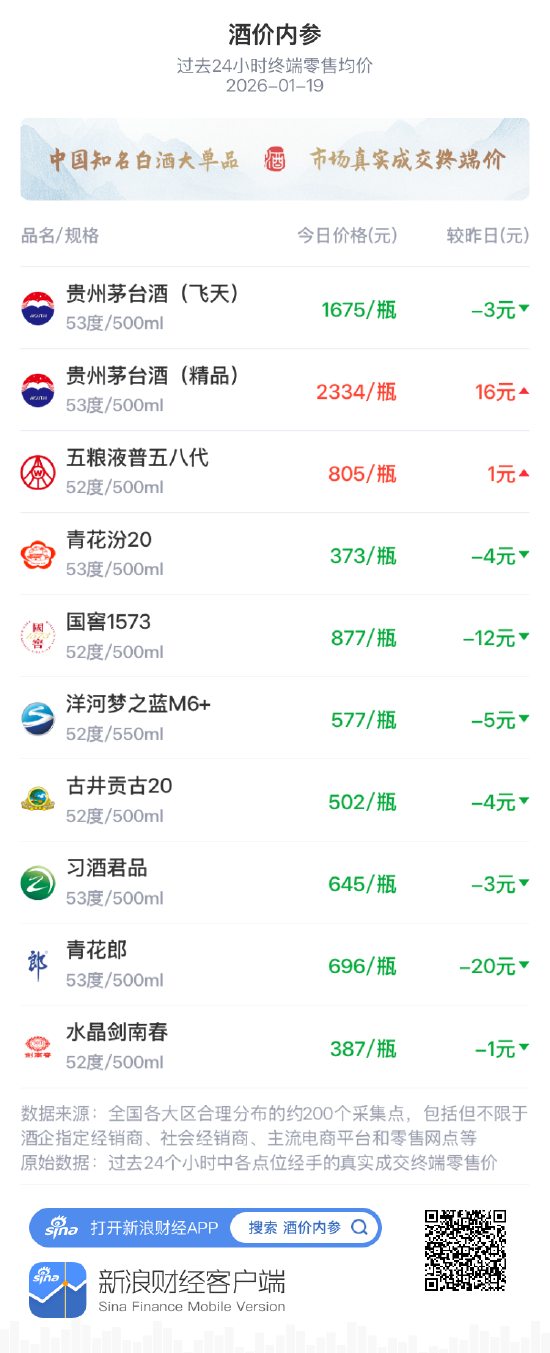
酒价内参1月19日价格发布,五粮液普五八代温和上涨1元
Xin Lang Cai Jing· 2026-01-19 01:20
Core Insights - The article highlights a significant decline in the retail prices of major Chinese liquor brands, indicating a market under pressure with prices hitting a two-month low [1][8] - The overall market shows a trend of eight products decreasing in price while only two products increased, reflecting ongoing inventory reduction challenges within the industry [1][8] Price Trends - The average retail price of the top ten liquor products fell to 8,871 yuan, a decrease of 35 yuan from the previous day [1][7] - The price drop is characterized by specific products: - Qinghua Lang led the decline with a drop of 20 yuan - Guojiao 1573 followed with a decrease of 12 yuan - Yanghe Dream Blue M6+ fell by 5 yuan - Other notable declines include 4 yuan drops for Gujing Gong and Qinghua Fen, and 3 yuan drops for Xijiu Junpin and Feitian Moutai [1][8] Market Data Collection - The "Wine Price Reference" collects data from approximately 200 sampling points across various regions, including designated distributors, social distributors, e-commerce platforms, and retail outlets, ensuring a comprehensive and objective price tracking system [2][8] - The data aims to provide a scientifically traceable overview of the market prices for well-known liquor brands [2][8] New Sales Channels - The introduction of new sales channels, such as the official i-Moutai platform selling Feitian Moutai at 1,499 yuan per bottle and boutique Moutai at 2,299 yuan, has begun to influence the market prices of these products [2][8] Company Announcements - Kweichow Moutai Co., Ltd. issued a statement warning against fraudulent recruitment information circulating online, emphasizing that they have not authorized any third parties to distribute such information [3][9] - The company reiterated that all sales contracts for 2026 are being handled through offline channels with existing corporate clients, and they are actively cooperating with authorities to address these fraudulent activities [3][9]
酒价内参1月19日价格发布 十大单品整体均价再创近两月新低
Xin Lang Cai Jing· 2026-01-19 01:19
Core Viewpoint - The Chinese liquor market is experiencing a price decline, with the average retail price of the top ten liquor products dropping, indicating ongoing pressure in the market [1]. Price Trends - The total retail price for a package of the top ten liquor products is 8,871 yuan, down by 35 yuan from the previous day [1]. - This marks the third time in two months that prices have hit a low point, reflecting a sustained downward trend [1]. Performance of Key Products - Out of the top ten core products, eight have seen price declines while only two have increased [1]. - The largest drop was observed in Qinghua Lang, which fell by 20 yuan; followed by Guojiao 1573 with a decrease of 12 yuan [1]. - Other notable declines include Yanghe Dream Blue M6+ down by 5 yuan, and several products including Gujing Gonggu 20 and Qinghua Fen 20 each down by 4 yuan [1]. - In contrast, the only significant price increase was for Boutique Moutai, which rose by 16 yuan, while Wuliangye Pu 58 also saw a slight increase of 1 yuan [1]. Market Dynamics - The price differentiation trend continues as the industry faces inventory reduction pressures [1]. - The data reflects real transaction prices collected from approximately 200 points across major regions, including designated distributors and mainstream e-commerce platforms [4].