
中航重机

Search documents
【最全】2025年航空发动机行业上市公司全方位对比(附业务布局汇总、业绩对比、业务规划等)
Qian Zhan Wang· 2025-05-17 03:10
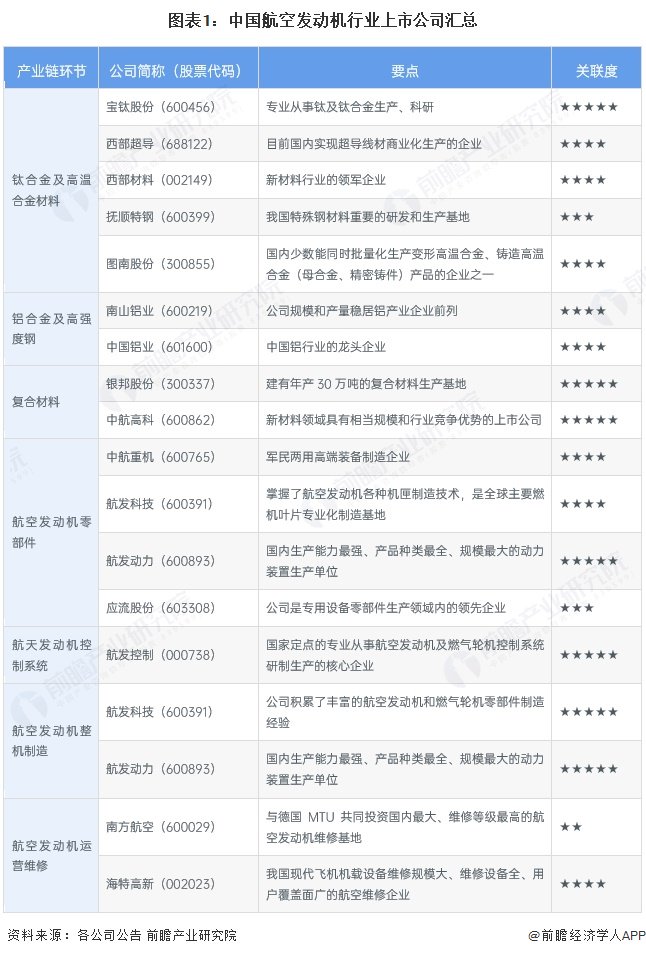
Summary of Key Points Core Viewpoint - The aviation engine industry in China is primarily dominated by a few key players, with a significant focus on innovation, research and development, and market expansion to enhance their competitive edge in both military and civilian sectors [1][18]. Group 1: Industry Overview - The aviation engine manufacturing segment includes four main types: turbojet, turbofan, turboshaft, and turboprop engines, largely monopolized by the China Aviation Engine Group [1]. - Key companies in the industry include Aviation Power (航发动力), Aviation Technology (航发科技), and Aviation Control (航发控制), among others [1][3]. Group 2: Company Performance - Aviation Power reported a revenue of 449.94 billion yuan in 2024, leading the industry in terms of revenue [16]. - The average gross margin for listed companies in the aviation engine sector is around 25%, with individual margins ranging from 10% to 35% [16]. - Aviation Control achieved a gross margin of 28.11% in 2024, reflecting its strong technological innovation capabilities [16]. Group 3: Business Layout and Market Position - Aviation Power and Aviation Technology have over 50% of their business focused on aviation engines, indicating a strong commitment to this sector [13]. - The regional distribution of companies shows that titanium alloy leaders are mainly located in Shaanxi, while other material representatives are concentrated in the East China region [5]. Group 4: Future Business Plans - Companies are focusing on innovation and R&D investments to expand their aviation engine business, with plans to enhance their capabilities in high-temperature alloy components and precision casting [19]. - Aviation Technology aims to participate in the development of the C919 aircraft's engines and expand its international subcontracting business [19]. Group 5: Key Financial Metrics - The largest revenue-generating company in the aluminum and high-strength steel sector is China Aluminum, with a revenue of 2370.66 billion yuan [4]. - The revenue of Aviation Power in the aviation engine sector is projected to exceed 400 billion yuan in 2024, highlighting its market leadership [4]. Group 6: Patent and Employee Information - China Aluminum and Aviation Power hold over 1000 patents, indicating a strong focus on innovation [8]. - Southern Airlines has the largest employee count among listed companies, exceeding 100,000 [8].







ETF日报|A股三大指数集体下跌,航空航天ETF(159227)收涨0.20%
Xin Lang Cai Jing· 2025-05-16 08:45
Group 1 - The Shanghai Composite Index fell by 0.40% to 3367.46 points, while the Shenzhen Component Index decreased by 0.07% to 10179.60 points, and the ChiNext Index dropped by 0.19% to 2039.45 points, indicating a significant loss effect in the market [1] - The total trading volume of the two markets reached 1.09 trillion yuan, reflecting a relatively active trading environment despite the declines [1] - The Aerospace ETF (159227) rose by 0.20% to a closing price of 0.99 yuan, with a trading volume of 28.6024 million yuan, indicating strong investor interest [1] Group 2 - The military industry is showing significant signs of performance recovery, with expectations for gradual improvement in fundamentals and sentiment as the 14th Five-Year Plan approaches its conclusion [1] - The military sector is expected to experience substantial domestic demand growth from 2025 to 2027, driven by multiple catalysts including the "14th Five-Year Plan" and the "Centenary of the Army" goals [1] - The National Aerospace Index (CN5082) has a high concentration in the military industry, with 99.2% of its coverage dedicated to core companies in the military sector, particularly in aviation and aerospace equipment [2] - The top ten weighted stocks in the National Aerospace Index account for 52.89% of the index, highlighting the dominance of key players in the aerospace sector [2]
前海开源新经济混合C连续3个交易日下跌,区间累计跌幅2.96%
Sou Hu Cai Jing· 2025-05-15 16:54
截止2025年3月31日,前海开源新经济混合C前十持仓占比合计52.12%,分别为:法拉电子(7.85%)、 紫光国微(6.10%)、盛弘股份(6.00%)、芯原股份(5.95%)、山东黄金(5.33%)、航发动力 (4.87%)、金盘科技(4.34%)、国轩高科(4.06%)、中航重机(4.01%)、杰华特(3.61%)。 来源:金融界 据了解,前海开源新经济混合C成立于2021年7月,基金规模3.71亿元,成立来累计收益率-35.05%。从 持有人结构来看,截至2024年末,前海开源新经济混合C的基金机构持有0.01亿份,占总份额的0.39%, 个人投资者持有2.14亿份,占总份额的99.61%。 公开信息显示,现任基金经理崔宸龙先生:中国国籍,研究生、博士,曾任深圳市前海安康投资发展有限公 司研究部研究员,2017年8月加盟前海开源基金管理有限公司,曾任权益投资本部研究员,现任权益投资本 部基金经理。2020年7月20日起担任前海开源公用事业行业股票型证券投资基金基金经理。2020年7月20 日起担任前海开源沪港深非周期性行业股票型证券投资基金基金经理。2020年10月27日起担任前海开源 新经济灵活配 ...
2025年中国航空发动机国产替代分析 国产化布局正在不断进行【组图】
Qian Zhan Wang· 2025-05-14 07:10
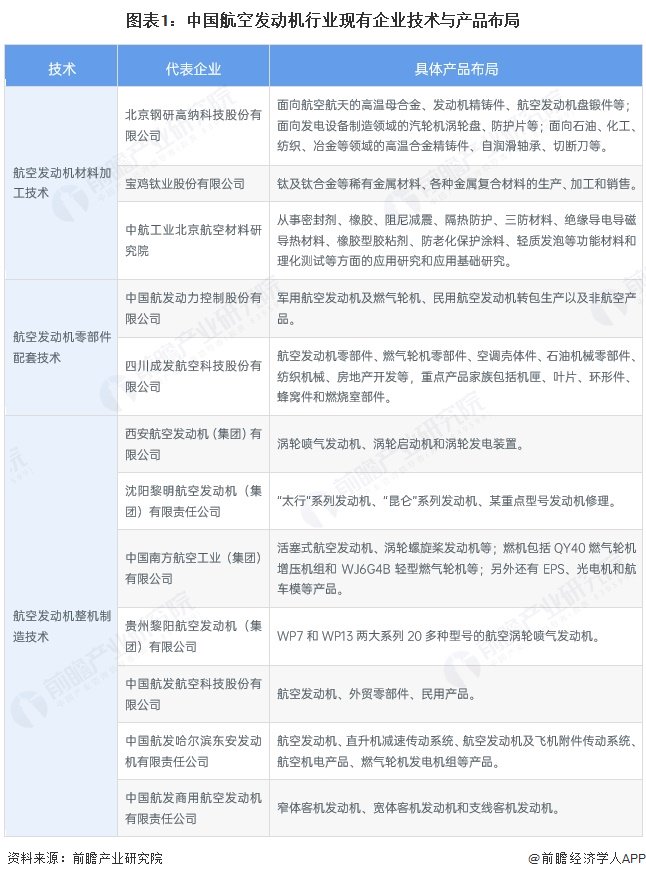
Core Insights - The Chinese aviation engine industry has achieved significant technological breakthroughs, focusing on three main areas: material processing, component manufacturing, and complete engine production [1][3]. Group 1: Technological Breakthroughs - Major companies in the aviation engine materials processing sector include Beijing Steel Research Technology Co., Ltd., which produces high-temperature alloys and precision castings for aerospace applications [2]. - In the component manufacturing sector, companies like Sichuan Chengfa Aviation Technology Co., Ltd. and Xi'an Aero Engine (Group) Co., Ltd. have developed various engine components, including turbine engines and combustion chamber parts [2][3]. - The complete engine manufacturing sector is represented by companies such as Guizhou Liyang Aviation Engine (Group) Co., Ltd., which has produced over 20 models of aviation turbine engines [3]. Group 2: Domestic Production and Development - China has established a relatively complete aviation engine research and production system, capable of developing various types of engines, including turboprop, turbojet, turbofan, and turboshaft engines [3]. - The domestically developed WS-20 engine is now used in the Y-20 transport aircraft, marking a significant step towards the complete domestic production of military aircraft engines [4]. Group 3: Market Position and Future Outlook - In the global military aircraft market, China ranks third with 3,309 military aircraft, accounting for 6% of the total, following the United States and Russia [6]. - The global fleet size is projected to grow from 20,563 aircraft in 2021 to 47,531 by 2041, with a shift towards the Chinese and Asia-Pacific markets [9].


5月13日前海开源新经济混合A净值下跌0.82%,近6个月累计下跌9.77%
Sou Hu Cai Jing· 2025-05-13 12:59
Group 1 - The core point of the article highlights the performance of Qianhai Kaiyuan New Economy Mixed A Fund, which has a latest net value of 2.0271 yuan, reflecting a decline of 0.82% [1] - The fund's one-month return is 2.77%, ranking 1110 out of 2164 in its category; its three-month return is -1.31%, ranking 1488 out of 2156; and its year-to-date return is -1.32%, ranking 1697 out of 2145 [1] - As of March 31, 2025, the fund's total assets amount to 3.794 billion yuan, with the top ten stock holdings accounting for 52.12% of the portfolio [1] Group 2 - The top ten stock holdings of the fund include: Farah Electronics (7.85%), Unisplendour (6.10%), Shenghong Co. (6.00%), Chipone (5.95%), Shandong Gold (5.33%), Aero Engine Corporation of China (4.87%), Jinpan Technology (4.34%), Guoxuan High-Tech (4.06%), AVIC Heavy Machinery (4.01%), and Jiehuate (3.61%) [1] - The fund was established on August 20, 2014, and is managed by fund manager Cui Chenlong, who has extensive experience in the investment field [2]
贵州上市公司2025年投资者集体接待日活动暨2024年度业绩说明会成功举办
Zheng Quan Shi Bao Wang· 2025-05-13 11:41
5月12日,2025年全国首场投资者集体接待日活动暨2024年度业绩说明会在贵州贵阳成功举办。本次活 动由贵州证监局指导,贵州证券业协会主办、深圳全景网协办,是贵州辖区连续第二年在上市公司年报 季后全国率先举行投资者集体接待日,也是第13年举办集体接待日活动。 贵州省国资委相关负责同志表示,近年来,省国资委监管企业所属控股上市公司借助资本市场实现高质 量发展能力进一步提升,各市(州)国资监管机构也充分利用资本市场促进当地经济高质量发展,整体 呈现上市公司主业更加突出、投资者关系维护有效提升、资产证券化步伐持续加快、产业链布局更趋完 善四大特征。下一步,省国资委将与贵州证监局共同推动双方联合印发的《关于加强监管企业控股上市 公司市值管理的通知》落实落地,积极引导国有控股上市公司切实发挥资本市场服务企业发展和优化资 源配置的功能,充分运用多元化资本市场工具,实现产业经营与资本运营融合发展,引导国有控股上市 公司专注主责主业,从价值创造、价值实现和价值经营三大环节发力,提升资本市场对贵州国有控股上 市公司的价值认同。 全景网相关负责人表示,贵州辖区上市公司历来重视资本品牌传播和投资者关系管理。多年来,贵州资 本市场 ...
ETF英雄汇(2025年5月13日):标普消费ETF(159529.SZ)涨停、国防军工板块回调居前
Xin Lang Cai Jing· 2025-05-13 09:01
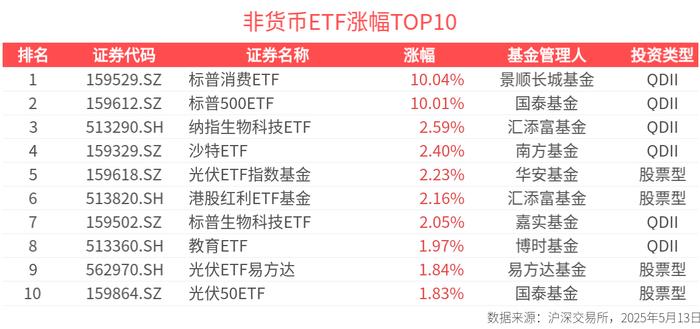
Market Overview - As of May 13, 2025, A-shares showed mixed performance with the Shanghai Composite Index up by 0.17% at 3374.87 points, while the Shenzhen Component Index and the ChiNext Index fell by 0.13% and 0.12%, closing at 10288.08 points and 2062.26 points respectively. The total trading volume across both markets reached 1.29 trillion yuan [1]. Industry Performance - The photovoltaic equipment, shipping ports, and cosmetics industries topped the gainers' list, with increases of 2.23%, 2.21%, and 1.97% respectively. A total of 500 non-currency ETFs rose, representing 44% of the market [2]. - The China Photovoltaic Industry Index increased by 1.53%, with specific ETFs such as the Photovoltaic ETF Index Fund, E Fund Photovoltaic ETF, and Photovoltaic 50 ETF rising by 2.23%, 1.84%, and 1.83% respectively. The China Global Education Theme Index rose by 0.85%, while the Education ETF increased by 1.97% [2]. ETF Performance - The latest share size of the S&P 500 ETF reached 347 million shares, closely tracking the S&P 500 Index, which includes 500 leading companies accounting for approximately 80% of the available market capitalization in the U.S. stock market [4]. - The current price-to-earnings ratio (PE-TTM) of the S&P 500 Index stands at 26.01, which is lower than 69.84% of the time over the past three years [5]. - The Nasdaq Biotechnology ETF has a share size of 1.135 billion shares, tracking the Nasdaq Biotechnology Index, which includes securities classified as biotechnology and pharmaceuticals [5]. - The Photovoltaic ETF Index Fund has a share size of 115 million shares, closely following the China Photovoltaic Industry Index, with key stocks including Longi Green Energy, Sungrow Power Supply, and TCL Technology [5]. Declining ETFs - A total of 547 non-currency ETFs declined, with a drop rate of 49%. The China 2000 Index performed poorly, falling by 0.30%, while the China Military Industry Index and the China Defense Index had the largest declines at 2.98% and 2.97% respectively [5]. - The top declining ETFs included the China 2000 Enhanced ETF, Aerospace ETF, and Military Leading ETF, with declines of 3.89%, 3.18%, and 3.08% respectively [7]. Premium Rates - The S&P 500 Consumer Select Index showed a premium of 25.03%, while the S&P 500 ETF had a premium of 19.68% at market close [8]. - The top ETFs by premium rate included the S&P Consumer ETF at 25.03% and the S&P 500 ETF at 19.68% [9].
军工板块“空中加油”!知名游资席位买入近7亿元
第一财经· 2025-05-13 05:31
Core Viewpoint - The military industry sector in A-shares has seen a significant increase in attention and investment, with a notable rise in stock prices driven by market sentiment and geopolitical factors, despite underlying performance challenges in the first quarter of 2024 [1][2][4]. Group 1: Market Performance - The military ETF recorded a cumulative increase of 4.91% last week, with a further rise of 4.68% on May 12, 2024, indicating strong market interest [1]. - The defense and military index has seen a cumulative increase of 13.42% since May, ranking among the top three sectors in terms of growth [4]. - Key stocks such as AVIC Chengfei (中航成飞) and Morningstar Aviation (晨曦航空) experienced significant price surges, with some stocks hitting the daily limit up [1][4]. Group 2: Financial Performance - In Q1 2024, the military sector's total revenue was 1,067.53 billion yuan, a decrease of 3.15% year-on-year, while net profit fell by 4.40% to 56.14 billion yuan [4][5]. - The overall profitability of the military sector remains at a low point compared to previous cycles, with many companies experiencing a decline in net profit despite some revenue recovery [2][4]. - Among 40 leading companies, the average revenue growth rate in Q1 was 15.14%, a recovery from the previous year's decline [5]. Group 3: Future Outlook - Companies in the military sector have set optimistic revenue targets for 2025, with expected growth rates for key players such as AVIC Xi'an (中航西飞) and AVIC High-Tech (中航高科) ranging from 2% to 14% [8]. - The contract liabilities of major manufacturers have increased, indicating a potential for revenue realization in the coming quarters [8]. - Despite a reduction in public fund allocations to the military sector over the past ten quarters, there is a belief that the sector's fundamentals will improve, leading to a potential recovery in valuations [9][10].




3D打印应用“全面开花”(附概念股)
Zheng Quan Shi Bao Wang· 2025-05-13 01:07
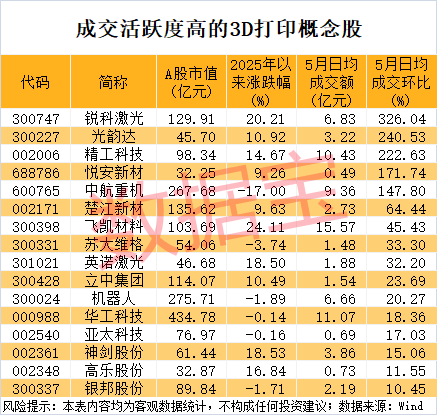
Core Insights - The development of 3D printing technology is becoming a significant force in cultivating new productive forces in China [1] - A breakthrough in medical 3D printing has been achieved by Caltech, enabling in-body manufacturing of medical implants without traditional invasive surgery, paving the way for personalized medicine [2] - The 3D printing industry is experiencing rapid growth, with projections indicating a global market potential of $88.3 billion by 2030 and a domestic market exceeding 120 billion yuan by 2029, with a compound annual growth rate of approximately 19.5% from 2024 to 2029 [3] Industry Developments - The application of 3D printing technology is expanding across various sectors, including aerospace, automotive, and biomedical, transitioning from an optional to a necessary component in high-end manufacturing [3] - The average increase in stock prices for 3D printing concept stocks in the A-share market is 17.18% this year, with four stocks seeing cumulative gains exceeding 50% [5] - A total of over 30 concept stocks related to 3D printing are listed in the A-share market, with companies like Jinggong Technology and Aidi Te focusing on product development in this field [4] Market Activity - As of May 12, 2023, several 3D printing concept stocks have shown significant trading activity, with 16 stocks experiencing a daily trading volume increase of over 10% [5] - Specific stocks such as Ruike Laser and Guangyun Da have reported substantial increases in trading volume, with Ruike Laser's trading volume increasing by 326.04% [7] - Valuation levels indicate that eight stocks have a rolling price-to-earnings ratio below 40, and seven stocks have a price-to-book ratio below 2 [6]
军工板块“空中加油”,资金持续博弈基本面与景气度拐点
Di Yi Cai Jing· 2025-05-13 00:35
Group 1 - The military industry is currently in a short-term performance bottoming phase, with leading companies, especially main engine manufacturers, showing a significant recovery in revenue year-on-year in Q1, although net profits remain under pressure [1][2] - The capital market's interest in the military industry has increased significantly, with military ETFs showing a cumulative increase of 4.91% last week, driven by heightened market sentiment due to geopolitical tensions [1][3] - In Q1, the military sector's total revenue was 1,067.53 billion, a year-on-year decrease of 3.15%, while net profit was 56.14 billion, down 4.40% [3][4] Group 2 - Among 40 leading companies in the military sector, all achieved positive revenue growth in Q1, with 14 companies experiencing double-digit growth, contrasting with 22 companies that saw revenue declines in the same period last year [4][5] - The average net profit growth rate for these 40 companies was -35.57%, indicating a significant decline in profitability compared to the previous year [4][5] - Some companies, such as Aviation Power and Aerospace Rainbow, reported net profit declines exceeding 70%, highlighting the challenges faced by the industry [5][6] Group 3 - Long-term profitability in the military sector is currently below the previous cycle's starting point in 2019, and the potential for a performance turnaround is crucial for further valuation increases [6][8] - Several companies have disclosed ambitious revenue targets for 2025, indicating positive growth expectations within the aerospace and shipbuilding sectors [6][8] - Public funds have been reducing their allocation to the military sector for ten consecutive quarters, with military-themed fund sizes decreasing significantly since their peak in Q1 2021 [7][8] Group 4 - The military industry is expected to undergo a valuation restructuring, benefiting from improved asset quality and market conditions, with a more favorable outlook for the second half of the year compared to the first half [8]


