DeepMind

Search documents
OpenAI、谷歌与xAI上演“抢人大战”,顶尖AI人才年薪达千万美元
3 6 Ke· 2025-05-22 10:16
Core Insights - The competition for top AI talent in Silicon Valley has intensified since the launch of ChatGPT in late 2022, evolving into a "star recruitment battle" akin to professional sports [1] - Major tech companies, including OpenAI and Google, are aggressively seeking "Individual Contributors" (ICs) who are crucial for breakthroughs in AI models, which can determine a company's success in the AI sector [1] Group 1: Recruitment Strategies - OpenAI has been actively recruiting top researchers, offering substantial resources and support for their research interests, which is often more appealing than the highest salary offers [2] - High salaries remain a significant tool for attracting talent, with reports of OpenAI offering $2 million retention bonuses and over $20 million in equity incentives to key researchers [2][3] - DeepMind is also competitive, providing annual salary packages up to $20 million and shortening stock vesting periods from four years to three [3] Group 2: Talent Scarcity - The number of "super talents" capable of making significant contributions to large language models is estimated to be between a few dozen and 1,000 globally, highlighting their extreme scarcity [5] - These core researchers are seen as "strategic assets" due to their ability to drive significant advancements in AI models, influencing the success or failure of AI labs [5] - The departure of OpenAI's former CTO, Mira Murati, to start her own company has intensified the talent war, as she has already recruited a substantial team from OpenAI [5] Group 3: Innovative Recruitment Approaches - Companies are adopting creative recruitment strategies, such as using sports data analysis methods to identify untapped AI talent [6] - Some firms are looking to recruit individuals from diverse fields, such as theoretical physics and quantum computing, to bring fresh perspectives into AI [6] - The rapid advancements in AI are attracting top talent from various disciplines, indicating a shift in the traditional recruitment landscape [6]



技术创新的性质
3 6 Ke· 2025-05-19 10:14
Group 1 - Demand is the fundamental driving force behind technological innovation, as historical examples illustrate that necessity leads to significant advancements [1][2] - The urgency and scale of demand determine the speed and level of innovation, with historical events like the Age of Discovery and the development of the internet driven by specific needs [2][3] - Technological innovation must find an economic purpose to be perfected and promoted, and it thrives when aligned with broad, practical demands [2][3] Group 2 - Innovation involves trial and error, which inherently requires costs; higher trial costs can slow technological progress [3][5] - The digital transformation of manufacturing is crucial, but it faces high trial costs due to the need for mature technologies before large-scale implementation [5][6] - Sectors with lower trial costs, such as entertainment and digital services, can innovate more rapidly and serve as testing grounds for new technologies [5][6] Group 3 - Technological innovation is a gradual process rather than a sudden breakthrough, often built on previous advancements and requiring long-term iteration [6][7] - Major inventions, like the steam engine and computers, evolved over time through continuous improvements rather than appearing suddenly [6][7] - The perception of innovation as revolutionary often overlooks the incremental efforts that lead to significant breakthroughs [7][8] Group 4 - Innovation often flourishes in resource-scarce environments, where necessity drives creativity and problem-solving [9][10] - Resource-rich countries may experience a "resource curse," leading to less innovation due to an over-reliance on existing resources [9][10] - Smaller, agile teams or startups can navigate innovation more effectively than larger organizations burdened by inertia and resource constraints [9][10] Group 5 - The diversity of ideas and backgrounds is crucial for innovation, as it fosters an environment where new concepts can emerge [11][12] - Historical examples show that regions with diverse populations often experience significant technological and economic advancements [11][12] - The global tech industry benefits from the contributions of immigrants, highlighting the importance of diverse talent in driving innovation [11][12] Group 6 - While youth is often associated with innovation, the average age of significant innovators has been rising, with many breakthroughs occurring in the 30-50 age range [12][13] - The trend indicates that experience and accumulated knowledge play a vital role in fostering innovation [12][13] - Despite the shift in age demographics, the urgency to innovate remains, emphasizing the need for timely action [13][15] Group 7 - Innovation is often unpredictable and can occur simultaneously across different individuals and regions, driven by similar social conditions [15][16] - Historical predictions about technological advancements have frequently proven overly optimistic or incorrect, illustrating the challenges of forecasting innovation [15][16] - The process of innovation is collaborative and iterative, with contributions from various individuals leading to breakthroughs [19][20]
技术创新的性质
腾讯研究院· 2025-05-19 08:07
Group 1 - Demand is the fundamental driving force behind technological innovation, and the urgency and scale of demand determine the speed and level of innovation [1][3] - Historical examples illustrate that significant innovations often arise from pressing needs, such as the development of the steam engine and the internet, which were driven by specific demands [3] - The integration of technology with practical, widespread needs is essential for its successful implementation and growth [3] Group 2 - Innovation involves trial and error, which inherently requires costs; higher trial and error costs can slow technological progress [4][5] - The digital transformation of manufacturing industries faces high trial and error costs due to stringent requirements for product quality and production stability [6] - Sectors with lower trial and error costs, such as entertainment and digital services, can innovate more rapidly and serve as testing grounds for new technologies [6] Group 3 - Technological innovation is a gradual process rather than a sudden breakthrough, often built upon previous advancements and requiring long-term iteration [7][8] - Major inventions, like the steam engine and computers, have undergone extensive improvements over time rather than appearing fully formed [8][10] - The perception of innovation as revolutionary often overlooks the incremental efforts that lead to significant breakthroughs [10] Group 4 - Resource-rich environments may hinder innovation due to a phenomenon known as the "resource curse," while resource-scarce regions often exhibit stronger innovation capabilities [12][13] - Large organizations may struggle with innovation due to organizational inertia and path dependency, suggesting that smaller, more agile teams may be more successful in driving innovation [13][14] Group 5 - Innovation thrives in diverse environments where different ideas and perspectives can intersect, akin to "cross-pollination" [16][17] - The movement of talent across regions is a key indicator of innovation potential, as diverse backgrounds contribute to new ideas and solutions [17] Group 6 - While youth has historically been associated with innovation, the average age of significant innovators has been rising, with many breakthroughs occurring in the 30-50 age range [18][21] - Despite the trend of older innovators, the urgency to innovate remains, emphasizing the importance of timely action [21] Group 7 - Innovations often emerge simultaneously from different individuals or groups, reflecting the maturity of social conditions rather than individual genius [23][24] - Predictions about the timing and impact of innovations can be notoriously inaccurate, highlighting the unpredictable nature of technological advancement [24][26]
黄仁勋Computex演讲:英伟达正在将其AI模型应用于自动驾驶汽车 计划于7月开源物理引擎Newton
Cai Jing Wang· 2025-05-19 07:13
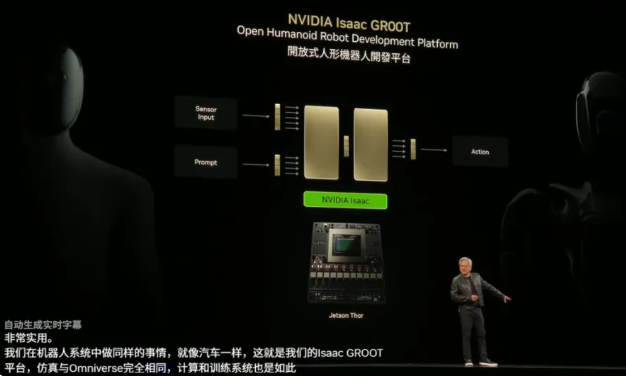
Group 1 - Nvidia's CEO Jensen Huang emphasized the impracticality of training robots in the physical world, advocating for training in a virtual environment that adheres to physical laws [1] - Nvidia is collaborating with DeepMind and Disney Research to develop a cutting-edge physics engine called Newton, which will be open-sourced in July [1] - The Newton engine supports GPU acceleration and features high differentiability and ultra-real-time operation capabilities, enabling effective learning through experience [1] Group 2 - Nvidia is advancing robotic systems in the automotive industry using the Isaac Groot platform, powered by a new processor named Jetson Thor, designed for a wide range of robotic applications [3] - The Isaac operating system manages neural network processing, sensor processing, and data pipelines, enhancing system capabilities with pre-trained models developed by specialized teams [3] - Nvidia's end-to-end autonomous vehicle technology stack is a comprehensive solution developed entirely in-house, facilitating collaboration with various partners to promote the commercialization of autonomous vehicles [3] Group 3 - Nvidia is applying its AI models to autonomous vehicles, launching a fleet in collaboration with Mercedes globally, aiming for implementation of end-to-end autonomous driving technology this year [5]

黄仁勋Computex讲话:宣布“AI工业革命” ,构建万亿美元AI基建版图
Jin Shi Shu Ju· 2025-05-19 05:35
Core Insights - Nvidia is transitioning from a traditional tech company to an "AI infrastructure company," aiming to build a future-oriented ecosystem for computing, robotics, and intelligent systems, with the AI infrastructure market projected to be worth trillions of dollars [1] Group 1: New Product Launches and Collaborations - Nvidia introduced new AI personal computing devices, DGX Spark and DGX Station workstations, and began mass production of the Blackwell RTX Pro6000 motherboard, enabling high-speed GPU cluster systems with 800Gbps communication bandwidth [1] - The company announced a partnership with Foxconn to build a supercomputer equipped with 10,000 Blackwell GPUs, positioning Foxconn as a cloud partner for AI infrastructure [1] Group 2: Development of New Tools and Platforms - Nvidia is developing the Newton physics engine in collaboration with DeepMind and Disney Research, which will be open-sourced in July and support GPU acceleration for training robots in virtual environments [2] - A new GPU-stacked storage platform and AIQ intelligent query system are being created to address the explosion of unstructured data, aiming to disrupt traditional database architectures [2] - The concept of "digital agents" is introduced to tackle the anticipated global workforce shortage of 50 million, providing AI assistants for software development and operations [2] Group 3: Robotics and Mobility - All mobile devices are expected to become robotic, leading to an industrial revolution, with Nvidia working on the Isaac Groot robotic system for autonomous driving and human-machine collaboration [3] - Collaborations with Mercedes and other companies are underway to deploy fleets equipped with end-to-end autonomous driving systems [3] Group 4: Next-Generation Computing - Nvidia is collaborating with Cisco to develop AI systems that integrate quantum technology with 5G/6G, launching the CUDA-Q hybrid computing platform [4] - The company is creating a "light-speed execution" architecture to enhance computing performance, emphasizing the transformative impact of DLSS and neural rendering technologies [4] Group 5: Future Positioning in AI Infrastructure - Data centers are evolving from traditional IT carriers to "AI factories," with a market size projected to reach trillions of dollars, highlighting Nvidia's unique advantage in its algorithm library, particularly the CUDAx ecosystem [5] - The transition from training to inference-driven AI is represented by the full-scale production and deployment of the Grace Blackwell system [5]
腾讯研究院AI速递 20250516
腾讯研究院· 2025-05-15 14:38
Group 1: Regulatory Developments - The U.S. Senator proposed a bill requiring companies like NVIDIA and AMD to embed geolocation tracking in high-end GPUs and AI chips, effective in six months [1] - The regulation covers AI processors, high-performance servers, and high-end graphics cards like the RTX 5090, aimed at preventing strategic hardware from flowing to unauthorized countries [1] - Chip manufacturers will be responsible for product tracking, and the bill mandates annual assessments for three years, potentially leading to more restrictions [1] Group 2: AI Model Updates - OpenAI officially launched the GPT-4.1 model in ChatGPT, available for Plus, Pro, and Team users, with enterprise and education users to gain access in the coming weeks [2] - GPT-4.1 shows excellent performance in coding tasks and instruction adherence, with significantly improved generation speed, serving as an ideal replacement for previous models [2] - The context window for ChatGPT's GPT-4.1 is limited to 128k tokens, falling short of the promised 1 million tokens in the API version, disappointing users [2] Group 3: New AI Models and Features - Anthropic plans to release new versions of Claude Sonnet and Opus, featuring "extreme reasoning" capabilities that establish a dynamic loop between reasoning and tool usage [3] - The new models can autonomously pause, reassess problems, and adjust strategies, with capabilities to automatically test and correct errors in code generation tasks [3] - A new model, codenamed Neptune, is reportedly in testing, supporting a maximum context length of 128k tokens [3] Group 4: Advancements in Voice Technology - MiniMax's new voice model, Speech-02, surpasses OpenAI and ElevenLabs in metrics like word error rate and speaker similarity, achieving state-of-the-art levels [4][5] - Speech-02 enables true zero-shot voice cloning and employs an innovative Flow-VAE architecture, requiring only a few seconds of audio to replicate speaker characteristics [5] - The model supports 32 languages and allows flexible control over voice tone and emotional modulation, costing only a quarter of ElevenLabs' competitors, marking a shift towards personalized AI voice technology [5] Group 5: Browser and Audio Innovations - Tencent launched the Yuanbao browser plugin for Chrome, offering features like word highlighting for questions, content summarization, foreign webpage translation, and one-click bookmarking [6] - The plugin includes a floating ball and sidebar for easy access to screenshot questions, file uploads, and content searches, enhancing web browsing efficiency [6] - Stability AI partnered with Arm to introduce the Stable Audio Open Small model, the fastest audio generation model for mobile, capable of generating 11 seconds of audio in 8 seconds [7] - The model, with 341 million parameters, is designed for short audio and sound effect generation, using data from copyright-free sources, but currently only supports English prompts [7] Group 6: Video Generation and Gaming AI - Alibaba released the open-source Wan2.1-VACE video generation model, supporting multiple tasks like text-to-video and image reference generation, usable on consumer-grade graphics cards [8] - The model comes in two versions: 1.3B (supporting 480P) and 14B (supporting 720P), utilizing an innovative video condition unit for various input types [8] - Tencent's mixed Yuan model developed an intelligent NPC system for the game "BUD," enabling autonomous actions, personalized interactions, emotional expression, and memory reasoning [10] - The game achieved over 20 million AI dialogues within three months, with the upcoming release of mixed image version 2.0 aimed at enhancing the AI product matrix [10] Group 7: AI Opportunities and Challenges - Sequoia Capital detailed the "trillion-dollar AI opportunity," emphasizing that AI is disrupting both software and service profit pools, with the application layer being the most valuable [12] - The emerging economy of intelligent agents will not only convey information but also facilitate transactions, track relationships, and build trust, leading to a nested economic network of human-machine collaboration [12] - The industry faces three major technical challenges: persistent identity authentication for intelligent agents, seamless communication protocol development, and security assurance, entering a new era of "high leverage, low certainty" [12]

深度|微软AI CEO:我们正从“你选择AI”的时代迈向“AI选择你”的临界点
Sou Hu Cai Jing· 2025-05-14 03:00
Core Insights - Mustafa Suleyman, CEO of Microsoft AI, emphasizes the evolution of AI from a tool that follows commands to an emotional companion that understands and interacts with users [4][5][23] - Microsoft has strategically invested in AI, notably in OpenAI, to diversify its technological capabilities and avoid the innovator's dilemma [5][6] - The relationship between technology and society is complex, with AI's role in emotional support and companionship becoming increasingly significant [21][22] Group 1: AI Evolution and Microsoft Strategy - Microsoft began its collaboration with OpenAI in 2019, with a partnership extending to 2030, showcasing a long-term commitment to AI development [4][5] - Suleyman highlights the shift from "you choose AI" to "AI chooses you," indicating a future where AI will be more personalized and emotionally intelligent [4][5] - The dual-track strategy of supporting internal development while embracing external partnerships has positioned Microsoft favorably in the AI landscape [5][6] Group 2: AI's Societal Impact - The emergence of AI companions reflects a societal shift towards seeking emotional connection and understanding from technology [21][22] - Concerns about privacy and the ethical implications of AI's role in personal relationships are becoming more prominent as AI integrates deeper into daily life [32][36] - The concept of "Action Quotient" (AQ) is introduced, emphasizing AI's ability to perform tasks in both digital and real-world contexts, enhancing user experience [20][21] Group 3: Future of Work and Technology - The fear of job loss due to AI is rooted in societal identity tied to work, but there is potential for a redefined relationship with work and leisure [37][38] - The conversation around AI's role in the workplace includes the need for a reassessment of value distribution and the impact on societal structures [38] - The adaptability of government and technology leaders in addressing AI's rapid evolution is crucial for effective regulation and accountability [10][11]


通用人工智能何时到来?
3 6 Ke· 2025-05-12 08:54
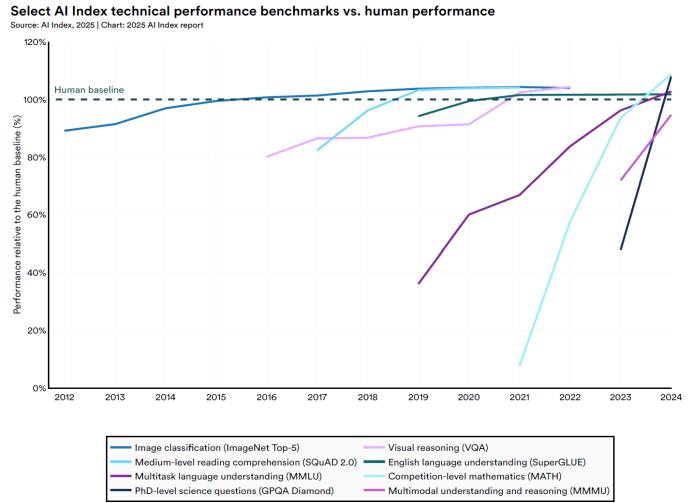
一、AI已在诸多任务领域超越人类 AI发展日新月异,在许多任务上已经陆续超越人类基线水平。如2015年图像分类,2018年中等水平阅 读理解,2020年视觉推理、英语语言理解,2023年多任务语言理解、竞赛级数学,2024年博士级科学问 题。下图所示的8项关键任务技能中,AI仅在多模态理解和推理能力上还略逊人类一筹,但从2023年开 始就加速提升。我们有望很快见证AI 能力在现有主流基准上"全部超越人类水平"的奇点时刻。 图 选定的 AI 指数技术性能基准与人类表现对比 二、AGI的终极目标或于年内实现 我们已经构建了无数在特定任务上超越人类水平的AI系统,但它们缺乏通用性,无法应对超出预定任 务之外的问题,尚处于"狭义人工智能(Narrow AI)"阶段。随着AI性能的大幅提升,具备跨领域能 力、在多个方面媲美甚至超越人类的、更强大的AI被提上日程。人们常将之命名为"通用人工智能 (AGI)"。 各国高度重视AGI。2023年4月28日中共中央政治局会议提出:"要重视通用人工智能发展";英国《国 家人工智能战略》 (2021 ) 对AGI进行了专门强调,指出"必须认真对待AGI和更通用AI的可能性"; 20 ...
通用人工智能何时到来?
腾讯研究院· 2025-05-12 08:11
闫德利 腾讯研究院资深专家 一、AI已在诸多任务领域超越人类 AI发展日新月异,在许多任务上已经陆续超越人类基线水平。如2015年图像分类,2018年中等水平阅读 理解,2020年视觉推理、英语语言理解,2023年多任务语言理解、竞赛级数学,2024年博士级科学问 题。下图所示的8项关键任务技能中,AI仅在多模态理解和推理能力上还略逊人类一筹,但从2023年开 始就加速提升。我们有望很快见证AI 能力在现有主流基准上"全部超越人类水平"的奇点时刻。 图 选定的 AI 指数技术性能基准与人类表现对比 二、AGI的终极目标或于年内实现 我们已经构建了无数在特定任务上超越人类水平的AI系统,但它们缺乏通用性,无法应对超出预定任务 之外的问题,尚处于"狭义人工智能 (Narrow AI) "阶段。随着AI性能的大幅提升,具备跨领域能力、在 多个方面媲美甚至超越人类的、更强大的AI被提上日程。 人们常将之命名为"通用人工智能(AGI)" 。 各国高度重视AGI。2023年4月28日中共中央政治局会议提出:"要重视通用人工智能发展";英国《国家 人工智能战略》 (2021 ) 对AGI进行了专门强调,指出"必须认真对待A ...

一文讲透AI历史上的10个关键时刻!
机器人圈· 2025-05-06 12:30
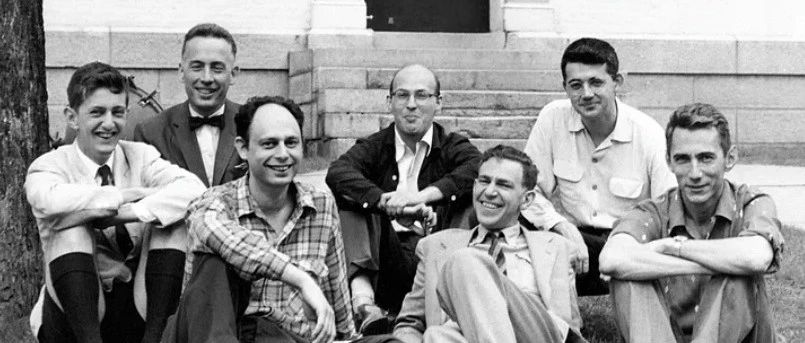
Core Viewpoint - By 2025, artificial intelligence (AI) has transitioned from a buzzword in tech circles to an integral part of daily life, impacting various industries through applications like image generation, coding, autonomous driving, and medical diagnosis. The evolution of AI is marked by significant breakthroughs and challenges, tracing back to the Dartmouth Conference in 1956, leading to the current technological wave driven by large models [1]. Group 1: Historical Milestones - The Dartmouth Conference in 1956 is recognized as the birth of AI, where pioneers gathered to explore machine intelligence, laying the foundation for AI as a formal discipline [2][3]. - In 1957, Frank Rosenblatt developed the Perceptron, an early artificial neural network that introduced the concept of optimizing models using training data, which became central to machine learning and deep learning [4][6]. - ELIZA, created in 1966 by Joseph Weizenbaum, was the first widely recognized chatbot, demonstrating the potential of AI in natural language processing by simulating human-like conversation [7][8]. - The rise of expert systems in the 1970s, such as Dendral and MYCIN, showcased AI's ability to perform specialized tasks in fields like chemistry and medical diagnosis, establishing its application in professional domains [9][11]. - IBM's Deep Blue defeated world chess champion Garry Kasparov in 1997, marking a significant milestone in AI's capability to outperform humans in strategic decision-making [12][14]. - The 1990s to 2000s saw a shift towards data-driven algorithms in AI, emphasizing the importance of machine learning [15]. - The emergence of deep learning in 2012, particularly through the work of Geoffrey Hinton, revolutionized AI by utilizing multi-layer neural networks and backpropagation techniques, leading to significant advancements in model training [17][18]. - The introduction of Generative Adversarial Networks (GANs) in 2014 by Ian Goodfellow transformed the field of generative models, enabling the creation of realistic synthetic data [20]. - AlphaGo's victory over Lee Sedol in 2016 highlighted AI's potential in complex games requiring intuition and strategic thinking, further pushing the boundaries of AI capabilities [22]. - The development of large language models began with the introduction of the Transformer architecture in 2017, leading to models like GPT-3, which demonstrated emergent abilities and set the stage for the current AI landscape [24][26].