贝达药业

Search documents
贝达药业三度冲击港股IPO:资金链承压、研发缩水与产品困局
Sou Hu Cai Jing· 2025-09-17 02:06
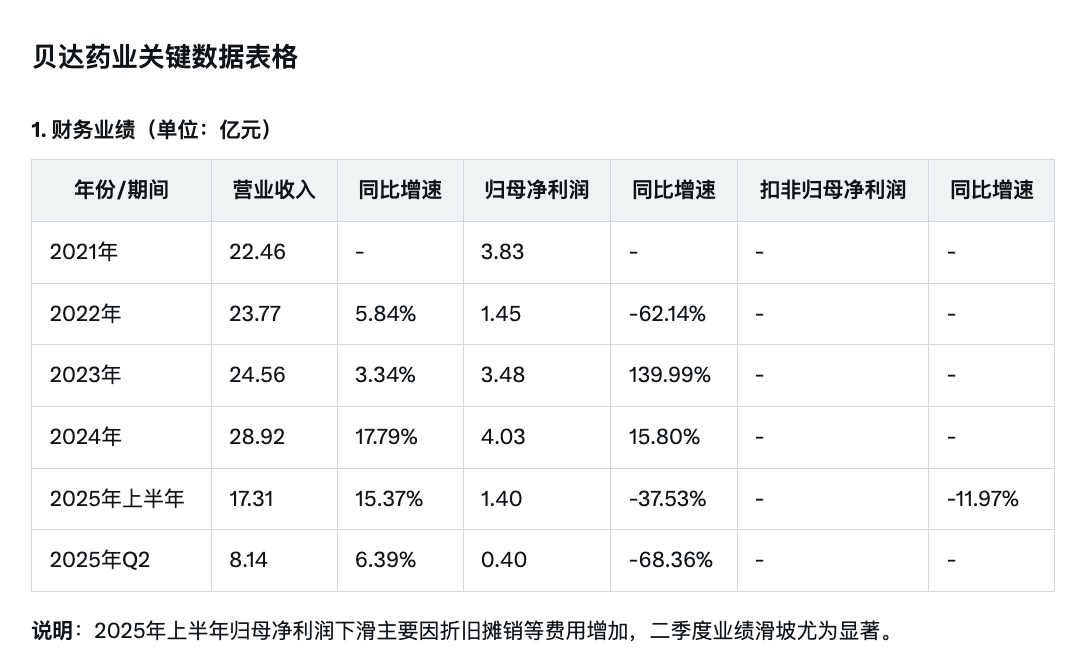
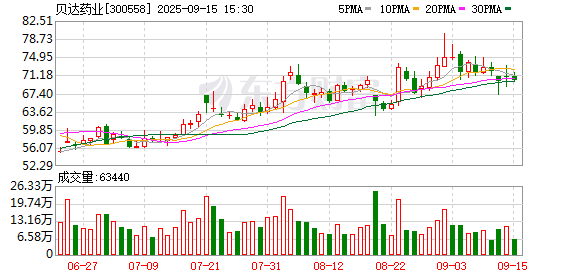
Core Viewpoint - Beida Pharmaceutical (300558.SZ) is seeking a third attempt for an IPO in Hong Kong to enhance its capital strength and support its internationalization process, following two previous unsuccessful attempts in 2021. The primary motivation appears to be alleviating the company's increasing financial pressure rather than solely supporting long-term R&D [2][3][4]. Financial Performance - In 2025 H1, Beida reported revenue of 1.731 billion, a year-on-year increase of 15.37%, but the net profit attributable to shareholders was only 140 million, down 37.53% year-on-year. In Q2 2025, net profit was 40 million, a significant decline of 68.36% [6]. - The company's revenue heavily relies on its cornerstone product, Kaimena, which has annual sales exceeding 1 billion, accounting for more than half of its main business revenue [5][6]. - The company’s operating cash flow in H1 2025 was 445 million, reflecting a year-on-year decrease of 14.70%, indicating tightening liquidity [3][6]. Capital Structure and Liquidity - As of the end of 2023, Beida's cash balance was 527 million, a significant drop from 792 million at the end of 2021. The current assets were 1.359 billion, while current liabilities stood at 1.757 billion, highlighting short-term debt pressure [2][3]. - The company plans to allocate 40% of the IPO proceeds for R&D, 30% for potential acquisitions, and the remainder for marketing network construction and working capital [3]. R&D and Product Pipeline - Beida's R&D investment has decreased from 700 million in 2022 to 255 million in H1 2025, with the R&D team size halved from 647 in 2022 to 327 in 2024. This reduction may hinder new drug development and weaken the company's competitiveness in the innovative drug sector [7]. - The company has eight marketed products, but the performance of new products like Beifutini has been disappointing, with sales in H1 2025 not reaching 10% of main business revenue [5][6]. Market Position and Challenges - The competitive landscape for third-generation EGFR-TKIs is intense, with seven products already on the market, which may further squeeze Beida's market space if more competitors are included in the medical insurance [5][6]. - Beida's stock performance has been weak, with a year-to-date increase of about 30%, and the current stock price of 70.73 per share is significantly lower than its historical high of 160.66 [7][8].

研报掘金丨天风证券:贝达药业核心业务稳健增长,维持“增持”评级
Ge Long Hui A P P· 2025-09-16 06:32
Core Viewpoint - Benda Pharmaceutical's net profit for H1 2025 is projected to be 140 million yuan, a year-on-year decrease of 37.53%, primarily due to increased depreciation and amortization expenses impacting current profits [1] Financial Performance - The company's EBITDA stands at 498 million yuan, reflecting a year-on-year growth of 13.10%, indicating stable growth in core business operations [1] - The decline in net profit is attributed to rising costs, while the core business remains robust [1] Product Development and Market Position - Benda Pharmaceutical's drug sales are steadily increasing, reinforcing its competitive advantage in the lung cancer treatment market [1] - The first-line treatment of the third-generation EGFRTKI, Beifu Tini, is set to benefit from its inclusion in the medical insurance catalog, marking a significant milestone [1] - The company has received approval for postoperative adjuvant therapy indications, further expanding its treatment offerings [1] Future Prospects - Two KRAS-targeted drugs were showcased at the 2025 AACR, indicating promising future developments in the pipeline [1] - The company is actively enhancing its innovative product portfolio in the lung cancer sector and pursuing external collaborations, including the approval of plant-derived albumin for market entry [1] - The investment rating remains "Buy," reflecting confidence in the company's growth trajectory [1]

国内市场需求与政策支持双轮驱动 创新药板块表现亮眼
Huan Qiu Wang· 2025-09-16 02:27
Core Insights - The Chinese innovative drug sector has become a hot area in the capital market this year, driven by the real demand for high-quality innovative drugs from domestic patients, which is seen as the core driver for industry recovery [1] Group 1: Market Performance - In the first half of this year, 21 innovative drug companies listed on A-shares achieved a revenue of 28.69 billion yuan, a year-on-year increase of approximately 42%, while 32 innovative drug companies listed on H-shares reported a revenue of 42.13 billion yuan, a year-on-year increase of about 10% [2] - Leading companies have shown particularly strong performance, with Heng Rui Medicine's innovative drug sales revenue reaching 7.57 billion yuan, a year-on-year increase of approximately 14.5% [2] - Innovative drugs from Bai Jie Shen Zhou, such as Bai Yue Ze and Bai Ze An, reported sales of 1.192 billion yuan and 2.643 billion yuan respectively, with year-on-year growth rates of 36.5% and 20.6% [2] Group 2: Policy and Market Dynamics - The Chinese innovative drug market is entering a dual development cycle with domestic medical insurance and overseas markets, leading to a gradual path to profitability for companies [2] - Since its establishment in 2018, the National Medical Insurance Bureau has included 149 innovative drugs in the medical insurance catalog through seven rounds of adjustments, significantly optimizing the clinical medication structure [3] - By May 2025, the medical insurance fund is expected to pay a cumulative 410 billion yuan for negotiated drugs, driving related drug sales to exceed 600 billion yuan [3] Group 3: Future Outlook - The innovative drug market in China is projected to reach a scale of 162 billion yuan by 2024, with medical insurance payments accounting for approximately 43.8% [4] - The commercial success of innovative drugs is seen as a starting point for higher-level research and development, with many companies increasing their R&D investments despite revenue growth [4] - China currently holds a 30% share in global drug research and development, with 1,775 first-in-class drug pipelines, representing 19% of the global total [4]



贝达药业第三次谋求港股IPO 账上货币资金5亿元
2 1 Shi Ji Jing Ji Bao Dao· 2025-09-16 00:14
Core Viewpoint - Beida Pharmaceutical is making its third attempt to list on the Hong Kong Stock Exchange (HKEX) after two previous unsuccessful attempts in 2021, indicating ongoing efforts to secure funding and enhance its market position [2][4]. Group 1: Company Background - Beida Pharmaceutical has been focused on innovative oncology drugs for over 20 years and was listed on the Shenzhen Stock Exchange in 2016 [3]. - The company has developed eight marketed drugs, including its first small molecule targeted anti-cancer drug, Erlotinib (brand name: Kaimena®), and other products targeting various cancers and conditions [3]. Group 2: Previous IPO Attempts - The company submitted its first prospectus to HKEX in February 2021, followed by a second attempt in December 2021, but both attempts did not lead to a successful listing [4]. Group 3: Financial Performance - For the first half of 2025, Beida Pharmaceutical reported revenue of 1.731 billion yuan, a year-on-year increase of 15.37%, but its net profit decreased by 37.53% to 140 million yuan due to rising depreciation and amortization costs [4]. - From 2021 to 2024, the company’s revenue showed consistent growth, reaching 2.892 billion yuan in 2024, while net profit fluctuated significantly during the same period [5]. Group 4: Funding Pressure - As of the first half of 2025, Beida Pharmaceutical had current assets of approximately 1.359 billion yuan and current liabilities of 1.757 billion yuan, indicating significant short-term debt pressure [6]. - The company reported a cash balance of 527 million yuan, which has decreased over the years, highlighting ongoing liquidity challenges [7]. Group 5: R&D Investment - Beida Pharmaceutical has made substantial investments in research and development, with expenditures of 861 million yuan to 1.002 billion yuan from 2021 to 2024, representing a significant percentage of total revenue [8]. - In the first half of 2025, R&D spending reached 299 million yuan, focusing on several key projects [9]. Group 6: Industry Context - Beida Pharmaceutical's pursuit of a Hong Kong listing reflects a broader trend among innovative pharmaceutical companies in A-shares seeking to access additional capital for R&D and market expansion [10].
贝达药业第三次谋求港股IPO,账上货币资金5亿元
2 1 Shi Ji Jing Ji Bao Dao· 2025-09-16 00:10
Core Viewpoint - Beida Pharmaceutical is making its third attempt to list on the Hong Kong Stock Exchange (HKEX) after two previous unsuccessful attempts in 2021, indicating a strategic move to enhance its capital base and support ongoing operations and R&D efforts [1][3]. Group 1: Company Background - Beida Pharmaceutical has been focused on innovative oncology drugs for over 20 years and was listed on the Shenzhen Stock Exchange in 2016 [2]. - The company has developed eight marketed drugs, including its first small molecule targeted anti-cancer drug, Erlotinib (brand name: Kaimena), and other products targeting various cancers [2]. Group 2: Previous IPO Attempts - The company submitted its first prospectus to HKEX in February 2021, followed by a second attempt in December 2021, both of which did not lead to a successful listing [3]. Group 3: Financial Performance - For the first half of 2025, Beida Pharmaceutical reported revenue of 1.731 billion yuan, a year-on-year increase of 15.37%, but net profit decreased by 37.53% to 140 million yuan due to rising depreciation and amortization costs [3]. - From 2021 to 2024, the company's revenue showed consistent growth, reaching 2.892 billion yuan in 2024, while net profit fluctuated significantly during the same period [3][4]. Group 4: Funding Pressure - The company is facing financial pressure, with current assets totaling approximately 1.359 billion yuan and current liabilities of 1.757 billion yuan as of mid-2025, indicating a significant short-term debt burden [5][6]. - As of mid-2025, Beida Pharmaceutical had cash reserves of 527 million yuan, down from previous years, highlighting a trend of decreasing liquidity [6]. Group 5: R&D Investment - Beida Pharmaceutical's R&D expenditures from 2021 to 2024 were substantial, amounting to 861 million yuan, 977 million yuan, 1.002 billion yuan, and 717 million yuan, representing a significant percentage of total revenue [7]. - In the first half of 2025, R&D investment reached 299 million yuan, focusing on several key projects [8]. Group 6: Industry Context - Beida Pharmaceutical's pursuit of a Hong Kong listing reflects a broader trend among innovative pharmaceutical companies in A-shares seeking to access additional capital markets for funding R&D and operational needs [9].
医药生物行业周报:关注海外地缘扰动,坚定看好国内创新产业链发展-20250915
Donghai Securities· 2025-09-15 09:22
Investment Rating - The report assigns an "Overweight" rating to the pharmaceutical and biotechnology industry, indicating that the industry index is expected to outperform the CSI 300 index by 10% or more over the next six months [34]. Core Insights - The pharmaceutical and biotechnology sector experienced a slight decline of 0.36% from September 8 to September 12, 2025, ranking 29th among 31 industries in the Shenwan index, underperforming the CSI 300 index by 1.74 percentage points. The current PE valuation for the sector is 31.72 times, which is at a historically low level, with a premium of 137% compared to the CSI 300 index [3][11][18]. - The report highlights the potential impact of a proposed executive order by the Trump administration aimed at restricting U.S. pharmaceutical companies from acquiring drug development pipelines from China. This move is seen as a national security priority and could significantly alter the global supply chain dynamics of the U.S. pharmaceutical industry [4][27][28]. - Despite the overall market performance being subdued, sub-sectors such as medical devices, pharmaceutical commerce, and medical services showed relative strength, with respective increases of 2.23%, 1.44%, and 0.51% [3][11]. Market Performance - The pharmaceutical and biotechnology sector has seen a year-to-date increase of 26.80%, ranking 8th among 31 industries, and outperforming the CSI 300 index by 11.88 percentage points. All sub-sectors have recorded gains, with medical services leading at 46.88% [13][19]. - The report notes that 262 stocks (55.27%) in the sector rose, while 201 stocks (42.41%) fell during the last week. The top five gainers included Zhend Medical (41.26%), Haooubo (27.96%), and Jimin Health (25.88%) [25][26]. Industry News - The report discusses the implications of the proposed executive order, which aims to cut off the pipeline of experimental drugs developed in China, affecting treatments for cancer, obesity, heart disease, and Crohn's disease. Major U.S. pharmaceutical companies have relied on low-cost experimental drugs from China to enhance their product lines [4][28][29]. - The report emphasizes that even if the order is enacted, it is likely to face significant legal challenges, which could delay or nullify its implementation. The potential loss from patent cliffs could exceed $236.4 billion, and U.S. companies may miss out on valuable assets if they cannot collaborate with Chinese firms [4][30]. Investment Recommendations - The report suggests focusing on high-performing stocks within the innovative drug chain, as well as quality stocks in medical devices, traditional Chinese medicine, pharmacies, and medical services. Recommended stocks include Teabo Bio, Rongchang Bio, and Betta Pharmaceuticals [5][31][32].
贝达药业三冲港股IPO:净利降、欠款拖、研发缩,14岁“现金牛”凯美纳扛得动吗
Hua Xia Shi Bao· 2025-09-15 08:44
Core Viewpoint - Beida Pharmaceutical plans to issue H-shares for listing in Hong Kong to enhance its capital strength and support its internationalization process, amid concerns over its financial performance and liquidity pressures [1][2][3]. Financial Performance - In the first half of 2025, Beida Pharmaceutical reported a revenue of 1.731 billion yuan, a year-on-year increase of 15.37%, while its net profit attributable to shareholders decreased by 37.53% to 140 million yuan, marking the first half-year profit decline since 2022 [3][4]. - The company's second-quarter performance showed a significant decline, with revenue of 814 million yuan, a slight increase of 6.39% year-on-year, and a net profit of 39.81 million yuan, down 68.36% year-on-year [5][6]. Debt and Liquidity Issues - As of June 30, 2025, Beida Pharmaceutical's current assets were 1.359 billion yuan, lower than its current liabilities of 1.757 billion yuan, indicating short-term debt pressure [3][4]. - The company has faced liquidity challenges, highlighted by a 1.8 billion yuan overdue payment to a partner, which has been outstanding for nearly two years [3][4]. Product Dependency and Market Competition - Beida Pharmaceutical's revenue is heavily reliant on early products, namely Kaimena and Beimeina, which together account for over 10% of the company's main business income [6][7]. - The newly approved product, Beifutini, has not met sales expectations, failing to reach the disclosure threshold of 246 million yuan in revenue for the first half of 2025, amidst fierce competition from other third-generation EGFR inhibitors [7][8]. R&D and Cost Management - The company has been reducing its R&D investment, with expenditures dropping from 700 million yuan in 2022 to 255 million yuan in the first half of 2025, raising concerns about its long-term innovation capabilities [11][12]. - Despite increasing sales and management expenses, the company's revenue growth has not kept pace, indicating a decline in cost control efficiency [11][12].
贝达药业三冲港股IPO:净利降、欠款拖、研发缩,14岁“现金牛”凯美纳扛得动吗|创新药观察
Hua Xia Shi Bao· 2025-09-15 08:37
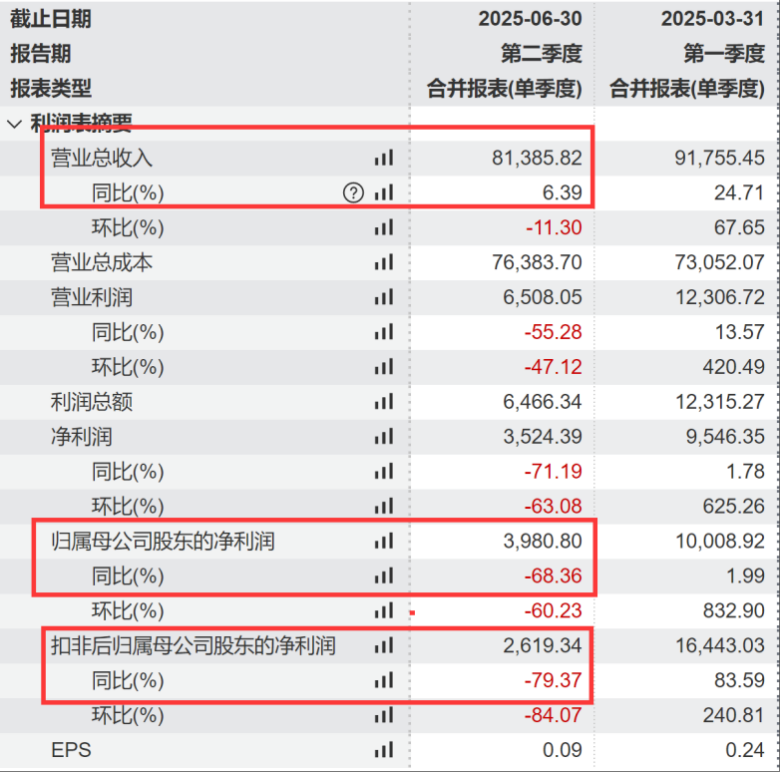
Core Viewpoint - The company, Betta Pharmaceuticals, has announced plans to issue H-shares for listing in Hong Kong, raising concerns about its financial health and motivations for fundraising amid a significant decline in net profit [1][2][3]. Financial Performance - In the first half of 2025, the company reported a revenue of 1.731 billion yuan, a year-on-year increase of 15.37%, while net profit attributable to shareholders fell by 37.53% to 140 million yuan, marking the first half-year profit decline since 2022 [3][5]. - The second quarter of 2025 saw a revenue of 814 million yuan, a slight increase of 6.39% year-on-year, but net profit dropped dramatically by 68.36% to 39.81 million yuan [3][6]. Debt and Cash Flow - As of June 30, 2025, the company's current assets were 1.359 billion yuan, which is lower than its current liabilities of 1.757 billion yuan, indicating short-term liquidity pressure [5]. - The net cash flow from operating activities for the first half of 2025 was 445 million yuan, a decrease of 14.70% year-on-year [5]. Product Portfolio and Market Competition - The company heavily relies on its early products, Kaimena and Bemena, for revenue, while newly approved product, Beifu, has not yet reached the revenue disclosure threshold and faces intense competition from other third-generation EGFR inhibitors [1][8][9]. - Kaimena has historically generated over 1 billion yuan in annual sales but has struggled with growth due to price reductions in the healthcare system [8][9]. R&D and Cost Management - The company has seen a reduction in R&D investment, dropping from 700 million yuan in 2022 to 255 million yuan in the first half of 2025, raising questions about its long-term innovation capabilities [12][13]. - Despite increasing sales, management and financial expenses have surged, with management costs rising by 23.47% and financial costs doubling by 118.06%, indicating deteriorating cost control [12][13]. IPO Motivation - The planned H-share issuance is seen as a potential solution to alleviate liquidity pressures, with funds intended for R&D, marketing network expansion, and operational costs [2][14]. - The company's ongoing debt issues, including a 180 million yuan overdue payment to a partner, further highlight its financial challenges [5][13].

医药生物行业双周报:海外不确定性加剧行业波动,中国创新药长期逻辑未变-20250915
Great Wall Glory Securities· 2025-09-15 08:27
Investment Rating - The investment rating for the pharmaceutical and biotechnology industry is "Positive" and the rating has been maintained [2] Core Views - The pharmaceutical and biotechnology industry index increased by 1.03% during the reporting period, outperforming the CSI 300 index which rose by 0.56% [3][16] - The industry valuation as of September 12, 2025, shows a PE (TTM overall method, excluding negative values) of 31.79x, up from 31.41x in the previous period, indicating an upward trend but still below the average [4][22] - Recent academic conferences and industry dynamics highlight the strength and resilience of China's innovative drug development capabilities [7][8] Industry Trends - The top-performing sub-industries include other biological products and medical research outsourcing, with increases of 4.17% and 3.64% respectively, while traditional Chinese medicine and hospitals saw declines of 1.36% and 1.23% [3][16] - A total of 48 listed companies in the pharmaceutical and biotechnology sector experienced a net reduction in shareholder holdings amounting to 3.686 billion yuan, with 6 companies increasing their holdings by 406 million yuan and 42 companies reducing by 4.092 billion yuan [4] Important Industry News - The NMPA has optimized the review and approval process for clinical trials of innovative drugs, aiming to enhance the efficiency of clinical research [26][27] - Sanofi's Teplizumab has been approved by the NMPA as the first innovative drug to delay the progression of type 1 diabetes [37][38] - The U.S. government is considering strict restrictions on Chinese pharmaceuticals, which may impact the industry [49][50] Investment Recommendations - Investors are advised to focus on companies with differentiated advantages in innovative pipelines, particularly in oncology, autoimmune, and metabolic disease areas [8] - Companies with international standard clinical and data capabilities, as well as those with mature license-out capabilities and global collaboration resources, are also recommended for investment [8]
贝达药业三冲港股IPO:净利降、欠款拖、研发缩
Sou Hu Cai Jing· 2025-09-15 08:24
Core Viewpoint - Beida Pharmaceutical has announced plans to issue H-shares for a Hong Kong listing, raising concerns about its operational status and financing motives amid a 37.53% decline in net profit for the first half of 2025 [2][3]. Financial Performance - For the first half of 2025, Beida reported revenue of 1.731 billion yuan, a year-on-year increase of 15.37%, while net profit was 140 million yuan, down 37.53%, marking the first half-year profit decline since 2022 [3][4]. - The second quarter saw revenue of 814 million yuan, a slight increase of 6.39%, but net profit plummeted by 68.36% to 39.81 million yuan [3][5]. - As of June 30, 2025, Beida's current assets were 1.359 billion yuan, which was lower than current liabilities of 1.757 billion yuan, indicating short-term liquidity pressure [4]. Debt and Cash Flow - Beida has faced scrutiny for a 180 million yuan overdue payment to a partner, highlighting its financial strain [4]. - The company reported a net cash flow from operating activities of 445 million yuan for the first half of 2025, a decrease of 14.70% year-on-year [4]. Product Portfolio and Market Competition - Beida's revenue is heavily reliant on early products, namely Kaimena and Beimina, which together account for over 10% of the company's main business income [6]. - The newly approved product, Beifutini, has not met sales expectations, failing to reach the disclosure threshold of 246 million yuan in revenue for the first half of 2025 [6][7]. - The competitive landscape for Beifutini is intense, with at least seven other third-generation EGFR inhibitors in the market, which could further pressure its sales [6]. R&D and Cost Management - Beida's R&D investment has been declining, from 700 million yuan in 2022 to 255 million yuan in the first half of 2025, raising questions about its commitment to long-term innovation [11][12]. - Sales expenses increased by 13.34% to 594 million yuan, while management expenses rose by 23.47% to 261 million yuan, indicating a decline in cost control efficiency [10][11]. - The company plans to use proceeds from the H-share issuance to support R&D activities, marketing network expansion, and working capital needs, suggesting that alleviating liquidity pressure is a significant motive for the IPO [12][14].