LVMH

Search documents
多资产 GOAL 下半年展望,本周的不同反应及关键研究-GS Equity Radar_ Multi-asset GOAL 2H outlook, mixed reactions and key research from the week
2025-07-19 14:57
Summary of Key Points from the Conference Call Industry Overview - **Chemicals and Industrials**: The chemicals sector experienced five profit warnings for FY25 from companies including BASF, Brenntag, Covestro, Solvay, and Fuchs SE, primarily due to weaker pricing and margins driven by oversupply in China and softer oil prices. The industrials sector showed mixed results, with some companies beating expectations while others missed, particularly in the electrical and construction segments [7][30]. Core Insights - **Market Sentiment**: Goldman Sachs' Risk Appetite Indicator has returned to more bullish levels, indicating a tactical neutral stance in asset allocation over the next three months, while maintaining a modestly pro-risk outlook for the next twelve months, particularly favoring equities [1]. - **Equity Strategy**: There is a preference for diversification across assets and regions, with a specific emphasis on European equities as the PEG ratio compared to the US has widened [1][7]. - **Profit Warnings**: The chemicals sector's profit warnings reflect broader market challenges, with BASF's muted share price reaction suggesting market anticipation of cuts. Conversely, Umicore's positive trading update stands out amid the negative sentiment in the sector [7][11][29]. Notable Company Performances - **Publicis**: Reported a significant 200 basis point beat on organic growth, attributed to market share gains, although shares fluctuated due to concerns over AI impacts [10]. - **Novartis**: Delivered strong results but saw a share price decline due to high expectations and pressures from generics and tariffs [10][33]. - **Luxury Sector**: Richemont reported strong results, particularly in the US and Middle East, indicating robust high-end demand, which supports a positive outlook for LVMH [11][31]. Investment Opportunities - **Nebius Group**: Initiated coverage with a Buy rating, highlighting a 25%+ price target upside due to its position in the AI Neocloud market [13][14]. - **UCB**: Initiated with a Buy rating, forecasting significant sales growth from its blockbuster drug Bimzelx, with peak sales expected to reach €7 billion by 2033 [16]. - **German Telcos**: Potential for increased mobile consolidation could lead to significant upside for companies like UTDI and 1&1 [23]. Risks and Considerations - **Dollar Depreciation**: The outlook for USD depreciation is expected to slow unless new catalysts emerge, such as deeper Fed cuts or movements in the Chinese Yuan [3][4]. - **Profit Expectations**: High expectations in sectors like pharmaceuticals may lead to muted market reactions despite strong earnings, as seen with Novartis [10][33]. Additional Insights - **Sector Trends**: The industrials sector showed a mix of strong and weak performances, with electrical names generally performing well while construction and mining sectors faced challenges [11][30]. - **Market Dynamics**: The luxury goods market is showing resilience, particularly in the US, while European markets face downside risks due to structural issues [36]. This summary encapsulates the key points discussed in the conference call, highlighting industry trends, company performances, investment opportunities, and associated risks.
用“恐龙皮”做奢侈品包包,是高级洗绿还是真实解决方案?
3 6 Ke· 2025-07-17 04:10
Core Viewpoint - The collaboration between VML, The Organoid Company, and Lab-Grown Leather aims to create "dinosaur leather" from collagen fragments found in a T. rex fossil, positioning it as a luxury item with claims of being "zero cruelty" and "biodegradable" [1][6][7]. Group 1: Scientific and Technical Aspects - The process involves extracting collagen fragments from a T. rex fossil discovered in Montana in 1988, which are then used to reconstruct the dinosaur's collagen gene sequence by referencing the genes of its modern relatives [3][6]. - Lab-Grown Leather claims that their "dinosaur leather" mimics the structure and feel of genuine leather, but the scientific validity of this claim is questioned due to the fragmented nature of the collagen extracted [6][7]. - The production of the leather requires extensive testing and processing, including tanning and finishing, to ensure quality standards such as thickness and durability [4]. Group 2: Environmental and Ethical Concerns - The environmental claims of "zero animal harm" and "biodegradable" are scrutinized, as the energy consumption and carbon footprint of the cell culture process remain undisclosed [7][8]. - The potential for the product to be a mere marketing gimmick rather than a genuine technological breakthrough raises concerns about the authenticity of the environmental narrative [6][8]. - The commercialization of extinct species raises ethical questions about the privatization of natural heritage, as it could lead to a new form of class distinction based on access to such luxury items [8][9]. Group 3: Industry Context and Challenges - The luxury goods industry is currently facing challenges, including a downturn in sales and changing consumer perceptions, particularly among younger generations who no longer view luxury items as status symbols [10][16][17]. - The high price point of the proposed dinosaur leather products is seen as a continuation of the luxury market's strategy to create scarcity and justify exorbitant pricing [8][14]. - Despite the potential for sustainable practices within the luxury sector, the focus on marketing and exclusivity may overshadow genuine efforts towards innovation and sustainability [11][13].

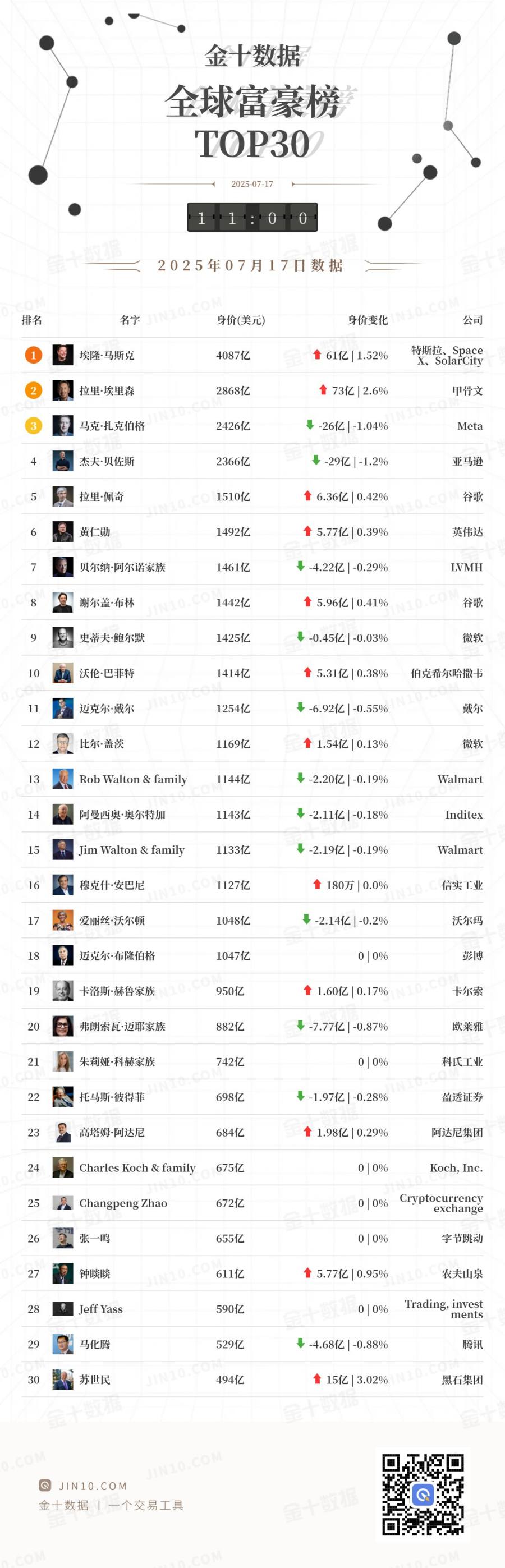
金十图示:2025年07月17日(周四)全球富豪榜





news flash· 2025-07-17 03:03
Group 1 - Elon Musk remains the richest person with a net worth of $408.7 billion, experiencing an increase of $1.61 billion or 1.52% [1] - Larry Ellison ranks second with a net worth of $286.8 billion, up by $7.3 billion or 2.6%, associated with Oracle [1] - Mark Zuckerberg's net worth decreased by $2.6 billion or 1.04%, bringing it to $242.6 billion, linked to Meta [1] Group 2 - Jeff Bezos has a net worth of $236.6 billion, down by $2.9 billion or 1.2%, related to Amazon [1] - Larry Page's wealth stands at $151.0 billion, increasing by $6.36 billion or 0.42%, connected to Google [1] - Jensen Huang's net worth is $149.2 billion, with a rise of $5.77 billion or 0.39%, associated with Nvidia [1] Group 3 - The Bernard Arnault family has a net worth of $146.1 billion, decreasing by $4.22 billion or 0.29%, linked to LVMH [1] - Sergey Brin's wealth is $144.2 billion, increasing by $5.96 billion or 0.41%, also related to Google [1] - Steve Ballmer's net worth is $142.5 billion, with a slight decrease of $0.45 billion or 0.03%, associated with Microsoft [1] Group 4 - Warren Buffett's net worth is $141.4 billion, increasing by $5.31 billion or 0.38%, linked to Berkshire Hathaway [1] - Michael Dell has a net worth of $125.4 billion, down by $6.92 billion or 0.55%, associated with Dell [1] - Bill Gates' wealth stands at $116.9 billion, with a slight increase of $1.54 billion or 0.13%, related to Microsoft [3]
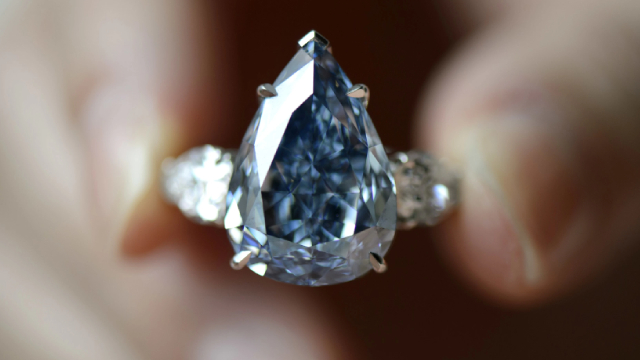
欧美豪买珠宝抗通胀,卡地亚业绩大涨,但中国消费者不买账?
Nan Fang Du Shi Bao· 2025-07-17 02:51
Core Viewpoint - Richemont Group reported a sales increase in Q1 of FY2025, driven by strong performance in the jewelry segment, despite a general slowdown in the luxury market [2][4]. Financial Performance - The group's sales reached €5.41 billion (approximately ¥450 billion), reflecting a 6% year-over-year growth at constant exchange rates, although slightly below analyst expectations of €5.47 billion [4]. - The net cash flow as of June 30 was €7.4 billion, indicating a stable financial position, with a 21% increase in stock price year-to-date [4]. Segment Analysis - The jewelry segment, including brands like Cartier and Van Cleef & Arpels, saw an 11% year-over-year sales increase, totaling €3.91 billion, contributing over 70% to the group's overall revenue [6]. - The watch segment, which includes brands like Vacheron Constantin and Piaget, experienced a 7% decline in sales to €824 million, indicating ongoing challenges [8]. - Other business segments, including fashion and accessories, saw a slight 1% decrease in sales, with notable performances from brands like Peter Millar and Alaïa [10]. Market Performance - The Americas, Middle East, and Africa markets achieved double-digit growth, while the Asia-Pacific region remained flat overall, with a 7% decline in sales from mainland China, Hong Kong, and Macau [10]. - The demand for gold in China remains strong, with a 4.6% year-over-year increase in gold consumption, indicating a shift towards investment-grade products among younger consumers [12]. Competitive Landscape - The rise of Chinese brand Lao Pu Gold poses a competitive threat to Cartier, with the brand's success linked to cultural confidence in China [13]. - Richemont's leadership acknowledges the need for continued creativity to maintain relevance in the evolving jewelry market [13]. Strategic Initiatives - Van Cleef & Arpels is focusing on promoting its Perlée collection in China, aiming to enhance its brand presence and adapt to local consumer preferences [17].

为什么越丑的鞋越值钱?
36氪· 2025-07-16 13:37
Core Viewpoint - The article discusses the rise of "ugly shoes," particularly focusing on Crocs and Birkenstock, highlighting how their unconventional designs have led to significant market success and brand recognition despite initial criticism [5][31]. Group 1: Company Performance - Crocs has outperformed the Dow Jones U.S. Footwear Index for four consecutive years, indicating strong market performance [6]. - Birkenstock has maintained double-digit revenue growth for nine consecutive quarters, showcasing its robust financial health [9]. - In the 2024 fiscal year, Crocs' revenue growth has significantly slowed, while Birkenstock continues to achieve double-digit growth despite having only half the revenue of Crocs, yet its market value exceeds Crocs by over 50% [29]. Group 2: Brand Strategy - Crocs employs a volume-driven strategy, achieving over $2 billion in sales from its Classic Clog model alone in 2024, surpassing the total sales of Adidas' Yeezy line [33]. - The company has adopted a light-asset operational model, outsourcing production to third-party manufacturers and significantly reducing order lead times [34]. - In contrast, Birkenstock focuses on maintaining product scarcity, producing 95% of its products in Germany and controlling distribution to enhance brand value [36]. Group 3: Market Positioning - Birkenstock's average selling price has consistently increased, with a high full-price sales rate of 90%, attracting middle-class consumers and luxury investors alike [41]. - The brand has successfully positioned itself as a luxury item, with its products being sold at significantly higher prices on secondary markets after collaborations with high-end brands [41]. - The article emphasizes that the key to success for these brands lies not in aesthetics but in creating a narrative that resonates with consumers, positioning their products as more than just footwear [44][50].

Yen weakness finally subdues luxury splurge at Cartier-owner Richemont
CNBC· 2025-07-16 07:36
Core Insights - The luxury market in Japan has experienced a decline in sales for Richemont, with a 15% year-on-year decrease at constant exchange rates in the fiscal first quarter [1] - This decline follows a significant 59% increase in revenues during the same quarter last year, driven by a weaker yen that boosted international tourism and luxury spending [2] - The depreciation of the yen began last year after the Bank of Japan ended negative interest rates and its yield curve control policy, leading to the yen reaching 38-year lows [2] - Richemont had previously benefited from the yen's weakness, reporting sales growth of 20% to 25% in Japan over consecutive quarters [3] - Other luxury groups, including LVMH, Kering, and Burberry, also experienced sales increases during this period, particularly from Chinese tourists [3] - A recent strengthening of the yen in the first half of 2025 has negatively impacted these sales trends [3]
加拿大鹅或被出售 贝恩资本12年投资面临退场
Xin Lang Zheng Quan· 2025-07-16 07:26
Core Viewpoint - The high-end consumer market is experiencing a downturn, prompting Bain Capital, the controlling shareholder of Canada Goose, to consider selling part or all of its stake in the company [1][2][3] Group 1: Bain Capital's Exit - Bain Capital has held Canada Goose's controlling stake since 2013, and its potential exit reflects a long investment cycle that exceeds the typical 5-10 years for private equity funds [2] - The firm has successfully driven Canada Goose's international expansion and its dual listing in 2017, achieving approximately a 7-fold increase in valuation from acquisition to IPO [2][3] - The decision to exit is seen as a strategic move in response to market conditions, with Canada Goose's stock price down over 60% from its 2021 peak, despite a 31.27% increase since the beginning of 2025 [3] Group 2: Canada Goose's Performance - For the fiscal year 2025, Canada Goose reported revenue of $1.3484 billion, a modest increase of 1.1%, and a net profit of $94.8 million, indicating resilience amid a challenging consumer environment [4] - However, revenue growth has sharply declined, with sales growth rates dropping from 21.54% in 2022 to just 1.1% in 2025 [4] - The Chinese market, once a growth driver, showed only a 1% increase in revenue for fiscal 2025, a stark contrast to the 47% growth in the previous year [4] Group 3: Industry Challenges - The luxury goods sector is facing significant cooling, with a projected 3% decline in global organic sales in Q2 2025, worsening from a 1% drop in Q1 [3] - Structural changes in the industry, such as climate change affecting demand for down jackets, are creating additional challenges for Canada Goose [5] - Increased competition from brands like Moncler and local Chinese brands is intensifying market pressures, as these competitors offer similar products at lower prices [6] Group 4: Strategic Responses - Canada Goose is attempting to diversify its product offerings and improve operational efficiency by launching new product lines and acquiring outdoor brands [7] - The company is also focusing on enhancing its retail and e-commerce capabilities, particularly in the Chinese market, following multiple leadership changes [4][7] - Despite these efforts, analysts believe that Canada Goose's strategies may not be sufficient to compete effectively with rivals like Moncler, which has adopted a dual-brand strategy to mitigate cyclical challenges [7] Group 5: Future Implications - Bain Capital's potential exit could catalyze industry consolidation, signaling a shift in private equity's view on high-end functional apparel [8][9] - The future of Canada Goose will depend on its ability to address sustainability demands, digital transformation, and competition from emerging players [9] - The brand must reassess its value proposition in a warming world, questioning the ongoing demand for high-priced winter apparel [9]

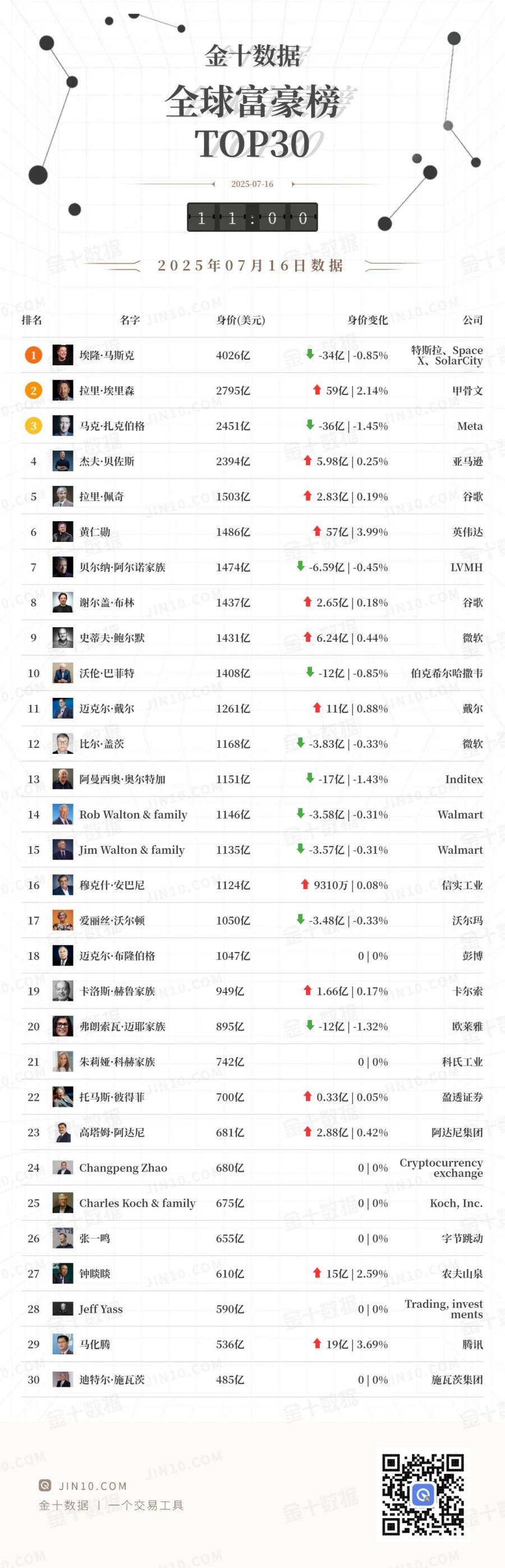
金十图示:2025年07月16日(周三)全球富豪榜
news flash· 2025-07-16 03:03
Core Insights - The article presents a ranking of the world's wealthiest individuals, highlighting their net worth and changes over a specific period. Group 1: Wealth Rankings - Elon Musk remains the richest person with a net worth of $402.6 billion, experiencing a decrease of $34 billion or 0.85% [1] - Larry Ellison ranks second with a net worth of $279.5 billion, an increase of $1.59 billion or 2.14% [1] - Mark Zuckerberg is third with a net worth of $245.1 billion, down by $3.6 billion or 1.45% [1] - Jeff Bezos follows in fourth place with a net worth of $239.4 billion, increasing by $5.98 billion or 0.25% [1] - Larry Page is fifth with a net worth of $150.3 billion, up by $2.83 billion or 0.19% [1] Group 2: Notable Wealth Changes - Huang Renxun (Jensen Huang) has a net worth of $148.6 billion, increasing by $5.7 billion or 3.99% [1] - The Bernard Arnault family has a net worth of $147.4 billion, decreasing by $6.59 billion or 0.45% [1] - Steve Ballmer's net worth is $143.1 billion, with an increase of $6.24 billion or 0.44% [1] - Warren Buffett's net worth stands at $140.8 billion, down by $1.2 billion or 0.85% [1] Group 3: Additional Wealth Rankings - Bill Gates has a net worth of $116.8 billion, decreasing by $3.83 billion or 0.33% [3] - Mukesh Ambani's net worth is $112.4 billion, with a slight increase of $0.93 billion or 0.08% [3] - Zhang Yiming has a net worth of $65.5 billion, remaining unchanged [3] - Ma Huateng's net worth is $53.6 billion, increasing by $1.9 billion or 3.69% [3]




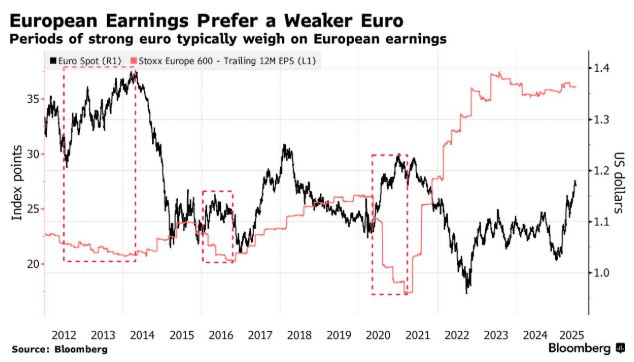
美元阴云笼罩欧股财报季:欧元升值13%重创欧企北美盈利,对冲策略成关键分水岭
智通财经网· 2025-07-15 08:24
Group 1 - The weak US dollar is expected to negatively impact European companies' earnings, making currency fluctuations a key issue for the earnings season [1] - Since the beginning of 2025, the euro has appreciated nearly 13% against the dollar, while the British pound has risen about 8% [1] - Companies with over 25% of their revenue from North America may face significant impacts from currency fluctuations, especially those lacking effective hedging strategies [1][5] Group 2 - Analysts have generally lowered their expectations, predicting a decline in European corporate earnings, which could lead to further downward revisions if negative trends continue [7] - The Stoxx 600 index is expected to see a year-on-year decline in earnings per share of 3%, marking the largest drop in five quarters due to weak demand and a 3.5% increase in the euro trade-weighted index [9] Group 3 - Sectors most sensitive to currency fluctuations include healthcare, luxury goods, and technology, with companies like Argenx (84% North America exposure) and Fresenius Medical (66% North America exposure) being particularly vulnerable [4] - Companies with advanced hedging strategies tend to perform better, as seen with Brunello Cucinelli SpA, which reported double-digit growth without being affected by currency fluctuations [14]
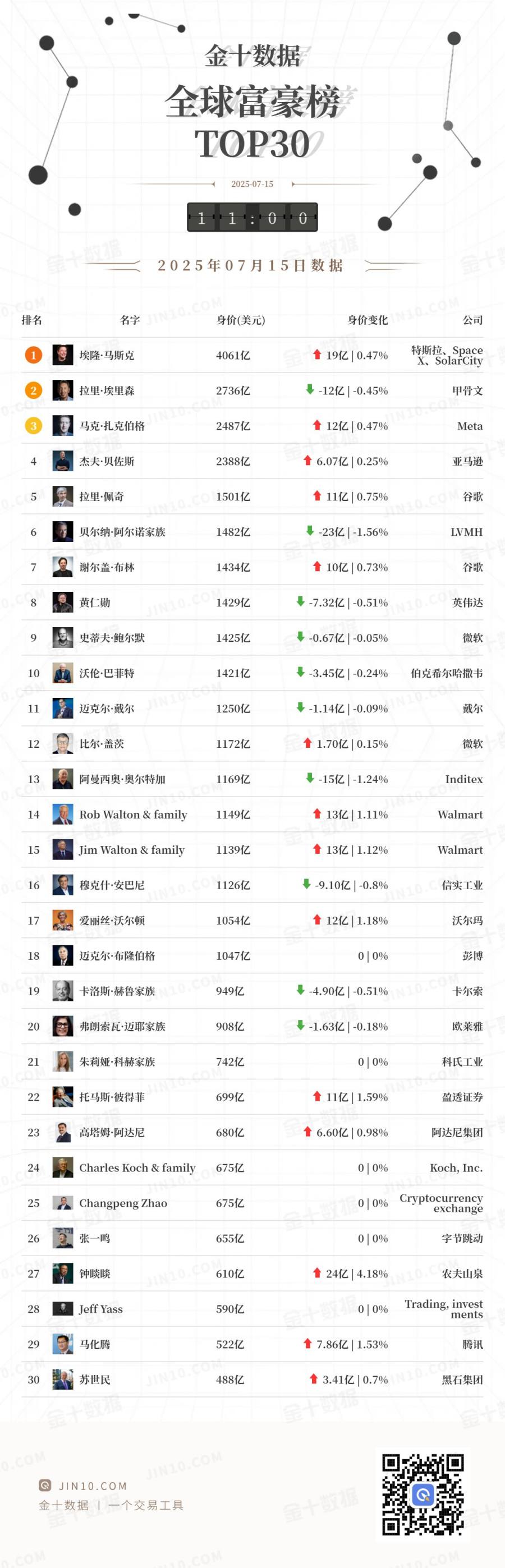
金十图示:2025年07月15日(周二)全球富豪榜
news flash· 2025-07-15 03:03
Group 1 - Elon Musk remains the richest person with a net worth of $406.1 billion, increasing by $1.9 billion or 0.47% [1] - Larry Ellison ranks second with a net worth of $273.6 billion, decreasing by $1.2 billion or -0.45% [1] - Mark Zuckerberg's net worth is $248.7 billion, up by $1.2 billion or 0.47% [1] - Jeff Bezos has a net worth of $238.8 billion, increasing by $6.07 million or 0.25% [1] - Larry Page's net worth is $150.1 billion, rising by $1.1 billion or 0.75% [1] Group 2 - The Bernard Arnault family has a net worth of $148.2 billion, decreasing by $2.3 billion or -1.56% [1] - Sergey Brin's net worth is $143.4 billion, increasing by $1 billion or 0.73% [1] - Jensen Huang has a net worth of $142.9 billion, decreasing by $732 million or -0.51% [1] - Steve Ballmer's net worth is $142.5 billion, decreasing by $67 million or -0.05% [1] - Warren Buffett has a net worth of $142.1 billion, decreasing by $345 million or -0.24% [1] Group 3 - Michael Dell's net worth is $125 billion, decreasing by $1.14 billion or -0.09% [3] - Bill Gates has a net worth of $117.2 billion, increasing by $1.7 billion or 0.15% [3] - Amancio Ortega's net worth is $116.9 billion, decreasing by $1.5 billion or -1.24% [3] - Rob Walton & family have a net worth of $114.9 billion, increasing by $1.3 billion or 1.11% [3] - Jim Walton & family have a net worth of $113.9 billion, increasing by $1.3 billion or 1.12% [3]