Arm Holdings plc

Search documents
暴跌40%!软银成为“OpenAI链”风向标
华尔街见闻· 2025-11-27 07:54
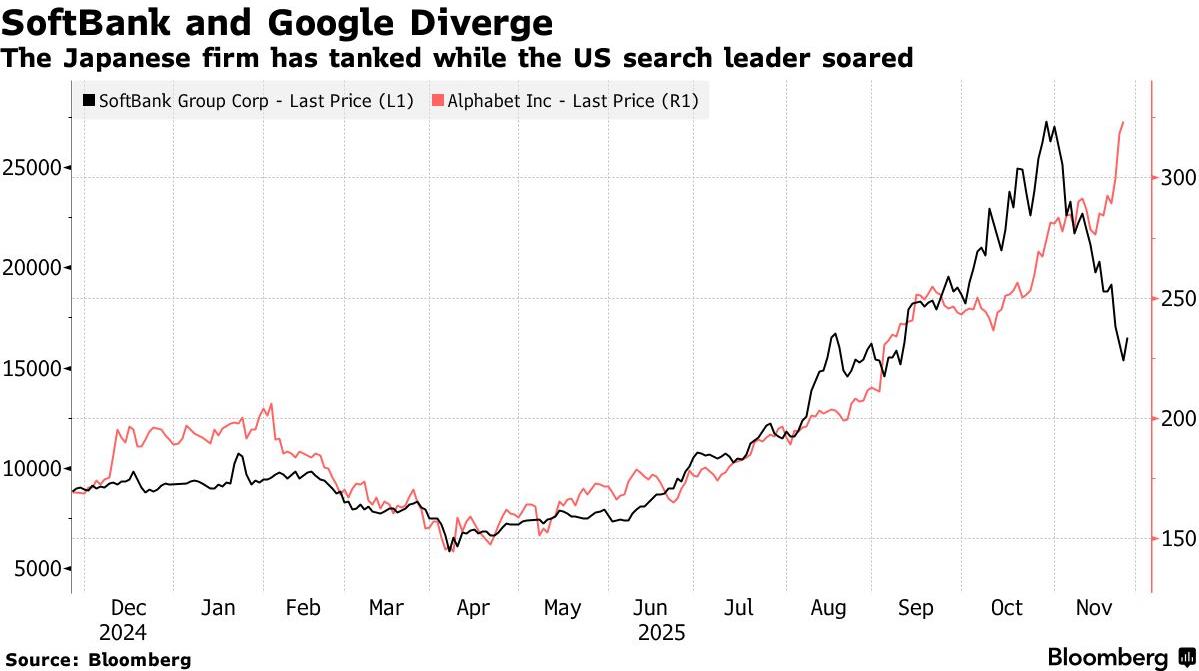
Core Viewpoint - The stock price of SoftBank Group has become a key indicator of market confidence in the non-public company OpenAI, amid rising concerns over overvaluation in the AI sector and changes in industry competition dynamics [1][3]. Group 1: SoftBank's Stock Performance - Since the end of October, SoftBank's stock has plummeted approximately 40%, resulting in a market value loss of over 16 trillion yen (about 102 billion USD) [3]. - The recent sell-off is primarily driven by market anxiety regarding competitive pressures faced by OpenAI, especially following the release of Alphabet's highly praised Gemini 3.0 model [3][9]. - The stock's decline reflects SoftBank's sensitivity to OpenAI's valuation and market position rather than a general downturn in the AI sector [9]. Group 2: Financial Implications and Investments - SoftBank previously benefited from its deep exposure to the AI sector, recording an unrealized gain of 14.6 billion USD from its investment in OpenAI, leading to a surprising net profit of 2.5 trillion yen in the second fiscal quarter [5]. - However, this same exposure has made SoftBank vulnerable to fluctuations in the AI industry [6]. - SoftBank is committed to paying 22.5 billion USD to OpenAI in December, part of a total investment commitment of 32 billion USD, which could represent over 20% of its net asset value if OpenAI's valuation reaches 500 billion USD [9]. Group 3: Strategic Moves by Masayoshi Son - Masayoshi Son aims to build a comprehensive AI ecosystem, going beyond being a financial investor in OpenAI, by engaging in various mergers and investments [10]. - SoftBank has sold shares in Nvidia and Oracle to raise funds for its AI chip and infrastructure strategy, believing that future devices will require high-efficiency AI chips [11]. - The company has acquired nearly 90% of Arm and completed a 6.5 billion USD acquisition of Ampere Computing, a server processor manufacturer [11]. Group 4: Market Dynamics and Investment Logic - The market is witnessing a shift in AI investment logic, moving away from indiscriminate buying of AI-related stocks to a more selective approach [13]. - Reports indicate that companies like Meta Platforms Inc. are planning to use Google's Gemini AI chips, raising concerns for Nvidia's business and affecting its Japanese suppliers [13][14]. - Conversely, companies like Toppan Holdings Inc. have seen stock price increases due to their partnerships in AI chip design, indicating a more nuanced evaluation of winners and losers within the AI supply chain [14].



今夜,大涨!
中国基金报· 2025-11-26 16:19
与此同时,针对2026年的乐观股市预测也开始陆续出炉。德意志银行策略师预计,标普500指数到2026年底将升至8000点,意味着还有18% 左右的上涨空间,背后支撑来自强劲的盈利和不断上升的股票回购。摩根大通的团队预计指数将达到7500点,法兴银行则给出的目标位是 7300点。 【导读】 科技股大涨 中国基金报记者 泰勒 大家好,今晚继续关注海外市场的消息。 11月26日晚间,美股三大指数集体上涨。道指大涨300点,纳指涨约0.7%。 分析师表示:"股市目前正在努力从过去几周的回调中反弹,这说明逢低买入的资金仍然非常积极。这次从10月末高点回落到 11月低点的跌幅其实只有大约4%,远低于典型意义上的10%回调线。我们确实预计股市会重新挑战此前高点,但从现在到年 底,并没有特别明显的利好催化剂能把市场进一步大幅往上推。" 交易员对降息的预期不断升温,在此前11月初,市场因科技股估值偏高而产生担忧,导致股市大幅回调,如今股市正重新积聚 动能。此后,美联储官员的一些"鸽派"表态又重新点燃了市场对12月降息的押注。 科技股集体大涨,费城半导体指数大涨超2%。 | 了 筛选 | | 最新价 = | 涨跌幅 = □' | ...

Stocks Climb on Hopes of Lower Interest Rates
Yahoo Finance· 2025-11-26 16:14
Economic Indicators - The Bureau of Labor Statistics (BLS) canceled the October consumer price report and will release the November report on December 18, while the October employment report will be included in the November report scheduled for December 16 [1] - The US November MNI Chicago PMI fell by 7.5 points to 36.3, marking the steepest contraction in 17 months and significantly below expectations of 43.6 [1][6] - US September capital goods new orders, excluding defense and aircraft, rose by 0.9% month-over-month, surpassing expectations of 0.3% [2] - Weekly initial unemployment claims unexpectedly fell by 6,000 to a 7-month low of 216,000, indicating a stronger labor market than the anticipated increase to 225,000 [2] Stock Market Performance - The S&P 500 Index rose by 0.49%, the Dow Jones Industrials Index increased by 0.51%, and the Nasdaq 100 Index was up by 0.54% [7] - Strength in semiconductor stocks contributed to market gains, with notable increases in companies like ASML Holding NV and Marvell Technology [12] - Optimism regarding a potential Federal Reserve rate cut is boosting stock prices, with the probability of a rate cut at the December FOMC meeting rising to 81% from 30% [5][7] Corporate Earnings - Q3 earnings for S&P 500 companies showed a 14.6% increase, more than doubling the expected 7.2% year-over-year growth, with 83% of companies exceeding forecasts [8] - Urban Outfitters reported Q3 net sales of $1.53 billion, exceeding the consensus of $1.49 billion, leading to a stock increase of over 12% [13] - Dell Technologies raised its 2026 revenue forecast to $112.2 billion, up from a previous estimate of $105 billion to $109 billion, which was stronger than the consensus of $107.94 billion [14] Company-Specific Developments - Boeing secured a $2.47 billion contract from the US Air Force for additional KC-46A Pegasus tankers, contributing to a stock increase of over 2% [15] - Nutanix's stock fell by more than 17% after reporting Q1 revenue of $670.6 million, which was below the consensus of $676.6 million [17] - Oracle's stock rose by more than 4% as analysts noted that the benefits of OpenAI have not yet been priced into the stock [14]
暴跌40%!软银成为“OpenAI链”风向标
美股IPO· 2025-11-26 11:15
Core Viewpoint - SoftBank's significant investment in OpenAI has exposed the company to volatility in AI valuations, leading to a stock price drop of approximately 40% since late October, primarily due to increased competition from Google's Gemini 3.0 [1][3][6] Group 1: Stock Performance and Market Sentiment - SoftBank's stock price has fallen about 40% since late October, resulting in a market value loss of over 16 trillion yen (approximately 102 billion USD) [3][5] - The release of Google's Gemini 3.0 has heightened concerns about OpenAI's competitive position, causing a 24% drop in SoftBank's stock price following the announcement [6][8] - The market's reaction indicates a reassessment of the risks and returns associated with SoftBank's aggressive investment strategy in AI [5][6] Group 2: Financial Commitments and Valuation Concerns - SoftBank is obligated to pay 22.5 billion USD to OpenAI in December as part of a total commitment of 32 billion USD, which could represent over 20% of SoftBank's net asset value if OpenAI's valuation reaches 500 billion USD [8][9] - Concerns about inflated valuations in the AI sector are growing, with SoftBank's CFO admitting uncertainty regarding the existence of an AI bubble [8][9] Group 3: Strategic Investments in AI Infrastructure - SoftBank's founder, Masayoshi Son, aims to build a comprehensive AI ecosystem through acquisitions and investments, including selling shares in Nvidia and Oracle to fund these initiatives [9][11] - The company holds nearly 90% of Arm, a chip architecture giant, and has recently acquired Ampere Computing LLC for 6.5 billion USD, while also planning to purchase ABB Ltd.'s robotics division for 5.4 billion USD [11][12] Group 4: Market Dynamics and Investment Strategy Shift - The era of indiscriminate buying of AI-related stocks is ending, with a shift towards more selective investment strategies as market differentiation becomes apparent [12] - Companies like Meta Platforms Inc. are opting for Google's Gemini AI chips, raising concerns for Nvidia's business and affecting its Japanese suppliers, while others like Toppan Holdings Inc. are benefiting from partnerships with Google [12][14]
Marvell Stock: AI Underdog
Forbes· 2025-11-26 10:20
Core Viewpoint - Marvell Technology's stock has declined nearly 31% in 2025, contrasting with a 16% rise in the Nasdaq-100, yet it remains reasonably priced compared to AI peers and has a strong financial position, suggesting potential for stock appreciation [2] Group 1: Stock Performance and Market Context - Marvell's stock underperformance is attributed to timing issues and delays in hyperscaler programs rather than a decline in its core business [5] - The stock's decline is significant but does not reflect Marvell's long-term strategic alignment within the AI landscape [5] Group 2: Competitive Advantages - Marvell possesses high-speed connectivity and custom silicon capabilities, establishing its AI footprint around the infrastructure layer, which is crucial for AI scalability [6][10] - As AI models evolve, the focus is shifting to data transfer rather than just compute capacity, an area where Marvell is recognized as a leading provider [7] Group 3: Industry Trends and Opportunities - Hyperscaler capital expenditures are substantial, with major companies like Amazon planning to invest up to $105 billion in 2025 for AI infrastructure [11] - The industry is transitioning from intense training cycles to large-scale inference, impacting custom AI accelerator orders and revenue forecasts [9] - Efficiency is becoming more important than raw computing power, driving demand for custom silicon solutions, which aligns with Marvell's strengths [12] Group 4: Valuation and Financial Health - Despite the stock's downturn, Marvell's fundamentals remain stable, with a valuation of 28x FY'26 forward earnings, lower than competitors like AMD and Nvidia [13][16] - Marvell has $4.8 billion in debt against a $69 billion market capitalization, resulting in a modest 7% debt-to-equity ratio, and $1.2 billion in cash with a 5.9% cash-to-assets ratio [16] - Bloomberg reported that SoftBank considered merging Marvell with ARM, highlighting Marvell's strategic relevance in AI silicon [16]

断崖式下跌40%!风暴眼中的软银(SFTBY.US):成也OpenAI,败也OpenAI?
智通财经网· 2025-11-26 09:44
Core Viewpoint - Concerns about the bubble-like valuations in the AI sector are weighing heavily on SoftBank Group's stock price, with the market increasingly viewing SoftBank as a "shadow proxy" for the unlisted OpenAI, leading to significant stock volatility [1][2]. Group 1: Stock Performance and Market Sentiment - SoftBank's stock has experienced a dramatic decline of nearly 40% since late October, resulting in a market capitalization loss of over 16 trillion yen (approximately $102 billion) [1]. - The recent launch of Google's Gemini 3.0 has intensified competitive pressures on OpenAI, contributing to a broader sell-off in the AI sector that has adversely affected SoftBank [1][2]. - Analysts suggest that SoftBank's stock fluctuations are more reflective of its sensitivity to OpenAI's performance rather than a general weakness in the AI market [4]. Group 2: Financial Performance and Strategic Moves - SoftBank's deep exposure to the AI sector, particularly its stake in OpenAI, has led to a significant unrealized gain of $14.6 billion, which was a key driver for a net profit surge to 2.5 trillion yen in the second fiscal quarter [2]. - The company is preparing to invest an additional $2.25 billion in OpenAI as part of a larger $32 billion commitment, highlighting its aggressive strategy to become a central player in the AI ecosystem [3][4]. Group 3: Strategic Acquisitions and Challenges - SoftBank recently completed a $6.5 billion acquisition of Ampere Computing, a U.S. chip design company, while also facing the need to raise funds for a proposed $5.4 billion acquisition of ABB Ltd.'s robotics division [3]. - The CFO of SoftBank expressed caution regarding the current valuation landscape, indicating that the determination of whether the AI sector is in a bubble can only be made in hindsight [3]. Group 4: Competitive Landscape and Investment Logic Shift - The rise of RISC-V architecture poses a competitive challenge to SoftBank's investments, as it gains traction in the AI chip design space, potentially impacting traditional players like NVIDIA [5]. - The investment logic in the AI sector is shifting from indiscriminate buying to a more selective approach, with investors now focusing on identifying winners and losers within the industry [6].

马来西亚德璞dprime透视英伟达及其持仓股:哪些 AI 趋势可寻?
Sou Hu Cai Jing· 2025-11-26 08:46
Core Insights - The AI sector in the US stock market is experiencing a new round of valuation recovery, reigniting market enthusiasm [3] - Nvidia's stock price has returned to its early-year high, and it briefly regained the top position in global market capitalization [3] - Other AI-related stocks, such as Oracle (ORCL) and Broadcom (AVGO), have also reached historical highs [3] - Nvidia's CEO Jensen Huang has been actively signaling strategic upgrades, with Morgan Stanley raising the company's target price following the GTC conference [3][6] Nvidia's Strategic Developments - Jensen Huang's recent speeches have highlighted Nvidia's strategic plans, including the evolution of traditional data centers into "AI factories" [4] - The new Blackwell architecture features NVLink technology with a backplane bandwidth of 130TB/s, significantly enhancing AI performance [4] Market Predictions and Analyst Ratings - Morgan Stanley forecasts a strong acceleration in Nvidia's growth, particularly in the European market, where revenue could increase eightfold from 2024 to 2026 [6] - The firm maintains an "overweight" rating with a target price of $170, indicating a potential upside of 17.49% from Nvidia's closing price on June 16 [6] - Other Wall Street firms have also reiterated positive ratings and target prices for Nvidia, with estimates ranging from $170 to $190 [9] Investment Landscape - Nvidia has established a venture capital arm, Nventures, to identify leading startups in the AI field, focusing on both core AI technology and its applications across various industries [10] - The company's investments span AI infrastructure, autonomous driving, and AI drug development, reflecting the rapid penetration of AI across sectors [10] - Nvidia's investment strategy emphasizes not only financial support but also technological empowerment and resource collaboration [10] Performance of Nvidia-Related Stocks - CoreWeave (CRWV) has seen a remarkable increase of over 290% since its listing in March, highlighting the volatility and growth potential in the AI sector [3][11] - Other notable Nvidia-related stocks include Arm Holdings (ARM) with a market cap of $150.46 billion and Nebius Group NV (NBIS) with a market cap of $12.01 billion, both showing significant year-to-date performance [11]

金价,大涨!油价,大跌
中国能源报· 2025-11-26 07:10
Economic Indicators - Recent data indicates a slowdown in consumer spending in the U.S., with September retail sales and producer price index showing signs of reduced economic momentum [1][3] - The private sector has seen an average weekly job cut of 13,500 positions over the past four weeks, indicating an increase in layoffs [1] Market Reactions - The expectation of interest rate cuts by the Federal Reserve has gained traction, leading to a rise in major U.S. stock indices, with the Dow Jones up 1.43%, S&P 500 up 0.91%, and Nasdaq up 0.67% [3] Technology Sector Developments - Google's new AI model, Gemini 3, has outperformed other models trained on Nvidia GPUs, leading to a surge in Alphabet's stock price, which rose 1.53% and approached a market capitalization of $4 trillion [6][8] - Nvidia's stock faced significant pressure, dropping over 7% at one point, and closing down 2.59%, marking a two-month low due to competition from Google's cost-effective TPU chips [10] European Market Trends - European stock indices collectively rose, driven by expectations of U.S. interest rate cuts and potential peace agreements in the Russia-Ukraine conflict, with the UK FTSE 100 up 0.78%, France's CAC 40 up 0.83%, and Germany's DAX up 0.97% [12] Commodity Price Movements - International oil prices fell due to concerns over potential oversupply as reports suggested Ukraine's agreement to a U.S.-proposed peace deal, with WTI crude closing at $57.95 per barrel, down 1.51% [15] - Gold prices increased by over 1% as expectations of Fed rate cuts led to a decline in U.S. Treasury yields and a weaker dollar, with December gold futures closing at $4,140.0 per ounce, up 1.12% [16]


软银(SFTBY.US)AI硬件宏图添关键资产!65亿美元收购Ampere落定
智通财经网· 2025-11-26 06:53
Core Viewpoint - SoftBank Group has completed the acquisition of US chip startup Ampere Computing for $6.5 billion, enhancing its position in the AI hardware sector [1][2] Group 1: Acquisition Details - The acquisition of Ampere Computing makes it a wholly-owned subsidiary of SoftBank Group, with its financial performance to be included in SoftBank's consolidated financial statements from the acquisition date [1] - Following the announcement, SoftBank's stock price rose by 8% in early trading on the Tokyo Stock Exchange [1] Group 2: Company Background - Ampere Computing was founded in 2018 by former Intel president Renee James and focuses on developing data center server chips based on Arm architecture, aiming to challenge the x86 ecosystem [1] - The company has launched the Ampere Altra and Ampere Altra Max cloud-native processors, which are already in use in seven major global data centers [1] Group 3: Strategic Implications - SoftBank, already a major shareholder in Arm, aims to leverage its holdings in Arm, Ampere, and Graphcore to regain control over key technologies in the global AI computing infrastructure ecosystem [2] - The acquisition significantly strengthens SoftBank's business layout in AI computing infrastructure, creating a vertical integration of instruction set architecture, CPU, and accelerator chips [2] Group 4: Vision of Leadership - SoftBank founder Masayoshi Son is focused on his "AI super blueprint," aiming to capitalize on the global AI wave for substantial investment returns [3] - The strategy includes a $500 billion project called "Stargate" in collaboration with OpenAI, Oracle, and the Abu Dhabi Technology Investment Fund, alongside significant long-term investments in AI leaders like OpenAI and TSMC [3]
AI 芯片迎来 “三国杀” 时代?谷歌被曝截胡 Meta 芯片大单,英伟达 10% 收入遭抢,AMD 躺枪大跌
AI前线· 2025-11-26 06:15
Core Insights - Meta is considering purchasing Google's Tensor Processing Units (TPUs), which could significantly impact the competitive landscape in AI chip supply [2][5][6] - The potential deal could allow Google to capture up to 10% of NVIDIA's data center revenue, translating to hundreds of billions in revenue growth for Google [2][5] - The introduction of TPUs as a viable alternative to NVIDIA's GPUs may alter the dynamics of the AI semiconductor market, intensifying competition [9][8] Group 1: Meta's Strategic Move - Meta plans to invest billions in Google's TPU technology, with chips expected to be deployed in its data centers by 2027 [2][5] - This partnership is seen as a strategic move to diversify Meta's chip supply and reduce reliance on a single vendor, thereby mitigating business risks [6][11] - Meta's capital expenditure for AI infrastructure is projected to reach between $70 billion and $72 billion this year, indicating a strong commitment to AI development [5] Group 2: Google's Competitive Position - Google's TPU technology is viewed as a core competitive advantage, providing efficient AI-specific computing solutions [2][4] - The latest TPU iteration, Ironwood, features advanced capabilities, including a dual-chip design and high-speed memory, enhancing its performance for AI workloads [4][5] - Google's cloud division is experiencing accelerated demand for both TPUs and NVIDIA GPUs, reflecting a growing market for AI infrastructure [7] Group 3: Market Reactions and Implications - Following the news of Meta's potential TPU procurement, Alphabet's stock rose approximately 5%, pushing its market capitalization above $3.8 trillion [5][6] - NVIDIA's stock experienced a decline, with a maximum drop of 7% following the announcement, indicating market concerns over its competitive position [2][8] - Other chip companies, such as AMD and Arm, also saw stock declines, suggesting a broader market reaction to the shifting competitive landscape in AI semiconductors [9] Group 4: Technical Challenges and Considerations - The integration of Google's TPUs into Meta's existing infrastructure may present significant challenges due to differences in architecture and programming models [11][12] - Meta's proprietary deep learning framework, PyTorch, will require adaptations to run efficiently on TPUs, potentially complicating the deployment process [11][12] - Despite these challenges, both companies have substantial software development resources, which may facilitate overcoming integration hurdles [12][13]