大成基金

Search documents
主动权益基金十年考:仅2只破百亿!大成高鑫A规模166亿十年涨416%,中欧时代先锋A规模123亿涨345.15%
Xin Lang Ji Jin· 2025-10-28 08:57
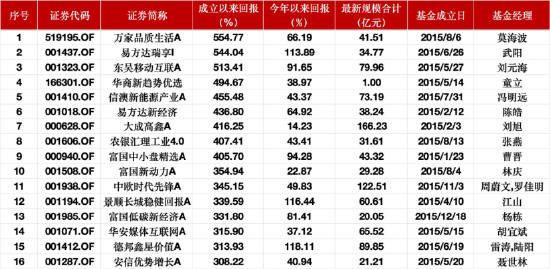
Core Insights - The report highlights the significant performance differentiation among 419 actively managed equity funds established in 2015, with a focus on long-term returns and strategic adjustments in holdings [1] Fund Performance - Only 2 funds have surpassed 10 billion yuan in size, namely Dachen Gaoxin A (16.623 billion yuan) and Zhongou Shidai Xianfeng A (12.251 billion yuan) [2] - Dachen Gaoxin A has achieved a cumulative return of 416.25% since its inception, with an annualized return of 16.51%, growing from 176 million yuan to 16.623 billion yuan, a nearly 95-fold increase [2][6] - Zhongou Shidai Xianfeng A has a total return of 345.15% over 10 years, with an annualized return of 16.12%, ranking 5th among 136 similar funds [6] Portfolio Composition - The funds have invested heavily in leading companies across various sectors, including China Mobile, Midea Group, Haomai Technology, and Tencent, reflecting a balanced approach between stable blue-chip stocks and high-growth companies [4] - Significant adjustments were made in the third quarter, with major reductions in cyclical and overseas assets, including a 43.91% reduction in China National Offshore Oil Corporation and a 22.07% reduction in Fuyao Glass [6][7] Investment Strategy - The fund managers emphasize a long-term investment philosophy focused on stock selection and understanding business fundamentals, contrasting with short-term trading behaviors [6][10] - In the AI sector, the funds are investing in areas such as humanoid robots, autonomous driving, and AI smart terminals, driven by positive industry trends and commercial viability [10] Market Trends - The report indicates a trend of increasing investment in cyclical and high-end manufacturing sectors, with notable increases in holdings of Wanhuachina and Sany Heavy Industry by 20.75% and 19.10%, respectively [9] - The balance between fund performance and size is highlighted as a critical consideration for fund managers and investors, with larger funds potentially facing flexibility issues and smaller funds at risk of liquidation [10]

周期行业基金:从投资能力分析到基金经理画像:金融产品每周见20251028-20251028
Shenwan Hongyuan Securities· 2025-10-28 06:38
Report Title - Cycle Sector Funds: From Investment Ability Analysis to Fund Manager Portraits - Weekly Insights on Financial Products 20251028 [1] Report Industry Investment Rating - Not provided in the report Core Viewpoints - Based on fund holdings, cycle sector funds can be classified into 5 types: "Cycle + Satellite", "Sector Rotation", "Sub - sector", "Cycle Rotation", and "Cycle Equilibrium". Most fund managers adopt "Cycle + Satellite" and "Sub - sector (mainly resources and energy)" strategies, with the fewest using the "Cycle Equilibrium" strategy [3]. - Three overall investment ability analyses of cycle sector funds: They can create relatively stable excess returns in the long - term compared to the sector index; are relatively good at stock - picking in utilities, basic chemicals, petroleum and petrochemicals, and non - ferrous metals, have outstanding stock - picking ability in building materials, transportation, coal, and steel in some periods, and are relatively weak in building decoration; and cycle sector fund managers have more prominent cycle stock - picking ability than all - sector fund managers [3]. - Seven dimensions to compare cycle sector funds with different style characteristics: High turnover does not necessarily mean high returns; there are many high - dividend and high - ROE style products, mainly mid - and large - cap stocks; most cycle sector funds hold idiosyncratic stocks; resource funds are more right - sided overall, while energy funds are more left - sided; by analyzing the skewness and kurtosis coefficients of stock - picking returns, fund managers with high confidence in stock - picking ability can be found; by finding similar funds and analyzing their performance in good and bad times, the environmental adaptability of fund managers can be characterized; there are products with outstanding sector rotation ability [3]. - How to screen the observation list of cycle sector funds: Screen with the following quantitative indicators: excess performance momentum, performance in good and bad environments, stock - picking ability, left - and right - sided investment ability; for rotation - type products and "Cycle + Satellite" style products, additionally consider their sub - sector rotation effects; other indicators to consider include the fund manager's tenure being as long as possible and the fund size being neither too large nor too small [3]. Summary by Directory 1. Cycle Sector Fund Screening and Classification - **Classification Method**: Based on Shenwan primary industry characteristics, four sub - sectors of the cycle sector are identified. Funds are classified into 5 types according to their average allocation ratio and rotation ratio in the cycle sector in the past three years: "Cycle + Satellite" (average cycle allocation ratio between 60% - 70%), "Sector Rotation" (average cycle allocation ratio below 50%), "Sub - sector" (average sub - sector allocation ratio > 50%), "Cycle Rotation" (annual average change in industry allocation ratio > 50%), and "Cycle Equilibrium" (the rest) [10]. 2. Cycle Sector Fund Stock - holding Characteristics - **Overall Excess Returns**: Cycle sector funds can create relatively stable excess returns in the long - term compared to passive indices, with prominent excess returns from February to August 2024 and since May 2025 [22]. - **Industry - Level Excess Returns**: They are relatively good at stock - picking in utilities and basic chemicals, have outstanding performance in building materials in some periods, and are relatively weak in building decoration [23]. - **Stock - picking Ability Comparison**: Cycle sector fund managers have more prominent cycle stock - picking ability than all - sector fund managers [32]. - **Stock - holding Preferences**: Cycle sector funds prefer to allocate resources, with most of their heavily - held cycle stocks in the resources category in the past two years. In contrast, balanced funds initially paid more attention to energy stocks, and no single category of stocks is overly favored in the top - allocated stocks in 25H1. Few stocks are continuously heavily held by cycle sector or balanced funds, indicating a natural rotation tendency of cycle stocks [37]. - **Cluster Analysis**: There are four relatively unique types: focusing on gold (e.g., Qianhai Kaiyuan Gold and Silver Jewelry), focusing on energy (coal) (e.g., Wanjia Selection A), focusing on transportation (e.g., GF Multi - Strategy), and generally偏向 resources (e.g., Qianhai Kaiyuan Shanghai - Hong Kong - Shenzhen Core Assets) [41]. 3. Comparison of Cycle Sector Funds with Different Style Characteristics - **Turnover and Return**: High - turnover cycle sector funds do not generally achieve higher returns in the short - term. In the long - term, there are high - performing products in both high - turnover and low - turnover groups [48]. - **Stock - holding Style**: There are many high - dividend and high - ROE style products in cycle sector funds, and most of their holdings are mid - and large - cap stocks. Different types of cycle sector funds have different market - cap preferences, with chemical funds having smaller - cap holdings, other sub - sector funds having mid - cap holdings, and balanced, rotation, and "Cycle + Satellite" products having relatively larger - cap holdings [49][53]. - **Stock Popularity**: Most cycle sector funds hold idiosyncratic stocks. Most high - performing cycle sector funds mainly hold individual idiosyncratic stocks, but some also hold more market - preferred stocks [61]. - **Left - and Right - sided Investment**: The left - sided buying coefficient of cycle sector funds is at the median level of active equities. Resource funds are more right - sided, energy funds are more left - sided, and balanced, "Cycle + Satellite", and rotation style products are around the median level. There are high - performing funds on both the left and right sides [66]. - **Stock - picking Ability**: By analyzing the skewness, kurtosis, and mean/standard deviation of stock - picking returns, funds with appropriate right - skewed returns, moderate kurtosis, and high mean/standard deviation can be selected [69]. - **Performance in Good and Bad Times**: Different types of products show different market environment adaptability. For example, many products with strong performance in bad times are "Cycle + Satellite" products, while those with strong performance in good times are mostly sub - sector theme products [72]. - **Sub - sector Rotation**: There are products with outstanding rotation ability in cycle sector funds, including actively rotating, rotation - downplaying, and timely - rotating products [76]. 4. Cycle Sector Fund Observation List - Quantitative indicators for screening: Excess performance momentum, performance in good and bad environments, stock - picking ability, left - and right - sided investment ability, sub - sector rotation effects for rotation - type and "Cycle + Satellite" style products, and other considerations such as the fund manager's tenure and appropriate fund size [79]. - Observation list: Funds such as Nuode Lixin A, Invesco Great Wall Pillar Industries A, ICBC Dividend Preferred A, SDIC UBS Prosperity Drive A, Dacheng Trend Industry A, and Dacheng State - owned Enterprise Reform A are included [3][80]
万润新能股价涨5.38%,大成基金旗下1只基金重仓,持有6.72万股浮盈赚取22.78万元
Xin Lang Cai Jing· 2025-10-28 03:24
Core Insights - Wanrun New Energy's stock price increased by 5.38% on October 28, reaching 66.45 CNY per share, with a trading volume of 236 million CNY and a turnover rate of 4.31%, resulting in a total market capitalization of 8.381 billion CNY. The stock has risen for three consecutive days, with a cumulative increase of 9.38% during this period [1] Company Overview - Hubei Wanrun New Energy Technology Co., Ltd. is located in Shiyan City, Hubei Province, and was established on December 24, 2010. The company went public on September 29, 2022. Its main business involves the research, production, sales, and service of lithium battery cathode materials [1] - The revenue composition of the company is as follows: lithium iron phosphate accounts for 96.49%, by-products 2.83%, phosphoric acid iron 0.41%, and others 0.27% [1] Fund Holdings - Dachen Fund has a significant holding in Wanrun New Energy, with its Dachen Zhuo Xiang One-Year Holding Mixed A Fund (010369) holding 67,200 shares as of the second quarter, representing 1.2% of the fund's net value, making it the tenth largest holding. The fund has realized a floating profit of approximately 227,800 CNY today and 363,600 CNY during the three-day increase [2] - The Dachen Zhuo Xiang One-Year Holding Mixed A Fund was established on November 16, 2020, with a current size of 208 million CNY. Year-to-date returns are 7.75%, ranking 6326 out of 8155 in its category, while the one-year return is 8.96%, ranking 5982 out of 8029. Since inception, the fund has returned 12.77% [2] - The fund manager, Su Bingyi, has a tenure of 13 years and 266 days, managing assets totaling 1.9 billion CNY, with the best fund return during his tenure being 245.86% and the worst being -71.74% [2]

机构风向标 | 瑞德智能(301135)2025年三季度已披露前十大机构持股比例合计下跌1.32个百分点
Xin Lang Cai Jing· 2025-10-28 02:57
Group 1 - The core viewpoint of the news is that 瑞德智能 (Reed Intelligent) has reported a decrease in institutional holdings in its A-shares, with a total of 8 institutional investors holding 19.30 million shares, representing 18.93% of the total share capital, which is a decline of 1.32 percentage points compared to the previous quarter [1] Group 2 - As of October 27, 2025, the total institutional holdings in 瑞德智能 (Reed Intelligent) amounted to 19.30 million shares, accounting for 18.93% of the total share capital [1] - The institutional investors include 佛山市瑞翔投资有限公司, 广东弘德投资管理有限公司, 广东美的智能科技产业投资基金管理中心, UBS AG, 中国工商银行, 深圳市银河风云网络系统股份有限公司, J.P.Morgan Securities PLC, and 国元证券 [1] - In the public fund sector, one public fund, 大成中证360互联网+指数A, reported a slight decrease in holdings, while 31 public funds did not disclose their holdings this quarter [2] - A new foreign institutional investor, UBS AG, was disclosed this quarter, indicating a slight change in foreign investment interest [2]
世纪瑞尔股价涨5.26%,大成基金旗下1只基金位居十大流通股东,持有290.56万股浮盈赚取84.26万元
Xin Lang Cai Jing· 2025-10-28 02:33
Group 1 - The core point of the news is that Century Real has seen a stock price increase of 5.26%, reaching 5.80 CNY per share, with a total market capitalization of 3.394 billion CNY [1] - Century Real's main business includes railway operation safety monitoring systems, urban rail transit passenger information service systems, and comprehensive railway operation and maintenance services [1] - The revenue composition of Century Real's main business is as follows: urban rail transit passenger information systems 34.84%, railway comprehensive informatization business 32.74%, railway operation safety monitoring systems 32.02%, and others 0.39% [1] Group 2 - Among the top ten circulating shareholders of Century Real, a fund under Dacheng Fund holds a position, specifically Dacheng CSI 360 Internet + Index A (002236), which reduced its holdings by 120,300 shares in the third quarter [2] - As of the latest data, Dacheng CSI 360 Internet + Index A has a total asset size of 698 million CNY and has achieved a year-to-date return of 38.29% [2] - The fund manager of Dacheng CSI 360 Internet + Index A is Xia Gao, who has a cumulative tenure of 10 years and 330 days, with the best fund return during this period being 225.06% [3]

迈信林股价涨5.16%,大成基金旗下1只基金重仓,持有5300股浮盈赚取1.71万元
Xin Lang Cai Jing· 2025-10-28 02:07
Group 1 - The core point of the article highlights the recent performance of Jiangsu Maxinlin Aerospace Technology Co., Ltd., which saw a stock price increase of 5.16%, reaching 65.78 CNY per share, with a trading volume of 178 million CNY and a turnover rate of 1.90%, resulting in a total market capitalization of 9.566 billion CNY [1] - Jiangsu Maxinlin was established on March 15, 2010, and went public on May 13, 2021. The company specializes in aerospace components and tooling, as well as precision components for various civil industries. The revenue composition is 85.69% from product sales and 14.31% from services [1] Group 2 - From the perspective of major fund holdings, Dachen Fund has a significant position in Maxinlin, with its Dachen Dynamic Quantitative Allocation Strategy Mixed A Fund (003147) holding 5,300 shares, accounting for 1.08% of the fund's net value, ranking as the eighth largest holding. The estimated floating profit today is approximately 17,100 CNY [2] - The Dachen Dynamic Quantitative Allocation Strategy Mixed A Fund was established on September 20, 2016, with a latest scale of 13.0132 million CNY. Year-to-date returns are 52.07%, ranking 1,076 out of 8,155 in its category; the one-year return is 58.16%, ranking 643 out of 8,029; and since inception, the return is 42.82% [2] - The fund manager, Xia Gao, has a tenure of 10 years and 330 days, managing total assets of 2.26 billion CNY, with the best fund return during the tenure being 225.06% and the worst being -71.74% [2]

10月纯债基金遇冷 公募新规临近债市格局有望重塑
2 1 Shi Ji Jing Ji Bao Dao· 2025-10-27 11:34
Core Insights - The bond fund products are experiencing significant redemptions, with at least 81 bond products facing large redemptions since the second half of 2025, particularly in October [1][2] - The shift in market preference has led to a decline in bond fund performance, while "fixed income+" and mixed products are gaining popularity [2][7] - The overall bond market is under pressure due to increased risk appetite for equities, resulting in a "strong stock, weak bond" market dynamic [1][3] Bond Market Performance - As of October 27, 2025, the average total return for short-term pure bond funds was only 0.03% for the past week and 0.20% for the past month, indicating poor performance [6] - The issuance of bond funds has significantly decreased, with only 19.52 billion units issued in October compared to 599.54 billion units in September [6][7] - The 10-year government bond yield fluctuated, with a recent drop to 1.8%, reflecting a volatile market environment [3][6] Market Dynamics - The bond market is facing a lack of clear direction, with trading logic rapidly changing and overall profitability weaker than in the equity market [2][3] - The new public fund fee regulations are impacting the market, leading to increased competition among fund managers, particularly affecting smaller public funds [2][8] - The anticipated changes in redemption rules and performance benchmarks are expected to reshape the investment landscape for bond funds [9]
天府证券ETF日报-20251027
天府证券· 2025-10-27 11:16
Report Overview - Report date: October 27, 2025 [5] - Analyst: Ma Yaoshi [5] - Qualification certificate: S1330524050001 [5] - Contact email: mayst@hxzb.cn [5] - Contact phone: 15201282186 [5] Market Overview - A-share market: The Shanghai Composite Index rose 0.71% to 3,950.31 points, the Shenzhen Component Index rose 2.02% to 13,289.18 points, and the ChiNext Index rose 3.57% to 3,171.57 points. The total trading volume of A-shares in the two markets was 1.9918 trillion yuan [2][6] - Leading gainers: Communications (4.73%), electronics (4.72%), and national defense and military industry (2.34%) [2][6] - Leading losers: Petroleum and petrochemicals (-1.36%), coal (-1.29%), and food and beverages (-1.18%) [2][6] Stock ETF - Top trading volume: The top three were the Harvest Shanghai - Science and Technology Innovation Board Chip ETF (up 5.40% with a discount rate of 5.47%), the ChinaAMC Shanghai - Science and Technology Innovation Board 50 ETF (up 4.21% with a discount rate of 4.31%), and the ChinaAMC CSI A500 ETF (up 1.38% with a discount rate of 1.49%) [3][7] Bond ETF - Top trading volume: The top three were the Haitong Fortune CSI Short - Term Financing Bond ETF (up 0.01% with a discount rate of 0.01%), the Bosera CSI Convertible and Exchangeable Bond ETF (up 0.43% with a discount rate of 0.54%), and the ChinaAMC Shanghai Benchmark Market - Making Treasury Bond ETF (down 0.02% with a discount rate of - 0.02%) [4][9] Gold ETF - Gold prices: AU9999 fell 0.60%, and Shanghai Gold fell 0.49% [12] - Top trading volume: The top three were the Huaan Gold ETF (down 0.49% with a discount rate of - 0.60%), the E Fund Gold ETF (down 0.50% with a discount rate of - 0.58%), and the Bosera Gold ETF (down 0.51% with a discount rate of - 0.63%) [12][13] Commodity Futures ETF - Performance: The Dacheng Non - Ferrous Metals Futures ETF rose 1.22% with a discount rate of 1.67%, the CCB Yisheng Zhengzhou Commodity Exchange Energy and Chemical Futures ETF fell 0.40% with a discount rate of - 0.03%, and the ChinaAMC Feed Soybean Meal Futures ETF fell 0.26% with a discount rate of 4.36% [13][14] Cross - Border ETF - Overseas indices: The Dow Jones Industrial Average rose 0.31%, the Nasdaq Composite rose 0.89%, the S&P 500 rose 0.58%, and the German DAX rose 0.23% the previous day. The Hang Seng Index rose 0.74%, and the Hang Seng China Enterprises Index rose 0.68% today [15] - Top trading volume: The top three were the E Fund CSI Hong Kong Securities Investment Theme ETF (up 1.28% with a discount rate of 1.65%), the Huatai - Peregrine CSI Korea Exchange Sino - Korean Semiconductor ETF (up 4.36% with a discount rate of 4.36%), and the Huatai - Peregrine Hang Seng Technology ETF (up 1.01% with a discount rate of 2.05%) [15][16] Money ETF - Top trading volume: The top three were the Yin Hua Day - to - Day Profit ETF, the Hua Bao Add - Benefit ETF, and the CCB Add - Benefit Money ETF [17][19]
天府证券ETF日报2025.10.27-20251027
天府证券· 2025-10-27 09:48
Report Summary Market Overview - On October 27, 2025, the Shanghai Composite Index rose 1.18% to 3996.94 points, the Shenzhen Component Index rose 1.51% to 13489.40 points, and the ChiNext Index rose 1.98% to 3234.45 points. The total trading volume of A-shares in the two markets was 2356.8 billion yuan. The top-performing sectors were communication (3.22%), electronics (2.96%), and comprehensive (2.68%), while the bottom-performing sectors were media (-0.95%), food and beverage (-0.20%), and real estate (-0.11%) [2][6]. Stock ETFs - The top-traded stock ETFs on this day were Huaxia SSE STAR 50 ETF, which rose 1.50% with a discount rate of 1.48%; Harvest SSE STAR Market Chip ETF, which rose 1.96% with a discount rate of 1.85%; and Huaxia CSI A500 ETF, which rose 1.28% with a discount rate of 1.33% [3][7]. Bond ETFs - The top-traded bond ETFs were Haifutong CSI Short-term Financing Bond ETF, which fell 0.00% with a discount rate of 0.00%; Cathay CSI AAA Sci-tech Innovation Corporate Bond ETF, which rose 0.02% with a discount rate of -0.03%; and Huaxia SSE Benchmark Market-making Corporate Bond ETF, which rose 0.06% with a discount rate of -0.31% [4][9]. Gold ETFs - Gold AU9999 fell 0.51% and Shanghai Gold fell 0.47%. The top-traded gold ETFs were Huaan Gold ETF, which fell 0.40% with a discount rate of -0.41%; Boshi Gold ETF, which fell 0.40% with a discount rate of -0.44%; and E Fund Gold ETF, which fell 0.46% with a discount rate of -0.44% [12]. Commodity Futures ETFs - Dacheng Non-ferrous Metals Futures ETF rose 0.72% with a discount rate of 1.30%; Jianxin Yisheng Zhengzhou Commodity Exchange Energy and Chemical Futures ETF rose 1.04% with a discount rate of 0.71%; and Huaxia Feed Soybean Meal Futures ETF rose 0.77% with a discount rate of 4.30% [15]. Cross-border ETFs - The previous trading day, the Dow Jones Industrial Average rose 1.01%, the Nasdaq rose 1.15%, the S&P 500 rose 0.79%, and the German DAX rose 0.13%. On this day, the Hang Seng Index rose 1.05% and the Hang Seng China Enterprises Index rose 1.10%. The top-traded cross-border ETFs were E Fund CSI Hong Kong Securities Investment Theme ETF, which rose 2.45% with a discount rate of 1.49%; Huatai-PineBridge Hang Seng Tech ETF, which rose 1.99% with a discount rate of 2.15%; and Huatai-PineBridge CSI KRX China-South Korea Semiconductor ETF, which rose 4.58% with a discount rate of 4.61% [18]. Money ETFs - The top-traded money ETFs were Yin Hua Ri Li ETF, Hua Bao Tian Yi ETF, and Money ETF Jian Xin Tian Yi [20].
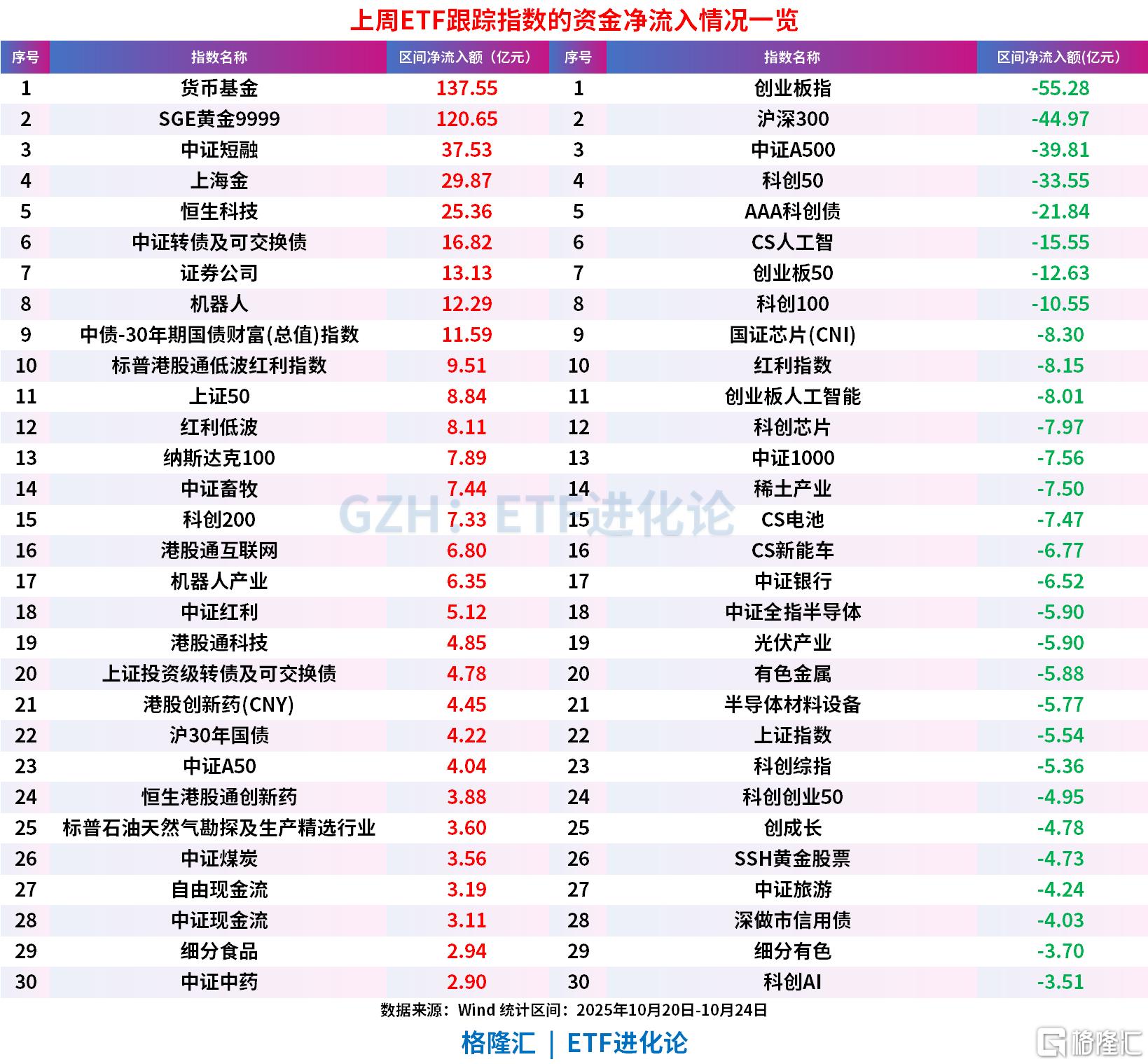
股票ETF上周大幅净流出超200亿,货币ETF、商品ETF均“吸金”超100亿
Ge Long Hui· 2025-10-27 09:28
Market Overview - The A-share market saw a broad increase last week, with the ChiNext Index, STAR Market 50, and Shenzhen Component Index leading gains at 8.05%, 7.27%, and 4.73% respectively, while the Shanghai Composite Index, CSI 300, and CSI 1000 lagged behind with returns of 2.88%, 3.24%, and 3.25% [1] - Trading volume for major indices decreased last week, with the communication, electronics, and machinery sectors performing well, returning 11.56%, 8.11%, and 4.8% respectively, while agriculture, food and beverage, and retail sectors underperformed with returns of -1.59%, -0.81%, and -0.28% [1] - Domestic and international equity markets performed well, with the ChiNext Index, Hang Seng Index, NASDAQ, and Nikkei 225 recording significant gains of 8.05%, 3.62%, 2.31%, and 3.61% respectively, leading to a rise in equity and QDII funds by 3.75% and 1.33% respectively [1] Fund Flow - The ETF market experienced a net inflow of 132.29 billion yuan last week, with stock ETFs seeing a net outflow of 264.97 billion yuan, while commodity ETFs and bond ETFs recorded net inflows of 153.25 billion yuan and 53.75 billion yuan respectively [2] - Notable net inflows were observed in money market funds, SGE Gold 9999, and CSI Short Bond, with inflows of 137.55 billion yuan, 120.65 billion yuan, and 37.53 billion yuan respectively [4] - Conversely, the ChiNext Index, CSI 300, and CSI A500 saw net outflows of 55.28 billion yuan, 44.97 billion yuan, and 39.81 billion yuan respectively [2][8] ETF Performance - Last week, stock ETFs generally rose, with A-share TMT ETFs, growth ETFs, and dual innovation ETFs showing high returns, averaging increases of 7.55%, 7.53%, and 7.30% respectively [11] - The top-performing ETFs included various ChiNext AI ETFs and communication ETFs, which surged over 13% [12] - In contrast, several robot-themed ETFs experienced declines, with the worst performers dropping between 9.34% and 10.03% [16][18] Fund Issuance - A total of 55 funds were reported last week, an increase from the previous week, including 3 FOFs and 4 QDIIs, with notable products such as the Guangfa CSI A50 ETF and Qianhai Kaiyuan STAR Market Semiconductor Equipment Theme ETF [20] - The total issuance scale of newly launched funds reached 154.96 billion yuan, with stock funds accounting for 82.38 billion yuan, mixed funds for 53.06 billion yuan, and bond funds for 19.52 billion yuan [20] - Last week, 28 new funds were established, with passive index funds and mixed FOFs being the most common types [20] Hot News - A public fund performance benchmark rule draft is set to be released [21] - Huatai-PineBridge's Yingtai Stable 3-Month Holding FOF completed fundraising in just one day, exceeding 50 billion yuan [21] - QDII funds tracking the NASDAQ and S&P 500 indices are facing purchase limits, with over 73% of funds limiting amounts to below 10,000 yuan [21]