鹏华基金

Search documents
新年新气象,4只ETF后天来“报到”
Sou Hu Cai Jing· 2026-01-03 12:46
Group 1 - The total public fund inflow after the New Year holiday exceeded 43 billion yuan, with 16 ETFs set to launch, collectively raising nearly 5 billion yuan [1] - The active equity funds established after November 2025 have a combined scale of over 38.7 billion yuan, indicating significant capital entering the market [4] Group 2 - The majority of ETF holders are individual investors, with some products having over 90% of their shares held by them, highlighting a strong retail interest [3] - Predictions suggest that an additional 2 trillion to 4 trillion yuan of liquid funds could enter the non-fixed deposit investment sector by 2026, indicating a substantial potential for market growth [3] - Six ETFs are scheduled to launch in the first week of 2026, with four of them debuting on January 5, 2026, contributing over 2 billion yuan to the A-share market [4]

见证历史,6万亿之上
Zhong Guo Ji Jin Bao· 2026-01-03 07:08
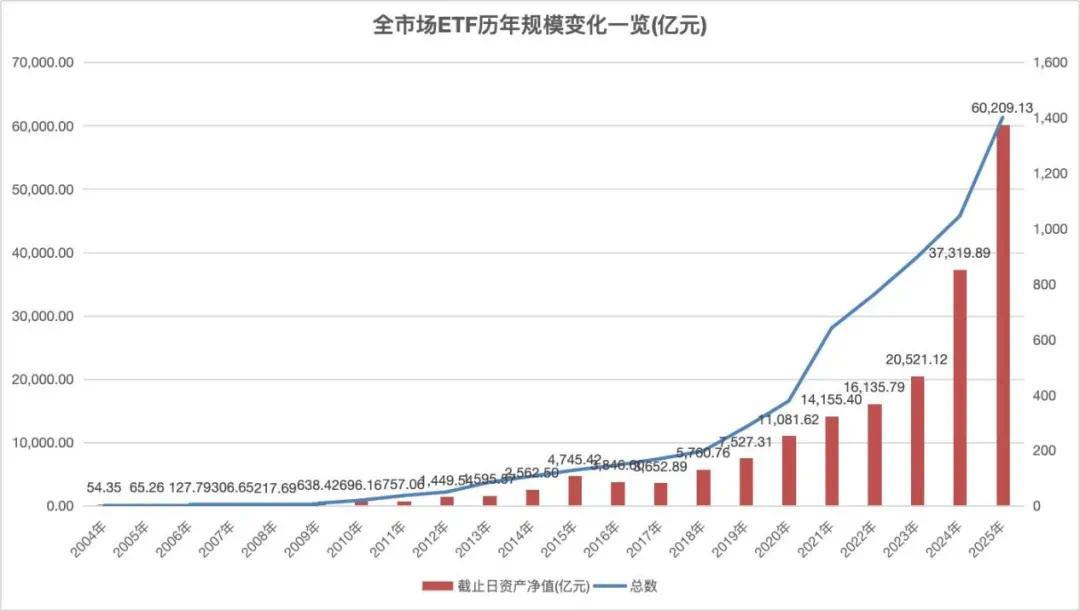
Group 1 - The total scale of the ETF market in China surpassed 6 trillion yuan for the first time, reaching 6.02 trillion yuan by the end of 2025, with a growth rate of 61.33% [2][4] - The number of ETF products increased from 1,046 at the end of 2024 to 1,401 by the end of 2025, marking a growth of 33.93% [2][4] - The market saw significant growth in various ETF categories, including bond ETFs, commodity ETFs, and cross-border ETFs, with the Hong Kong Stock Connect Internet ETF leading in net inflows [2][4][12] Group 2 - Six ETFs experienced a doubling in unit net value growth, particularly in sectors like communication, artificial intelligence, and non-ferrous metals, with the top ten performing ETFs averaging over 105% growth [4][6] - Conversely, some ETFs tracking food and beverage indices showed poor performance, with declines ranging from 7% to nearly 13% [4][6] Group 3 - Major fund companies such as Huaxia, E Fund, and Huatai-PB maintained the top three positions in ETF management scale, with Huaxia leading at 957.16 billion yuan [17][18] - In terms of net inflows, Huaxia and E Fund also led, with several other companies like Guotai and Fortune seeing net inflows exceeding 100 billion yuan [17][18] Group 4 - The bond ETF market saw explosive growth, with the total scale surpassing 800 billion yuan, driven by the popularity of the Sci-Tech Bond ETF [24][26] - The total number of newly established ETFs in 2025 reached a record high of 362, with a total issuance of 2.664 billion units, significantly exceeding previous years [22][23] Group 5 - The ETF custody market also experienced concentration, with major banks like Industrial and Commercial Bank of China and China Construction Bank leading in custody scale, collectively holding over 4.5 trillion yuan [29][30] - A trend of standardization in ETF naming emerged, with major institutions like E Fund completing the renaming of their ETFs to align with new guidelines [31]
这个板块火了!成立不足一年,ETF规模突破110亿元
Zheng Quan Shi Bao Wang· 2026-01-03 06:37
Core Insights - The satellite sector has shown remarkable investment performance, with several satellite ETFs experiencing over 40% growth in December alone, leading to a total market size exceeding 11 billion yuan by the end of December 2025, a significant increase of over 140% from the end of November 2025 [1][2] Group 1: Market Performance - By December 31, 2025, the total scale of satellite-related ETFs and linked products surpassed 11 billion yuan, with a notable increase from 4.491 billion yuan at the end of November [1][2] - The first satellite ETF tracking the National Commercial Satellite Communication Industry Index was launched by Yongying Fund, achieving a scale of 6.66 billion yuan and a return of 71.15% since its inception [1][2] - The largest product tracking the CSI Satellite Industry Index is the ZhaoShang CSI Satellite Industry ETF, with a scale of 1.531 billion yuan, contributing to a total of 4.397 billion yuan for all products linked to this index [1][2] Group 2: Industry Development - The satellite industry is recognized as a core component of the aerospace economy, with national strategies emphasizing its role in fostering new productive forces [3] - The "14th Five-Year Plan" includes the satellite industry as a strategic emerging industry, aligning with national security and technological advancement [3][4] - The industry has transitioned from a "follower" to a "leader" in global satellite technology, driven by advancements in low-orbit satellite internet and commercial remote sensing [4] Group 3: Investment Opportunities - Fund managers highlight that the commercial space sector is on the brink of a significant breakthrough, driven by policy support, technological advancements, and expanding application scenarios [5][6] - The successful business model of SpaceX and the potential of low-orbit satellite internet are seen as key drivers for industry growth [6] - Investment opportunities are identified in satellite launch schedules, breakthroughs in heavy-lift rockets, and cost reductions in rocket and satellite manufacturing [7]
这个板块火了!成立不足一年,ETF规模突破110亿元
券商中国· 2026-01-03 06:16
Core Viewpoint - The satellite industry is expected to shine by the end of 2025, with significant investment performance and a notable increase in the scale of related ETFs, which surpassed 11 billion yuan by the end of December 2025, marking a growth of over 140% from the previous month [1][2]. ETF Market Overview - As of the end of 2025, the total scale of satellite industry-related ETFs and linked products exceeded 11 billion yuan, with the largest being the Yongying National Commercial Satellite Communication Industry ETF at 6.66 billion yuan, achieving a return of 71.15% since its inception [1][2]. - The market features four satellite industry indices, with two having tracking products. The Yongying ETF is the only one tracking the National Commercial Satellite Communication Industry Index, while 11 products track the CSI Satellite Industry Index, with the largest being the Zhaoshang CSI Satellite Industry ETF at 1.531 billion yuan [2][4]. Industry Growth Drivers - The satellite industry is experiencing a surge in interest due to favorable policies, technological advancements, and expanding application scenarios, positioning it as a key component of the aerospace sector and a focus of national strategic goals [6][7]. - The "14th Five-Year Plan" has identified aerospace as a strategic emerging industry, with the satellite sector being a critical branch that is benefiting from a tripartite resonance of policy, capital, and technology [7][8]. Investment Opportunities - Fund managers believe that the commercial aerospace sector is on the brink of a breakthrough, driven by four key factors: policy support, technological breakthroughs, financial interest, and expanded application scenarios [8][9]. - Investment opportunities in the satellite industry are expected to arise from the rhythm of satellite launches, breakthroughs in large-capacity rockets, and cost reductions in rocket and satellite manufacturing [9].

见证历史!6万亿之上
Xin Lang Cai Jing· 2026-01-03 04:50
Group 1 - The core theme of the article is the significant growth of the ETF market in China, with the total market size reaching 6.02 trillion yuan by the end of 2025, marking a 61.33% increase from the previous year [4][6][33] - The number of ETF products increased to 1,401, reflecting a growth of 33.93% from the end of 2024, indicating a robust expansion in the market [4][27] - Major players in the ETF market include Huaxia, E Fund, and Huatai-PB, which dominate the management scale, with Huaxia leading at 957.16 billion yuan [23][24] Group 2 - The performance of ETFs showed structural differentiation, with six ETFs achieving a unit net value growth rate exceeding 100%, particularly in sectors like communication, artificial intelligence, and non-ferrous metals [6][7] - Conversely, some ETFs tracking food and beverage indices experienced declines, with the wine ETF dropping by 12.96% [9][6] - The top ten ETFs by net inflow included the Hong Kong Stock Connect Internet ETF, which attracted over 566 billion yuan, highlighting the strong demand for cross-border investment products [17][10] Group 3 - The bond ETF market also saw explosive growth, with the total size surpassing 800 billion yuan, driven by the popularity of the Sci-Tech Bond ETF, which accounted for over 50% of the annual growth in this segment [29][28] - The A500 ETF segment became a focal point of competition, with total assets exceeding 300 billion yuan and significant net inflows recorded in December 2025 [31][32] - The ETF issuance market experienced a historic surge, with 362 new ETFs launched in 2025, surpassing the total from the previous two years combined [27][28] Group 4 - The ETF custody market also expanded, with the top five custodians holding approximately 75% of the total ETF market size, indicating a concentration of assets among leading institutions [33] - A trend towards standardization in ETF naming was observed, with major firms like E Fund completing the renaming of their products to align with new regulatory guidelines [34]





430亿元!公募新年入市资金来了
证券时报· 2026-01-03 02:50
Core Viewpoint - The article discusses the anticipated influx of public funds into the market in 2026, driven by the launch of ETFs and actively managed equity funds, with a total expected scale exceeding 430 billion yuan by the end of 2025 [1][6]. Group 1: ETF Market - Six ETFs are set to launch in the first week of 2026, with a total funding of over 20 billion yuan, including significant contributions from individual investors [3][9]. - The total scale of the 16 ETFs expected to enter the market after New Year's is nearly 50 billion yuan, with a focus on technology and innovation sectors [3][6]. - The stock positions of these ETFs are currently low, indicating potential for future growth as they begin to deploy their capital [3][5]. Group 2: Actively Managed Equity Funds - Over 66 actively managed equity funds were established by the end of December 2025, with a total fundraising of approximately 387.35 billion yuan, contributing significantly to the market [4][5]. - The average return of these newly established funds is relatively low, suggesting that a substantial portion of the raised capital is yet to be invested [5]. Group 3: Potential for Increased Investment - There is a significant potential for "deposit migration" into the market, with estimates suggesting an additional 2 trillion to 4 trillion yuan could flow into non-fixed deposit investments in 2026 [10]. - The total scale of ETFs reached over 6 trillion yuan by the end of 2025, with nearly 1 trillion yuan added during that year, indicating strong investor interest [10]. Group 4: Market Dynamics and Future Outlook - The market is expected to shift its driving factors from valuation to profitability, with anticipated recovery in earnings growth and return on equity (ROE) levels in 2026 [11][12]. - The technology investment landscape is expected to become more challenging in 2026, requiring precise industry timing and stock selection to achieve excess returns [13].

430亿元!公募新年入市资金来了
券商中国· 2026-01-02 23:31
Core Viewpoint - The article discusses the anticipated influx of public funds into the market in 2026, driven by new ETFs and actively managed equity funds, with a total expected scale exceeding 430 billion yuan by the end of 2025 [5]. Group 1: ETF Market Overview - As of December 31, 2025, six ETFs are set to launch in the first week of 2026, collectively bringing over 20 billion yuan in incremental funds to the A-share market [3]. - The total scale of the 16 ETFs expected to enter the market after New Year's is nearly 50 billion yuan [3]. - Individual investors dominate the ownership of these new ETFs, with personal holdings exceeding 90% in many cases [2][8]. Group 2: Actively Managed Equity Funds - By the end of 2025, 66 actively managed equity funds were established, with a total fundraising scale of approximately 387.35 billion yuan [4]. - The average return since inception for these newly established funds is 0.75%, indicating that a significant portion of the raised funds is yet to be deployed in the market [4]. - Notable funds include Guangfa Quality Preferred and E Fund Industry Preferred, each exceeding 30 billion yuan in scale [4]. Group 3: Potential for Increased Market Participation - There is a significant potential for "deposit migration" into the market, with estimates suggesting an additional 2 trillion to 4 trillion yuan could flow into non-deposit investment areas in 2026 [9]. - The total scale of ETFs reached over 6 trillion yuan by the end of 2025, with nearly 1 trillion yuan being new inflows during that year [7]. Group 4: Market Dynamics and Future Outlook - The market is expected to shift its driving factors from valuation to profitability, with anticipated recovery in earnings growth and return on equity (ROE) levels in 2026 [10]. - The technology investment landscape is projected to become more challenging in 2026, requiring precise industry timing and stock selection for excess returns [11]. - Key areas of focus in the AI sector include optical communication, storage chips, domestic computing power breakthroughs, and AI application implementation [11].

主动管理、固收+、ETF三大赛道--一文读懂今年公募基金大赢家
Hua Er Jie Jian Wen· 2026-01-01 06:41
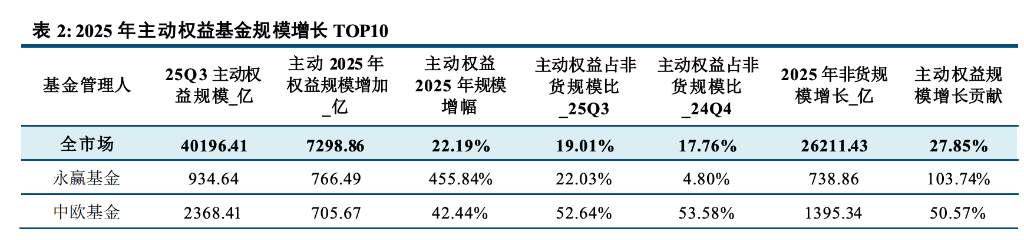
Core Insights - The public fund market is expected to accelerate growth in 2025, driven by a continued ETF investment boom and a shift towards multi-asset allocation strategies [1] - The report from CITIC Securities highlights a recovery in active equity fund sizes, primarily driven by net asset value increases, while passive index funds dominate growth [1][3] - Fixed income products are experiencing significant differentiation, with a notable expansion in "fixed income plus" products amid a low-interest-rate environment [1][13] Group 1: Fund Market Trends - By Q3 2025, the size of passive index funds increased by over 1.1 trillion yuan, with ETF sizes surpassing 5 trillion yuan [1] - Active equity funds have shown a recovery in excess returns, but their size growth is mainly due to net asset value increases, reflecting investors' tendency to take profits in a recovering market [1] - The fixed income market is weakening, with long-term pure bond fund sizes decreasing by over 600 billion yuan, while short-term pure bond funds decreased by nearly 250 billion yuan [1] Group 2: FOF Market Recovery - The FOF (Fund of Funds) market has significantly rebounded, with over 80 new FOF funds launched in 2025, totaling a new issuance scale of 80 billion yuan [2] - New FOFs increasingly reflect multi-asset allocation characteristics, including equity, fixed income, commodity funds, QDII funds, and public REITs [2] Group 3: Active Equity Fund Performance - Notable growth in active equity funds was observed among several fund managers, with Yongying Fund, China Europe Fund, and E Fund each increasing their active equity fund sizes by over 35 billion yuan [3][8] - Yongying Fund's "Smart Selection Series" achieved a remarkable growth of over 760 billion yuan in active equity fund size, with a 576 billion yuan increase attributed to this series alone [7][8] - China Europe Fund's active equity fund size grew by over 705 billion yuan, with a 42.44% increase, driven by strong performance in TMT sector funds [8] Group 4: Fixed Income Plus Fund Growth - The report indicates a significant growth in "fixed income plus" funds, with the size of these funds increasing by over 1.1 trillion yuan, particularly favored by institutional investors [13][14] - The leading growth in fixed income plus funds is attributed to secondary bond funds, with many achieving top rankings in performance over the past two years [14] Group 5: ETF Market Dynamics - The ETF market is showing a clear trend of concentration among leading players, with Huaxia Fund, E Fund, and Huatai-PB Fund each holding over 10% market share [16] - By Q3 2025, Huaxia Fund's ETF size reached 941.69 billion yuan, accounting for 16.52% of the market, while E Fund's ETF size was 872.96 billion yuan, representing 15.32% [16] - Major contributors to ETF size growth include gold ETFs and mainstream broad-based ETFs, with significant increases noted in the sizes of Huatai-PB CSI 300 ETF and Huaxia CSI 300 ETF [16][18]
顶流陨落,鹏华基金前副总王宗合突然病逝,一个时代的告别
Sou Hu Cai Jing· 2025-12-31 18:32
Core Insights - The passing of Wang Zonghe, a prominent figure in the public fund industry, marks a significant loss for the sector, reflecting both the glory and harsh realities of the high-pressure role of fund managers [2] Group 1: Career Highlights - Wang Zonghe's career peak was on July 8, 2020, when his management of Penghua Craftsmanship Selected Mixed Fund attracted 137.1 billion yuan in a single day, setting a record for public fund subscriptions [3] - His investment strategy focused on long-term holdings in leading companies, particularly in the liquor sector, resulting in annualized returns exceeding 10% for products like Penghua Consumer Preferred and Pension Industry, earning multiple awards [3] Group 2: Challenges and Decline - Following a market correction in late 2021, Wang's performance faced significant pressure despite attempts to pivot towards sectors like new energy and pharmaceuticals, leading to continued declines in net value [5] - Health issues began affecting Wang from 2021, yet he continued to fulfill his duties until he gradually stepped down from managing 21 funds between February and April 2023, officially leaving his vice president role in February 2024 [5] Group 3: Legacy and Industry Reflection - After Wang's departure, his flagship funds were taken over by new managers, but they struggled to maintain performance, with the Penghua Craftsmanship Selected Fund's scale shrinking to 6.5 billion yuan and experiencing nearly a 30% loss since inception [6] - The situation highlights the vulnerability of the "star fund manager dependency" phenomenon, questioning the sustainability of products once the personal brand fades, emphasizing the need for robust research and investment systems [6] - Wang's investment philosophy of focusing on quality leaders and long-term holding will continue to serve as a guiding principle for future fund managers [7]

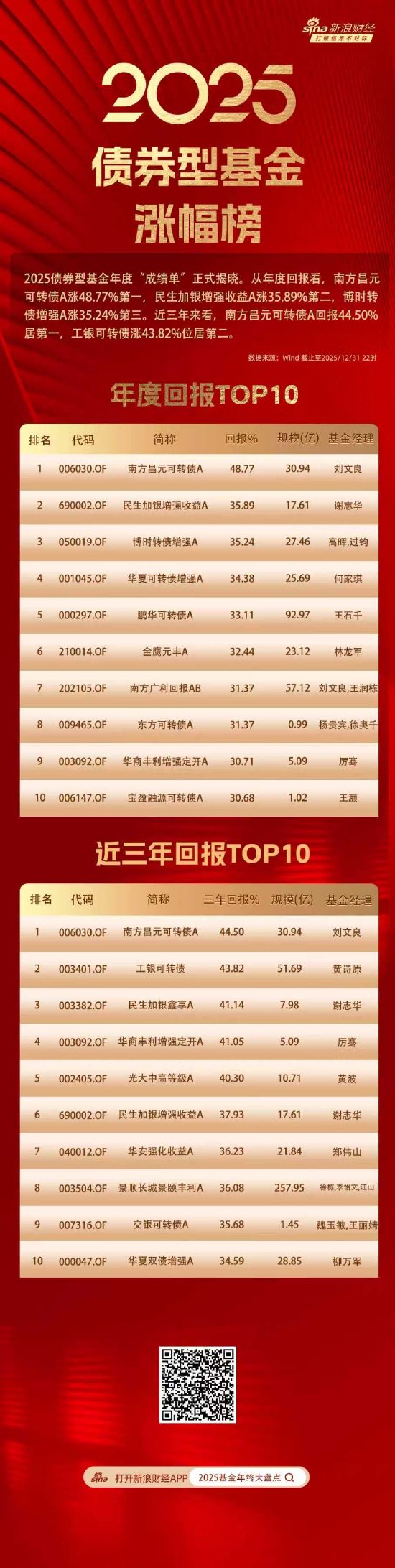
债券基金2025年度榜单揭晓:南方昌元可转债A以回报48.7%夺冠,汇添富丰和纯债亏7.7%垫底
Xin Lang Cai Jing· 2025-12-31 16:07
Group 1 - The core point of the article highlights that convertible bond funds have emerged as the best-performing category within bond funds, with significant returns leading the market [1][15] - As of 2025, the total scale of the public fund industry is approaching 36 trillion, indicating a robust growth trend [1][15] - The top-performing fund, Southern Changyuan Convertible Bond A, achieved an impressive annual return of 48.77%, significantly outperforming its peers [2][16] Group 2 - The top three funds in the bond category are Southern Changyuan Convertible Bond A (48.77%), Minsheng Jia Yin Enhanced Income A (35.89%), and Bosera Convertible Bond Enhanced A (35.24%), showcasing a clear performance gap among them [2][19] - The market is witnessing a trend where funds are concentrating towards leading products and star managers, with Penghua Convertible Bond A being the only fund exceeding 9.297 billion in scale [2][16] - Notably, some high-performing funds have relatively small scales, such as Dongfang Convertible Bond A and Baoying Rongyuan Convertible Bond A, both around 0.1 billion, indicating potential for growth [2][16] Group 3 - Fund managers are increasingly adopting a model of managing multiple funds or collaborating in teams, with notable performances from managers like Liu Wenliang of Southern Fund [3][17] - The long-term performance of convertible bond funds remains strong, with Southern Changyuan Convertible Bond A leading with a three-year return of 44.50% [8][22] - The long-term performance rankings show a more diverse strategy composition compared to short-term rankings, with funds like Guangda Zhonggaodeng A and Huashan Strengthened Income A also achieving competitive returns [9][23] Group 4 - The "blacklist" of underperforming bond funds reveals that the bottom ten funds have experienced losses exceeding 4%, with some being pure bond products facing significant net value pressure [10][24] - The worst-performing fund, Huitianfu Fenghe Pure Bond A, recorded a return of -7.70%, indicating challenges in the current interest rate environment [10][24] - Several funds have shrunk to "mini-fund" status, raising concerns about their operational viability and potential liquidity risks [12][27]