Synopsys

Search documents
Chiplet和异构集成到底是什么?
半导体行业观察· 2025-03-22 03:17
Core Viewpoint - The article discusses the emerging concepts of "chiplet" and "heterogeneous integration," highlighting the lack of standardized definitions and the implications for the semiconductor industry [2][3][4]. Summary by Sections Chiplet Definition and Characteristics - Chiplets are discrete components that can be integrated into a single package, differing from traditional multi-chip modules (MCM) [3][4]. - A key feature of chiplets is the direct connection between chips through standardized interfaces, which enhances performance and efficiency compared to MCMs [4][5]. - The economic rationale for chiplets stems from the high costs associated with advanced nodes and the inability to produce larger chips [4][5]. Standardization and Interoperability - The standardization of interfaces, such as UCIe and Bunch of Wires (BoW), is crucial for ensuring interoperability among chiplets from different sources [5][6]. - There is a debate on whether a chiplet must have a standardized interface to qualify as such, with some experts arguing that the presence of a die-to-die interface is essential [12][19]. Heterogeneous Integration - Heterogeneous integration involves combining different types of chips within a single package, which can include various nodes and materials [13][14]. - The definitions of heterogeneous integration vary, with some emphasizing the need for different functionalities among the chips involved [13][17]. - The complexity of integrating analog and photonic chips adds further challenges to the standardization of definitions in this area [10][18]. Industry Implications - The lack of consensus on definitions may hinder interoperability and complicate the development of advanced packaging processes [19]. - As the industry evolves, the need for clear definitions will become increasingly important for decision-making and market differentiation [19][20].

NVIDIA Blackwell Accelerates Computer-Aided Engineering Software by Orders of Magnitude for Real-Time Digital Twins
Globenewswire· 2025-03-18 19:23
Core Insights - NVIDIA announced that leading CAE software vendors, including Ansys, Altair, Cadence, Siemens, and Synopsys, are enhancing their simulation tools by up to 50 times using the NVIDIA Blackwell platform [1][2] - The integration of NVIDIA Blackwell with CUDA-X libraries allows industries such as automotive, aerospace, energy, manufacturing, and life sciences to significantly reduce product development time, cut costs, and improve design accuracy while maintaining energy efficiency [2][3] Ecosystem Support - A growing ecosystem of software providers is integrating Blackwell into their offerings, including companies like Altair, Ansys, Cadence, Siemens, and Synopsys, enabling customers to develop real-time digital twins with enhanced interactivity [4][3] - Rescale has launched a CAE Hub that streamlines access to NVIDIA technologies and CUDA-accelerated software, providing high-performance computing and AI technologies in the cloud powered by NVIDIA GPUs [8] Industry Applications - Cadence is utilizing NVIDIA Grace Blackwell-accelerated systems to tackle challenges in computational fluid dynamics, achieving multibillion cell simulations in under 24 hours, which previously required extensive CPU resources [5][6] - Boom Supersonic plans to use NVIDIA Omniverse Blueprint and Blackwell-accelerated CFD solvers on Rescale CAE Hub to design and optimize its new supersonic passenger jet, enabling 4 times more design explorations [9][10] Performance Enhancements - The collaboration between NVIDIA and various software providers is leading to significant performance improvements, with GPU-based simulations being up to 1.6 times faster compared to previous generations [7] - The combination of NVIDIA Blackwell architecture with Siemens' digital twins is expected to drastically reduce development times and costs, enhancing efficiency in design and manufacturing processes [7]


两会重点!政策红利下RISC-V引来发展良机
Wind万得· 2025-03-13 22:36
Core Viewpoint - RISC-V architecture is gaining significant attention due to its open-source nature, flexibility, and scalability, positioning it as a key player in the semiconductor industry, particularly in high-performance computing and AI applications [1][2][3]. Group 1: RISC-V Overview - RISC-V is an open-source instruction set architecture established in 2010, breaking the high licensing fees and customization difficulties associated with x86 and ARM architectures [2]. - Over 4,000 companies, including major players like Google, Huawei, and NVIDIA, have joined the RISC-V International Foundation by the end of 2024, indicating strong industry support [2]. Group 2: Market Drivers - The demand for RISC-V is driven by the need for self-sufficiency in semiconductor supply chains amid international trade tensions, allowing companies to design their own processor cores [3]. - The rise of AI and IoT devices has created a need for low-power, high-performance solutions, making RISC-V an ideal choice due to its modular design and efficiency improvements of over 300% in specific applications [3]. Group 3: Policy Support - Since 2018, Chinese policies have increasingly focused on RISC-V, with significant investments from the National Integrated Circuit Industry Investment Fund and initiatives to promote RISC-V in various sectors [4][5]. - The Ministry of Industry and Information Technology plans to release national guidelines for RISC-V development, emphasizing its strategic importance and supporting the entire industry chain [5]. Group 4: EDA Tools and IP Core - EDA tools and IP cores are critical to the RISC-V ecosystem, with EDA software playing a vital role in the design process of integrated circuits [9][10]. - The RISC-V ecosystem is expected to see significant growth, with the IP market projected to reach $12 billion by 2025, driven by a compound annual growth rate of 58% [13]. Group 5: Investment Dynamics - Since 2018, the domestic semiconductor industry has made substantial progress, particularly in "hard core" segments, while EDA and IP sectors still require increased domestic replacement rates [17]. - The EDA and IP markets are becoming investment hotspots, with significant capital inflow expected to support technological breakthroughs and market demand [17][18].
DVCon U.S. 2025 Announces Stuart Sutherland Best Oral Presentation & Best Poster Winners, Record Attendance & Conference Highlights
Globenewswire· 2025-03-11 15:44
Core Insights - The 2025 Design and Verification Conference and Exhibition U.S. (DVCon U.S.) achieved record attendance, marking a successful return to in-person events since the pandemic [1][2][3] - The conference showcased advancements in AI, formal verification, and industry standards, emphasizing its role as a premier event for the design and verification community [3] - DVCon U.S. 2026 is scheduled to take place at the Hyatt Regency in Santa Clara, California, from March 2-5, 2026, indicating growth and expansion for future events [5] Attendance and Participation - DVCon U.S. 2025 attracted participants from 32 countries, representing approximately 350 companies, with 404 first-time attendees [2] - Overall attendance reached around 1,067, including representatives from 26 exhibiting companies, and the exhibit floor was sold out [2] Awards and Recognitions - The Stuart Sutherland Best Oral Presentation award was won by a team from NVIDIA for their work on "Hierarchical Formal Verification and Progress Checking of Network-on-Chip Design" [3] - Best Poster honors were awarded to Jonathan Bonsor-Matthews and Greg Law for their poster on "Time-Travel Debugging for High-Level Synthesis Code" [3] Keynote Highlights - The industry keynote addressed the transformative role of AI in chip design and verification, with insights from leaders at Synopsys and Microsoft [4] - A panel discussion highlighted the increased complexity of verifying AI chips, with experts noting they are 50% more difficult to verify due to their dynamic behaviors [4] Future Directions - The proceedings from DVCon U.S. 2025 will be publicly available in June, allowing broader access to the insights shared during the conference [6] - The conference aims to continue fostering innovation and collaboration within the design and verification community as it prepares for future events [3][5]

汽车芯片行业,大变
半导体行业观察· 2025-03-08 03:39
Core Viewpoint - Automotive original equipment manufacturers (OEMs) are navigating significant changes in their business and technology landscapes, including tariff threats, geopolitical shifts, and evolving relationships with suppliers [1][2][6] Group 1: Industry Challenges - OEMs are facing complexities in controlling vertical markets, requiring them to predict customer needs and focus on chips, IP, and software, areas where many are inexperienced [2][4] - The transition to new technologies is causing shifts in core relationships, with varying levels of understanding among suppliers regarding OEMs' needs for advanced features like ADAS [2][3] - The integration of complex systems and software poses significant challenges, as traditional automotive practices have not adequately addressed software quality and complexity [3][4] Group 2: Evolution of ECU Architecture - The historical evolution of electronic control units (ECUs) has led to increased complexity, with luxury vehicles now containing up to 150 ECUs, making management difficult [5][6] - Many companies are transitioning to domain controllers and central computing units to streamline architecture, especially for new entrants without legacy systems [5][6] - The bundling of hardware and software by major suppliers is changing business models, leading to a need for OEMs to adapt their strategies [6][10] Group 3: Electric Vehicle Market Dynamics - Despite a slowdown in global automotive sales, the electric vehicle (EV) market is growing, with projections indicating significant increases in EV adoption in the U.S. and Europe by 2030-2035 [7][8] - EVs require more semiconductors than traditional vehicles, with hybrid and electric vehicles having semiconductor content valued at over twice that of internal combustion engine vehicles [7][8] Group 4: Strategic Partnerships - OEMs are increasingly forming strategic partnerships within their ecosystems to address the complexities of modern automotive technology [10][11] - The shift in OEM roles is evident as they begin to build internal software capabilities and directly engage with semiconductor providers to align with future requirements [11][12] - The automotive ecosystem is evolving, with a focus on collaboration to enhance software and hardware integration, moving away from isolated operations [12][16] Group 5: Market Pressures and Adaptation - OEMs are under pressure to adapt quickly to market demands, with a focus on reducing time-to-market for new technologies and features [16][17] - The integration of new technologies into established processes is a significant challenge, requiring OEMs to manage complex supply chains and customer expectations [16][17] - The need for robust security systems and rapid development cycles is critical as customer expectations evolve [16][17]

EUV,前景光明
半导体芯闻· 2025-02-28 10:03
Core Insights - The demand for AI chips is experiencing exponential growth, but the cost and complexity of production limit this technology to a few companies. This situation may soon change [1][2]. Group 1: Demand and Production Challenges - The demand for advanced node chips to support AI applications is rapidly increasing, putting pressure on the industry's ability to meet this demand [2][4]. - EUV lithography technology is crucial for manufacturing these chips, but it requires significant investment and has become a major barrier to scaling production [2][6]. - Currently, only five semiconductor manufacturers are using EUV in mass production, which concentrates EUV capabilities in a few companies [6][9]. Group 2: Technological Developments - The transition to smaller transistor sizes is essential for maximizing power efficiency and computational density in AI accelerators and GPUs [4][5]. - High NA EUV is becoming the only viable method for mass production at 1.8nm and below, increasing the demand for EUV capabilities [4][5]. - Research and development efforts are ongoing to improve EUV technology, including new materials and advanced process controls [2][9]. Group 3: Economic and Infrastructure Considerations - The high costs associated with EUV technology, including the price of masks and the operational expenses of EUV tools, remain significant challenges [12][13]. - Government-supported research centers are working to address these economic challenges by improving EUV mask technology and process control [9][12]. - Alternative business models and infrastructure strategies are needed to make EUV accessible to smaller foundries and companies [24][25]. Group 4: Future Outlook - The AI chip market is expected to grow at least tenfold in the next 5 to 7 years, indicating a strong future demand for EUV technology [7][8]. - The industry's ability to scale EUV technology will determine the next phase of semiconductor manufacturing [26]. - Innovations in light source efficiency and alternative lithography methods will be critical for expanding EUV's application beyond the largest players in the industry [20][22].

Synopsys(SNPS) - 2025 Q1 - Earnings Call Transcript
2025-02-27 02:14
Financial Data and Key Metrics Changes - The company reported Q1 revenue of $1.46 billion, down 4% year-over-year, and non-GAAP EPS of $3.03, down 10% due to one less work week compared to Q1 '24 [6][32] - Non-GAAP operating margin was 36.5%, with total GAAP costs and expenses at $1.2 billion [32] - For fiscal year 2025, the revenue guidance is set between $6.745 billion and $6.05 billion, with non-GAAP EPS guidance of $14.88 to $14.96 per share [33][36] Business Line Data and Key Metrics Changes - Design Automation revenue increased by 4% year-over-year, despite one less week of revenue [11] - The company launched new HAPS 200 prototyping systems and ZeBu 200 emulation systems, enhancing performance significantly [12] - Design IP revenue decreased by 17% year-over-year, but opportunities are expanding due to AI customer needs [23] Market Data and Key Metrics Changes - AI and HPC markets remained robust, while industrial, automotive, and consumer electronics faced challenges [7] - China sales showed a deceleration trend, with expectations of continued decline below corporate average due to restrictions and economic slowdown [50][76] Company Strategy and Development Direction - The company is focused on AI-driven design solutions and is progressing with the acquisition of ANSYS to enhance its offerings [9] - The strategy emphasizes addressing design complexity and energy demands through innovative solutions [8] - The company aims to leverage AI capabilities to transform engineering workflows and improve productivity [18][108] Management's Comments on Operating Environment and Future Outlook - Management expressed confidence in the company's resilient business model and strong momentum driven by AI growth [29] - The outlook for semiconductor R&D investment is positive, expected to grow from 6% to 9% of sales per year [41] - Management acknowledged challenges in the consumer electronics and automotive sectors but noted a recent acceleration in design activity [44][58] Other Important Information - The backlog exiting Q1 was reported at $7.7 billion [67] - Cash flow from operations was approximately $1.8 billion, with free cash flow around $1.6 billion [34] Q&A Session Summary Question: Growth trends in AI and non-AI segments - Management noted a bifurcation in the semiconductor market, with strong demand in AI and HPC, while consumer electronics and automotive are slower [39][41] Question: Sales performance in China - Management indicated that sales in China are expected to continue decelerating due to restrictions and economic factors [50][76] Question: Design activity for non-AI customers - Management observed a stabilization in design activity for non-AI customers, particularly in mobile and PC sectors [58] Question: Cost control and guidance for next quarter - Management highlighted that Q1 costs were lower than anticipated due to timing, but Q2 typically sees a step-up due to merit increases [112][115] Question: Backlog composition and customer engagement - Management confirmed no significant change in customer behavior regarding backlog duration, maintaining consistent contract durations [81][82]

SRAM,还没死
半导体行业观察· 2025-02-27 01:50
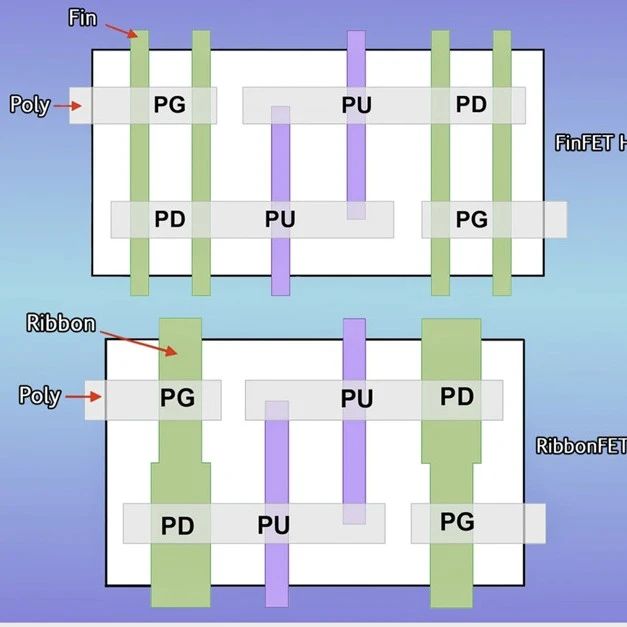
Core Viewpoint - The article discusses the advancements in SRAM technology presented by Intel and TSMC at the IEEE International Solid-State Circuits Conference (ISSCC), highlighting the use of new nanosheet transistor architecture to improve memory density and performance. Group 1: SRAM Technology Advancements - Intel and TSMC have achieved SRAM density of 38.1 megabits per square millimeter using storage cells of 0.021 square micrometers, with Intel improving density by 23% and TSMC by 12% [1][2] - The new nanosheet transistor architecture allows for better scalability of SRAM compared to previous FinFET designs, enabling more flexible current driving capabilities [2][3] - Intel's 18a technology introduces a backside power network, which helps reduce circuit area by allowing for a critical capacitor to be built beneath the SRAM cell [3][4] Group 2: Design Flexibility and Performance - Nanosheet devices provide greater flexibility in SRAM unit size, allowing for a reduction in unit area by up to 23% for Intel [3] - TSMC engineers have extended bit line lengths to connect more SRAM units, reducing the need for peripheral circuits and increasing overall density by nearly 10% [4] - Synopsys has developed a new SRAM design that achieves similar density to Intel and TSMC but operates at lower speeds, with a maximum speed of 2.3 GHz compared to TSMC's 4.2 GHz and Intel's 5.6 GHz [6][7] Group 3: Power Efficiency - Synopsys employs a dual-rail design that allows SRAM arrays and peripheral circuits to operate at different voltages, reducing power consumption while maintaining performance [5][6] - The voltage for SRAM cells can range from 540 millivolts to 1.4 volts, while peripheral voltage can be as low as 380 millivolts, optimizing power efficiency [6]