
太辰光

Search documents
通信行业2025年半年报综述:行业业绩稳健增长,关注AI快速发展带来的行业计划
Xin Lang Cai Jing· 2025-09-17 05:40
Communication Industry - The 92 tracked listed companies in the communication industry achieved a total revenue of 1,295.945 billion yuan in the first half of 2025, a year-on-year increase of 3.16% [1] - The net profit attributable to the parent company reached 137.277 billion yuan, up 7.79% year-on-year [1] - The industry gross margin was 29.46%, an increase of 0.07 percentage points year-on-year, while the net profit margin was 10.59%, up 0.45 percentage points year-on-year [1] - The performance of the optical module industry was strong, driven by the rapid development of AI technology, leading to sustained growth in demand for optical modules [1] - The three major operators maintained stable revenue, with improved cost control capabilities and increased cloud revenue due to AI development [1] - The rapid development of commercial aerospace is expected to create opportunities for the satellite internet industry [1] Operators - The three major operators achieved a revenue of 1,013.393 billion yuan in the first half of 2025, a year-on-year growth of 0.33%, and a net profit of 113.601 billion yuan, up 5.14% year-on-year [1] - The cloud business revenue of the three major operators reached a total of 151 billion yuan in the first half of 2025 [1] - Key stocks to watch include China Mobile (600941.SH), China Unicom (600050.SH), and China Telecom (601728.SH) [1] Optical Communication - The 11 tracked listed companies in the optical communication industry achieved a total revenue of 44.995 billion yuan in the first half of 2025, a year-on-year increase of 33.44% [2] - The net profit attributable to the parent company was 9.676 billion yuan, up 124.91% year-on-year [2] - The demand for high-speed optical devices is driven by the growth in global data center construction and the increasing capital expenditure of cloud vendors in China and the U.S. [2] - Key stocks to watch include Zhongji Xuchuang (300308.SZ), Tianfu Communication (300394.SZ), Xinyi Sheng (300502.SZ), Taicheng Light (300570.SZ), and Guangxun Technology (002281.SZ) [2] Satellite Internet - The 10 tracked listed companies in the satellite internet industry achieved a total revenue of 12.590 billion yuan in the first half of 2025, a year-on-year decline of 5.77% [3] - The net profit attributable to the parent company was 327 million yuan, down 56.59% year-on-year [3] - The government work report emphasized the "safe and healthy development" of commercial aerospace, marking a new phase of large-scale application [3] - The commercial aerospace industry is expected to undergo a transformation and upgrade, with the market scale likely to exceed 2.5 trillion yuan [3] - Key stocks to watch include China Satellite (600118.SH) and Huace Navigation (300627.SZ) [3] Communication Equipment Manufacturers - The 11 tracked listed companies in the communication network equipment and devices industry achieved a total revenue of 91.579 billion yuan in the first half of 2025, a year-on-year increase of 16.27% [3] - The net profit attributable to the parent company was 6.031 billion yuan, down 1.77% year-on-year [3] - The rapid development of AI is expected to bring incremental demand [3] - Key stocks to watch include ZTE Corporation (000063.SZ), Unisoc (000938.SZ), and Quectel (603236.SH) [3]
研判2025!中国波分复用器行业产业链、市场规模、竞争格局及发展趋势分析:高速、大容量通信网络的需求不断增加,推动波分复用器市场规模扩大[图]
Chan Ye Xin Xi Wang· 2025-09-17 01:11
Core Viewpoint - The global data traffic is experiencing explosive growth due to the proliferation of the internet, cloud computing, and streaming services, leading to increased demand for bandwidth in data center interconnections. Traditional Ethernet connection technologies are struggling to meet this demand, while Wavelength Division Multiplexing (WDM) technology offers an effective solution. The market for WDM devices, particularly wavelength division multiplexers, is expected to grow significantly, reaching $4.85 billion in 2024 and projected to increase to $6.6 billion by 2029 [1][8]. Wavelength Division Multiplexer Industry Overview - Wavelength Division Multiplexers (WDM) are critical optical components in fiber optic communication systems, allowing multiple wavelengths of light to be transmitted simultaneously over a single fiber, thus enhancing transmission capacity and reducing costs [3][4]. - The WDM technology includes Coarse Wavelength Division Multiplexing (CWDM) and Dense Wavelength Division Multiplexing (DWDM), which are essential for high-capacity data transmission in metropolitan area networks [4][5]. Industry Chain of Wavelength Division Multiplexers - The industry chain consists of upstream suppliers of raw materials and core components, midstream manufacturers producing WDM devices, and downstream applications in telecommunications, data centers, and metropolitan networks [6]. - The demand for WDM technology is driven by the increasing need for high-speed and reliable internet connections, particularly with the rise of mobile devices and the expansion of 5G and IoT technologies [6][7]. Market Size and Growth - The global WDM market is projected to reach $4.85 billion in 2024, with a growth forecast to $6.6 billion by 2029, reflecting the increasing data traffic demands [1][8]. - In China, the WDM market is expected to reach 1.67 billion yuan in 2024, with a year-on-year increase of 7.8% [9]. Competitive Landscape - The Chinese WDM market is primarily dominated by domestic companies such as Huawei and ZTE, which are enhancing their market share through technological innovation and expansion. International players like Ciena and Cisco are also active in the market, particularly in high-end segments [9][10]. Industry Development Trends - The industry is moving towards higher density and larger capacity solutions, enabling more wavelength channels to be transmitted over a single fiber, thus improving efficiency [13]. - There is a focus on reducing energy consumption and costs through advanced manufacturing processes and smart energy-saving technologies [14]. - The application of WDM technology is expanding beyond traditional telecommunications into emerging markets such as industrial automation and smart homes, increasing demand for reliable and secure communication networks [15].



研报掘金丨浙商证券:维持太辰光“买入”评级,下游持续高景气,业绩延续高增态势
Ge Long Hui A P P· 2025-09-16 09:09
Core Viewpoint - The report from Zheshang Securities highlights that Taicheng Light achieved a net profit attributable to shareholders of 173 million yuan in the first half of the year, representing a year-on-year increase of 118.0% [1] Financial Performance - In Q2 2025, the company realized a net profit of 94 million yuan, which is a year-on-year increase of 96.8% and a quarter-on-quarter increase of 18.4% [1] - The company's external sales revenue reached 681 million yuan in the first half of the year, marking a year-on-year growth of 71.19% [1] Market Demand and Growth Strategy - The explosive growth in global AI computing power demand has significantly boosted the company's demand [1] - The company is actively expanding production capacity through a dual approach of "domestic + overseas" strategies [1] Product Development and Supply Chain - MT insert is the core component of MPO connectors, and the company is focusing on independent research and production of MT inserts through its subsidiary [1] - The self-developed MT insert manufactured MPO connectors have achieved large-scale production and sales in the first half of the year, with ongoing efforts to certify more specifications of MT inserts [1] - The self-sufficiency of core components not only ensures supply chain security but also directly enhances product gross margins [1] Investment Rating - The report maintains a "Buy" rating for the company [1]

AI算力下半场,具备预期差的方向
Ge Long Hui· 2025-09-11 13:53
Core Insights - The rise of ASIC chip manufacturers, exemplified by Broadcom, is reshaping the technology investment landscape, with ASICs transitioning from a supporting role to a leading position in the market [1][3][10] Market Overview - The global ASIC chip market is projected to reach approximately $12 billion in 2024, with expectations to exceed $30 billion by 2027, reflecting a compound annual growth rate (CAGR) of 34% from 2024 to 2027 [1] - Major cloud service providers (CSPs) are increasingly favoring ASICs over traditional GPUs due to their efficiency and cost-effectiveness in AI applications [3][4] Technological Advancements - ASICs are designed for specific tasks, offering superior performance compared to GPUs, which are more generalized [3] - Innovations such as IP core reuse and cloud design platforms have significantly reduced ASIC development cycles from 18-24 months to 6-12 months, cutting costs by over 60% [4] Competitive Landscape - Broadcom's XPU product has captured a 60% market share in data center interconnect scenarios, with a 63% year-over-year increase in AI chip revenue [6] - Major players like Amazon and Google are not only consumers but also producers of ASICs, with self-developed ASICs expected to account for 25% of their computing power procurement by 2024 [6] Manufacturing and Supply Chain - Domestic manufacturers are advancing in ASIC production, with companies like SMIC and Changdian Technology enhancing manufacturing capabilities [7] - The high power consumption of ASICs has led to increased demand for cooling solutions and optical interconnects, creating new market opportunities [8] Investment Considerations - Investors are advised to focus on companies with visible long-term orders, strong technological barriers, and flexible supply chains in cooling and optical interconnects [9][10] - The transition from general-purpose computing to specialized ASICs is likened to the shift from feature phones to smartphones, indicating a significant investment opportunity in this evolving sector [10]

AI算力下半场,具备预期差的方向
格隆汇APP· 2025-09-11 12:40
Core Viewpoint - The rise of ASIC chip manufacturers, exemplified by Broadcom, signifies a major shift in technology investment, with ASICs transitioning from a supporting role to a leading position in the market [2]. Market Overview - The global ASIC chip market is projected to reach approximately $12 billion in 2024, with expectations to exceed $30 billion by 2027, reflecting a compound annual growth rate (CAGR) of 34% from 2024 to 2027 [2]. Company Performance - Broadcom reported a 63% year-over-year increase in AI chip revenue in Q3, driven by a significant $10 billion custom AI chip order from a major client [5]. - The company's XPU product holds a 60% market share in data center interconnect scenarios [13]. Technology Advancements - ASICs are designed for specific tasks, offering superior efficiency compared to general-purpose GPUs, which are likened to multi-functional tools [6]. - Recent technological innovations have reduced the design cycle for ASICs from 18-24 months to 6-12 months, while development costs have decreased by over 60% [6]. Competitive Landscape - Major cloud service providers like AWS and Google are increasingly investing in ASIC technology, with AWS's Trainium2 outperforming NVIDIA's H100 in inference tasks by 30-40% in cost-effectiveness [8][9]. - Domestic players like Cambricon are also advancing, with their SiYuan 590 chip reducing AI inference costs by 45% [7]. Industry Dynamics - The high power consumption of ASICs (up to 700W per chip) is driving demand for supporting technologies such as liquid cooling and optical interconnects, which are expected to grow faster than the ASIC chip market itself [11]. - The total cost of ownership (TCO) for Google's TPUv4 is 55% lower than that of GPUs, primarily due to savings in power and cooling [9]. Investment Opportunities - The ASIC market is expected to create multi-layered investment opportunities, similar to the transition from feature phones to smartphones, where both leading companies and supporting players will benefit [15]. - Investors are advised to focus on companies with long-term major clients, strong technological barriers, and flexible supporting capabilities in liquid cooling and optical interconnects [17].


太辰光股价涨5.24%,中欧基金旗下1只基金重仓,持有7700股浮盈赚取4.41万元
Xin Lang Cai Jing· 2025-09-11 10:18
Group 1 - The stock of Shenzhen Taicheng Technology Co., Ltd. (太辰光) increased by 5.24% to 115.00 CNY per share, with a trading volume of 1.192 billion CNY and a turnover rate of 5.53%, resulting in a total market capitalization of 26.12 billion CNY [1] - The company, established on December 12, 2000, and listed on December 6, 2016, specializes in the research, production, and sales of optical devices, with 98.02% of its revenue coming from optical device products [1] - The company is located in Shenzhen, Guangdong Province, and operates under a multi-address business model [1] Group 2 - According to data, one fund under China Europe Fund holds a significant position in Taicheng Technology, with the China Europe Jintian Mixed A Fund (中欧瑾添混合A) owning 7,700 shares, accounting for 0.29% of the fund's net value, ranking as the eighth largest holding [2] - The China Europe Jintian Mixed A Fund was established on November 9, 2021, with a current size of 252 million CNY, yielding a return of 4.82% this year, ranking 6,658 out of 8,175 in its category [2] - The fund manager Wang Shen has a tenure of 10 years and 116 days, with a best return of 55.62% during his management period, while Zhao Yucheng has been managing for 1 year and 139 days, achieving a best return of 12.84% [2]
F5G概念涨5.10%,主力资金净流入这些股
Zheng Quan Shi Bao Wang· 2025-09-11 10:02
Group 1 - F5G concept stocks increased by 5.10%, ranking fifth among concept sectors, with 35 stocks rising, including Jin Xin Nuo which hit a 20% limit up [1] - Notable gainers in the F5G sector include Zhongji Xuchuang (up 14.28%), Taicheng Guang (up 11.97%), and Shijia Guangzi (up 9.69%) [1] - The F5G concept sector saw a net inflow of 5.105 billion yuan from main funds, with 23 stocks receiving net inflows, and 10 stocks exceeding 100 million yuan in net inflows [2] Group 2 - The top net inflow stock was Zhongji Xuchuang with 1.734 billion yuan, followed by Jianqiao Technology (734 million yuan), and Huagong Technology (572 million yuan) [2] - The net inflow ratios for Jin Xin Nuo, Jianqiao Technology, and Feiling Kesi were 24.56%, 18.90%, and 12.42% respectively [3] - The trading volume and turnover rates for key stocks in the F5G sector indicate strong investor interest, with Jin Xin Nuo showing a turnover rate of 20.81% [3]


专业选手实战大赛丨“牛人”青睐哪些股?9月11日十大买入个股榜、十大买入金额个股榜出炉
Xin Lang Zheng Quan· 2025-09-11 08:39
Group 1 - The "Second Golden Kylin Best Investment Advisor Selection" event is currently ongoing, with over 3,000 professional investment advisors participating in simulated trading competitions [1] - The event aims to provide a platform for investment advisors to showcase their capabilities and enhance communication with the public, thereby promoting the healthy development of China's wealth management industry [1] Group 2 - The top ten stocks by buy frequency in the stock group as of September 11 are led by Shenghong Technology (sz300476) and include New Yisheng (sz300502) and Sanweitong (sz002115) among others [1] - The top ten stocks by buy amount in the stock group as of September 11 are also led by New Yisheng (sz300502) and Shenghong Technology (sz300476), with Tianfu Tongxin (sz300394) and Zhongji Xuchuang (sz300308) following [2][3] - The data for the top buy stocks and ETFs is based on the frequency and amount of purchases made by all participating advisors, reflecting their investment preferences [4]





甲骨文隔夜爆拉35%+斩获OpenAI三千亿美元大单,AI算力板块又爆了,5G通信ETF涨5%,工业富联连续两日涨停,CPO巨头新易盛、中际旭创涨超8%
Ge Long Hui· 2025-09-11 02:48
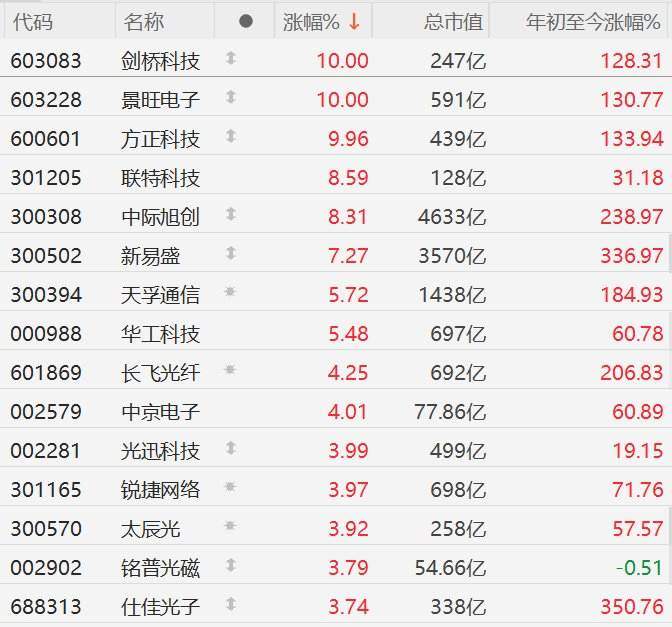
Group 1 - The AI computing power sector in A-shares has experienced significant growth, with major companies like Industrial Fulian (601138) hitting the daily limit for two consecutive days, and CPO giants such as Xinyi Sheng (300502) and Zhongji Xuchuang (300308) rising over 8% [1] - The 5G communication ETF increased by 5.1%, while the AI-focused ETF from the ChiNext market rose by 4.27%, indicating strong investor interest in AI and related technologies [1] Group 2 - Notable stock performances include Cambridge Technology (603083) and Jingwang Electronics (603228), both achieving a 10% increase, while other companies like Fangzheng Technology (600601) and Lian Te Technology (301205) also saw significant gains [2] - Oracle's stock surged nearly 36% after its earnings report, with its cloud business growth forecast raised from 70% to 77%, and a $300 billion computing power agreement signed with OpenAI [2] Group 3 - Citigroup has raised the target price for "Yizhong Tian," suggesting that despite recent price increases in Chinese optical module stocks, the visibility of demand through 2027 warrants a reevaluation to over 20 times the price-to-earnings ratio [3] Group 4 - The 5G communication ETF (515050) is primarily weighted towards communication equipment, consumer electronics, and optical modules, while also covering AI computing hardware and PCB companies [4] - The ChiNext AI ETF (159381) has the highest CPO content and lowest fee rate, including major stocks like Xinyi Sheng and Zhongji Xuchuang [4] - The AI ETF (515070) covers the entire AI industry chain, including AI chips, computing infrastructure, and algorithm applications [4]



部分赛道型基金疑似调仓 算力之后或AI应用接棒
Zhong Guo Zheng Quan Bao· 2025-09-11 00:34
Core Viewpoint - The article discusses the recent adjustments in the technology sector, particularly in AI-related investments, highlighting a shift in focus from computing power to AI applications as market conditions evolve [1][2][7]. Group 1: Market Adjustments - Significant adjustments have been observed in the technology sector, particularly in high market-cap growth stocks, leading to a degree of divergence among funds [2][7]. - The recent market correction is seen as a healthy cooling-off period after several months of rising valuations, allowing for the digestion of valuation bubbles [2][7]. Group 2: Fund Performance and Adjustments - Some actively managed equity funds have begun to increase their focus on AI applications, including areas like smart driving, AI hardware, and humanoid robots [1][8]. - Notable funds, such as Yongying Technology and Dongwu Mobile Internet, have shown concentrated holdings in specific stocks, with significant fluctuations in net asset values (NAV) during recent market movements [3][4]. - Funds that did not heavily invest in technology stocks have experienced increased volatility in their NAVs, indicating a potential shift in investment strategies [5][6]. Group 3: Future Investment Opportunities - Analysts suggest that AI applications are expected to gradually materialize, presenting substantial growth potential and investment opportunities [8]. - Investment strategies are shifting towards AI applications, with a focus on sectors like smart driving and advanced semiconductor processes, as companies' profitability models become clearer [8][7].
