
AI硬件

Search documents
早盘直击|今日行情关注
申万宏源证券上海北京西路营业部· 2026-03-20 02:46
Market Overview - The A-share market experienced a decline, with all three major indices falling, influenced by the overnight drop in US stocks and escalating tensions in the Middle East. The Shanghai Composite Index briefly fell below the 4000-point mark before a slight rebound at the close, indicating weakened market sentiment. Over 4900 stocks declined, reflecting a significant loss effect, with focus shifting to defensive sectors like oil and gas, and coal [1] Geopolitical Impact - The uncertainty surrounding the oil transportation route in the Strait of Hormuz is expected to affect the price trends of crude oil and the US dollar in the near term. The market's risk appetite will largely depend on whether there is a substantial easing of tensions in the Middle East [1] Future Market Outlook - The ongoing geopolitical uncertainty may influence short-term market dynamics, particularly if crude oil prices rise significantly, which could heighten market concerns and impact A-share sector rotations. The sustained strength of the petrochemical sector may suppress preferences for technology growth sectors, leading to a slower upward trend for indices while individual stock performance lags behind the market [1] Long-term Trends - Despite short-term fluctuations, the long-term upward trend for A-shares remains intact, supported by increased household savings entering the market and a recovery in the performance of A-share listed companies [1] Sector Focus - As March approaches, marking the annual report season, high-performing sectors will attract market attention. Notable sectors include: 1. AI hardware, with a confirmed industry trend and increasing token usage for major AI models, indicating a peak in AI applications by 2026 [2] 2. Semiconductor localization, focusing on semiconductor equipment, wafer manufacturing, materials, and IC design [2] 3. New energy materials benefiting from rapid growth in domestic and overseas storage demand, showing signs of supply shortages and price increases, with a continued upward trend expected through 2026 [2] 4. Price-increasing cycles in non-ferrous metals and chemicals, with anticipated strong annual report performances due to sustained price increases [2]


申万宏源2026年春季A股投资策略概要:蓄力牛市2.0,时代资产不退场
Shenwan Hongyuan Securities· 2026-03-14 09:44
Group 1 - The core viewpoint of the report emphasizes the resilience of A-shares amidst geopolitical conflicts, indicating that China's asset pricing is adapting to a changing competitive landscape, which enhances market resilience [3][4]. - The report identifies two types of inflation assets: new economy and strategic resources, highlighting that capital expenditure in the new economy is on the rise, creating a scarcity-driven demand expansion, while strategic resource security is a necessity under great power competition [3][4]. - The report outlines the need for a capital market that supports asset allocation migration, emphasizing the importance of diversifying resident asset allocation, optimizing resource allocation towards strategic directions, and revitalizing existing assets to support innovation and transformation [5]. Group 2 - The A-share market is currently in a structural bull phase, transitioning to a range-bound adjustment period, with limited adjustment magnitude but a duration measured in quarters [7][8]. - The report predicts that the overall profit growth for A-shares in 2026 will be better than in 2025, with a projected year-on-year growth of 12.9% under neutral assumptions, and an optimistic scenario suggesting a growth rate of 16.6% [8][9]. - The report maintains a mid-term projection of a "two-stage bull market," indicating that the current phase is a transition from structural bull to a range-bound adjustment, with a potential new upward trend starting in the second half of 2026 [9][11]. Group 3 - The report discusses the structural characteristics of the "Bull Market 2.0" accumulation phase, referencing historical experiences from 2014 and 2018-2019, indicating that this phase is characterized by the exhaustion of leading sectors and a decrease in the space for new opportunities [11][12]. - It emphasizes the importance of extending main asset lines and macro narratives, particularly focusing on the AI industry chain and cyclical alpha opportunities, as potential investment avenues during this phase [12]. - The report suggests that the structural bull and comprehensive bull phases are interconnected, with a focus on technology and cyclical alpha remaining as mid-term directions for investment [12].
如何看待恒生科技未来走势?
HTSC· 2026-03-11 02:50
Market Performance - The Hang Seng Technology Index has experienced a maximum drawdown of 28% since October 2025, with a cumulative decline of 25.3% as of March 2, 2026[2][10]. - The index saw a peak cumulative increase of 58% from early 2025 until its peak in October 2025[2]. Key Drivers of Decline - The decline is attributed to two main factors: a visible AI revaluation and a hidden adjustment in consumer earnings expectations[2][3]. - The first phase of decline (October 2, 2025, to November 21, 2025) was driven by a 19.3% drop in valuation, while the second phase (January 14, 2026, to March 2, 2026) saw a 15.6% decline, primarily affecting internet consumption and comprehensive platforms[10][12]. Sector Analysis - The technology sector remains under pressure, with AI hardware showing resilience while AI software has largely digested its revaluation since July 2025[3][31]. - Consumer sectors, particularly consumer electronics and home appliances, are under significant pressure, with earnings expectations still needing stabilization[3][37]. Future Outlook - The Hang Seng Technology Index is projected to stabilize between 4,500 and 4,850 points, with a neutral scenario around 4,690 points[42]. - Key catalysts for recovery include the stabilization of consumer earnings, a peak in competitive pressures, and positive developments in AI applications by major firms[4][42]. Investment Sentiment - Southbound capital has significantly increased its allocation to the Hang Seng Technology Index since August 2025, indicating a "buy the dip" mentality[4][49]. - The latest sentiment index reading is at 58, which has not yet triggered a buy signal, suggesting caution in the market[4][47].
展商报名丨雷峰网 AWE 探展计划启动,30个核心高层直达你的展台
雷峰网· 2026-03-03 12:08
Core Insights - The article discusses the shift in global AI investment focus from software to hardware between 2025 and 2026, highlighting the importance of physical AI at events like AWE, which features over 1,000 brands and 300 global launches [2] - It identifies six major pain points for exhibitors at AWE, including mismatched audience engagement, lack of effective feedback, and difficulties in establishing meaningful connections [2][4] Group 1: Pain Points at AWE - Mismatched audience engagement leads to ineffective interactions, with many attendees being casual visitors rather than decision-makers [2][4] - There is a lack of professional audience groups to provide valuable insights on product competitiveness and market acceptance [2][4] - Exhibitors face challenges in maximizing return on investment (ROI) due to inefficient networking and communication with potential partners [4] Group 2: Proposed Solutions - The article proposes a targeted approach to address these pain points, emphasizing the need for direct engagement with core decision-makers rather than general sales staff [3][5] - It suggests organizing a specialized visiting team to facilitate deeper discussions and evaluations of technology and market potential [3][5] - The initiative aims to create a more effective networking environment, allowing for immediate discussions on investment, agency agreements, and procurement [5] Group 3: Recruitment for Deep Visit Stations - The article outlines the criteria for brands to become "Deep Visit Stations" at AWE, focusing on those with advanced AI hardware and a willingness to engage in meaningful discussions [6][8] - Brands are encouraged to provide a 20-30 minute session led by their CXOs to discuss technology and collaboration opportunities [8] - The initiative aims to connect exhibitors with a decision-making audience, including investors and supply chain executives, to enhance business opportunities [8][9] Group 4: Expected Outcomes - The initiative is designed to maximize customer acquisition efficiency and enhance the quality of feedback received from industry experts [5][14] - It aims to foster long-term relationships through informal interactions, moving from public engagements to private discussions [5][14] - The goal is to transform exhibition spaces into hubs of deep connections, ultimately increasing brand visibility and partnership potential [15]

定期报告:三月延续震荡偏强成长占优
Huajin Securities· 2026-03-01 07:40
Investment Rating - The report suggests a positive outlook for the A-share market in March, indicating a potential for a strong performance driven by favorable policies and external conditions [1][5][9]. Core Insights - Historical analysis shows that A-shares tend to exhibit volatility in March, influenced by policy changes and external events, with a notable increase in fundamental factors post the National People's Congress (NPC) [5][6]. - The report anticipates that March 2026 will see a continuation of the spring market trend, with a focus on technology and cyclical sectors, particularly favoring small and mid-cap stocks [1][24]. - The report highlights that sectors with high earnings growth, such as automotive, machinery, and non-ferrous metals, are expected to outperform in March [1][24]. Summary by Sections Section 1: March A-share Market Outlook - Historical data indicates that only 7 out of the last 16 years saw the Shanghai Composite Index rise in March, with performance largely dictated by policy and external events [5][6]. - The report predicts a relatively strong performance for A-shares in March 2026, supported by potentially positive NPC policies and limited external risks [1][9]. Section 2: Industry Allocation - The report emphasizes a focus on technology growth and certain cyclical industries in March, suggesting that these sectors may continue to outperform [1][24]. - Historical trends show that growth and consumption styles have led the market in March, driven by policy support and industry trends [26][28]. - The report identifies that small and mid-cap stocks may have an advantage in March, supported by favorable liquidity conditions and rising commodity prices [1][24][28]. Section 3: Economic and Earnings Recovery - Economic indicators suggest a continuation of weak recovery trends in March, with consumer confidence on the rise and retail sales expected to improve due to supportive policies [18][19]. - Earnings growth is projected to rebound in March, particularly in sectors like non-ferrous metals and chemicals, driven by rising commodity prices and demand in technology sectors [19][20].
三月延续震荡偏强,成长占优
Huajin Securities· 2026-02-28 10:24
Group 1 - The report indicates that the A-share market is likely to experience a strong oscillation in March, continuing the spring market trend, influenced by policies and external events, with a rising impact of fundamentals after the Two Sessions [7][10] - Historical data shows that in the past 16 years, the Shanghai Composite Index has only risen in March in 7 years, highlighting the volatility of the market during this period [7][10] - The report suggests that March's market performance will be primarily driven by policy expectations, external events, and liquidity conditions, with a potential for positive sentiment following the Two Sessions [7][10] Group 2 - The report emphasizes that sectors related to technology growth and certain cyclical industries are expected to outperform in March, with a focus on small and mid-cap stocks [26][28] - Historical analysis indicates that growth and consumption styles have often led the market in March, driven by policy support and industry trends [28][30] - The report identifies high-growth sectors such as automotive, machinery, and electronics as likely to perform well in March, with a recommendation to accumulate positions in these areas [26][28] Group 3 - The report highlights that March may see a continuation of weak economic recovery, with consumer confidence and retail sales expected to improve due to supportive policies [20][21] - It notes that the profitability of cyclical industries, particularly in metals and chemicals, is likely to rise, contributing to overall earnings growth in the A-share market [21][22] - The report anticipates that the issuance of special bonds may increase in March, further supporting infrastructure investment and economic activity [20][26]
未知机构:交易台高盛中国市场综述上证综指039科创500-20260228
未知机构· 2026-02-28 02:35
Summary of Key Points from Conference Call Industry Overview - The conference call discusses the performance of the Chinese stock market, specifically focusing on various indices such as the Shanghai Composite Index, ChiNext Index, and others, indicating a mixed performance with the Shanghai Composite Index up by 0.39% and the ChiNext Index down by 1.04% [1][1]. Core Insights and Arguments - The overall trading volume in the A-share market reached 2.51 trillion RMB, reflecting a relatively quiet morning session that strengthened after the release of the zz bureau meeting communiqué [1][1]. - The zz bureau meeting emphasized the need for proactive macro policies, including the continuation of an active fiscal policy and a prudent monetary policy aimed at stabilizing employment, enterprises, markets, and expectations [1][1]. - The securities sector showed a brief rally in response to the meeting's positive interpretation, although the upward momentum could not be sustained throughout the day [1][1]. - The metals sector continued its strong performance, with an overall increase of over 3% across the board [1][1]. - Conversely, concerns in the artificial intelligence sector led to declines in the IGBT, CPO, and semiconductor sectors [1][1]. Additional Important Content - Post-Chinese New Year, trading activity significantly increased, with nominal trading volume rising by 30% compared to the pre-holiday period [2][2]. - There was a notable net buying in the information technology sector, shifting focus from hardware to AI application areas, indicating a strategic pivot in investment interests [2][2]. - The cyclical metals sector demonstrated strong momentum, attracting hedge funds to chase gains [3][3]. - In the selling side, a net selling stance was maintained on financial and real estate sectors, indicating a cautious outlook on these value chain segments [4][4].
瀛通通讯股价下跌2.08%至19.80元,主力资金连续三日净流出
Jing Ji Guan Cha Wang· 2026-02-28 01:30
Group 1 - The stock price of Yingtong Communications fell by 2.08% to 19.80 yuan, with a trading volume of 96.36 million yuan and a turnover rate of 3.24%, resulting in a total market capitalization of 3.688 billion yuan [1] - The main funds experienced a net outflow of 4.73 million yuan on the same day, marking a continuous net outflow trend for three days, with a cumulative net outflow of 24.43 million yuan over the past five days, indicating short-term pressure on capital [1] - The stock price is approaching a resistance level of 20.12 yuan, with an average cost of shares at 19.68 yuan; a breakthrough of the resistance level could initiate an upward trend, but caution is advised regarding potential pullback risks [1] Group 2 - On February 26, 2026, Yingtong Communications announced that its wholly-owned subsidiary obtained a patent for "a positioning welding device for ultra-fine coaxial wire," which will enhance the company's intellectual property protection system and improve long-term core competitiveness, although it will not have a significant short-term impact on production and operations [2] - The company continues to focus on emerging sectors such as wireless headphones and AI hardware, supported by a previously announced capacity expansion project for wireless headphones in October 2025, which will provide support for future growth [2]

突然爆了!老登资产席卷全球
Ge Long Hui A P P· 2026-02-26 08:41
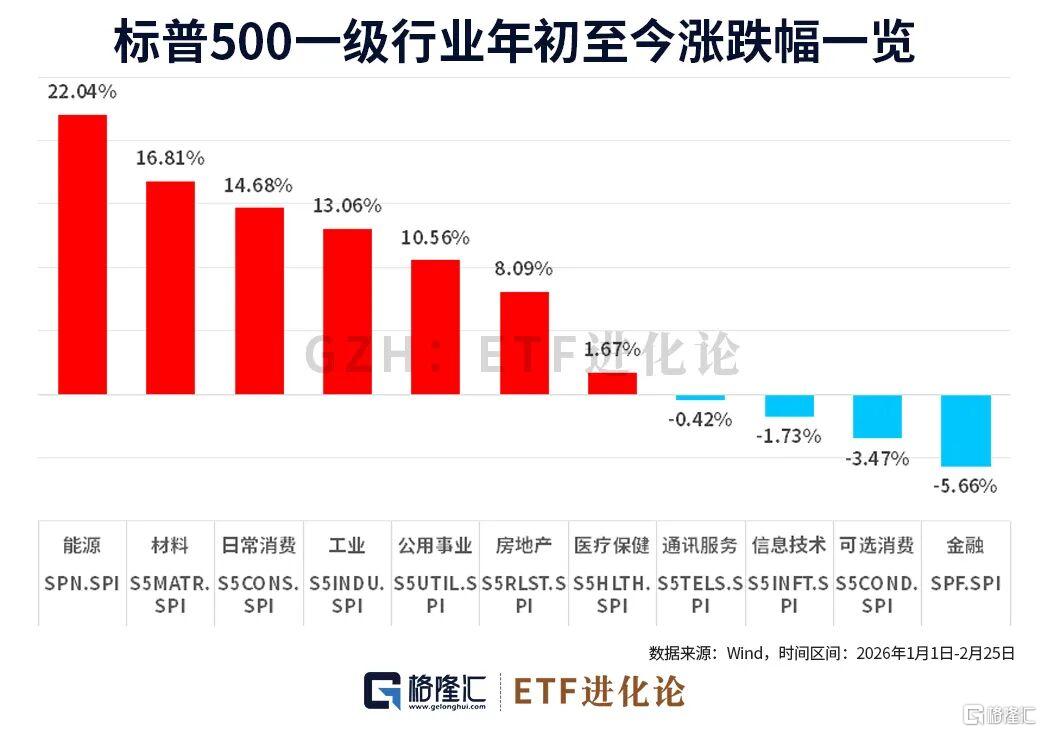
Group 1 - Nvidia's Q4 performance has exceeded expectations, leading to a surge in AI hardware stocks in the A-share market, with semiconductor ETFs in China and South Korea nearing their daily limit up, and electricity-related ETFs rising by 3% and 2.9% respectively [1] - A significant shift is occurring where technology growth is increasingly reliant on physical assets, marking a departure from the previous dominance of financial assets over physical assets [2][3] - The HALO concept, which combines heavy assets with low obsolescence, is gaining traction, indicating a paradigm shift in investment strategies towards assets that are less susceptible to technological changes [2][3] Group 2 - The rise in physical asset values is driven by geopolitical tensions and resource nationalism, which have made these assets more valuable as a safe haven compared to software and light asset industries [4] - The South Korean stock market has seen unprecedented growth, with the composite index surpassing 6000 points for the first time and achieving a year-to-date increase of 49.67% [4][5] - A-share market trends reflect a similar "physical asset supremacy," with significant gains in sectors such as construction materials, non-ferrous metals, and petrochemicals [7] Group 3 - ETFs with high physical asset content have dominated the performance charts, with several indices, including semiconductor and oil and gas resources, showing gains of over 25% year-to-date [10] - In the first two trading days of the year, A-share financing clients purchased a total of 57.5 billion yuan, indicating strong capital inflow into physical assets [13] - The top sectors for net buying include electronics, non-ferrous metals, and power equipment, highlighting investor interest in HALO stocks [17][18] Group 4 - High inflows into HALO-focused ETFs have been observed, with significant net purchases in gold, semiconductor materials, and electricity equipment ETFs [20] - The macroeconomic environment is favoring heavy asset industries, as manufacturing PMI has rebounded, surpassing service sector PMI [22] - Tech giants are projected to spend approximately $1.5 trillion on capital expenditures from 2023 to 2026, with $650 billion expected this year alone, indicating a strong focus on infrastructure investments [22]
首席展望|东方财富陈果:马年A股或会走出类“N”形走势
Xin Lang Cai Jing· 2026-02-26 00:48
Core Viewpoint - The article highlights the optimistic outlook of foreign investment banks towards China's economy in 2026, suggesting a favorable environment for A-shares and Hong Kong stocks due to policy support, improving corporate profits, and capital inflows [1] Group 1: Market Trends - The A-share market is expected to exhibit a "N" shaped trend in 2026, with a continuation of the upward trend from late last year into the Spring Festival [2] - External liquidity easing may be nearing its end, and while the AI industry shows medium-term promise, short-term discrepancies between reality and expectations may impact the market [2] - Despite potential market fluctuations in the second quarter, the upward trend of the A-share market is likely to remain intact due to the ongoing recovery of domestic demand [2] Group 2: Key Focus Areas - Investors should pay attention to the development of the AI industry, particularly innovations in AI applications, as this is crucial for the A-share market in 2026 [3] - Marginal improvements in China's macroeconomy, including real estate and consumption, are also significant, with indicators showing positive trends [3] - The relationship between global re-inflation and liquidity is important, as the global inflation cycle is ahead of China's, and the Federal Reserve's interest rate decisions will be key indicators to watch [3] Group 3: Capital Inflows - The overall upward trend in the market since the "924" rally has created a profit-making effect, attracting more capital recognition towards A-shares due to China's competitive advantages and economic resilience [3] - There is a clear trend of incremental capital inflows into A-shares, with both domestic and foreign investors viewing opportunities as outweighing risks [3] Group 4: Currency and Asset Revaluation - The trend of RMB appreciation is expected to be sustained, positively impacting the capital market [4] - The expectation of RMB appreciation may lead to a return of funds previously allocated to global assets, contributing to a potential "Asset Revaluation 2.0" in China [5] Group 5: Investment Opportunities - Investment opportunities are concentrated in three areas: the AI industry, particularly infrastructure and hardware; cyclical sectors with ongoing commodity price increases; and the pharmaceutical sector, which may benefit from AI advancements [6] - The technology sector is highlighted as requiring careful selection for investment, with significant opportunities anticipated in technology, cyclical sectors, real estate, and certain consumer segments [6]
