
圆通速递

Search documents
万丰奥威目标价涨幅近90%;太阳能等7家公司评级被调低|券商评级观察
2 1 Shi Ji Jing Ji Bao Dao· 2025-11-24 01:05
Group 1 - The core viewpoint of the articles highlights significant changes in stock ratings and target prices for various companies, with notable increases for Wan Feng Ao Wei, Guang Xun Technology, and Tai Chen Guang [1] - Wan Feng Ao Wei's target price increased by 89.64%, Guang Xun Technology by 81.99%, and Tai Chen Guang by 71.51%, all within the automotive parts and communication equipment sectors [1] - A total of 408 companies received broker recommendations during the period, with Yili receiving 5 recommendations, and Top Group and United Imaging Medical receiving 4 each [1] Group 2 - Three companies had their ratings upgraded, including Huadong Heavy Machine from "Hold" to "Buy" by Caixin Securities, Sinopec from "Add" to "Buy" by Huatai Securities, and Hongyuan Electronics from "Add" to "Buy" by CITIC Securities [1] - Seven companies had their ratings downgraded, including Solar Energy from "Strong Buy" to "Recommended" by Huachuang Securities, Source Technology from "Buy" to "Add" by Western Securities, and Titan Technology from "Strong Buy" to "Recommended" by Huachuang Securities [1] - During the same period, 77 instances of first-time coverage were reported, with Delijia receiving an "Outperform" rating from Guosen Securities, and YTO Express, Yanjiang Co., and Far East Co. receiving "Add" or "Buy" ratings from various brokers [2]



我省两产业集聚区入选重点培育名单
Liao Ning Ri Bao· 2025-11-24 01:04
Group 1 - The Ministry of Industry and Information Technology released the first batch of "One County, One Policy" for textile and apparel characteristic industrial clusters, with 25 clusters selected nationwide, including two from Liaoning Province [1] - The Xingcheng Swimwear Industrial Cluster in Huludao occupies the largest share of the global swimwear market, with an annual production and sales of 170 million pieces, generating an annual output value of 15 billion yuan, and employing approximately 80,000 people [1] - The swimwear cluster has diversified into yoga wear, beachwear, cycling apparel, and accessories, with online sales reaching 5 billion yuan, and 80% of national swimwear e-commerce orders originating from this area [1] Group 2 - The Pulandian Textile and Apparel Industrial Cluster in Dalian, led by Dayang Group, focuses on suits and various apparel, with 428 textile and apparel enterprises and an expected industrial output value of 3.56 billion yuan in 2024 [1] - The cluster is transitioning to a consumer-driven "customization on demand" model, producing 2 million customized garments annually, maintaining the highest export volume in the country, and holding a significant share in the global high-end customization market [1] - Liaoning Province is enhancing the textile industry's influence by focusing on "products, scenarios, and clusters," improving brand recognition through exhibitions, and targeting key areas such as non-woven materials and swimwear transformation [2]
快递业价值战取代价格战
Jing Ji Ri Bao· 2025-11-23 21:53
Core Insights - The "Double 11" shopping festival has concluded quietly, but significant changes in the express delivery industry are emerging, including rising prices and new e-commerce business models, which present both opportunities and challenges for the market [1] Price Increase Trends - A price increase in the express delivery sector is ongoing, with 22 provinces raising prices, particularly in regions like Guangdong and Zhejiang, where the minimum price has been set at 1.2 to 1.4 yuan per package [1][2] - The average price of express delivery has dropped to 7.52 yuan per package in the first half of the year, a year-on-year decrease of 7.7%, indicating a long-standing reliance on low prices [2][3] Industry Dynamics - The price war has led to reduced profit margins and declining service quality, resulting in increased consumer complaints about delivery issues [3] - Regulatory bodies are pushing for a return to rational competition and an end to the price war, emphasizing the need for a sustainable industry ecosystem [3] Cost Distribution Challenges - The rise in delivery prices has prompted a reevaluation of cost distribution among e-commerce platforms, merchants, delivery companies, and consumers, which is crucial for the sustainability of the anti-"involution" movement [4][5] - E-commerce platforms are beginning to take on a role in balancing costs, with measures such as reducing shipping insurance costs for merchants [5] Profitability and Innovation - The express delivery industry is shifting from chaotic competition to rational pricing, with a focus on technological innovation and infrastructure investment to enhance efficiency and profitability [6][7] - Major companies like JD Logistics are investing heavily in automation and technology to reduce costs and improve service quality [6][7] Future Outlook - The industry is expected to enter a new phase by 2026, characterized by government guidance and proactive transformation by companies, focusing on technology investment and restructuring profit distribution mechanisms [6][7] - The ultimate goal is to create a sustainable ecosystem where merchant costs are manageable, consumer experiences are enhanced, and company profits are stable, moving away from a reliance on low prices [7]
快递业:从“价格战”到“服务战”
Zheng Quan Ri Bao Zhi Sheng· 2025-11-23 17:13
Core Viewpoint - The recent price increase in the express delivery industry is seen as a crucial attempt to break the "low-price dependency" and reconstruct the value logic of the industry, with 22 provinces already raising delivery prices [1][3][4]. Price Increase Background - The price increase began in Yiwu, Zhejiang, with a new minimum price of 1.2 yuan per ticket, followed by Guangdong raising the average price to over 1.4 yuan [1][2]. - Major express companies have raised prices for e-commerce clients by 0.3 to 0.5 yuan for packages under 1 kilogram [2]. Industry Challenges - The express delivery industry has faced a long-standing dilemma of "price for volume," leading to unsustainable profit margins, with the average price per ticket dropping to 7.52 yuan, a 7.7% year-on-year decrease [2][3]. - Complaints about service quality have surged, with issues like violent sorting and delivery delays becoming common [3]. Regulatory Environment - The price adjustments are largely driven by policy guidance aimed at correcting irrational competition and promoting rational market behavior [2][3]. - The National Postal Administration has emphasized the need for improved industry regulations and quality standards [3]. Industry Dynamics - The price increase has led to a restructuring of interests within the supply chain, with e-commerce platforms, merchants, and consumers needing to find a balance in cost-sharing [4][5]. - Small online shops that rely on low shipping costs face significant pressure, often needing to adjust their pricing strategies to maintain profitability [5]. Sustainable Profit Models - The express delivery industry is transitioning from chaotic competition to rational pricing, with a focus on technological innovation and infrastructure investment [6][7]. - Leading companies like JD Logistics are investing heavily in automation and technology to enhance efficiency and reduce costs [6]. Future Outlook - The industry is expected to deepen its focus on value rather than just price increases, aiming to create a sustainable ecosystem where merchant costs are manageable, consumer experiences are improved, and company profits are stable [8].

申万宏源交运一周天地汇:VLCC再创新高,俄油出口显著下滑,关注年度策略5年维度全球交运复盘
Shenwan Hongyuan Securities· 2025-11-22 13:26
Core Insights - The report highlights a significant increase in VLCC (Very Large Crude Carrier) freight rates, reaching a new high, driven by a notable decline in Russian oil exports, which has created additional demand for oil transportation from the Middle East to India and China [3][4] - The report suggests a positive outlook for the transportation sector, particularly in shipping and aviation, with recommendations for specific companies such as China Merchants Energy and COSCO Shipping Energy [3][4] - The report emphasizes the importance of monitoring seasonal trends in freight rates, particularly the potential for a "not-so-dull" off-season from December to February [3] Industry Overview - The transportation index has decreased by 5.00%, underperforming the CSI 300 index by 1.23 percentage points, with the express delivery sector showing the smallest decline at -2.75% and the public transport sector experiencing the largest drop at -9.35% [4][11] - The shipping sector has shown mixed performance, with the Baltic Dry Index increasing by 5.67% while the coastal dry bulk freight index fell by 3.47% [4][11] - The report notes that the average freight rate for VLCCs has risen by 5% week-on-week, reaching $126,371 per day, with the Middle East to Far East route hitting a new high of $138,144 per day [3][4] Shipping Sector Insights - The report indicates that the average freight rate for the fourth quarter is approaching $99,000 per day, marking it as one of the highest quarterly averages in history [3] - The decline in Russian oil exports has been significant, dropping from nearly 4 million barrels per day to around 3 million barrels per day, which has increased demand for oil from the Middle East [3][4] - The report also highlights the recovery of chartering activities following the Bahri conference, with shipowners beginning to control capacity due to tightening supply [3] Aviation Sector Insights - The report discusses the unprecedented challenges in the aircraft manufacturing supply chain, with an aging fleet expected to persist over the next 5-10 years, leading to constrained supply [3] - It anticipates a significant improvement in airline profitability as capacity is allocated to international routes, suggesting a potential golden era for airlines [3] - Recommendations include major airlines such as China Eastern Airlines and Spring Airlines, which are expected to benefit from these trends [3] Express Delivery Sector Insights - The express delivery industry is entering a new phase of competition, with three potential scenarios outlined: price recovery leading to utility-like profitability, continued competitive pressure, or higher-level consolidation [3] - Companies such as Shentong Express and YTO Express are highlighted as having strong potential due to their competitive advantages and market positioning [3] High Dividend Stocks in Transportation - The report lists high dividend yield stocks in the transportation sector, including Bohai Ferry with a yield of 8.08% and China Railway with a yield of 3.95% [21] - The focus on high dividend stocks is seen as a stable investment strategy amidst market fluctuations [21]




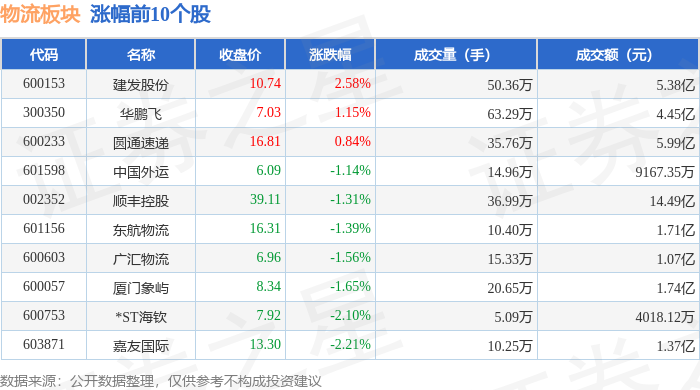
物流板块11月21日跌1.86%,龙洲股份领跌,主力资金净流出7.46亿元
Zheng Xing Xing Ye Ri Bao· 2025-11-21 09:33
Market Overview - The logistics sector experienced a decline of 1.86% on November 21, with Longzhou Co. leading the drop [1] - The Shanghai Composite Index closed at 3834.89, down 2.45%, while the Shenzhen Component Index closed at 12538.07, down 3.41% [1] Individual Stock Performance - Jianfa Co. (600153) saw an increase of 2.58% in its closing price at 10.74, with a trading volume of 503,600 shares and a transaction value of 538 million [1] - Longzhou Co. (002682) reported a significant drop of 9.92%, closing at 5.72, with a trading volume of 1,066,100 shares and a transaction value of 614 million [2] - Other notable declines included Pulu Tong (002769) down 6.56% and Tiensheng Co. (002800) down 6.48% [2] Capital Flow Analysis - The logistics sector experienced a net outflow of 746 million from institutional investors, while retail investors saw a net inflow of 401 million [2] - The data indicates that speculative funds had a net inflow of 344 million [2] Detailed Capital Flow for Selected Stocks - Guanghui Logistics (600603) had a net inflow of 16.10 million from institutional investors, while it faced a net outflow of 10.09% from speculative funds [3] - Hongchuan Wisdom (002930) reported a net inflow of 6.75 million from institutional investors and a net inflow of 4.51 million from speculative funds [3] - New Ning Logistics (300013) had a net inflow of 1.75 million from institutional investors, with speculative funds showing a net inflow of 10.38 million [3]




快递10月数据点评:件量增速降至较低水平,双十一热度略低预期
Dongxing Securities· 2025-11-21 09:08
Investment Rating - The industry investment rating is "Positive" [39] Core Viewpoints - The growth rate of express delivery volume has decreased to a low level, with October's national express service business volume reaching 17.6 billion pieces, a year-on-year increase of 7.9%, marking the lowest growth rate of the year [1][10] - The decline in the growth rate is attributed to a decrease in the enthusiasm for this year's Double Eleven shopping festival, as consumers are becoming more rational and impulsive spending is reduced due to prolonged promotional periods and consumption downgrade [2][7] - The express delivery companies are showing a divergence in strategies, with companies like Yunda experiencing a significant drop in growth rate, while companies like YTO maintain a relatively high growth rate due to a strong desire to increase market share [2][17] - The average revenue per piece for the major express companies has continued to rise, but the extent of the increase varies among companies, indicating a clear differentiation in strategies [3][28] Summary by Sections 1. Overview of the Industry - In October, the express delivery business volume reached 17.6 billion pieces, with a year-on-year growth of 7.9%. The same-city business volume decreased by 7.4%, while the intercity business volume increased by 9.6% [10][20] - The trend of "anti-involution" has been forming since July, leading to a significant decline in growth rates [7][10] 2. Express Delivery Volume - The express delivery volume growth rate has further declined in October, which is believed to be related to the cooling of the Double Eleven shopping festival [10][17] 3. Average Revenue per Piece - The average revenue per piece for the major express companies has shown a continued increase, with Shentong, YTO, and Yunda experiencing month-on-month increases of 2.8%, 0.9%, and 4.5% respectively [28][29] - The average revenue per piece for the industry has seen a year-on-year decline of 3.0% [26][28] 4. Structural Changes - The industry concentration ratio (CR8) in October was 87.0, an increase of 1.8 compared to the same period last year, indicating a slight increase in market concentration [35][36] 5. Investment Recommendations - The current anti-involution trend is expected to have strong sustainability, leading to a high-quality transformation in the industry. Companies are encouraged to focus on service quality rather than solely on volume [39]
自贡快递区域分拨日处理能力已突破500万件 更快收货!你的自贡冷吃兔已“提速”
Si Chuan Ri Bao· 2025-11-21 07:26
Core Insights - The logistics capabilities in Zigong have significantly improved with the simultaneous operation of two major logistics parks, enhancing the daily processing capacity to over 5 million packages and integrating smart and cold chain logistics [1][3][6] Group 1: Operational Efficiency - The YTO Express Sichuan (Zigong) Intelligent Innovation Park features a fully automated sorting system, increasing unloading efficiency from 1,500-2,000 packages per hour to 4,500 packages per hour, with a sorting line speed of 3 meters per second [3] - Real-time tracking and management of 34 loading points have improved operational efficiency, with reduced damage and mis-sorting rates [3] Group 2: Cold Chain Innovations - The Shudao Logistics Zigong Park includes a 20,000-ton multi-temperature intelligent cold storage, which operates quietly and efficiently, reducing energy consumption by over 20% compared to traditional cold storage [4][5] - The park employs an AI temperature control system for precise monitoring and has implemented a rainwater collection system for irrigation, while also preparing for future solar power generation [5] Group 3: Market Potential and Support - Zigong's logistics landscape is bolstered by 23 A-level logistics companies and a high demand for local products, with over 40 million packages shipped annually, providing ample opportunities for YTO's smart sorting and Shudao's cold chain services [6] - Local government policies support the development of a regional logistics center, enhancing the collaboration between logistics companies and the postal management bureau [6]
财通证券:快递行业增速换挡 各品牌之间增速分化
智通财经网· 2025-11-21 02:25
Core Viewpoint - The express delivery industry is expected to recover as the trend of reducing competition continues, with a focus on companies like YTO Express, ZTO Express, Shentong Express, and Yunda Express, which show potential for growth and valuation recovery [1] Industry Volume and Price - As of October 2025, the express delivery industry's business volume growth rate is 7.9%, surpassing the growth rate of physical online retail sales at 4.9% and social consumer goods retail sales at 2.9% [1] - The average revenue per delivery in the express delivery industry is 7.48 yuan, reflecting a year-on-year decline of 3.00% and a month-on-month decline of 0.85%, influenced by the trend of smaller packages and localized price competition [1] Regional Volume and Price - In October 2025, the year-on-year growth rates for express delivery business volume in different regions are +6.7% for Class I areas, +12.6% for Class II areas, and +23.2% for Class III areas, with non-grain-producing areas showing significantly higher growth than grain-producing areas [2] - The year-on-year growth rates for average revenue per delivery in these regions are -2.5% for Class I areas, -5.0% for Class II areas, and -12.3% for Class III areas, indicating a notable easing of price competition in grain-producing areas [2] Company Volume and Price - In October 2025, the year-on-year business volume growth rates for major companies are as follows: YTO Express +12.82%, Yunda Express -5.11%, Shentong Express +3.98%, and SF Express +26.26%, with YTO Express and SF Express outperforming the industry average [3] - The year-on-year revenue per delivery growth rates for these companies are: YTO Express -3.46%, Yunda Express +4.46%, Shentong Express +7.39%, and SF Express -9.97%, indicating a significant price recovery in the context of reduced competition, particularly for Yunda Express and Shentong Express [3]

