
重庆银行

Search documents
银行视角看25Q3货币政策执行报告:重提跨周期调节,保持合理利率比价关系维护息差稳定
Orient Securities· 2025-11-14 05:34
Investment Rating - The report maintains a "Positive" investment rating for the banking sector, indicating an expectation of relative outperformance compared to market benchmarks [6]. Core Viewpoints - The report highlights a cautious optimism regarding the banking sector's performance in Q4 2025, driven by stabilizing interest margins and improving fundamentals despite external uncertainties [3][4]. - It emphasizes the importance of maintaining a reasonable interest rate spread to support net interest margins, with a focus on effective monetary policy transmission [9][11]. Summary by Sections Investment Recommendations and Targets - The report identifies two main investment lines: 1. High-quality small and medium-sized banks with stable fundamentals, including targets like Chongqing Rural Commercial Bank (601077, Buy), Ningbo Bank (002142, Buy), and Nanjing Bank (601009, Buy) [4]. 2. Large state-owned banks with solid defensive value, such as Industrial and Commercial Bank of China (601398, Not Rated) and Agricultural Bank of China (601288, Not Rated) [4]. Banking Industry Overview - The report discusses the current state of the banking industry, noting a stabilization in interest margins and a cautious approach to monetary policy, with a focus on cross-cycle adjustments to enhance macroeconomic governance [9][11]. - It also mentions the need for a comprehensive macro-prudential management system to address risks in small financial institutions, suggesting that mergers and restructuring may accelerate [11]. Monetary Policy and Financial Conditions - The report indicates that the monetary policy will continue to be moderately accommodative, with a focus on maintaining reasonable growth in financial aggregates and credit [9][10]. - It highlights that the credit growth rate is expected to decline marginally, with a projected loan growth rate of 6.6% in Q3 2025 [9]. Interest Rate Dynamics - The report stresses the importance of maintaining a reasonable interest rate spread, with specific guidelines for banks to avoid issuing loans at rates lower than government bond yields [9][11]. - It notes that as of Q3 2025, the net interest margin for listed banks has stabilized, benefiting from a significant reduction in funding costs [9][11].




10月金融数据点评:社融增速仍承压,信贷偏弱,票据冲量
Orient Securities· 2025-11-14 04:45
Investment Rating - The report maintains a "Positive" outlook for the banking sector as of Q4 2025 [5][21]. Core Viewpoints - The report highlights that the growth of social financing remains under pressure, with a year-on-year increase of 8.5% in October 2025, which is a decrease of 0.2 percentage points compared to August [8][9]. - Credit growth is weak, with a notable reliance on bill financing to compensate for the decline in traditional loans [13][14]. - The report suggests that the banking sector is expected to show relative strength due to stabilizing interest margins and positive fundamental changes [21][22]. Summary by Sections Social Financing and Credit - In October 2025, social financing increased by 8.5% year-on-year, with a total increment of 815 billion yuan, which is 597 billion yuan less than the previous year [9][10]. - The total amount of RMB loans decreased by 201 million yuan, with a year-on-year decline of 3.166 billion yuan, indicating a seasonal dip in credit [8][9]. - Government bond issuance saw a year-on-year decrease of 560.2 billion yuan, further weakening the support for social financing [10][11]. - Direct corporate financing increased by 189.4 billion yuan, with bond financing up by 148.2 billion yuan and stock financing up by 41.2 billion yuan [10][11]. Loan Structure - Total RMB loans grew by 6.5% year-on-year, with new loans amounting to 220 billion yuan, which is 280 billion yuan less than the previous year [13][14]. - Household loans saw a significant decline, with short-term and medium-to-long-term loans both under pressure, leading to a year-on-year decrease of 5.156 billion yuan [13][14]. - Corporate loans primarily relied on bill discounting, which increased by 331.2 billion yuan year-on-year, while general loans saw a notable decrease [14][15]. Monetary Supply - M1 and M2 growth rates showed marginal declines, with M1 growing by 6.2% and M2 by 8.2% year-on-year [18][19]. - In October 2025, new RMB deposits totaled 610 billion yuan, with a year-on-year increase of 100 billion yuan, despite a significant drop in household deposits [18][20]. - Non-bank deposits increased significantly, indicating a shift away from traditional household savings [18][20]. Investment Recommendations - The report recommends focusing on high-quality small and medium-sized banks, with specific buy ratings for Chongqing Rural Commercial Bank, Ningbo Bank, Nanjing Bank, and Hangzhou Bank [21][22]. - It also suggests considering state-owned banks with stable fundamentals, such as Industrial and Commercial Bank of China, China Construction Bank, and Agricultural Bank of China, which are currently unrated [21][22].
银行研思录25:银行股息率排名与中期分红进度梳理-20251114
CMS· 2025-11-14 03:02
Investment Rating - The report does not explicitly state an investment rating for the banking sector, but it provides detailed insights into dividend yields and distribution processes, which can inform investment decisions. Core Insights - The report outlines the latest dividend yields and mid-term dividend processes for A and H shares of listed banks, emphasizing the importance of accurately calculating dynamic dividend yields to avoid discrepancies across periods [1][2]. - It details the two processes for mid-term dividends following the 2023 revision of the regulatory guidelines, highlighting the conventional and simplified processes for implementing mid-term dividends [2]. - The report provides a comprehensive overview of key dates related to dividend distribution for both A and H shares, including the importance of purchasing shares before the ex-dividend date to qualify for dividends [3][4]. Summary by Sections Dynamic Dividend Yield Calculation - A simplified yet accurate method for calculating dynamic dividend yield is introduced, defined as "rolling 12-month EPS * cash dividend rate / share price," which helps avoid issues related to overlapping or missing annual and mid-term dividends [1]. - The report calculates the cash dividend rate using a standardized approach across different banks, resulting in a clear comparison of dividend yields as of November 13, 2025 [1]. Mid-Term Dividend Processes - The report explains the two processes for mid-term dividends: the conventional process requiring shareholder approval and a simplified process allowing for quicker implementation [2]. - The simplified process is designed to enhance flexibility for companies in distributing mid-term dividends, thereby improving shareholder returns [2]. Dividend Distribution Key Dates - For A shares, investors must purchase shares before the ex-dividend date to receive dividends on the same day, while H shares typically see a delay of about one month for dividend payments [3][4]. - The report outlines the differences in the dividend distribution timeline between A and H shares, emphasizing the need for investors to be aware of these timelines to maximize their returns [3][4]. Mid-Term Dividend Progress - As of November 13, 2025, 31 A-share banks have confirmed mid-term dividends, while 11 H-share banks have also confirmed their dividend distributions [9][11]. - The report categorizes banks based on their dividend status, detailing those that have implemented dividends, those that are pending, and those that have opted not to distribute dividends [9][10][11]. - It highlights that the end of 2025 and early 2026 is expected to be a peak period for mid-term dividend distributions, suggesting potential investment opportunities for dividend-seeking investors [11].




银行2025年三季报综述:息差筑底,手续费改善,国有行全部营利双增
China Post Securities· 2025-11-13 10:57
Industry Investment Rating - The industry investment rating is maintained at "Outperform" [2] Core Viewpoints - The overall operating income, pre-provision profit, and net profit growth rates for listed banks in the first three quarters of 2025 are 0.91%, 0.56%, and 1.48% respectively, indicating a recovery in performance driven by scale and an ongoing improvement in fee income [4][12] - The growth rate of interest-earning assets for listed banks is 9.40% year-on-year, with loans and debt investments increasing by 7.83% and 13.94% respectively [4][5] - The net interest margin for listed banks is stable at 1.35%, with a slight decline in state-owned banks, while other types of banks have stabilized [5] - Non-interest income has increased by 5.02% year-on-year, although it has seen a quarter-on-quarter decline due to adjustments in the bond market [5] - The asset quality is improving, with the non-performing loan ratio at 1.23%, showing a slight decrease from the previous half-year [5] Summary by Sections 1. Performance Recovery Driven by Scale and Fee Improvement - In the first three quarters of 2025, listed banks showed a growth in operating income, pre-provision profit, and net profit, with respective growth rates of 0.91%, 0.56%, and 1.48% [12] - City commercial banks outperformed other types of banks, while state-owned banks also showed positive growth [12] 2. Growth of Interest-Earning Assets and Slower Expansion of Liabilities - The year-on-year growth rate of interest-earning assets for listed banks is 9.40%, with loans and debt investments increasing by 7.83% and 13.94% respectively [4][5] 3. Stabilization of Net Interest Margin - The net interest margin for listed banks is stable at 1.35%, with a slight decline in state-owned banks [5] 4. Non-Interest Income Performance Affected by Bond Market Adjustments - Non-interest income increased by 5.02% year-on-year, but saw a quarter-on-quarter decline due to bond market adjustments [5] 5. Improvement in Asset Quality and Declining Credit Costs - The non-performing loan ratio for listed banks is 1.23%, showing a slight decrease from the previous half-year, with a significant decline in credit costs [5][12] 6. Investment Recommendations - Focus on banks with significant deposit maturities and potential for interest margin improvement, such as Chongqing Bank, China Merchants Bank, and Bank of Communications [6] - Attention to city commercial banks that will benefit from improvements in fixed asset investment, such as Jiangsu Bank, Qilu Bank, and Qingdao Bank [6]




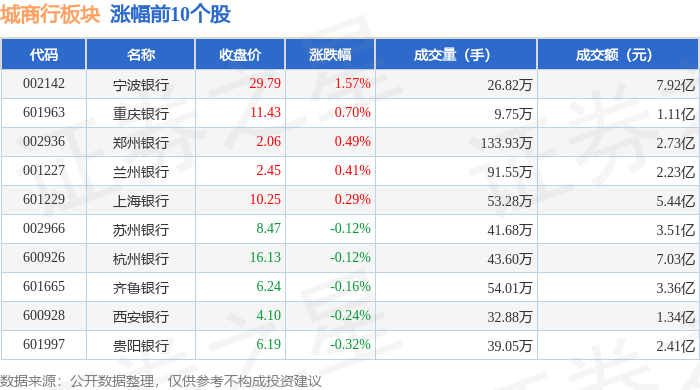
城商行板块11月13日跌0.02%,长沙银行领跌,主力资金净流出6796.93万元
Zheng Xing Xing Ye Ri Bao· 2025-11-13 08:45
Core Points - The city commercial bank sector experienced a slight decline of 0.02% on November 13, with Changsha Bank leading the drop [1] - The Shanghai Composite Index closed at 4029.5, up 0.73%, while the Shenzhen Component Index closed at 13476.52, up 1.78% [1] Summary by Category Stock Performance - Ningbo Bank (002142) closed at 29.79, with an increase of 1.57% and a trading volume of 268,200 shares, totaling a transaction value of 792 million yuan [1] - Chongqing Bank (601963) closed at 11.43, up 0.70%, with a trading volume of 97,500 shares, totaling 111 million yuan [1] - Zhengzhou Bank (002936) closed at 2.06, up 0.49%, with a trading volume of 1,339,300 shares, totaling 273 million yuan [1] - Other banks such as Lanzhou Bank, Shanghai Bank, and Suzhou Bank showed minor fluctuations in their stock prices, with varying trading volumes and values [1] Capital Flow - The city commercial bank sector saw a net outflow of 67.9693 million yuan from main funds, while retail funds experienced a net outflow of 99.3293 million yuan [3] - Conversely, speculative funds recorded a net inflow of 166.7 million yuan [3]


银行板块“逆袭”大戏能否延续?
Di Yi Cai Jing· 2025-11-13 05:56
Core Viewpoint - The banking sector in the A-share market has experienced a dramatic reversal in the fourth quarter, with the Shenwan Bank Index rising nearly 9% since the beginning of the quarter, significantly outperforming the broader market [2][3]. Market Performance - The banking sector's strong performance is not a one-day event but shows a trend of upward movement, with the Shenwan Bank Index increasing by 8.86% in the fourth quarter, compared to a 3.02% rise in the Shanghai Composite Index [3][4]. - Individual stocks have shown even greater gains, with Agricultural Bank of China and Chongqing Bank rising over 27%, and Shanghai Bank and Xiamen Bank increasing by more than 17% [3]. Fund Flow and Investor Sentiment - In the third quarter, the banking sector was the only one to decline, with a cumulative drop of 10.19%, and public funds significantly reduced their holdings, selling 535.9 million shares [4]. - In contrast, over 6 billion yuan has flowed into bank-related ETFs in the fourth quarter, indicating a shift in investor sentiment towards the banking sector [4][6]. Institutional Interest - There has been an increase in institutional interest in the banking sector, with 11 banks receiving attention from 62 institutions since the beginning of the fourth quarter [4][5]. - Some banks that were previously heavily sold off in the third quarter are now being researched by institutions, indicating a potential turnaround in investor perception [5]. Valuation and Dividend Appeal - Analysts attribute the renewed interest in bank stocks to their low valuation and high dividend yield, making them attractive in a risk-averse environment as the year ends [6][7]. - The banking sector's valuation remains at historical lows, and the high dividend characteristics are expected to attract long-term capital, including insurance funds and public funds [6][7]. Divergent Views on Investment Value - There is a divergence in institutional views regarding the investment value of the banking sector, with some analysts believing that the sector's valuation does not fully reflect its true value, particularly for quality regional banks [8][9]. - Other analysts express caution, suggesting that the recent gains in bank stocks may be driven by short-term factors and that the sector's appeal may be more tactical than fundamental [9].
银行板块“逆袭”大戏能否延续?
第一财经· 2025-11-13 05:49
Core Viewpoint - The banking sector in the A-share market has experienced a dramatic reversal in the fourth quarter, with the Shenwan Banking Index rising nearly 9% since the beginning of the quarter, significantly outperforming the broader market [3][5]. Group 1: Market Performance - The banking sector, which was the only declining sector in the third quarter with a drop of 10.19%, has seen a strong recovery, with Agricultural Bank and Industrial and Commercial Bank reaching historical highs [5][6]. - As of November 12, the Shenwan Banking Index has increased by 8.86% in the fourth quarter, compared to a 3.02% rise in the Shanghai Composite Index during the same period [5][6]. - Individual stocks have shown even greater gains, with Agricultural Bank and Chongqing Bank rising over 27%, and Shanghai Bank and Xiamen Bank increasing by more than 17% [5][6]. Group 2: Fund Flows and Investor Sentiment - In the third quarter, public funds reduced their holdings in the banking sector by 53.59 billion shares, with 42 out of 55 bank stocks experiencing reductions [6][7]. - In contrast, over 60 billion yuan has flowed into bank-related ETFs in the fourth quarter, indicating a shift in market sentiment towards banking stocks [6][7]. - Institutional interest in the banking sector has increased, with 11 banks receiving attention from 62 different institutions for research since the beginning of the fourth quarter [6][7]. Group 3: Investment Drivers - The recovery in banking stocks is attributed to multiple factors, including stable cash flows, high dividends, and low valuations, which have made them attractive in a risk-averse environment [7][8]. - The low allocation of active funds to the banking sector has reached a five-year low, suggesting potential for increased investment as market conditions evolve [7][8]. - Policy changes are also seen as a driving force for increased allocation to banking stocks, as public funds look to rebalance their portfolios [8][9]. Group 4: Divergent Views on Investment Value - There is a division among institutional investors regarding the investment value of banking stocks, with some believing that the sector still holds significant potential for growth, especially among regional banks [9]. - Others express caution, suggesting that the recent gains may be driven by short-term factors and that the sustainability of these trends remains uncertain [9].

重庆多家银行违规遭处罚 涉事银行拒绝回应整改措施
Xin Lang Cai Jing· 2025-11-13 02:31
Core Insights - The banking sector in Chongqing is facing increased regulatory scrutiny, with multiple banks receiving fines for various violations, indicating a trend of heightened enforcement in the industry [1][8]. Regulatory Actions - Industrial Bank's Chongqing branch was fined 4.2 million yuan for serious violations, including inadequate loan "three checks," poor credit management, and evasion of recording regulations [3][4]. - Chongqing Bank was fined 2.2 million yuan for similar issues, including inadequate loan "three checks" and imprudent investment practices [5][9]. - Hengfeng Bank's Chongqing branch was fined 2.6 million yuan for covering up bad loans and failing to manage investments properly [1]. Violations and Consequences - The violations at Industrial Bank included multiple serious issues such as inadequate loan checks, misclassification of assets, and poor management of non-standard investment businesses [3][4]. - Several individuals associated with these violations received warnings or fines, highlighting accountability within the institutions [3][5]. Industry Trends - In the third quarter of 2025, banks received a total of 1,448 fines amounting to 829 million yuan, representing an 84.63% year-on-year increase, with credit business violations being a significant concern [8]. - The trend of violations has shifted from real estate to other areas, including the repayment of bad loans and investment in stocks and funds [8]. Financial Health of Chongqing Bank - As of July 2023, Chongqing Bank's total assets reached 1,008.7 billion yuan, but the bank's risk management shortcomings have been exposed by repeated fines [7]. - The bank's non-performing loan ratio stood at 1.17% as of mid-2025, with declines in key capital adequacy ratios compared to the end of 2024 [7]. Expert Opinions - Experts attribute the frequent violations to a combination of factors, including banks prioritizing short-term performance over risk management and a lack of compliance systems in rapidly expanding new business areas [10]. - The increased regulatory penalties serve as a warning about management vulnerabilities and signal a normalization of stringent regulatory oversight in the banking sector [10].

银行直售房,没那么吓人
Ge Long Hui· 2025-11-12 10:55
Core Insights - The recent surge in banks selling properties has raised concerns about the accumulation of non-performing assets within the banking sector [1][2][4] - Data indicates that the number of properties listed for sale by various rural credit systems is substantial, with Guangdong, Sichuan, and other provinces showing significant figures [1][2][6] - Despite the high number of properties being sold, they represent a small fraction of the overall housing inventory in major cities like Guangzhou, Shenzhen, and Chengdu [6][11][9] Summary by Sections Property Sales Data - Since August 2024, the Guangdong rural credit system has listed 12,386 properties for sale, while the Sichuan rural credit system has listed 24,821 properties since November 2024 [1] - Other provinces such as Liaoning, Guizhou, Jilin, and Fujian have also contributed to the total number of properties being sold [1] Market Reaction - The market has reacted with surprise, speculating that banks may be facing a significant amount of non-performing assets [2][4] - The perception is that the properties being sold are just the tip of the iceberg, indicating a larger issue with banks needing to liquidate assets [2] Non-Performing Loans and Asset Management - The sale of properties is often linked to borrowers' inability to repay loans, leading banks to reclaim and sell these assets [3] - The current data suggests that the number of properties being sold is relatively small compared to the total inventory of second-hand homes available in the market [6][11] Trends in Non-Performing Loan Rates - The overall non-performing loan rates for listed banks have been declining since 2020, indicating that banks have been effectively managing and disposing of non-performing assets [12][13] - As of November 2025, the non-performing loan rates for various banks show a downward trend compared to previous years, with many banks reporting lower rates than in 2020 [12][13] Industry Restructuring - The banking sector has undergone significant reforms and consolidations, with over 300 rural banks being merged or restructured in 2025 alone [15] - Major banks have also participated in these consolidations, indicating a strategic move to strengthen their positions and manage non-performing assets more effectively [15] Asset Disposal Efforts - Banks have been actively disposing of non-performing assets, with significant amounts being processed each year [18][20] - In 2025, banks disposed of 1.5 trillion yuan in non-performing assets, reflecting a proactive approach to managing risk [20] - The rural commercial banks have seen the highest non-performing loan rates but have also experienced the most significant reductions in these rates over the years [21][22]

城商行板块11月12日涨0.05%,长沙银行领涨,主力资金净流入2.2亿元
Zheng Xing Xing Ye Ri Bao· 2025-11-12 08:49
Core Insights - The city commercial bank sector experienced a slight increase of 0.05% on November 12, with Changsha Bank leading the gains [1] - The Shanghai Composite Index closed at 4000.14, down 0.07%, while the Shenzhen Component Index closed at 13240.62, down 0.36% [1] Stock Performance - Changsha Bank (601577) closed at 10.08, up 0.90% with a trading volume of 199,800 shares and a transaction value of 201 million yuan [1] - Shanghai Bank (601229) closed at 10.22, up 0.89% with a trading volume of 597,100 shares and a transaction value of 611 million yuan [1] - Other notable performances include: - Lanzhou Bank (001227) at 2.44, up 0.41% - Jiangsu Bank (616009) at 11.13, up 0.27% - Beijing Bank (601169) at 5.73, up 0.17% [1] Capital Flow - The city commercial bank sector saw a net inflow of 220 million yuan from main funds, while retail investors experienced a net outflow of 200 million yuan [2] - Key capital flows include: - Jiangsu Bank (600919) with a net inflow of 10.4 million yuan from main funds [2] - Beijing Bank (601169) with a net inflow of 62.5 million yuan from main funds [2] - Shanghai Bank (601229) with a net inflow of 58.5 million yuan from main funds [2]

