鹏华

Search documents
4只公告上市ETF仓位超60%
Zheng Quan Shi Bao Wang· 2026-01-05 03:24
Core Viewpoint - Three stock ETFs have recently announced their listing, with varying stock positions indicating different investment strategies and market conditions [1] Group 1: ETF Stock Positions - The stock position of the Invesco Hang Seng Biotechnology ETF is 15.90%, while the XQHS300 Quality ETF has a stock position of 62.01%, and the E Fund Shanghai Stock Exchange Sci-Tech Innovation Board Chip ETF has a stock position of 5.37% [1] - In the past month, 23 stock ETFs have announced their listings, with an average stock position of only 29.09%. The highest stock position is held by the Industrial Bank Sci-Tech Innovation Entrepreneurship Artificial Intelligence ETF at 75.70% [1] Group 2: Fundraising and Shareholder Structure - The average number of shares raised by the recently listed ETFs is 4.46 million, with the largest being the E Fund CSI Sci-Tech Innovation Entrepreneurship Artificial Intelligence ETF at 13.36 million shares [2] - Institutional investors hold an average of 18.62% of the shares, with the highest proportions in the Hua Bao CSI Hong Kong Stock Connect Automotive Industry Theme ETF (64.43%), the Jiao Yin CSI Selected Hong Kong and Shanghai Technology 50 ETF (48.92%), and the Guangfa CSI A50 ETF (45.22%) [2] Group 3: ETF Listing Details - The listing details of several ETFs include the establishment date, fundraising scale, and stock positions, with notable examples being the E Fund Shanghai Stock Exchange Sci-Tech Innovation Board Chip ETF with a stock position of 5.37% and the Invesco Hang Seng Biotechnology ETF with a stock position of 15.90% [3]
科创债ETF异军突起,6000亿资金追逐的背后
市值风云· 2025-12-31 10:08
Core Viewpoint - The bond ETF market, particularly the Sci-Tech bond ETFs, has experienced rapid growth, reaching a scale of nearly 350 billion yuan within just six months, indicating a significant shift in investor interest towards bond ETFs as compared to stock ETFs [1][6]. Group 1: Market Growth - As of December 30, 2025, the total scale of bond ETFs reached 813.26 billion yuan, representing a growth of over 360% since the beginning of the year [4]. - The rapid influx of funds into Sci-Tech bond ETFs has driven the overall credit bond ETF scale close to 600 billion yuan [5][6]. - The first batch of 10 Sci-Tech bond ETFs launched in July 2025 sold out on the first day, showcasing high market demand [7]. Group 2: Factors Driving Popularity - The growth of Sci-Tech bond ETFs is attributed to several factors, including supportive policies, product advantages, and the attractiveness of underlying assets [9]. - The introduction of the "Technology Board" policy in May 2025 laid the groundwork for the launch of Sci-Tech bond ETFs [10]. - The product features such as T+0 trading, pledge repurchase capability, low fees, and high transparency align well with institutional investors' needs [11]. Group 3: Underlying Assets - Sci-Tech bond ETFs primarily invest in credit bonds issued by technology innovation institutions or those focused on technology innovation, with a majority being AAA-rated bonds from state-owned enterprises [13]. - The AAA Sci-Tech bond index tracked by the Jia Shi Sci-Tech bond ETF has shown an annualized return of 4.11% since its base date, with a low annualized volatility of 1.02%, outperforming many short and medium-term bond funds [13]. Group 4: Target Investors - Sci-Tech bond ETFs are suitable for specific types of investors, particularly institutional investors looking to optimize asset allocation [15][16]. - Long-term funds such as pensions, insurance, and bank wealth management products are using these ETFs as core underlying assets for asset-liability matching and liquidity management [17]. - For individual investors seeking stability, Sci-Tech bond ETFs offer a less volatile investment option compared to direct stock market investments, along with regular coupon income [18].

机器人ETF鹏华(159278)涨超3.6%,特斯拉Optimus发包在即
Xin Lang Cai Jing· 2025-12-30 05:37
Group 1 - The robotics sector experienced a collective surge, with significant updates from Sanhua, indicating that Optimus is set to begin batch deliveries starting Q1 2026, covering 80,000 to 100,000 units, including orders for 2027, and securing supply rights for all 14 rotary joints and some linear actuators [1] - As of December 30, 2025, the National Securities Robotics Industry Index (980022) rose by 3.6%, with constituent stocks such as Boke Co., Ltd. (688160) increasing by 19.08%, Haozhi Electromechanical (300503) by 17.06%, and Zhongdali De (002896) by 6.94% [1] - The Penghua Robotics ETF (159278) increased by 3.34%, with the latest price reported at 1.12 yuan, closely tracking the National Securities Robotics Industry Index [1] Group 2 - As of November 28, 2025, the top ten weighted stocks in the National Securities Robotics Industry Index (980022) include Shuanghuan Transmission (002472), Ecovacs (603486), and Greentech Harmonics (688017), collectively accounting for 40.47% of the index [2]

突破2600亿!指增“黄金时代”正在来临,来看大厂样本
Zheng Quan Shi Bao Wang· 2025-12-28 13:32
Core Insights - The public fund industry is undergoing a transformation with the tightening of performance benchmarks, pushing all players towards a competitive landscape focused on index-enhanced strategies, which are becoming a significant structural trend in the market [1][2] - As of the end of 2025, the scale of quantitative index-enhanced funds has surpassed 260 billion, with a notable increase in new product launches, indicating a strong market response [2] Industry Trends - The introduction of the regulatory framework by the China Securities Regulatory Commission (CSRC) is establishing performance benchmarks as a new guiding principle for the public fund industry [1] - The number of newly established index-enhanced funds reached 177, with a total issuance scale exceeding 97.518 billion, surpassing the total from the previous three years [1][2] Competitive Landscape - Leading fund companies are building comprehensive index ecosystems, with firms like China Merchants Fund and Tianhong Fund leading in product offerings and market coverage [4] - Mid-tier and smaller firms are focusing on niche strategies to carve out their market share amidst competition from larger players [4] Performance Metrics - A significant 95.97% of enhanced index products achieved positive returns in the year, with the highest return reaching 85.77% [5] - 86.01% of index-enhanced products delivered positive excess returns, with nine products exceeding 20% in excess returns compared to their benchmarks [5][6] Technological Advancements - Tianhong Fund's quantitative index-enhanced business has evolved into a core area, leveraging AI to achieve systematic and scientific investment strategies [8][9] - Over 70% of the excess factors in Tianhong's quantitative index-enhanced products are derived from AI learning, showcasing a shift from traditional methods to AI-driven approaches [9][10] Operational Efficiency - The operational model at Tianhong involves a highly engineered "alpha pipeline" that integrates various data sources and models to enhance investment decision-making [11][12] - The collaborative structure within Tianhong's research and investment teams ensures a seamless execution of strategies, combining human expertise with advanced systems to achieve stable long-term excess returns [12]
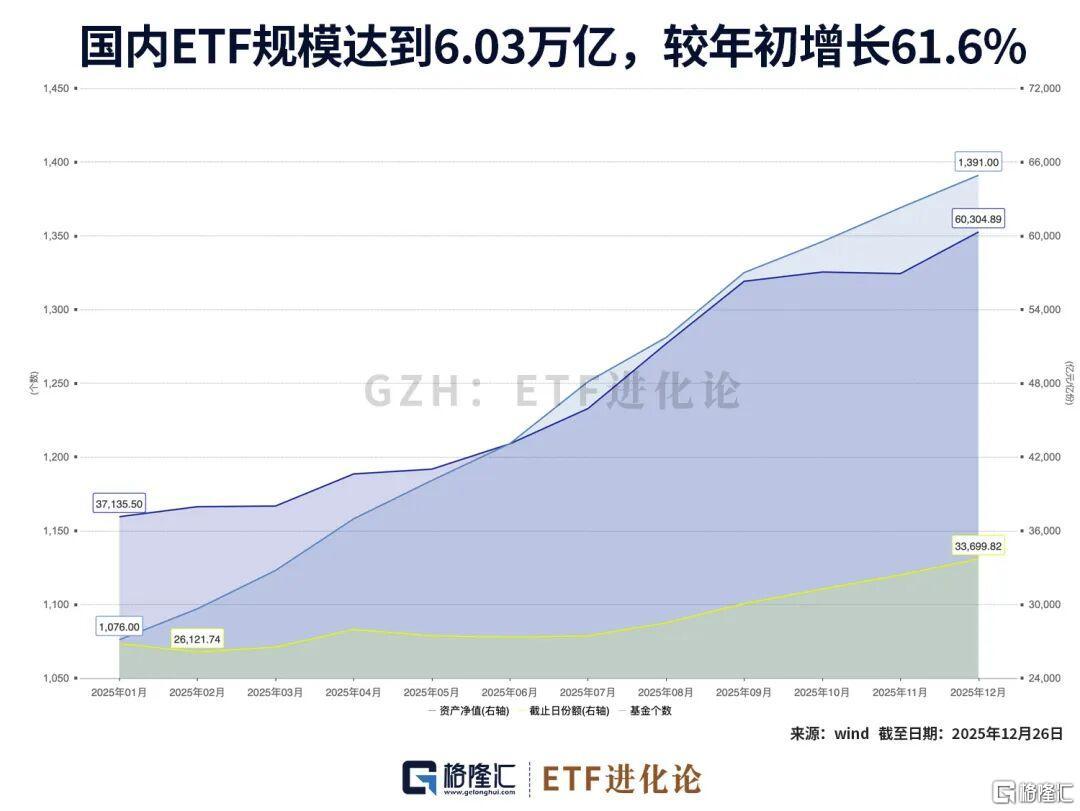
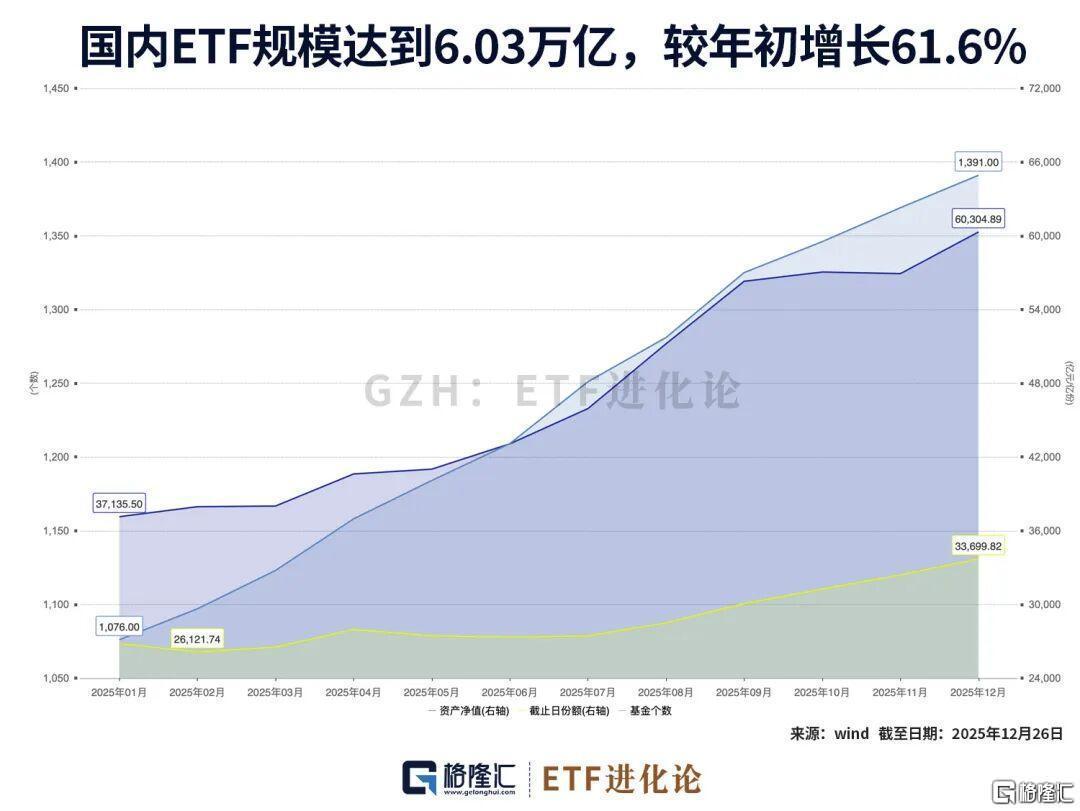
中国ETF总规模首破6万亿元!7只千亿级ETF,125只ETF规模突破百亿
Xin Lang Cai Jing· 2025-12-28 07:02
Core Insights - The Chinese capital market is entering an "ETF era" by 2025, with the total market size of ETFs reaching 6 trillion yuan, a remarkable increase of 61.6% in just one year [1][3][4] Market Growth - The ETF market has shown rapid growth, breaking through significant thresholds of 4 trillion, 5 trillion, and 6 trillion yuan within 2025, indicating a clear acceleration in market expansion [3][4] - Historical data shows that the ETF market grew from 1 trillion yuan in 2020 to 2 trillion in 2023, and then to 3 trillion in 2024, culminating in a "super explosion" in 2025, where the market crossed multiple trillion thresholds in a matter of months [4][5] Market Structure - The ETF landscape has transformed, with ETFs becoming a key component of the public fund system, featuring 1,381 ETFs, including 7 flagship ETFs exceeding 100 billion yuan and 125 ETFs surpassing 10 billion yuan [5][9] - The Huatai-PB CSI 300 ETF leads the market with a size of 427.07 billion yuan, making it the only ETF to exceed 400 billion yuan [5][7] Fund Inflows - In 2025, 50 ETFs experienced net inflows exceeding 10 billion yuan, with the Hong Kong Stock Connect Internet ETF attracting the highest inflow of 57.07 billion yuan, followed by the Gold ETF with 41.70 billion yuan [17][19] - Bond ETFs have also seen significant inflows, with the Short-term Bond ETF and 30-Year Treasury Bond ETF attracting 35.05 billion yuan and 22.35 billion yuan, respectively [17][19] Competitive Landscape - The top three fund companies dominate the ETF market, holding 41% of the market share, while the top ten companies account for 75% [21] - The "ETF Billion Club" expanded from 12 to 16 members in 2025, with new entrants including Huatai-PB, Hai Fu Tong, Penghua, and Tianhong [21] Global Context - The domestic ETF market is approximately one-fourth the size of the U.S. market, indicating that the long-term trend of index-based investing is just beginning in China [27]
中国ETF总规模首破6万亿元!谁是2025年的胜者?
Xin Lang Cai Jing· 2025-12-28 07:01
Core Insights - The Chinese capital market is entering an "ETF era" by 2025, with the total market size of ETFs reaching 6 trillion yuan, a 61.6% increase in just one year [1][3][4] Market Growth - The ETF market has shown rapid growth, breaking through 4 trillion, 5 trillion, and 6 trillion yuan in quick succession within 2025, indicating a clear acceleration in growth [3][4] - Historical data shows that the ETF market grew from 1 trillion yuan in 2020 to 2 trillion in 2023, and 3 trillion in 2024, culminating in a significant leap in 2025 [4] Market Structure Changes - The growth in ETF size has transformed the market landscape, making ETFs a key component of the public fund system, with 1,381 ETFs in total, including 7 flagship ETFs exceeding 100 billion yuan [5][9] - The Huatai-PB CSI 300 ETF leads the market with a size of 427.07 billion yuan, followed by other major ETFs from E Fund, Huaxia, and others [5][7] Fund Inflows - In 2025, 50 ETFs saw net inflows exceeding 10 billion yuan, with the Hong Kong Stock Connect Internet ETF attracting the most at 57.07 billion yuan, followed by the Gold ETF with 41.70 billion yuan [17][19] - Bond ETFs also saw significant inflows, with the Short-term Bond ETF and 30-Year Treasury Bond ETF attracting 35.05 billion yuan and 22.35 billion yuan, respectively [17] Competitive Landscape - The top three fund companies dominate the ETF market, holding 41% of the market share, while the top ten companies account for 75% [21] - The "ETF billion club" expanded from 12 to 16 members in 2025, with new entrants including Huitianfu, Haifutong, and Penghua [21] Global Context - The domestic ETF market is approximately one-fourth the size of the U.S. market, indicating that the long-term trend of indexation in China is just beginning [27]
ETF 日报 2025.12.22-20251222
Da Lian Shang Pin Jiao Yi Suo· 2025-12-22 09:33
Market Overview - On December 22, 2025, the Shanghai Composite Index rose 0.69% to close at 3917.36 points, the Shenzhen Component Index rose 1.47% to close at 13332.73 points, and the ChiNext Index rose 2.23% to close at 3191.98 points. The trading volume of A-shares in the two markets was 1882.4 billion yuan. The top-performing sectors were communication (4.28%), comprehensive (2.63%), and electronics (2.62%), while the bottom-performing sectors were media (-0.61%), banking (-0.52%), and beauty care (-0.45%) [2][6] Stock ETF - The top-traded stock ETFs on this day were Huatai-PineBridge CSI A500 ETF, which rose 1.22% with a discount rate of 1.28%; ChinaAMC CSI A500 ETF, which rose 1.03% with a discount rate of 1.20%; and Guotai CSI A500 ETF, which rose 1.03% with a discount rate of 1.16%. The top ten stock ETFs by trading volume are also listed in the report, including information such as price, change rate, tracking index, and discount rate [3][7][8] Bond ETF - The top-traded bond ETFs were Haifutong CSI Short-term Financing Bond ETF, which remained unchanged with a discount rate of -0.01%; China Merchants CSI AAA Science and Technology Innovation Corporate Bond ETF, which rose 0.06% with a discount rate of -0.18%; and Penghua Shanghai Stock Exchange AAA Science and Technology Innovation Bond ETF, which rose 0.03% with a discount rate of -0.18%. The top five bond ETFs by trading volume are also detailed [4][9][10] Gold ETF - Gold AU9999 rose 1.77% and Shanghai Gold rose 1.96%. The top-traded gold ETFs were Huaan Gold ETF, which rose 2.13% with a discount rate of 2.01%; Boshi Gold ETF, which rose 2.01% with a discount rate of 1.92%; and E Fund Gold ETF, which rose 2.01% with a discount rate of 1.91%. The top five gold ETFs by trading volume are presented [12][13] Commodity Futures ETF - Dacheng Nonferrous Metals Futures ETF rose 0.83% with a discount rate of 1.38%; Jianxin Yisheng Zhengzhou Commodity Exchange Energy and Chemical Futures ETF rose 1.65% with a discount rate of 1.81%; and ChinaAMC Feed Soybean Meal Futures ETF fell 0.10% with a discount rate of 3.06%. Information on these commodity futures ETFs is provided [15][16] Cross-border ETF - The previous trading day, the Dow Jones Industrial Average rose 0.38%, the Nasdaq Composite rose 1.31%, the S&P 500 rose 0.88%, and the German DAX rose 0.37%. On this day, the Hang Seng Index rose 0.43% and the Hang Seng China Enterprises Index rose 0.43%. The top-traded cross-border ETFs were E Fund CSI Hong Kong Securities Investment Theme ETF, which fell 0.10% with a discount rate of -0.79%; Huatai-PineBridge CSI KRX China-South Korea Semiconductor ETF, which rose 3.57% with a discount rate of 6.06%; and GF CSI Hong Kong Innovative Drug ETF, which fell 1.18% with a discount rate of -1.53%. The top five cross-border ETFs by trading volume are shown [18][19] Money ETF - The top-traded money ETFs on this day were Yin Hua Day Profit ETF, Hua Bao Add Benefit ETF, and Money ETF. The top three money ETFs by trading volume are listed [20][21]
首批七只人工智能ETF陆续上市,基金经理直呼“行情变化太快不敢建仓”
Sou Hu Cai Jing· 2025-12-19 02:38
Group 1 - The first three listed AI ETFs are experiencing market fluctuations, with the E Fund AI ETF (159140.SZ) showing a decline of 1.38% on December 18, with a turnover rate of 17.11% and a transaction volume of 230 million yuan [1] - The other two listed AI ETFs, Yongying (159141.SZ) and Invesco (159142.SZ), have also recorded declines of -2.97% and -1.45% respectively since their listing [1] - The underlying index, the CSI AI Innovation and Entrepreneurship Index, was launched on May 14 and includes 50 companies involved in providing resources, technology, and application support for AI [1] Group 2 - As of December 17, the index's largest free float market capitalization is 655.54 billion yuan, while the smallest is 3.25 billion yuan, with the top five samples accounting for 45.56% of the total weight [2] - The largest weight within the index is held by Xinyi Technology (300502.SZ) at 11.09%, followed by Zhongji Xuchuang (300308.SZ) at 10.41%, and other companies like Lanjing Technology (688008.SH) and Cambricon (688256.SH) at 9.58% and 9.33% respectively [2] - On December 18, the significant declines in the stocks of Xinyi Technology (down 4.62%) and Zhongji Xuchuang (down 3.18%) contributed to a 1.15% drop in the index [2] Group 3 - The first batch of seven AI ETFs was issued by multiple firms, including E Fund, Huatai-PB, and Invesco, with a rapid approval and issuance process [6] - Individual investors are the main subscribers for the Huatai-PB AI ETF (159139.SZ), making up 87.73% of the total, while institutional investors are more prominent in the Yongying AI ETF (159141.SZ), accounting for 34.43% [7][8] - The Yongying AI ETF's successful fundraising in one day was attributed to strong institutional support, with significant subscriptions from various asset management firms [8] Group 4 - Current regulations require that ETFs maintain at least 90% of their assets in stocks upon listing, but rapid market changes can complicate the speed of asset acquisition [9] - The technology sector has seen significant growth this year, with some sub-sectors reaching historical high valuations, raising questions about potential valuation corrections [10] - Despite short-term market fluctuations, the long-term outlook for the AI industry remains positive, with stronger financial health and faster commercialization processes compared to the past [10]

天府证券ETF日报2025.12.18-20251218
天府证券· 2025-12-18 09:26
Report Summary 1. Market Overview - The Shanghai Composite Index rose 0.16% to close at 3876.37 points, the Shenzhen Component Index fell 1.29% to close at 13053.97 points, and the ChiNext Index fell 2.17% to close at 3107.06 points. The trading volume of A-shares in the two markets was 1677 billion yuan. The top-performing sectors were banking (1.97%), coal (1.89%), and petroleum and petrochemicals (1.25%), while the bottom-performing sectors were power equipment (-2.22%), communications (-1.58%), and electronics (-1.51%) [2][6]. 2. Stock ETFs - The top-trading-volume stock ETFs were Huatai-PineBridge CSI A500 ETF (down 0.73%, premium rate -0.60%), ChinaAMC CSI A500 ETF (down 0.69%, premium rate -0.62%), and Southern CSI A500 ETF (down 0.74%, premium rate -0.59%) [3][7]. 3. Bond ETFs - The top-trading-volume bond ETFs were Haifutong CSI Short-term Financing Bond ETF (up 0.01%, premium rate -0.01%), China Merchants CSI AAA Technology Innovation Corporate Bond ETF (up 0.01%, premium rate -0.23%), and Penghua SSE AAA Sci-Tech Innovation Bond ETF (up 0.03%, premium rate -0.18%) [4][9]. 4. Gold ETFs - Gold AU9999 rose 0.29% and Shanghai Gold rose 0.09%. The top-trading-volume gold ETFs were HuaAn Gold ETF (up 0.09%, premium rate 0.23%), Bosera Gold ETF (up 0.08%, premium rate 0.21%), and E Fund Gold ETF (up 0.07%, premium rate 0.20%) [12]. 5. Commodity Futures ETFs - Dacheng Non-ferrous Metals Futures ETF rose 0.16% with a premium rate of 0.51%; Jianxin Yisheng Zhengzhou Commodity Exchange Energy and Chemical Futures ETF rose 1.26% with a premium rate of 1.40%; China Feed Soybean Meal Futures ETF fell 0.21% with a premium rate of 1.73% [15]. 6. Cross-border ETFs - The previous trading day saw the Dow Jones Industrial Average down 0.47%, the Nasdaq down 1.81%, the S&P 500 down 1.16%, and the German DAX down 0.48%. Today, the Hang Seng Index rose 0.12% and the Hang Seng China Enterprises Index fell 0.02%. The top-trading-volume cross-border ETFs were E Fund CSI Hong Kong Securities Investment Theme ETF (down 1.11%, premium rate -1.13%), Huatai-PineBridge Hang Seng Tech ETF (down 1.26%, premium rate -1.60%), and GF CSI Hong Kong Innovative Drug ETF (up 0.16%, premium rate -0.21%) [17]. 7. Money Market ETFs - The top-trading-volume money market ETFs were YinHua RiLi ETF, HuaBao TianYi ETF, and Money Market ETF [19].
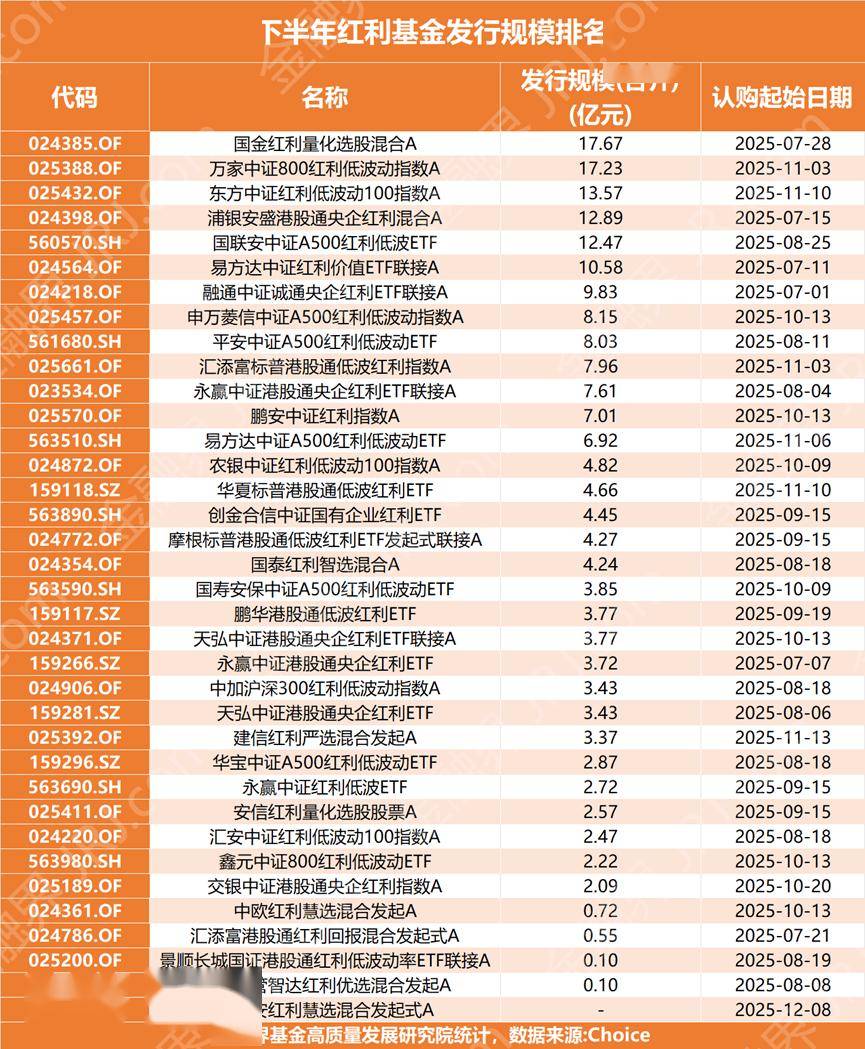
下半年募资能力较强的红利基金,看看哪只让你意外了?
Sou Hu Cai Jing· 2025-12-14 08:42
Group 1 - The core viewpoint of the articles highlights a significant acceleration in the issuance and fundraising of dividend-themed public funds in the second half of the year, with a notable increase in both the number and scale of new products [1][3] - In the first half of the year, 26 dividend-themed funds were established, raising approximately 9.3 billion yuan, with a median size of around 300 million yuan. In contrast, by December 12, 36 new dividend-themed funds were launched in the second half, raising a total of 20.4 billion yuan, representing a doubling in scale compared to the first half [1][3] - The average fundraising capability of single funds has significantly improved, with the largest fund raising 1.767 billion yuan and the median size increasing to 400 million yuan [1][3] Group 2 - Among the 36 new funds, 27 are index funds and 9 are actively managed equity funds, indicating that tool-based products dominate the dividend strategy [1] - The top fundraising fund in the second half is the Guojin Dividend Quantitative Stock Mixed A, which raised 1.767 billion yuan, followed closely by the Wanji Zhongzheng 800 Dividend Low Volatility Index A at 1.723 billion yuan [3] - The issuance activity is led by Yongying Fund, which launched 3 dividend-themed funds, while several other companies, including Yifangda, Tianhong, and Penghua, each issued 2 products [3] Group 3 - A structural change is evident in the current issuance trend, with Hong Kong dividend funds becoming a significant source of new products, as 12 related products were established in the second half, surpassing the number from the first half [3] - The leading fund in the Hong Kong dividend category is the浦银安盛港股通央企红利混合A, which raised 1.289 billion yuan, with other funds like the 汇添富标普港股通低波红利指数 and 永赢中证港股通央企红利ETF联接 also showing substantial fundraising [3] - The "dividend low volatility" strategy has seen rapid expansion, with 18 related products launched in the second half, tracking various indices such as 中证800红利低波 and 中证A500红利低波, providing investors with more diverse options [3]