
OceanBase

Search documents
人工智能应用带动云数据库需求激增
Xin Hua Cai Jing· 2025-08-28 14:37
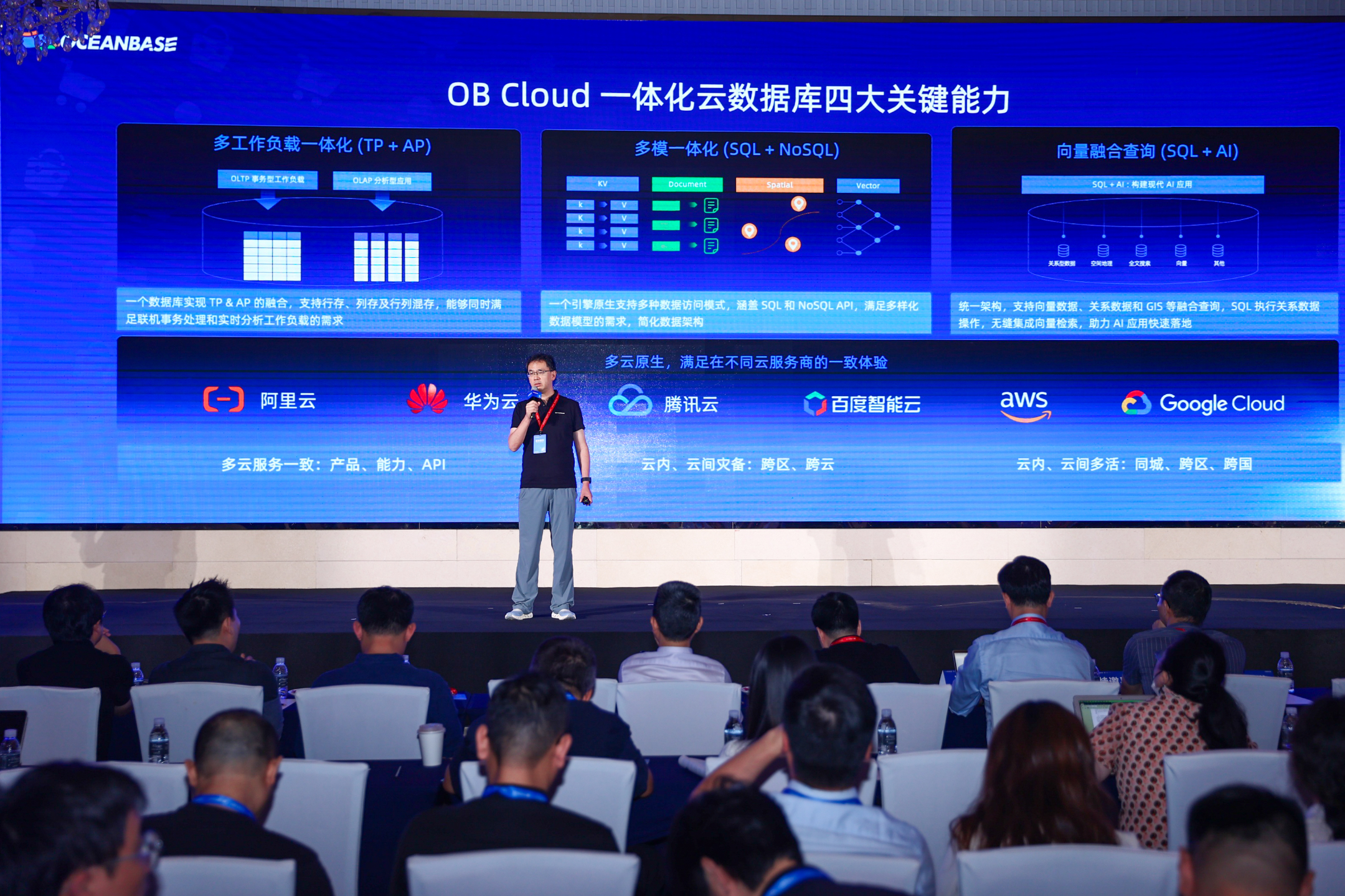
Group 1 - The core viewpoint of the article highlights the increasing demand for cloud databases driven by the need to process vast amounts of unstructured data in generative artificial intelligence applications [1] - OceanBase's cloud database product, OB Cloud, has served over 200 leading retail enterprises, including Li Ning, Anta, Haidilao, and Pop Mart, covering various retail sectors such as footwear, dining, fast-moving consumer goods, and DTC [1] - The retail industry is shifting from extensive traffic operations to deep user value exploration, with over 90% of enterprises believing that generative AI will enhance productivity [1] Group 2 - OceanBase, a fully self-developed distributed database founded in 2010, launched the integrated cloud database platform OB Cloud in 2022 to support various industries in their digital transformation [2] - The integrated cloud database is transitioning from a "cost center" to a "growth engine," capable of handling traffic surges during events like promotions and live broadcasts through linear scaling [2] - The next round of competition in the retail industry is fundamentally about the capability of the "data foundation," emphasizing the importance of ecosystem collaboration for success [2]
一体化云数据库从“成本中心”转向“增长引擎”
Guo Ji Jin Rong Bao· 2025-08-28 12:21
Core Insights - The first "2025 Retail Data Foundation Innovation Conference" was held in Shanghai, where the "Integrated Cloud Database White Paper" was released, marking the first authoritative report on the value of integrated cloud databases in the retail industry [1] - The white paper emphasizes that integrated cloud databases are transitioning from a "cost center" to a "growth engine" in the era of "second-level decision-making" and "centimeter-level insights" [1] - Key business scenarios analyzed include consumer services, supply chain management, and omnichannel operations, with case studies from 12 leading companies such as Pop Mart and Li Ning [1] Industry Challenges and Opportunities - The retail industry is facing dual challenges from pulse-like traffic impacts and AI transformations, necessitating a stable, efficient data foundation that supports AI applications [3] - Over 90% of companies believe generative AI will enhance productivity, yet traditional architectures suffer from data delays, system fragmentation, and resource redundancy, hindering real-time decision-making and AI innovation [3] - The retail sector must address three core challenges: managing "pulse-like traffic surges," transforming data into a "real-time decision engine," and evolving AI from a "value-add" to a "core infrastructure" [3]

国产数据库在金融领域应用逐渐深入
Jin Rong Shi Bao· 2025-08-08 07:55
Core Insights - The distributed transaction database market in China's financial sector is accelerating, with a market size of approximately $220 million in 2023, reflecting a year-on-year growth of 12.1% [1] - Domestic databases are gradually being adopted in the financial industry, moving away from reliance on foreign technologies due to increased emphasis on data security and self-controllable technologies [1][4] - The market is characterized by a "headstrong" trend, with the top five vendors holding nearly 90% of the market share, approximately 86.9% [3] Market Dynamics - The digital transformation in the financial sector is driven by factors such as the growth of banking business scale, rapid product innovation, and the need for high system availability [2] - OceanBase leads the market with a 23.2% share in the local deployment of distributed transaction databases in the financial sector, generating revenue of 270 million yuan [3] - The banking sub-market is estimated to be around $150 million in 2023, primarily corresponding to internal trading systems [3] Challenges and Opportunities - Domestic database vendors are still in a catch-up phase, primarily used in peripheral areas of financial institutions, while core systems are still dominated by foreign vendors like Oracle [4] - Financial databases require high concurrency, low latency, high availability, and strong disaster recovery capabilities, which pose significant challenges for domestic vendors [6] - The transition from peripheral to core systems is often gradual, with financial institutions adopting a risk-controlled approach [5] Future Outlook - The year 2024 is anticipated to mark a large-scale deployment phase for distributed databases, necessitating continuous optimization of product performance and enhancement of core capabilities by vendors [7] - Collaboration between financial institutions and vendors is crucial for successful digital transformation, as it cannot be achieved independently by either party [8] - There is optimism regarding the potential of domestic databases to meet the high-performance and reliability demands of the financial sector as technology and experience improve over time [8]
OceanBase: 以分布式数据库支持金融机构核心系统升级 助力高质量发展
Jin Rong Shi Bao· 2025-08-08 07:55
Group 1 - The central financial work conference emphasizes the importance of technology finance, green finance, inclusive finance, pension finance, and digital finance for the high-quality development of the financial industry, advocating for innovation and sustainable development in financial services [2] - The digital transformation of financial institutions is no longer optional but a necessity driven by regulatory policies and the digital economy, with a significant increase in data volume from TB to PB and ZB levels [3][4] - The shift from centralized databases to distributed databases is a major trend in the industry, as traditional centralized systems struggle to handle massive data and high concurrency demands [4][6] Group 2 - OceanBase, a distributed database, has been widely adopted by major financial institutions for core system upgrades, demonstrating significant improvements in performance, reliability, and cost-effectiveness [8][11] - The successful upgrade of core systems, such as the Industrial and Commercial Bank of China and China Pacific Insurance, showcases the feasibility and benefits of transitioning to distributed database architectures [8][12] - OceanBase's self-developed technology ensures independent control over core code, enhancing security and performance while meeting the high demands of the financial sector [7][11] Group 3 - The upgrade process for core systems involves a structured approach, including demand analysis, technical selection, application adaptation, and continuous monitoring, which helps ensure a smooth transition [9] - Financial institutions like China Pacific Insurance and Bank of Communications are actively pursuing distributed upgrades to enhance operational stability and meet modern business needs [12][13] - OceanBase has achieved significant market share in the financial sector, being the leading independent database vendor and demonstrating its capability to support large-scale financial operations [11]
金融业分布式数据库“收敛”格局清晰 下半场比拼生态化与商业化
Zhong Guo Jing Ying Bao· 2025-07-29 15:08
Core Insights - The distributed database market in China is increasingly concentrating among leading vendors, with Ant Group's OceanBase, ZTE's Jin Zhuan Xin Ke, and Tencent Cloud accounting for 60% of the local deployment market share in 2024 [1][3] - The overall market size for distributed databases in the Chinese financial sector is projected to reach 2.037 billion RMB in 2024, with major players like Tencent Cloud, Alibaba Cloud, OceanBase, Huawei Cloud, and Jin Zhuan Xin Ke holding over 70% of the market [1][2] - IDC forecasts that by 2027, the number of active vendors in the distributed database market will drop to fewer than ten, leading to intensified competition among top players [1][3] Market Trends - The local deployment segment of the distributed database software market is expected to reach $190 million in 2024, growing by 16.2% year-on-year, while the public cloud market is projected to reach $240 million, with a year-on-year growth of 15.9% [2] - In the financial sector, local deployment accounts for 72.26% of the distributed database market, primarily serving large banks and various financial institutions [2][3] - The market is transitioning from "core replacement" to "full integration," with increasing barriers to entry accelerating market consolidation [1][3] Competitive Landscape - In the financial distributed database market, Tencent Cloud (21.3%), Alibaba Cloud (18.5%), OceanBase (18.3%), and Huawei Cloud (15.9%) are the top four players [3] - OceanBase leads the local deployment market with a 23.9% share, followed by Jin Zhuan Xin Ke (21.7%), Tencent Cloud (20.0%), and Huawei Cloud (19.2%) [3] - The competitive dynamics show that each major vendor has distinct strengths and strategies, with OceanBase focusing on large banks and expanding into foreign banks [5][6] Future Outlook - The market is expected to experience a "convergence" trend from 2025 to 2028, with increasing concentration among a few leading vendors [3][6] - The demand for unitized architecture and cross-cloud deployment capabilities is rising among large financial institutions, while smaller institutions prioritize lightweight and cost-effective solutions [6] - OceanBase is expanding its business beyond finance into sectors like telecommunications, energy, and healthcare, indicating a diversification strategy [8][9]


7.22犀牛财经晚报:二季度末金融机构贷款余额268.56万亿元 淘宝闪购澄清未上线“1分钱自提”产品
Xi Niu Cai Jing· 2025-07-22 10:29
Group 1: Financial Institutions and Loans - As of the end of Q2 2025, the balance of RMB loans from financial institutions reached 268.56 trillion yuan, marking a year-on-year growth of 7.1% with an increase of 12.92 trillion yuan in the first half of the year [1] - The balance of RMB real estate loans stood at 53.33 trillion yuan, showing a year-on-year increase of 0.4%, with a half-year increase of 416.6 billion yuan [1] - The balance of personal housing loans was 37.74 trillion yuan, reflecting a slight year-on-year decline of 0.1%, but with a half-year increase of 51 billion yuan [1] Group 2: Display Panel Market - Global shipments of display panels larger than 9 inches are expected to grow by 2.9% year-on-year to 876 million units in 2025, an improvement from the previous forecast of 2.6% growth [2] Group 3: Telecommunications Industry - The telecommunications industry in China reported a total revenue of 905.5 billion yuan in the first half of 2025, representing a year-on-year growth of 1% [2] - The total telecommunications business volume increased by 9.3% year-on-year when adjusted for last year's prices [2] Group 4: Distributed Database Market - OceanBase has captured a 21.2% market share in the local deployment of distributed transaction databases in China, ranking first in the market [3] - In the financial sector, OceanBase holds a 23.9% market share, again leading in local deployment [3] - The market for locally deployed distributed transaction databases is expected to grow faster than the public cloud market starting in 2025 [3] Group 5: AI and Technology Developments - OpenAI's "Star Gate" AI project with SoftBank has faced delays, with plans to construct only one small data center by the end of the year instead of the initially promised larger scale [4] - ByteDance has launched a new general-purpose robot model, GR-3, capable of understanding complex language instructions and manipulating flexible objects [5] Group 6: Corporate Financial Performance - Microelectronic physiology expects a net profit increase of 76.34% to 105.73% for the first half of 2025, with projected revenues between 215 million and 230 million yuan [8] - Anfu Technology reported a net profit of 107 million yuan for the first half of 2025, reflecting a year-on-year growth of 14.38% [10] Group 7: Market Performance - The three major indices in the market saw slight increases, with the Shanghai Composite Index rising by 0.62% and the Shenzhen Component Index by 0.84%, both reaching new highs for the year [11] - The market turnover reached approximately 1.89 trillion yuan, with significant activity in infrastructure-related stocks [11]
数据库大内卷 AI功能竟成为“皇帝的新装”
Sou Hu Cai Jing· 2025-07-19 00:09
Core Insights - The domestic database industry is facing a critical period with less than two years remaining for companies to adapt to the "Xinchuang" (indigenous innovation) requirements set by the government [2][3] - The "State-owned Assets Document No. 79" mandates that by the end of 2027, all central enterprises must have secure and reliable information systems replaced with domestic alternatives [3] - The domestic database market is highly competitive, with nearly 300 companies participating, categorized into three main camps: academic, tech giants, and startups [3][4] Market Dynamics - The financial sector is the largest customer for databases, accounting for 20% of the market, making it crucial for database companies to establish a foothold in this area [6][11] - Current domestic database replacement rates in various sectors show that the financial industry has a 40% replacement rate for non-core systems and only 15% for core systems [9][10] - The overall market for domestic database replacements is expected to grow rapidly, with significant opportunities in the financial sector as foreign products currently dominate [18] Challenges and Competition - The transition to domestic databases in the financial sector is complex, with banks prioritizing stability and performance, especially for core business systems [12][13] - The core banking systems are still predominantly reliant on foreign databases, with over 80% market share, indicating a substantial opportunity for domestic vendors [18] - The competition among domestic database vendors has intensified, leading to a phenomenon of "internal competition" or "involution," where companies are pressured to lower prices and enhance features, including AI capabilities [22][23][26] Technological Landscape - The domestic database market features a wide variety of products, with over 280 types available, focusing on compatibility, especially with Oracle [23] - Despite the push for AI integration, the actual necessity and effectiveness of AI features in databases remain questionable, with many vendors emphasizing AI capabilities more for marketing than practical application [28][30] - The integration of AI into database management is seen as a future trend, but current implementations are still in the early stages and may not meet immediate operational needs [30][31]

张勇、俞永福等9人退出阿里合伙人;小米未来5年研发投入预计2000亿元;荣耀完成IPO辅导备案
Sou Hu Cai Jing· 2025-06-27 04:51
Group 1: Alibaba's Partner Restructuring - Alibaba Group has reduced its partner organization from 26 to 17 members, focusing on frontline business leaders and further rejuvenating its core management team [2] Group 2: Xiaomi's Product Launches - Xiaomi officially launched the YU7 series with prices ranging from 253,500 to 329,900 yuan, and announced a total investment of 5.79 billion yuan in the assisted driving sector [3] - Xiaomi also introduced AI glasses starting at 1,999 yuan, with plans to invest an additional 200 billion yuan in R&D over the next five years [3] Group 3: Honor's IPO Progress - Honor Technology has completed its IPO counseling registration with the Shenzhen Securities Regulatory Commission, potentially becoming the first AI terminal ecosystem company listed in A-shares [4] Group 4: Meituan's AI Investment - Meituan's core local business CEO revealed that the company invests over 10 billion yuan annually in AI, emphasizing the importance of building a solid AI infrastructure [5] Group 5: Apple's CarPlay Ultra Controversy - Apple faces opposition from car manufacturers regarding its CarPlay Ultra system, with several luxury brands stating they will not adopt the new software [6] Group 6: Changes in Apple's App Store Policies - Apple has revised its App Store terms to provide developers with more options for directing users to better deals outside the App Store, in response to EU digital antitrust laws [6] Group 7: He Kaiming Joins Google DeepMind - He Kaiming, a prominent figure in computer vision, has joined Google DeepMind as an outstanding scientist, enhancing the company's research capabilities [7] Group 8: Google Cloud's New CFO - Google Cloud has appointed Kobi Bar Nathan as its new CFO, who previously held a similar position at Oracle [8] Group 9: SoftBank's AI Ambitions - SoftBank aims to become the largest platform supplier in the "super artificial intelligence" sector within the next decade, with a total investment commitment of 32 billion USD to OpenAI [9] Group 10: NVIDIA's Challenge to Cloud Giants - Major cloud providers like Amazon, Microsoft, and Google are facing competition from NVIDIA, which has launched its own cloud computing service and invested in AI cloud startups [10] Group 11: CoreWeave's Acquisition Attempt - CoreWeave is seeking to acquire AI server supplier Core Scientific to expand its capacity in the AI server cloud rental market [11] Group 12: OceanBase's Brand Upgrade - OceanBase has officially adopted the Chinese brand name "Haiyang Database" as part of its strategy to embrace the AI era [13] Group 13: Growth in True Wireless Earbuds Market - The global shipment of true wireless earbuds increased by 18% year-on-year in Q1 2025, reaching 78 million units, marking the highest growth rate since 2021 [15]





OceanBase CEO杨冰:以“海扬”之名,根自研攻坚数据难题
Sou Hu Cai Jing· 2025-06-26 06:34
Core Viewpoint - The announcement of the rebranding of OceanBase to "海扬数据库" (Haiyang Database) signifies the company's commitment to the domestic market and its ambition to lead innovation in distributed database technology globally [1][4]. Company Overview - OceanBase has evolved from a payment core system to a distributed database, demonstrating its capability to handle peak transaction demands, such as processing 420,000 transactions per second during high-traffic events like "Double Eleven" [4]. - The company emphasizes its "100% self-research" approach, which allows it complete control over its core code and the ability to adapt to complex business scenarios [4][5]. Market Position and Growth - OceanBase has experienced over 100% growth in customer numbers for four consecutive years, establishing benchmark cases in key industries such as finance, government, telecommunications, and transportation [5]. - The company has expanded its global footprint, providing services in over 50 geographical regions, including Asia-Pacific, the Middle East, Africa, Europe, and the Americas [5]. Industry Context - The rise of digital economy and AI technologies presents unprecedented challenges for database storage, processing, and analysis capabilities, creating significant opportunities for domestic databases like OceanBase [7]. - The demand for reliable, high-performance, and cost-effective database solutions is increasing as companies undergo digital transformation [7]. Future Strategy - OceanBase plans to continue focusing on both private and public cloud sectors, addressing core system upgrade challenges and expanding its ecosystem through partnerships [8]. - The company aims to leverage its distributed architecture and technology innovations to provide integrated data solutions for the AI era, with recent product releases already validated in leading industries [8].

OceanBase启用中文名“海扬数据库”,目标成为全球知名的中国数据库品牌
Zheng Quan Shi Bao Wang· 2025-06-26 05:32
Group 1 - OceanBase officially launched its Chinese brand name "海扬数据库" (Haiyang Database) on June 26, marking a comprehensive brand strategy upgrade, which reflects the company's commitment to the domestic market and its ambition to lead innovation in distributed database technology globally [1] - The new brand name "海扬" symbolizes OceanBase's capability to handle massive data volumes, exemplified by its ability to process up to 420,000 transactions per second for Alipay, showcasing its strong distributed architecture [1] - OceanBase has undergone 15 years of independent research and development, emphasizing its commitment to self-research and innovation in the face of the growing data demands driven by the digital economy [1] Group 2 - Since its inception in 2010, OceanBase has developed a native distributed architecture that has successfully passed rigorous tests in high-transaction scenarios, achieving breakthroughs in high availability, performance, and scalability [2] - Since its commercialization in 2020, OceanBase has seen its customer base grow over 100% for four consecutive years, establishing numerous benchmark cases in key industries such as finance, government, and telecommunications [2] - OceanBase is actively building an open ecosystem, collaborating with over 1,200 partners, contributing 4 million lines of open-source code, and achieving over 60,000 cluster deployments with downloads exceeding one million [2] Group 3 - With the advent of the AI era, OceanBase is focusing on a "Data×AI" strategy to create an integrated data foundation for enterprises, helping them gain a competitive edge in AI applications [2] - The company has released version 4.4.0 of its integrated data foundation for the AI era and its first application product, PowerRAG, which has been validated in leading enterprises across various industries [2] - OceanBase aims to establish "海扬数据库" as a well-known brand in the global database market, ensuring that Chinese database technology secures a place on the global stage [3]