南京银行

Search documents
密集落地!6家银行,敲定首席合规官!
券商中国· 2026-01-05 04:43
Core Viewpoint - The establishment of Chief Compliance Officer (CCO) positions in Chinese banks has intensified in 2025, driven by regulatory requirements aimed at enhancing compliance management within financial institutions [2][4]. Group 1: Regulatory Background - In March 2025, the Financial Regulatory Administration implemented the "Compliance Management Measures for Financial Institutions," mandating that financial institutions appoint a CCO at their headquarters, who must be a senior management member [2][4]. - The year 2025 serves as a critical transitional period for compliance management, with many banks already appointing CCOs and obtaining regulatory approval for their qualifications [8]. Group 2: Appointment Trends - Several banks, including Jiangyin Bank, Ping An Bank, and Minsheng Bank, have recently appointed CCOs, with many of these positions filled by existing senior executives such as presidents or vice presidents [4][5][6]. - The trend shows that many banks are opting for current executives to take on the CCO role, which may help mitigate internal communication costs associated with having too many specialized positions [4][7]. Group 3: Compliance Management Practices - The unique nature of financial institutions necessitates a higher standard of compliance management compared to general enterprises, emphasizing the need for a robust compliance culture [4]. - The "Compliance Management Measures" also allow for the CCO to concurrently hold other executive roles, which is particularly beneficial for smaller banks [4][8]. Group 4: Recruitment Initiatives - Some regional banks, such as Jiangxi Bank and Shangrao Bank, have actively sought to recruit CCOs, indicating a proactive approach to compliance management [9]. - Recruitment criteria for these positions often prioritize candidates with judicial experience or previous roles in compliance departments of major banks [9].


苏州金融监管分局核准孙惠南京银行苏州分行副行长任职资格
Jin Tou Wang· 2026-01-05 03:29
三、南京银行应督促上述核准任职资格人员持续学习和掌握经济金融相关法律法规,牢固树立风险合规 意识,熟悉任职岗位职责,忠实勤勉履职。 二、南京银行应要求上述核准任职资格人员严格遵守金融监管总局有关监管规定,自南京银行政许可决 定作出之日起3个月内到任并向我分局报告。未在上述规定期限内到任的,本批复文件失效,由苏州金 融监管分局办理行政许可注销手续。 2025年12月30日,苏州金融监管分局发布批复称,《南京银行(601009)关于孙惠任职资格审核的请 示》(宁银发〔2025〕358号)收悉。经审核,现批复如下: 一、核准孙惠南京银行股份有限公司苏州分行副行长的任职资格。 ...

南京银行董事长谢宁:三十而励 奋力点亮“好银行”的鲜明标识
Shang Hai Zheng Quan Bao· 2026-01-04 20:27
® 谢宁 ◎记者 黄坤 南京银行董事长谢宁在发表2026年新年寄语时表示,2025年是"十四五"规划收官之年,也是南京银行新 时期高质量发展的攻坚之年、实干之年。全体南京银行人紧扣时代脉搏、奏响改革强音,与地方经济社 会发展同频共振、共生共荣,"向好奋进"的发展成色进一步彰显,"向新而行"的发展动能进一步增 强,"向高攀登"的发展空间进一步打开,交出了一份高质量发展的新答卷。 谢宁表示,前行路上,风雨与彩虹共生,机遇和挑战同在。回望2025年,从繁华都市到美丽乡村,从产 业园区到田间地头,从智能化工厂到街边小店,全体南京银行人以实干创造实绩、以奋斗展现作为,用 点点微光汇聚成璀璨星河,陪伴万千客户一路前行,也在孜孜耕耘中感受了成长的喜悦、品尝了收获的 回甘。 "三十而励,跃见未来"。谢宁表示:2026年是"十五五"规划的开局之年,也是南京银行三十而立再出发 的起步之年。在充满光荣和梦想的新征程上,南京银行将坚守战略定力、激发变革锐气、释放管理效 能、厚植优良文化,奋力点亮"好银行"的鲜明标识,朝着"打造国内一流的区域综合金融服务商"的战略 愿景加速迈进,坚定谱写南京银行高质量发展的灿烂新篇! ...

看好开门红,把握金融修复机会
HTSC· 2026-01-04 11:58
证券研究报告 金融 看好开门红,把握金融修复机会 华泰研究 2026 年 1 月 04 日│中国内地 行业周报(第一周) 投资机会方面证券>银行>保险。2025 年收官,A 股、港股全年日均成交额 同比+63%、+89%;A 股日均融资余额同比+34%;上证、恒指、恒生科技 全年均录得两位数涨幅。证监会修订发布《公开募集证券投资基金销售费用 管理规定》,销售阶段改革正式落地,相较征求意见稿,正式稿进一步细化 认申购费率要求,对赎回费机制有一定放宽,并将整改期统一为 12 个月。 REITs 高质量发展和商业不动产 REITs 试点规则发布,明确支持符合条件 的公募基金将 REITs 纳入投资范围,探索 REITs ETF,并推动将 REITs 纳 入沪深港通。 子行业观点 1)证券:2025 年申万证券指数涨幅 2.6%,跑输沪深 300 指数 15.1pct, 尤其 9 月以来明显滞涨。元旦假期港股交出亮眼答卷,2 号恒指、科指分别 涨 2.76%、4.00%,中资券商指数涨 2.93%。2)银行:2025 年全年涨幅为 12.5%,在 30 个一级行业中排名第 22;银行指数跑输沪深 300 指数 5.2 ...
多行业联合红利资产12月报:股息率年关盘点-20260104
Huachuang Securities· 2026-01-04 06:46
证 券 研 究 报 告 【策略月报】 股息率年关盘点 ——多行业联合红利资产 12 月报 策略研究 策略月报 2026 年 01 月 04 日 华创证券研究所 证券分析师:姚佩 邮箱:yaopei@hcyjs.com 执业编号:S0360522120004 证券分析师:吴一凡 邮箱:wuyifan@hcyjs.com 执业编号:S0360516090002 证券分析师:徐康 电话:021-20572556 邮箱:xukang@hcyjs.com 执业编号:S0360518060005 证券分析师:欧阳予 邮箱:ouyangyu@hcyjs.com 执业编号:S0360520070001 证券分析师:韩星雨 邮箱:hanxingyu@hcyjs.com 执业编号:S0360525050001 证券分析师:单戈 邮箱:shange@hcyjs.com 执业编号:S0360522110001 证券分析师:马野 邮箱:maye@hcyjs.com 执业编号:S0360523040003 相关研究报告 《【华创策略】杠杆&ETF 资金分化趋势逆转—— 流动性&交易拥挤度&投资者温度计周报》 2025-12-01 《【华 ...
优先股隐退永续债上位!银行业资本补充进入密集冲刺期,年利息至少省3%
Xin Lang Cai Jing· 2026-01-04 05:31
Core Viewpoint - The Chinese banking industry is undergoing a significant transformation, with banks redeeming high-cost preferred shares and issuing perpetual bonds as a more cost-effective financing alternative, driven by declining social financing costs and regulatory changes [2][4][11]. Group 1: Redemption of Preferred Shares - By the end of 2025, a total of 9 banks announced the redemption of preferred shares, amounting to 111.8 billion RMB in domestic preferred shares and 5.72 billion USD in foreign preferred shares [4]. - In December 2025 alone, five banks, including Changsha Bank and Beijing Bank, redeemed a total of 45.8 billion RMB in preferred shares [3]. - The redemption of preferred shares is facilitated by their lack of maturity dates but includes redemption clauses, allowing banks to manage capital flexibly [4]. Group 2: Issuance of Perpetual Bonds - As of December 31, 2025, Chinese commercial banks issued 69 perpetual bonds, raising a total of 821.8 billion RMB, marking a historical high in both issuance quantity and scale [5]. - The interest rates for newly issued perpetual bonds generally ranged from 2.0% to 2.9%, the lowest in nearly three years, with a significant issuance peak occurring in the second half of 2025 [5][6]. - The issuance of perpetual bonds is seen as a response to the urgent need for capital replenishment, especially among small and medium-sized banks facing declining capital adequacy ratios [2][6]. Group 3: Cost Savings and Financial Efficiency - By replacing preferred shares with perpetual bonds, banks can save at least 3% annually on interest expenses, significantly reducing their financing costs [8][10]. - For instance, the interest rate on newly issued perpetual bonds is substantially lower than that of previously issued preferred shares, with examples showing potential annual savings of 12.8 million RMB for banks like Industrial Bank [10]. - The transition from preferred shares to perpetual bonds is viewed as a strategic move to optimize capital structure and reduce interest payment burdens, aligning with regulatory requirements [8][10]. Group 4: Regulatory Environment and Market Dynamics - The shift towards perpetual bonds is influenced by regulatory changes that favor capital instruments with loss absorption capabilities, making traditional preferred shares less attractive [11]. - The approval process for issuing perpetual bonds is simpler and faster compared to preferred shares, which require dual regulatory approvals, thus enhancing their appeal to banks [11]. - The current low-interest-rate environment is expected to persist, allowing banks to lock in low financing costs for the next 5 to 10 years, effectively mitigating the pressure from narrowing net interest margins [10].







2025银行股业绩梳理
2 1 Shi Ji Jing Ji Bao Dao· 2025-12-31 23:42
Core Viewpoint - The A-share banking sector experienced a year of volatility in 2025, with an overall increase of 7%, which is significantly lower than the 34.39% gain in 2024, yet many individual bank stocks reached historical highs [1][3]. Group 1: Market Performance - By the end of 2025, 35 out of 42 bank stocks in the sector recorded gains, with 20 banks hitting historical highs and 21 banks increasing by over 10%, while 6 banks saw gains exceeding 20% [1][6]. - Agricultural Bank of China saw a remarkable stock price increase of over 52% during the year, briefly surpassing Industrial and Commercial Bank of China (ICBC) in market capitalization [1][3]. - ICBC maintained its position as the "king of stocks" with a market capitalization of 2.63 trillion yuan and a stock price increase of 21.54% [1][3]. Group 2: IPO Market - The A-share IPO market for banks remained stagnant in 2025, with no new listings, as several banks, including Guangzhou Bank, withdrew their applications [2][11]. - The only banks still in the IPO queue are Dongguan Bank, Huzhou Bank, Hubei Bank, Jiangsu Kunshan Rural Commercial Bank, and Guangdong Nanhai Rural Commercial Bank [11]. Group 3: Investment Trends - Long-term funds, particularly insurance capital, have been actively purchasing bank stocks, with insurance companies holding 382.5 million shares valued at 37.976 billion yuan by the end of Q3 2025 [8]. - The "stock accumulation for dividends" strategy has gained popularity among investors, with 28 out of 42 listed banks offering dividend yields above 4% [7][8]. Group 4: Capital Support - In 2025, state-owned banks received significant capital injections, with a total of approximately 520 billion yuan raised through targeted placements to enhance their capital structure [10]. - Meanwhile, smaller banks attracted investments from foreign and local state-owned enterprises, although the IPO process remains challenging for most [10][11].

2025年度A股大数据排行榜
Wind万得· 2025-12-31 22:50
Market Overview - In 2025, the A-share market exhibited a comprehensive upward trend, with major indices showing an average increase of over 10%. The growth was particularly pronounced in growth sectors, with the ChiNext Index, North Exchange 50, and Sci-Tech 50 indices each rising by over 30% [1][3]. - The structural characteristics of the market were evident, with technology and resource sectors leading the performance. The optical module (CPO) index surged by over 180%, while indices for optical chips, copper-clad laminates, optical communications, and optical circuit switches all exceeded 100% growth [1][3]. A-share Index Performance - The ChiNext Index led the gains in 2025 with a cumulative increase of 49.57%. The North Exchange 50 and Sci-Tech 50 indices followed with increases of 38.80% and 35.92%, respectively. Other indices such as the Shenzhen Component Index, Wind All A, and CSI 1000 also saw gains exceeding 20% [3]. A-share Industry Performance - Among the 35 industries classified by Wind, 31 recorded increases in 2025. The non-ferrous metals industry topped the list with a cumulative increase of 92.20%. Hardware equipment and industrial trade sectors also performed well, with increases of 62.39% and 54.65%, respectively. Conversely, the daily consumer retail sector saw a decline of 6.42% [5]. A-share Hot Concepts - The optical module (CPO) index was the strongest performer in 2025, with a cumulative increase of 181.28%. Other notable performers included optical chips (130.78%), copper-clad laminates (129.58%), optical communications (125.58%), and optical circuit switches (112.55%). The rare metals, copper industry, and rare earth indices also showed significant growth, with increases of 119.85%, 103.64%, and 98.97%, respectively [9]. A-share Market Capitalization - By the end of 2025, the total market capitalization of the A-share market reached approximately 118.91 trillion yuan, marking a 26.6% increase from the end of 2024 [15]. - The Shanghai main board had the highest number of listed companies at 1,699, accounting for 31.06% of the total. The Shenzhen main board followed with 1,490 companies (27.24%), while the ChiNext and Sci-Tech boards had 1,393 and 600 companies, representing 25.47% and 10.97%, respectively [13]. Financing and Investment Trends - As of the end of 2025, the A-share margin trading balance was reported at 25.553 billion yuan, reflecting a 5.21% increase from the third quarter and a year-on-year increase of 35.91% [22]. - The top gainers in terms of stock price included Weiwei New Materials, which saw a cumulative increase of 1,820%, followed by Tianpu Co., with a 1,645% increase. Conversely, Shijin Technology led the decline with a 51% drop [24]. IPO Activity - In 2025, the A-share market saw a total of 112 IPOs, representing a 9.8% increase year-on-year. The fourth quarter alone accounted for 36 IPOs, up 9.1% from the previous year [49]. - The total fundraising from IPOs in 2025 reached 130.83 billion yuan, a significant increase of 97.4% year-on-year, with the fourth quarter alone raising 54.86 billion yuan, up 165.0% [51].

获资千万,江苏首单双质押融资落地雨花
Xin Lang Cai Jing· 2025-12-31 17:56
Core Insights - The first "data intellectual property + data asset" dual pledge financing in Jiangsu has been successfully implemented in Nanjing, showcasing the market value of data and the potential for new productive forces in the industry [1] Company Overview - Nanjing Kaos Data Technology Co., Ltd. is a tech enterprise located in Yuhuatai District, providing industrial IoT products and solutions, including online monitoring, smart operation, industrial control, and supply chain optimization services [2] - The company completed the registration of two high-value data application products, which include a device fault self-diagnosis model data and a vibration characteristic value algorithm library, and successfully secured a financing credit limit of 40 million yuan from banks [2] Financing and Market Development - The dual pledge financing allows Nanjing Kaos to convert its high-value data into low-cost credit funds, effectively addressing the company's financing needs and exploring a replicable and scalable practice path for the market-oriented allocation of data elements [3] - The data intellectual property registration is a core step in confirming data assets, providing legal basis for data transactions, collaborative development, and protecting against misuse, thereby promoting the healthy development of the digital economy [1]
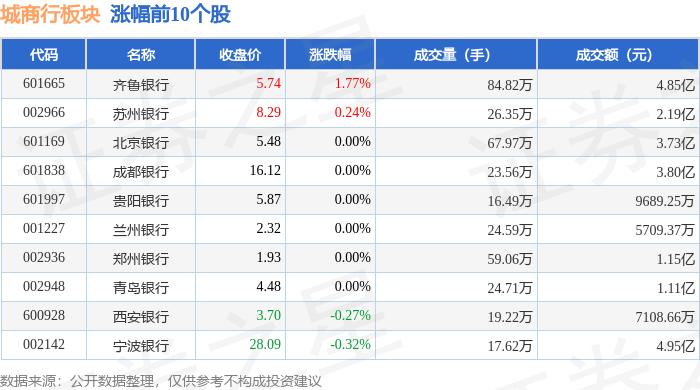
城商行板块12月31日跌0.33%,厦门银行领跌,主力资金净流入2.01亿元
Zheng Xing Xing Ye Ri Bao· 2025-12-31 09:07
Market Overview - The city commercial bank sector experienced a decline of 0.33% on December 31, with Xiamen Bank leading the drop [1] - The Shanghai Composite Index closed at 3968.84, up 0.09%, while the Shenzhen Component Index closed at 13525.02, down 0.58% [1] Individual Bank Performance - Qilu Bank closed at 5.74, up 1.77% with a trading volume of 848,200 shares and a transaction value of 485 million [1] - Suzhou Bank closed at 8.29, up 0.24% with a trading volume of 263,500 shares and a transaction value of 219 million [1] - Xiamen Bank closed at 7.34, down 1.08% with a trading volume of 133,200 shares and a transaction value of 97.8 million [2] - Nanjing Bank closed at 11.43, down 0.78% with a trading volume of 235,600 shares and a transaction value of 270 million [2] Capital Flow Analysis - The city commercial bank sector saw a net inflow of 201 million from institutional investors, while retail investors experienced a net outflow of 9.56 million [2] - The capital flow for individual banks shows that Shanghai Bank had a net inflow of 48.9 million from institutional investors, while Hangzhou Bank had a net outflow of 50.55 million [3] - Suzhou Bank recorded a net inflow of 30.66 million from institutional investors, while retail investors had a net outflow of 27.1 million [3]