微软

Search documents
微软Q2业绩会实录:大部分投入资本周期已通过合同锁定
Xin Lang Ke Ji· 2026-01-29 02:08
财报发布后,微软CEO萨提亚·纳德拉(Satya Nadella)和执行副总裁兼CFO艾米·胡德(Amy Hood)等公司高管出席了随后举行的财报电话会议,解读财报要点,并回答分析师提问。 以下是电话会议实录: 摩根士丹利分析师基思·维斯(Keith Weiss):从财报数据来看, 微软本季度每股摊薄收益增 长了24%( non-GAAP),这一结果非常出色,充分体现了团队的执行力。营收增长稳健,利润 率也在提升,但盘后交易中股价却出现下跌。我认为,投资者担忧的核心问题之一是资本支出增 速过快,甚至超出预期,这引发了市场对长期资本支出投资回报率(ROI)的担忧。因此,希望 各位能帮助我们厘清几个问题:如何看待产能扩张及其对未来Azure增长的推动作用?更重要的 是,该如何看待这一投资在未来实现时的回报率? 艾米·胡德:谢谢基思。我先回答,萨提亚之后会补充更宏观的观点。我认为你提出的问题非常直 接,也是很多投资者关心的,即资本支出与Azure营收之间的关联。其实上季度和本季度,我们 都在更具体地说明资本支出(尤其是CPU和GPU等短期资产的支出)的去向。有时,或许可以 将我们给出的Azure指引理解为"分配产能 ...

微软第二财季净利润384.58亿美元,同比增长60%
Sou Hu Cai Jing· 2026-01-29 01:57
Core Viewpoint - Microsoft reported strong financial results for Q2 of FY2026, with significant revenue and profit growth, but faced a decline in stock price due to slowing cloud business growth [1][2]. Financial Performance - Total revenue for Q2 was $81.273 billion, a 17% increase from $69.632 billion year-over-year, with a 15% increase when adjusted for constant currency [1][5]. - Net profit reached $38.458 billion, up 60% from $24.108 billion year-over-year, with a 57% increase on a constant currency basis [1][5]. - Diluted earnings per share were $5.16, a 60% increase from $3.23 year-over-year, with a 58% increase when adjusted for constant currency [5]. Segment Performance - Cloud revenue amounted to $51.5 billion, a 26% year-over-year increase, with a 24% increase on a constant currency basis [5]. - Productivity and Business Processes revenue was $34.1 billion, up 16% year-over-year, with LinkedIn revenue growing 11% [5]. - Intelligent Cloud revenue reached $32.9 billion, a 29% increase year-over-year, with Azure and other cloud services growing 39% [5]. - More Personal Computing revenue was $14.3 billion, a 3% decline year-over-year, although Windows OEM and devices revenue grew by 1% [5]. Shareholder Returns - Microsoft returned $12.7 billion to shareholders through dividends and stock buybacks, a 32% increase year-over-year [5].

全文|微软Q2业绩会实录:大部分投入资本周期已通过合同锁定
Xin Lang Cai Jing· 2026-01-29 01:55
专题:聚焦美股2025年第四季度财报 摩根士丹利分析师基思·维斯(Keith Weiss):从财报数据来看, 微软本季度每股摊薄收益增长了24% ( non-GAAP),这一结果非常出色,充分体现了团队的执行力。营收增长稳健,利润率也在提升,但 盘后交易中股价却出现下跌。我认为,投资者担忧的核心问题之一是资本支出增速过快,甚至超出预 期,这引发了市场对长期资本支出投资回报率(ROI)的担忧。因此,希望各位能帮助我们厘清几个问 题:如何看待产能扩张及其对未来Azure增长的推动作用?更重要的是,该如何看待这一投资在未来实 现时的回报率? 艾米·胡德:谢谢基思。我先回答,萨提亚之后会补充更宏观的观点。我认为你提出的问题非常直接, 也是很多投资者关心的,即资本支出与Azure营收之间的关联。其实上季度和本季度,我们都在更具体 地说明资本支出(尤其是CPU和GPU等短期资产的支出)的去向。有时,或许可以将我们给出的Azure 指引理解为"分配产能指引",即我们能实现的Azure营收规模,因为当我们投入资金、将GPU(重中之 重)部署到集群中时,实际上是在做长期决策。 我们首先要满足的是自研应用的使用增长需求,比如Mi ...
10票赞成2票反对,美联储宣布不降息!鲍威尔向继任者提议:与美国政治“划清界限”;微软、特斯拉公布“成绩单”,黄金突破5500美元关口
Mei Ri Jing Ji Xin Wen· 2026-01-29 01:26
当地时间1月28日,美联储主席鲍威尔表示,建议下一届美联储主席与美国政治"划清界限"。 当天早些时候,美联储公布最新一期货币政策会议纪要,宣布将联邦基金利率目标区间维持在3.5%至3.75%之间不变。随后,美联储主席鲍威尔就该决定 举行发布会,并就美国当前经济状况及美联储下任主席等问题接受记者提问。 会议纪要显示,现有指标表明,就业增长仍处于低位,失业率已显现出趋于稳定的迹象。通胀水平仍处于较高水平。委员会致力于实现最大就业和长期通 胀率达到2%的目标。经济前景的不确定性仍然很高。委员会密切关注其双重使命面临的风险。为支持其目标,美联储决定将联邦基金利率目标区间继续 维持在3.5%至3.75%之间。 具体表决细节显示,美联储以10票赞成、2票反对的结果,决定将基准利率维持在3.5%至3.75%区间。美联储理事沃勒以及米兰投下反对票,主张降息25 个基点。 在此次利率政策出台前,市场普遍预期美联储将在本周政策会议上维持利率不变,此前该机构已在2025下半年连续三次降息。 美联储主席鲍威尔在发布会表示,美国失业率已出现一些企稳迹象,劳动力市场在逐渐走软后可能正在趋于稳定,招聘、职位空缺和工资增长几乎没有变 化;消 ...
直线拉升!美联储重磅消息,鲍威尔最新发声!
天天基金网· 2026-01-29 01:07
Core Viewpoint - The Federal Reserve decided to maintain the federal funds rate target range at 3.5% to 3.75%, which aligns with market expectations, leading to significant movements in the precious metals market and mixed performance in U.S. stock indices [5][21]. Group 1: Federal Reserve Decision - The Federal Reserve's decision to keep the interest rate unchanged was supported by 10 out of 12 committee members, with only two members advocating for a 25 basis point cut [5]. - Economic indicators suggest that U.S. economic activity is expanding steadily, but uncertainties regarding the economic outlook remain high, with ongoing concerns about inflation and employment growth [5][21]. Group 2: Market Reactions - Following the Fed's announcement, gold prices surged, reaching a new high of over $5400 per ounce, while COMEX silver futures rose by more than 10% [2][15]. - The Dow Jones increased by 0.02%, while the S&P 500 decreased by 0.01%, and the Nasdaq rose by 0.17%, indicating a mixed performance among major U.S. stock indices [6]. Group 3: Technology Sector Performance - Major technology stocks showed varied performance, with the Nasdaq's seven tech giants index rising by 0.19%. Notable movements included Nvidia up by 1.59% and Google and Microsoft increasing by 0.38% and 0.22%, respectively, while Apple, Amazon, Meta, and Tesla experienced declines [8][10]. - Microsoft reported Q2 FY2026 revenue of $81.27 billion, exceeding analyst expectations, but its stock fell over 7% post-announcement before recovering [10]. - Meta's Q4 FY2025 revenue reached $59.89 billion, surpassing market estimates, leading to a stock increase of over 10% after hours [10]. Group 4: Commodity Prices - International oil prices rose, with light crude oil futures increasing by $0.82 to $63.21 per barrel, and Brent crude oil futures up by $0.83 to $68.40 per barrel [19]. - Precious metals saw significant price increases, with gold and silver prices rising sharply following the Fed's decision, indicating a strong market reaction to monetary policy [15][17].

微软财报亮眼却遭市场“用脚投票”:云业务增速微降 AI“狂烧钱”吓坏投资者
Jin Rong Jie· 2026-01-29 00:33
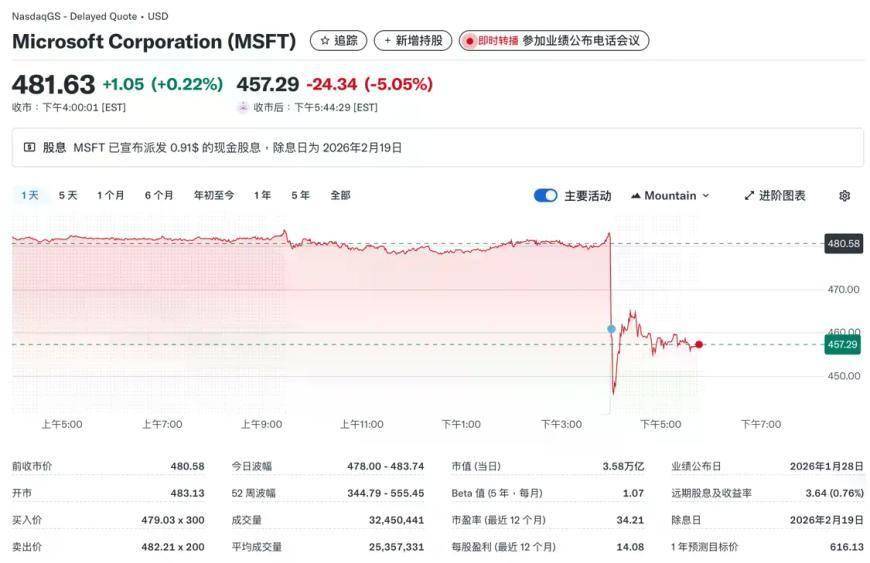
Core Viewpoint - Microsoft reported strong financial results for Q2 FY2026, exceeding Wall Street expectations, but concerns over slowing Azure growth and record capital expenditures led to a significant drop in stock price after hours [1][2]. Financial Performance - For the second quarter ending December 31, Microsoft achieved revenue of $81.27 billion, a year-over-year increase of approximately 17%, surpassing the market expectation of $80.3 billion [2]. - Net profit reached $38.46 billion, translating to earnings per share of $5.16, significantly above the expected $3.92 [2]. - Adjusted earnings per share were $4.14, also exceeding forecasts [2]. - A notable portion of the profit increase was attributed to changes in accounting treatment for the investment in OpenAI, contributing an additional $1.02 to earnings per share [2]. Cloud Business Performance - Microsoft's "Intelligent Cloud" segment, including Azure, generated revenue of $32.91 billion, a nearly 29% year-over-year increase, slightly above expectations [3]. - Azure and other cloud services revenue grew by 38% year-over-year at constant currency, matching analyst predictions, but the growth rate slowed by one percentage point compared to the previous quarter [3]. - Despite the overall cloud revenue surpassing $50 billion for the first time at $51.5 billion, the deceleration in Azure's growth raised concerns about the sustainability of AI-driven cloud growth [3]. Capital Expenditures and AI Investment - Capital expenditures surged to $37.5 billion, a 66% year-over-year increase, exceeding analyst expectations of $36.2 billion [4]. - Approximately two-thirds of this expenditure was allocated to computing chips for data centers to meet AI demand [4]. - CEO Satya Nadella noted an increase of nearly 1 gigawatt in computing capacity during the quarter, but the significant investment raised questions about the return on AI investments [4]. - The "remaining performance obligations" (RPO), indicating future revenue from signed contracts, reached a record $625 billion, more than doubling year-over-year, with 45% of this amount linked to agreements with OpenAI [4][5]. Competitive Landscape and Stock Performance - Microsoft is the first among major cloud service companies to report quarterly financial results, serving as a key indicator of the efficiency of AI investments among tech giants [7]. - In contrast to Microsoft's stock decline, Meta's stock rose significantly after announcing increased AI spending, highlighting differing market perceptions of AI strategies [7]. - The emergence of competitors like Google's Gemini model and Anthropic is intensifying pressure on Microsoft's AI and traditional software businesses [7]. - As of the close on Wednesday, Microsoft's stock was priced at $481.63, experiencing a drop of over 7% in after-hours trading, and a decline of approximately 11% over the past three months, underperforming the S&P 500 index, which rose by 1% during the same period [7].
微软股价盘后大跌,支出创纪录新高且云业务增长放缓
Sou Hu Cai Jing· 2026-01-29 00:31
Core Viewpoint - Microsoft's stock price has significantly declined due to soaring expenditures and slowing growth in cloud business sales, raising investor concerns about the return on artificial intelligence investments taking longer than expected [1] Financial Performance - Capital expenditures for the second fiscal quarter reached $37.5 billion, a 66% increase compared to the same period last year, exceeding analyst expectations of $36.2 billion [1] - Azure cloud computing revenue grew by 38% after adjusting for currency fluctuations, barely meeting analyst expectations, but this growth rate has slowed compared to the previous quarter [1] - The company anticipates Azure sales growth of 37% to 38% for the current fiscal quarter [1] Stock Market Reaction - Microsoft's stock price fell approximately 7% in after-hours trading, closing at $481.63 during regular trading hours in New York [1]
微软(MSFT.US)财报亮眼却遭市场“用脚投票”:云业务增速微降 AI“狂烧钱”吓坏投资者
Zhi Tong Cai Jing· 2026-01-29 00:27
Core Viewpoint - Microsoft reported strong financial results for Q2 of FY2026, with revenue and profit exceeding Wall Street expectations. However, concerns over slowing growth in Azure cloud services and significant capital expenditures related to AI investments led to a sharp decline in its stock price post-announcement [1]. Financial Performance - For the second quarter ending December 31, Microsoft achieved revenue of $81.27 billion, a year-over-year increase of approximately 17%, surpassing the market expectation of $80.3 billion. Net profit reached $38.46 billion, translating to earnings per share of $5.16, significantly exceeding the expected $3.92. Adjusted earnings per share were $4.14, also above forecasts. Notably, the surge in net profit was partly due to changes in accounting treatment for investments in OpenAI, contributing an additional $1.02 to earnings per share [2]. Cloud Business Performance - Microsoft's "Intelligent Cloud" segment, including Azure, generated revenue of $32.91 billion, a nearly 29% year-over-year increase, slightly above expectations. However, the growth rate of Azure and other cloud services, which increased by 38% year-over-year at constant currency, showed a deceleration of one percentage point compared to the previous quarter. This slowdown raised concerns among investors betting on stronger cloud performance [3]. Capital Expenditures and AI Investment Concerns - Capital expenditures surged to $37.5 billion, a 66% year-over-year increase, exceeding analyst expectations of $36.2 billion. Approximately two-thirds of this expenditure was allocated to computing chips for data centers to meet AI demands. CEO Satya Nadella noted an increase of nearly 1 gigawatt in computing capacity during the quarter. Despite significant investments, the company faces challenges in rapidly expanding sufficient computing capacity to meet demand [4]. Remaining Performance Obligations (RPO) - The remaining performance obligations (RPO), representing future revenue under contract but not yet recognized, reached a record $625 billion, more than doubling year-over-year. This figure surpassed Oracle's reported $523 billion. However, 45% of Microsoft's RPO is tied to agreements with OpenAI, highlighting the company's deep reliance on this AI startup [4][5]. Other Business Segments - The Productivity and Business Processes segment, which includes Office, Dynamics, and LinkedIn, generated revenue of $34.12 billion, a 16% year-over-year increase, exceeding expectations. Microsoft also reported that its AI assistant, Microsoft 365 Copilot, has gained 15 million commercial user seats, indicating initial adoption momentum. Conversely, the More Personal Computing segment, which includes Windows, Xbox, Surface, and Bing, saw revenue decline by approximately 3% year-over-year to $14.25 billion, slightly below expectations, with gaming revenue down 9.5% [6]. Industry Competition and Stock Pressure - Microsoft is the first of the three major cloud service companies to report quarterly financial results, serving as a key indicator of the efficiency of AI investments among tech giants. Microsoft, Amazon, Google, and Meta are expected to collectively spend over $500 billion on AI this year. In contrast to Microsoft's post-earnings stock decline, Meta's stock surged following its announcement of increased AI spending, reflecting differing market expectations regarding AI strategies. Analysts noted that Microsoft's stock performance is closely tied to OpenAI's outcomes, particularly amid competition from Google's Gemini model and other emerging competitors [7].
美联储按下降息暂停键,美股三大指数涨跌互现,存储股大爆发,英特尔涨11.04%,希捷劲升19.14%,西数涨10.7%
Jin Rong Jie· 2026-01-29 00:26
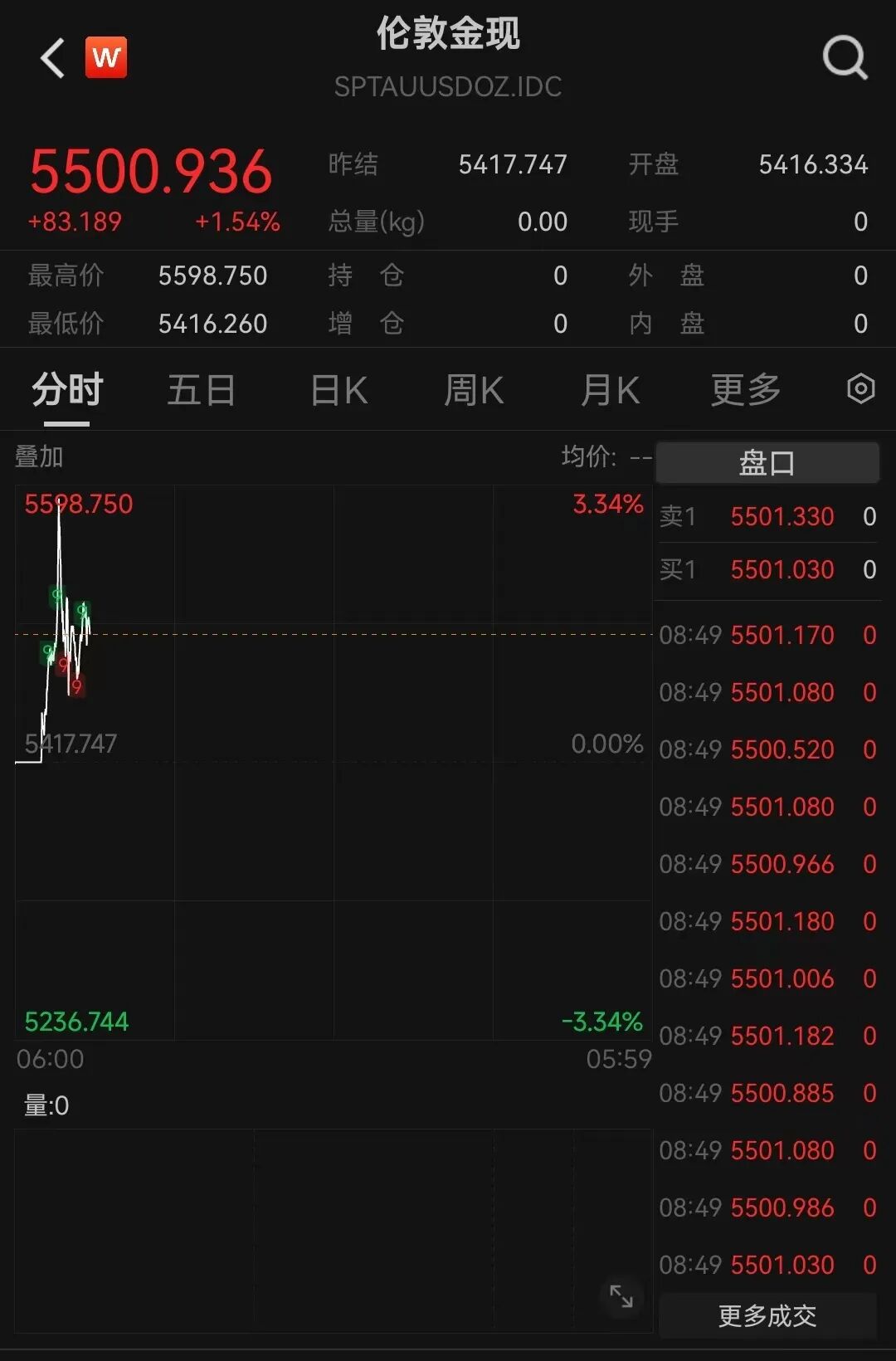
Group 1: Federal Reserve Decision - The Federal Reserve maintained the federal funds rate target range at 3.5% to 3.75%, ending a series of rate cuts since September of the previous year [1] - There was internal dissent within the Federal Open Market Committee (FOMC), with two members voting against the decision, advocating for a 25 basis point cut, indicating ongoing debates over monetary policy [1] - Fed Chairman Jerome Powell stated that the current policy rate is at a neutral level and highlighted the resilience of consumer spending and business investment, along with signs of stabilization in the unemployment rate [1] Group 2: Market Reactions - U.S. stock indices showed mixed results, with the Dow Jones Industrial Average slightly up by 0.02%, the Nasdaq Composite up by 0.17%, and the S&P 500 down by 0.01% [2] - The Philadelphia Semiconductor Index rose by 2.34%, reaching a new historical high, with significant gains in major semiconductor stocks such as Intel (up 11.04%) and Texas Instruments (up 9.94%) [4] - The semiconductor market is experiencing a broad recovery, with demand exceeding supply across nearly all segments, as noted by Argent Capital Management [5] Group 3: Tech Giants Earnings - Microsoft reported Q2 revenue of $81.27 billion, slightly exceeding market expectations, but the stock initially dropped over 7% in after-hours trading [6] - Meta's Q4 revenue reached $59.89 billion, a 24% year-over-year increase, leading to a stock price surge of over 9% in after-hours trading [6] - Tesla's adjusted EPS of $0.50 surpassed estimates, and the company announced developments in its humanoid robot and vehicle production, resulting in a 3% increase in stock price [6] Group 4: Chinese Stocks Performance - The Nasdaq Golden Dragon China Index saw a slight increase of 0.32%, with individual stocks showing a mixed performance [7] - Notable gainers included New Oriental (up 5.32%) and Li Auto (up 2.39%), while Pinduoduo experienced a significant decline of 3.84% [7] Group 5: Precious Metals and Oil Market - Precious metals prices surged following the Fed's decision, with gold prices reaching a new high of $5,425.757 per ounce, and silver prices increasing by 10.15% to $116.71 per ounce [9] - Oil prices rose due to escalating tensions in Iran, with light crude oil futures up by 1.31% to $63.21 per barrel [9] Group 6: Market Outlook - The focus will be on the announcement of the new Federal Reserve chair and subsequent policy directions, with market expectations indicating a high probability of maintaining rates in March and April [10] - The semiconductor industry's recovery, tech giants' earnings, and geopolitical developments are expected to continue influencing global financial market volatility [10]