
邮储银行

Search documents
黄金结构性存款走红 部分银行产品额度紧张
Shang Hai Zheng Quan Bao· 2026-01-25 18:54
在低利率环境下,多家银行密集推出相关产品,部分银行一度额度紧张,甚至售罄。上海证券报记者了 解到,这种"存款+衍生品"的组合结构通过挂钩金价波动实现收益弹性,但业内人士提醒,看似稳健的 产品背后暗藏认知误区,"最高收益率"触发条件往往较为严苛,投资者实际获得的多为中间档或保底收 益。 黄金结构性存款成"抢手货" 随着利率持续下行,存款流向问题日益成为市场关注的焦点。2026年初,大额存单利率已普遍降至1% 以下,传统存款产品收益率空间不断收窄。此外,低风险理财产品的收益率也呈现同步下行态势,大量 资金正面临着配置压力。 ■延伸阅读 黄金结构性存款走红 部分银行产品额度紧张 ◎记者 徐潇潇 开年至今,国际现货黄金价格涨幅已超过14%。受金价持续走强影响,黄金结构性存款以其兼具保本属 性和收益弹性的特点,吸引了投资者的目光。 与此同时,受国际金价波动影响,黄金市场近期再度成为关注焦点。进入2026年以来,黄金延续强劲走 势。北京时间1月23日,伦敦现货黄金价格首次突破4900美元/盎司大关。 在此背景下,寻找既能保障本金安全,又能获得相对较高收益的稳健型投资渠道,已成为当前投资者的 共同诉求。嗅觉灵敏的投资者,包 ...
一批具有代表性的明星产品和解决方案亮相 300余家企业“竞技”2026年商业航天首展
Shang Hai Zheng Quan Bao· 2026-01-25 18:50
Core Insights - The Beijing Commercial Aerospace Industry High-Quality Development Promotion Conference was held, focusing on enhancing the development of commercial satellite remote sensing data resources from 2026 to 2030 [1][2] - A significant policy was released to optimize financial support and encourage investment in high-quality remote sensing data projects [2] Group 1: Policy and Government Initiatives - The Beijing government aims to strengthen technological breakthroughs, accelerate industry cultivation, and deepen application demonstrations to contribute to the construction of a space power [2] - The policy includes six key areas: enhancing basic capabilities, common support capabilities, technological innovation, optimizing the development environment, and expanding application scenarios for remote sensing data [2][3] Group 2: Industry Developments and Innovations - The 2026 Beijing International Commercial Aerospace Exhibition showcased over 300 companies, including major players like Blue Arrow Aerospace and Galaxy Aerospace, presenting cutting-edge industry achievements [1][4] - Key products included the world's first continuously successful liquid oxygen-methane rocket and models of reusable rockets, highlighting advancements in rocket technology and cost reduction [4][5] Group 3: Financial Services and Investment Opportunities - The exhibition featured a dedicated area for aerospace investment and financial services, with major banks presenting tailored financing solutions for commercial aerospace companies [5] - Customized insurance products for rocket launches and satellite operations were introduced, indicating a growing financial ecosystem supporting the aerospace sector [5]
消金行业多措并举促进消费者尽享贴息政策红利
Zheng Quan Ri Bao Zhi Sheng· 2026-01-25 17:12
Core Viewpoint - The joint announcement by the Ministry of Finance, the People's Bank of China, and the National Financial Regulatory Administration aims to optimize personal consumption loan subsidy policies, thereby reducing credit costs for consumers and enhancing their willingness to spend [1] Group 1: Policy Implementation - The new policy includes support for financial innovation, extension of policy duration, expansion of support scope, and enhancement of subsidy areas and processing institutions [1] - Major platforms like Ant Group, JD.com, and Du Xiaoman have quickly introduced measures to translate policy benefits into consumer services [2] Group 2: Company Responses - Ant Group has extended the subsidy policy until the end of 2026, removed the previous limit of 500 yuan on subsidies for single transactions, and lifted restrictions on consumption areas [2] - JD.com has fully adopted the new policy, ensuring rapid delivery of benefits to users, and has expanded the scope of its subsidy services [2] - Du Xiaoman focuses on optimizing service experience and enhancing financial accessibility, launching a "credit limit increase and interest reduction" service [2] Group 3: Market Impact - Zhongyuan Consumer Finance has combined subsidies with rights protection, benefiting over 3.46 million people and providing discounts exceeding 52.46 million yuan [3] - Haier Consumer Finance has launched a "Smart Home Installment" service, leading to an average sales increase of about 30% in retail stores [5] - The policy has resulted in a "precise drip irrigation" of consumer subsidies, boosting sales for platform merchants and providing discounts to consumers [4] Group 4: Future Directions - Financial institutions are encouraged to deepen integration with high-frequency consumption scenarios and optimize product designs to meet diverse customer needs [5] - There is a recommendation for regional financial institutions not included in the national subsidy program to actively pursue local consumption subsidy policies [5]

财政贴息进行时!“加码”促消费,多家机构行动
券商中国· 2026-01-25 14:11
Core Viewpoint - The article discusses the extension and optimization of the personal consumption loan interest subsidy policy in China, which aims to stimulate consumer spending and support economic growth until December 31, 2026 [1][3]. Policy Extension and Adjustments - The personal consumption loan interest subsidy policy has been extended to December 31, 2026, with the new implementation period set from September 1, 2025, to December 31, 2026 [1]. - The annual subsidy rate remains at 1%, with the funding burden shared between central and local governments at a ratio of 90% to 10% [3][4]. Bank Responses and Offerings - Banks have begun to implement new subsidy execution plans, including incorporating credit card installment payments into the subsidy scope and removing restrictions on certain consumption scenarios [2][4]. - Current personal consumption loan rates from a state-owned bank are reported as low as 3% for a one-year term and 3% for a three-year term, with potential further reductions through merchant subsidies [3]. Optimization of Subsidy Policy - The policy has been optimized in four main areas: expanding the support scope, broadening the subsidy fields, increasing the subsidy standards, and adding more financial institutions to handle the loans [4]. - New financial institutions, including city commercial banks, rural commercial banks, foreign banks, consumer finance companies, and auto finance companies, have been added to the list of entities eligible to provide subsidies [4]. Implementation and Customer Experience - Major banks like ICBC, ABC, and BOC have confirmed that customers with existing agreements will automatically benefit from the new policy starting January 1, 2026, without needing to reapply [5]. - Banks are providing clear operational guidelines for customers to apply for the subsidy, ensuring a smooth experience [5][6]. Market Impact and Financial Institutions' Role - Financial institutions are actively increasing consumer credit offerings and optimizing products and services to stimulate market activity and consumer spending [6]. - Consumer finance companies are also extending the subsidy policy and removing previous limits on single transaction subsidies to support larger and diverse consumer needs [7]. Compliance and Risk Management - Banks are emphasizing compliance with the subsidy policy, warning against fraudulent activities related to subsidy claims, and outlining consequences for violations [7].


多家物流企业宣布:春节不打烊
Sou Hu Cai Jing· 2026-01-25 10:13
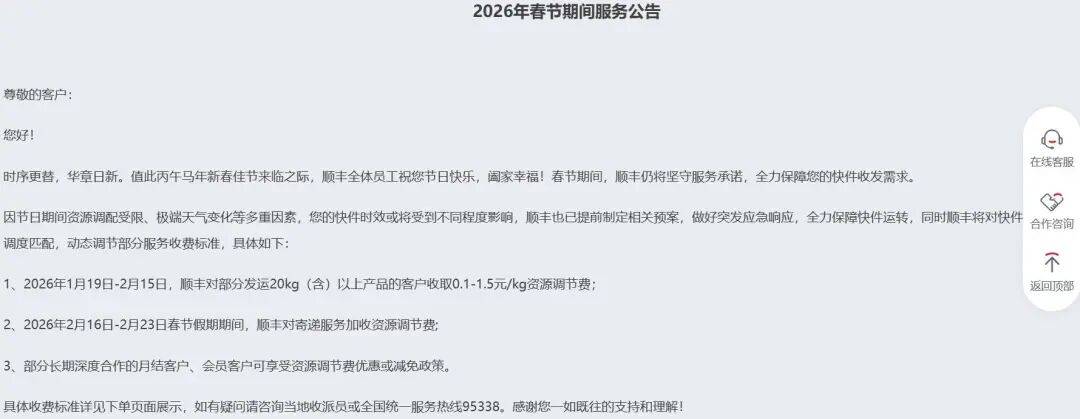
Core Viewpoint - The logistics industry is preparing for the upcoming Spring Festival, with several companies announcing service adjustments and resource fees to manage increased demand and operational challenges during the holiday period [1][2][5]. Group 1: Service Adjustments - SF Express, JD Logistics, and Deppon have announced that they will implement resource adjustment fees during the Spring Festival due to limited resource allocation and extreme weather conditions [2][5]. - SF Express will charge a resource adjustment fee of 0.1-1.5 yuan/kg for shipments over 20kg from January 19 to February 15, 2026, and additional fees during the holiday period [2]. - JD Logistics will add a resource adjustment fee of 0.1-1.2 yuan/kg for express heavy goods from January 19 to February 23, 2026, with varying fees for different customer agreements [5]. Group 2: Service Continuity - JD Logistics will continue to provide services such as warehousing, delivery, and express collection during the Spring Festival, with all "Asia No. 1" smart industrial parks operating around the clock [8]. - Deppon will also implement resource adjustment fees for certain customers and products during the peak period from January 19 to February 23, 2026 [8][9]. Group 3: Temporary Service Suspensions - Yimidida and Shunxin Express will suspend collection and delivery services during the Spring Festival, with Yimidida ceasing operations from February 10 to February 25, 2026, and Shunxin Express from February 12 to February 24, 2026 [10][12]. - Cross-border Express will maintain normal collection and delivery services but will not guarantee timeliness for shipments during the holiday period [14]. Group 4: Industry Trends - The Spring Festival is a peak period for logistics demand, leading to increased operational costs due to labor shortages and uneven cargo volumes [9]. - The practice of charging "resource adjustment fees" during the Spring Festival has become a common industry standard, primarily affecting commercial clients [9].


2025年度中国上市公司治理和ESG优秀企业榜单
Sou Hu Cai Jing· 2026-01-25 08:10
Core Insights - The CCG50 Forum released the 2025 annual rankings of Chinese listed companies' governance and ESG performance, evaluating 5,292 companies based on various governance indices and ESG criteria [1][3][13]. Governance Rankings - The governance rankings include 11 core lists, with the top 100 companies ranked based on a comprehensive index. Notable companies include: - Health元, 唐山港, and 西部证券 leading the overall governance list [2][8]. - 中煤能源 topped the small investor protection list, evaluated on 36 indicators across four dimensions [2][15]. - 唐山港 ranked first in the board governance category, assessed on 38 indicators [2][21]. - 埃斯顿 led the financial governance list, evaluated on 31 indicators [2][39]. ESG Rankings - The ESG rankings are divided into non-financial and financial sectors: - In the non-financial sector, 中国石油, 中国石化, and 中国中铁 ranked highest, evaluated on 132 indicators with weights of 55% for governance, 35% for social responsibility, and 10% for environmental protection [3]. - The financial sector's top ten ESG companies include 工商银行 and 农业银行, evaluated based on industry-specific criteria [3]. Risk Awareness - The forum also published a list of 50 companies with governance risks, including *ST 广道 and ST 中迪, providing a reference for investors [3][19]. Methodology - The rankings were developed using scientific modeling and quantitative calculations rather than traditional voting methods, referencing international standards to showcase the differences in governance levels and ESG performance among Chinese listed companies [3][13][19].







投资前瞻(1.26—2.1)|50万亿元居民存款即将到期,钱何处去;从“规模导向”到“投资者回报导向”,公募基金业绩比较基准指引来了
Sou Hu Cai Jing· 2026-01-25 07:22
Macro and Financial - China's GDP is projected to grow by 5% in 2025, reaching 140.19 trillion yuan, with a 4.5% growth in Q4 [5] - The Ministry of Finance has launched a package of policies to promote domestic demand, focusing on expanding private investment and boosting consumer spending [6][7] - The People's Bank of China indicates there is still room for interest rate cuts and reserve requirement ratio reductions in 2026 [7] - The first Loan Prime Rate (LPR) of 2026 remains unchanged at 3.0% for one year and 3.5% for five years, with potential for future reductions [7] Capital Market - The China Securities Regulatory Commission (CSRC) has issued new guidelines for public fund performance benchmarks, effective March 1, 2026, aiming to shift the industry focus from scale to investor returns [14] - The CSRC has also imposed a fine of 5.11 billion yuan on an individual for manipulating stock prices, alongside a three-year market ban [15] - Shanghai has introduced 18 measures to enhance the trading capacity of non-ferrous metal commodities, aiming to improve global resource allocation and pricing influence [16] Precious Metals Market - The global metals market is experiencing a significant surge, with gold and silver reaching their highest weekly gains since 2020, and silver prices surpassing 100 dollars per ounce for the first time [17][20] - The weakening of the US dollar has led to increased demand for safe-haven assets, contributing to the rise in precious metal prices [20] Business and Industry - Beijing has issued measures to encourage capable enterprises to engage in mergers and acquisitions within the satellite data industry, aiming to create globally competitive companies [21] - The first A-share IPO of 2026 has been accepted, with Shanghai Suiruan Technology aiming to raise 6 billion yuan for AI chip development [22] - The commercial aerospace company Zhongke Aerospace has completed its IPO counseling, marking a significant step in its market entry [23]
个人贷款不良率骤增 银行超低折竞抛
经济观察报· 2026-01-25 04:58
Core Viewpoint - The article discusses the increasing trend of personal non-performing loan (NPL) transfers in the banking sector, driven by regulatory changes and the rising pressure of bad debts on financial institutions [1][5]. Group 1: Market Dynamics - The personal NPL transfer market is experiencing a surge, with transaction volumes rising from 186.48 billion in 2021 to 965.30 billion in 2023, and projected to reach 1583.50 billion in 2024 [3][4]. - As of January 22, 2026, there were 20 new announcements for personal NPL transfers within the month, indicating heightened activity in the market [2][8]. - The average discount rate for personal NPL packages has significantly decreased, with rates dropping from 8%-10% before 2023 to around 5% in 2026 [10][11]. Group 2: Regulatory Impact - A regulatory notification extended the trial period for bulk transfers of personal NPLs until December 31, 2026, allowing a wider range of financial institutions to participate in the transfer process [2][4]. - The expansion of trial institutions to include city commercial banks and rural commercial banks has led to a notable increase in the volume of NPL transfers [5][17]. Group 3: Borrower Profile and Economic Context - The borrower demographic for personal NPLs includes failed entrepreneurs, unemployed individuals relying on credit cards for living expenses, and consumers with excessive debt [4][20]. - The economic backdrop, characterized by macroeconomic fluctuations and income instability, has exacerbated the bad debt situation, compelling banks to offload risk assets [5][20]. Group 4: Challenges in Asset Recovery - The recovery rates for NPLs have declined, with some packages facing average recovery rates below 6%, marking the lowest in five years [12][13]. - Financial institutions are facing challenges in asset valuation and recovery due to incomplete documentation and inefficient legal processes [26][28]. Group 5: Strategic Adjustments - Banks are adapting their strategies by improving the quality of NPL packages, such as reducing overdue times and increasing the concentration of borrowers in economically developed areas [24][25]. - There is a push for enhanced transparency and standardization in the NPL transfer process to improve market confidence and asset pricing [28].


个贷不良资产转让“狂奔”
Jing Ji Guan Cha Wang· 2026-01-25 03:17
Core Viewpoint - The personal non-performing loan (NPL) transfer market is experiencing a significant surge, driven by regulatory extensions and increasing demand for asset transfers among financial institutions [2][3][12]. Group 1: Market Dynamics - Jiangsu Guannan Rural Commercial Bank announced the re-listing of a personal NPL transfer project, with a total outstanding principal and interest amounting to 68.89 million yuan, involving 309 borrowers [2]. - The regulatory extension of the pilot program for transferring personal NPLs until December 31, 2026, has led to a notable increase in transfer announcements, with 20 new cases reported in January alone [2][3]. - The transaction volume of personal NPLs has shown substantial growth, from 18.65 billion yuan in 2021 to an estimated 200 billion yuan in 2025, indicating a robust market expansion [3]. Group 2: Borrower Profile - The typical borrowers in the personal NPL category include failed entrepreneurs, unemployed individuals relying on credit cards, and consumers with excessive debt [3][17]. - A case study of a failed entrepreneur highlights the challenges faced by individuals who have accumulated significant credit card debt, illustrating the broader issue of personal financial distress [18]. Group 3: Financial Institution Strategies - Financial institutions are increasingly motivated to offload NPLs due to rising default rates and declining recovery rates, prompting a shift in strategies to manage risk [4][5]. - The average discount rate for transferring personal NPLs has decreased significantly, from 8%-10% before 2023 to around 5% currently, reflecting the competitive nature of the market [6][11]. - Institutions are adapting their asset packages to improve recovery prospects, including reducing overdue durations and increasing the concentration of borrowers in economically developed regions [19][20]. Group 4: Regulatory Environment - The regulatory framework has expanded the scope of institutions eligible to participate in the NPL transfer market, which has contributed to increased activity and competition [12][13]. - Recent regulatory measures aim to enhance compliance and transparency in the NPL transfer process, with a focus on addressing potential violations and improving operational standards [21][22]. Group 5: Challenges and Future Outlook - The NPL transfer market faces ongoing challenges, including difficulties in asset valuation, legal proceedings, and operational inefficiencies, which hinder effective recovery efforts [20][22]. - The long-term resolution of personal NPL issues is contingent upon improving the financial health of borrowers and reducing the generation of new NPLs [22].

非遗和“国潮”拉满体验感
Liao Ning Ri Bao· 2026-01-25 00:54
Core Insights - The "Ninety-Nine Consumption Season" in Liaoning will launch a themed consumption activity called "Five-Nine" on January 26, focusing on intangible cultural heritage, "Guochao" consumption, and livelihood discounts to stimulate winter consumption potential [1] Group 1: Thematic Activities - The event will feature various cultural and consumption experiences, including traditional customs, intangible cultural creations, and specialty dining, with discounts and cultural experience projects to promote the integration of "old customs" and "new consumption" [1] Group 2: Participation and Coverage - Local businesses across various sectors, including retail, dining, tourism, and automotive, will participate by offering discounts, rebates, and subsidies to enhance the impact of the "Ninety-Nine Consumption Season" and boost the winter consumption market [2] - Major attractions and commercial complexes will launch promotional activities, including special ticket offers and cultural performances, to enrich consumer experiences [2] - Financial institutions, such as Postal Savings Bank of Liaoning, will introduce various consumer discounts and services to support over 20,000 merchants, enhancing policy coverage and convenience [2]