青岛银行

Search documents
青岛银行(002948) - 关于股东及其一致行动人权益变动触及1%整数倍的提示性公告
2025-11-03 09:46
证券代码:002948 证券简称:青岛银行 公告编号:2025-042 青岛银行股份有限公司(以下简称"本行")于2025年11月3日收到青岛国信产 融控股(集团)有限公司(以下简称"国信产融控股")出具的《关于增持青岛银行 股份有限公司股份的告知函》。国信产融控股于2025年9月23日至10月31日(包括 首尾两日),通过港股通渠道增持本行H股股份83,430,000股,占本行股份总数的 1.43%,交易期间不涉及本行定期报告静默期、重大事项敏感期,资金来源为自有 资金。 青岛银行股份有限公司 关于股东及其一致行动人权益变动触及 1%整数倍 的提示性公告 本行股东青岛国信产融控股(集团)有限公司保证向本行提供的信息内容真实、准确、 完整,没有虚假记载、误导性陈述或重大遗漏。 本行及董事会全体成员保证公告内容与信息披露义务人提供的信息一致。 2 本次变动是否为履行已 作出的承诺、意向、计 划 是 否 本行在《中国证券报》《上海证券报》《证券时报》 《证券日报》和巨潮资讯网(http://www.cninfo.com.cn/) 披露了日期为2025年9月2日的《关于大股东增持股份计 划的公告》(公告编号:202 ...
青岛银行(03866) - 截至二零二五年十月三十一日股份发行人的证券变动月报表
2025-11-03 08:36
FF301 股份發行人及根據《上市規則》第十九B章上市的香港預託證券發行人的證券變動月報表 I. 法定/註冊股本變動 | 1. 股份分類 | 普通股 | 股份類別 | H | | | 於香港聯交所上市 (註1) | | 是 | | | --- | --- | --- | --- | --- | --- | --- | --- | --- | --- | | 證券代號 (如上市) | 03866 | 說明 | | | | | | | | | | | 法定/註冊股份數目 | | | 面值 | | | 法定/註冊股本 | | | 上月底結存 | | | 2,291,945,474 | RMB | | | 1 RMB | | 2,291,945,474 | | 增加 / 減少 (-) | | | | | | | RMB | | | | 本月底結存 | | | 2,291,945,474 | RMB | | | 1 RMB | | 2,291,945,474 | | 2. 股份分類 | 普通股 | 股份類別 | A | | 於香港聯交所上市 (註1) | | 否 | | | --- | --- | --- | --- ...
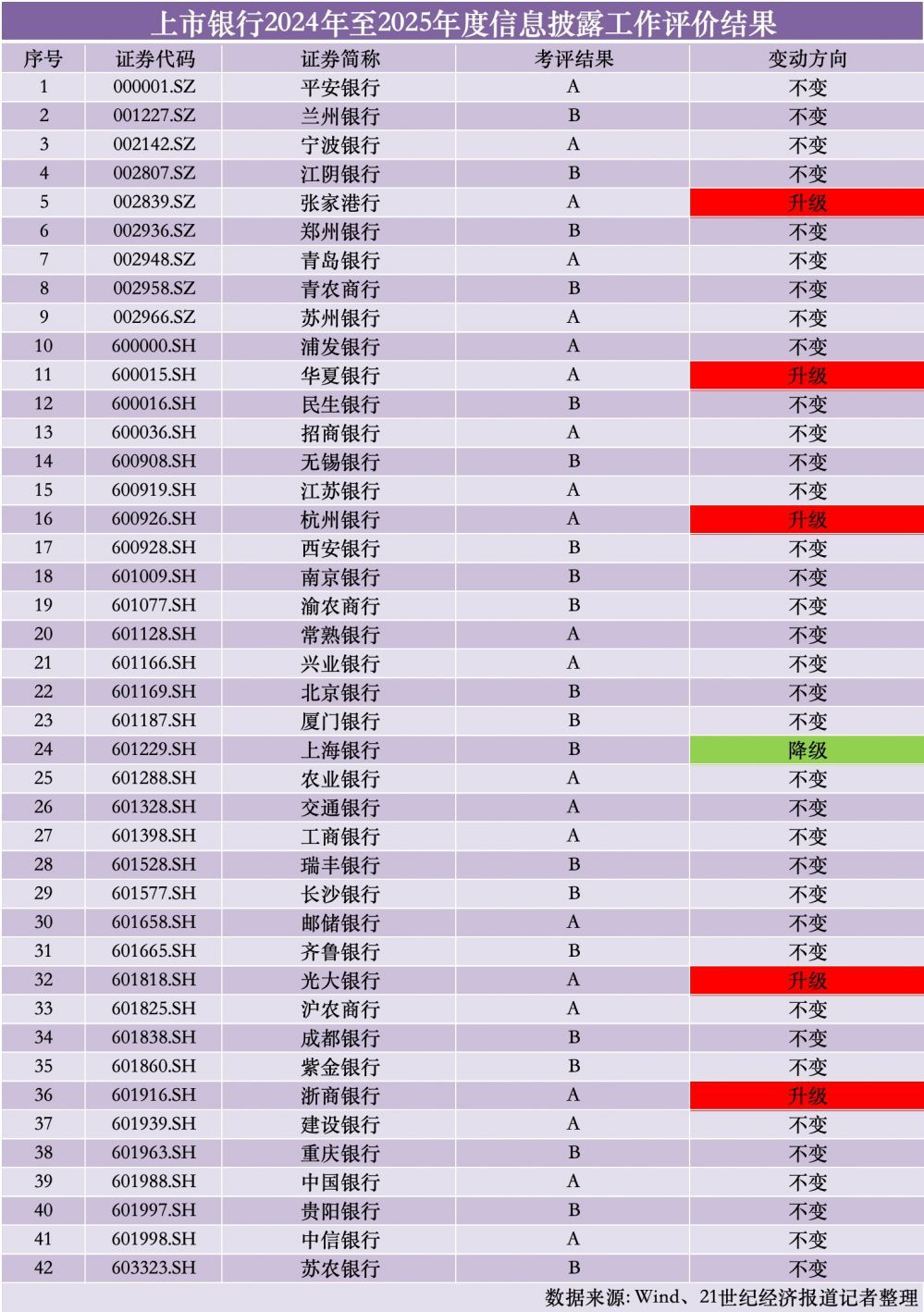
42家上市银行信披考评出炉:22家获A,光大、华夏和浙商银行提级
2 1 Shi Ji Jing Ji Bao Dao· 2025-11-03 08:21
Core Insights - The recent disclosure evaluation results for listed banks in China for the 2024-2025 period show that all listed banks received ratings of B or above, with 22 banks rated A, indicating a strong performance in information disclosure [1] Summary by Category Overall Ratings - All listed banks achieved a rating of B or higher, with 22 banks rated A, reflecting consistent performance compared to the previous year [1] - Only six banks experienced rating changes, with five banks improving their ratings and one bank, Shanghai Bank, experiencing a downgrade [1] Banks with Rating Changes - The following banks improved their ratings: - Zhangjiagang Bank - Hangzhou Bank - Huaxia Bank - Everbright Bank - Zhejiang Commercial Bank [1] - Shanghai Bank was the only bank to see a downgrade in its rating [1] Detailed Ratings - A selection of banks and their ratings includes: - Ping An Bank: A - Ningbo Bank: A - Agricultural Bank of China: A - Industrial and Commercial Bank of China: A - Shanghai Bank: B (downgraded) [2]





寻找绩优股:2026年银行业年度策略
GUOTAI HAITONG SECURITIES· 2025-11-03 05:20
Investment Rating - The report indicates a cautious outlook on the credit growth rate, suggesting a shift towards quality improvement, with expectations for a recovery in corporate loan increments by 2026 [5][9]. Core Insights - Credit growth is expected to slow significantly starting in 2024, but the decline in growth rate is anticipated to moderate by 2026, with corporate loans likely to see a year-on-year increase [7][9]. - The relationship between credit growth and economic growth is weakening, emphasizing the need to optimize credit structure and reduce idle financial resources [9]. - The report highlights that the banking sector's total asset growth will outpace loan growth in 2025, driven by government bond supply and fiscal policies [9]. Summary by Sections Credit Growth Forecast - New RMB loans are projected at 21.3 trillion, 23.6 trillion, and 18.9 trillion yuan for 2022, 2023, and 2024 respectively, with a further estimate of 14.7 trillion yuan for the first three quarters of 2025 [9]. - For 2026, new loans are expected to be between 17.2 trillion and 17.7 trillion yuan, corresponding to a growth rate of 6.3% to 6.5% [9]. Loan Composition - In 2023, the total RMB loans are expected to reach 237.59 trillion yuan, with a year-on-year growth rate of 10.6% [8]. - Retail loans are projected to grow from 80.10 trillion yuan in 2023 to 82.84 trillion yuan in 2024, reflecting a growth rate decline from 5.7% to 3.4% [8]. - Corporate loans are anticipated to increase from 157.07 trillion yuan in 2023 to 171.01 trillion yuan in 2024, with a growth rate of 12.7% [8]. Regional Performance - Regions such as Jiangsu, Zhejiang, Sichuan, and Shandong are expected to continue outperforming the national average in loan growth due to strong economic performance and support from new policy financial tools [12]. Banking Sector Dynamics - The report notes that state-owned banks are expected to maintain a competitive edge due to lower funding costs and capital injections from the Ministry of Finance [12]. - The net interest margin is in a downward trend, but the rate of decline is expected to slow starting in 2025, with some smaller banks potentially stabilizing their margins by 2026 [13][17]. Asset Quality - As of Q2 2025, the non-performing loan (NPL) ratio for listed banks is reported at 1.25%, indicating a stable asset quality despite pressures on retail credit [37]. - The report emphasizes that while retail loan NPLs have increased since 2021, corporate loan clearances have improved significantly, providing a buffer against retail risks [37].




债市波动 挤压银行投资收益空间
Shang Hai Zheng Quan Bao· 2025-11-02 17:54
Core Viewpoint - The volatility in the bond market and the narrowing net interest margin have pressured the revenue of several listed banks in the first three quarters of this year, leading to a gradual decline in the benefits from the "bond bull" market [1][2] Group 1: Revenue Impact - Many listed banks have faced revenue pressure due to bond market fluctuations and a slowdown in credit expansion, with investment income becoming a crucial support for profits [2][3] - As of the end of Q3 2025, 24 out of 42 listed banks reported a year-on-year decline in non-interest income, and 8 banks saw a drop in net investment income [2] - Notably, China Merchants Bank reported a significant loss of 8.827 billion yuan in fair value changes, with a quarterly loss of 4.008 billion yuan in Q3 alone [2][3] Group 2: Strategies to Mitigate Losses - Some banks have managed to achieve year-on-year growth in investment income by actively selling bonds to lock in floating profits during high market conditions [4] - For instance, China Construction Bank's investment net income increased by 150.55%, while several other banks reported over 70% growth in investment income [4] - The strategy of "selling bonds to realize floating profits" is based on the classification of financial assets, where certain assets can confirm investment income upon sale [4] Group 3: Future Outlook and Adjustments - Analysts suggest that the sustainability of the "selling bonds to supplement profits" strategy will decline as previously accumulated floating profits are exhausted [5] - The People's Bank of China has signaled a return to government bond trading operations, which is expected to enhance monetary policy flexibility and stabilize market expectations [6] - As the bond market enters a low-volatility phase, banks are shifting their investment strategies from relying solely on interest margin gains to enhancing active trading and risk management capabilities [7]



债市波动挤压银行投资收益空间
Shang Hai Zheng Quan Bao· 2025-11-02 17:53
Core Viewpoint - The volatility in the bond market and the narrowing net interest margin have pressured the revenue of several listed banks in the first three quarters of the year, leading to a gradual decline in the benefits from the "bond bull" market [1][2]. Group 1: Revenue Impact - Many listed banks have faced revenue pressure due to bond market fluctuations and a slowdown in credit expansion, with investment income becoming a crucial support for profits [2][3]. - As of the end of Q3 2025, 24 out of 42 listed banks reported a year-on-year decline in non-interest income, and 8 banks saw a drop in net investment income [2]. - Notably, China Merchants Bank reported a loss of 8.827 billion yuan in fair value changes, with a quarterly loss of 4.008 billion yuan in Q3 alone [2][3]. Group 2: Strategies to Mitigate Losses - Some banks have managed to achieve year-on-year growth in investment income by actively selling bonds to lock in profits during high market conditions [4]. - For instance, China Construction Bank's investment net income increased by 150.55%, while several other banks also reported over 70% growth in investment income [4]. - The strategy of "selling bonds to realize floating profits" is based on the classification of financial assets, where certain assets can confirm investment income upon sale [4]. Group 3: Future Outlook and Adjustments - Analysts suggest that the sustainability of the "selling bonds to supplement profits" strategy will decline as previously accumulated floating profits are exhausted [5]. - The People's Bank of China has signaled a return to government bond trading operations, which is expected to enhance monetary policy flexibility and stabilize market expectations [6]. - As the bond market enters a low-volatility phase, banks are shifting their investment strategies from relying solely on interest margin gains to enhancing active trading and risk management capabilities [7].
A股中小银行前三季度业绩分化
Zheng Quan Ri Bao· 2025-11-02 16:41
Core Insights - The performance of A-share listed banks in the third quarter of 2025 shows significant differentiation among small and medium-sized banks, with city commercial banks leading, rural commercial banks in the middle, and joint-stock banks under pressure [1] Group 1: City Commercial Banks - City commercial banks have demonstrated outstanding performance, with 14 out of 17 banks reporting year-on-year revenue growth and 16 reporting net profit growth [2] - Chongqing Bank reported the highest performance, achieving revenue of 11.74 billion yuan, a year-on-year increase of 10.4%, and a net profit of 4.879 billion yuan, up 10.19% [2] - Other banks like Qingdao Bank, Nanjing Bank, and Ningbo Bank also showed steady growth, with Qingdao Bank's revenue at 11.013 billion yuan (5.03% increase) and net profit at 3.992 billion yuan (15.54% increase) [2] Group 2: Rural Commercial Banks - Most rural commercial banks also reported increases in both revenue and net profit, but the growth rates were relatively moderate, with most banks showing single-digit growth [3] - A few rural banks achieved double-digit growth, contrasting with the performance of city commercial banks [3] Group 3: Joint-Stock Banks - Joint-stock banks faced a decline in both revenue and net profit, although the rate of decline has narrowed compared to the first half of the year, indicating signs of stabilization [3] - For instance, Ping An Bank reported revenue of 100.668 billion yuan, down 9.8%, and net profit of 38.339 billion yuan, down 3.5%, with declines narrowing by 0.2 and 0.4 percentage points respectively [3] Group 4: Asset Quality - The overall asset quality of small and medium-sized banks has improved, with non-performing loan ratios remaining low [4] - Specific banks like Wuxi Rural Commercial Bank and Nanjing Bank maintained non-performing loan ratios of 0.78% and 0.83% respectively, while Chongqing Bank's ratio decreased to 1.14% [4] - Factors contributing to the improvement in asset quality include enhanced risk management, focused regional market strategies, and effective macroeconomic policies [4]


金融行业周报(2025、11、02):公募业绩比较基准改革落地,各板块三季报披露完毕-20251102
Western Securities· 2025-11-02 13:31
Investment Rating - The report indicates a positive outlook for the insurance sector, suggesting it is the most growth-oriented direction in the financial industry during structural transformation [1][15] - The securities industry is viewed as relatively undervalued with high year-on-year growth in performance, making it a favorable investment opportunity [2][18] - The banking sector is recommended for selective investment in high-quality banks with strong fundamentals and improving performance [3][21] Core Views - The non-bank financial index decreased by 0.46%, underperforming the CSI 300 index by 0.03 percentage points, while the banking sector saw a decline of 2.16%, underperforming the CSI 300 by 1.74 percentage points [1][9] - The insurance sector experienced a notable increase in new business value (NBV) growth, with significant contributions from improved agent productivity and bancassurance efforts [12][13] - The securities sector's performance is driven by strong growth in brokerage and proprietary trading businesses, with overall earnings exceeding expectations [2][16] - The banking sector's earnings showed steady growth, with a slight improvement in net interest margins and a stable asset quality outlook [19][21] Summary by Sections Insurance Sector - The insurance sector's NBV growth for the first three quarters of 2025 showed significant increases, with notable performances from major companies [12][13] - The sector is expected to benefit from a supportive policy environment and increasing allocations to equity investments [15] - Recommended stocks include Xinhua Insurance A+H, China Ping An A+H, and China Life H [3][15] Securities Sector - The securities sector's PB valuation stands at 1.43x, indicating a favorable entry point for investors [2][18] - The report highlights the recovery in brokerage and proprietary trading as key drivers of performance, with a positive outlook for the sector [16][18] - Recommended stocks include Guotai Junan A+H, Huatai Securities A+H, and Oriental Securities A+H [3][18] Banking Sector - The banking sector's PB valuation is at 0.54x, with earnings growth expected to continue into the fourth quarter [19][21] - The report suggests focusing on banks with strong fundamentals and improving performance metrics, particularly those with low non-performing loan ratios [22][21] - Recommended stocks include Hangzhou Bank and a focus on other quality banks such as China Merchants Bank and Bank of Communications [3][22]
信贷“换锚”驱动两位数增幅 重庆银行晋升万亿规模行列
Zhong Guo Jing Ying Bao· 2025-10-31 19:12
Core Viewpoint - The financial performance of regional banks, particularly city commercial banks, is showing significant divergence, with Chongqing Bank becoming a highlight by surpassing the 1 trillion yuan asset mark in Q3 2023, reflecting a broader trend of aggressive asset expansion among city commercial banks [1][2]. Group 1: Chongqing Bank's Performance - Chongqing Bank's total assets reached 1.0227 trillion yuan as of September 30, 2023, marking a year-on-year increase of 19.39% [2]. - The bank's deposits totaled 554.25 billion yuan, up 16.9% year-on-year, while loans reached 520.39 billion yuan, reflecting an 18.1% increase [2]. - The bank's net interest margin was 1.32%, down 4 basis points year-on-year, but the decline was less severe compared to previous quarters, indicating improved profitability [3]. Group 2: Industry Trends - City commercial banks are increasingly focusing on corporate loans, particularly in manufacturing and infrastructure sectors, to stabilize their net interest margins amid declining loan rates [1][6]. - The overall asset growth among city commercial banks is notable, with 10 out of 12 banks showing growth rates exceeding 10%, contrasting with 16 banks experiencing growth below 5% [4]. - The divergence in growth rates among banks is attributed to regional economic differences, with banks in economically vibrant areas like the Yangtze River Delta and Pearl River Delta performing better [4][5]. Group 3: Challenges and Strategic Adjustments - The pressure on net interest margins is prompting banks to adjust their loan structures, reducing reliance on low-yielding bill financing and increasing high-yield corporate loans [6][7]. - Capital constraints are becoming a common challenge for city commercial banks, with many facing declining core tier-one capital ratios due to rapid asset expansion [8][9]. - Banks are shifting their focus from scale-driven growth to efficiency-driven strategies, emphasizing the need for capital-efficient operations and exploring light-capital business models [10].
青岛银行的前世今生:营收110.13亿行业第十,净利润41.25亿行业第十一,规模扩张与质效提升并进
Xin Lang Zheng Quan· 2025-10-31 14:16
Core Viewpoint - Qingdao Bank, established in 1996 and listed in 2019, is a competitive regional bank in Shandong province, offering diversified financial services [1] Financial Performance - As of Q3 2025, Qingdao Bank reported revenue of 11.013 billion yuan, ranking 10th among 17 banks in the industry, with the industry leader, Jiangsu Bank, at 67.183 billion yuan [2] - The net profit for the same period was 4.125 billion yuan, placing it 11th in the industry, with Jiangsu Bank leading at 31.895 billion yuan [2] Financial Ratios - The asset-liability ratio for Qingdao Bank in Q3 2025 was 93.84%, higher than the industry average of 92.63% [3] - The gross profit margin was 42.57%, which is below the industry average of 45.51% but improved from 39.97% in the previous year [3] Executive Compensation - Chairman Jing Zailun's compensation for 2024 was 2.4978 million yuan, a decrease of 26,100 yuan from 2023 [4] Shareholder Information - As of September 30, 2025, the number of A-share shareholders decreased by 9.96% to 45,900, while the average number of circulating A-shares held per shareholder increased by 11.06% to 67,800 [5] - The bank's revenue growth rate was 5.0% and net profit growth rate was 15.5% for the first three quarters of 2025, with notable increases in net interest income and corporate loans [5] Business Highlights - Key business highlights include a 12.0% increase in net interest income, a 14.6% growth in corporate loans, and a reduction in the non-performing loan ratio to 1.10% with a provision coverage ratio of 270% [5]